
Precision Pump Chambers & Cavity Assemblies
Industrial-grade diffuse reflectors, triple-bore laser head assemblies, and specialized laser glass fabricated for rigorous duty cycles in medical aesthetic systems and industrial laser machining.
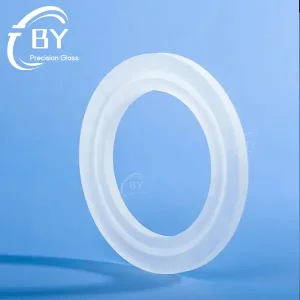
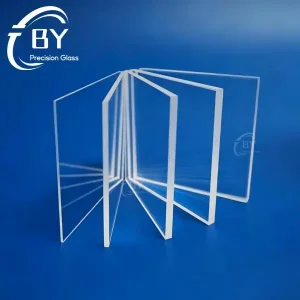
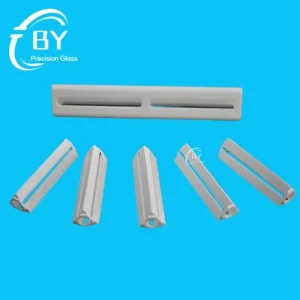
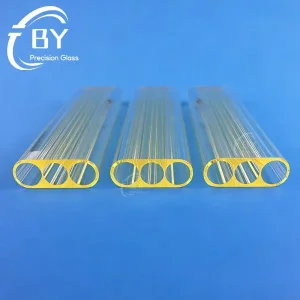
Ceramic Laser Cavities: Materials, Performance & Integration
A deep dive into 99.7% porous alumina ceramics, diffuse reflectance physics, glazed cooling interfaces, and next-generation DPSS pumping efficiency.
Material Science of Porous Al₂O₃
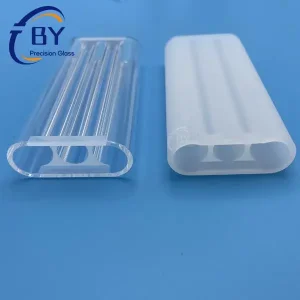
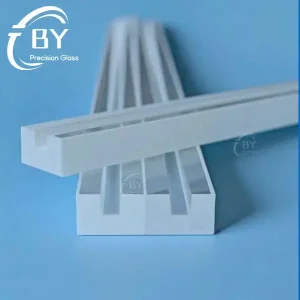
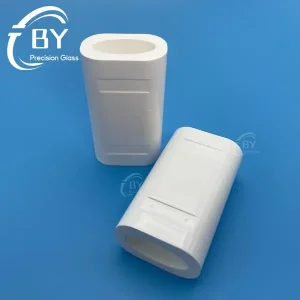
Modern wholesale ceramic laser cavities rely on ultra-high purity porous alumina (>99.7% Al₂O₃). The micro-porous matrix creates controlled volumetric scattering, generating a near-Lambertian diffuse reflection profile. Operating with over 97.8% diffuse reflectivity across the 600–1000 nm spectral window, these components maximize photon recycling around Nd:YAG, Alexandrite, and Holmium laser rods while mitigating severe thermal lensing.
Corrosion-Proof Glaze Vitrification
Flashlamp-pumped systems circulate deionized (DI) cooling water directly through the pump chamber. Untreated ceramic experiences water absorption and gradual binder leaching under high ultraviolet irradiance. BY Photonics applies an engineered high-temperature borosilicate or rare-earth-doped liquid glaze on fluid contact channels, forming an impervious, hydrolytically stable barrier rated for thousands of operational firing hours.
Precision Multi-Bore Fluidics
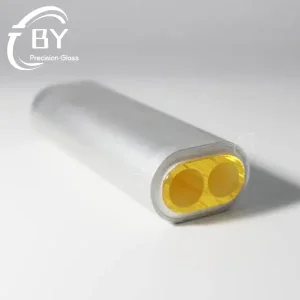
Whether matching legacy Candela GentleLase/MaxPro systems or modern diode-side-pumped industrial heads, multi-bore cavities require micro-tolerances. Concentricity of lamp and crystal bores must remain strictly under ±0.05 mm to avoid localized hotspot generation, asymmetrical beam profiles, and catastrophic gain rod fracture during high-repetition pulsed bursts.
China Factory 4.0: Supply Chain Agility & Scalability
By unifying slip-casting, CNC green machining, high-temperature sintering, and ultrasonic diamond finishing under one roof in Tianjin, BY Photonics delivers unmatched batch repeatability.
In-House Vertical Integration
Eliminating external subcontracting avoids dimensional drift and production delays. Raw powder batching, automated isostatic pressing, green-body carving, 1750°C controlled atmosphere firing, and post-sinter precision lapping operate under rigorous internal quality protocols.
Real-Time Spectral Metrology
Every ceramic cavity production lot undergoes diffuse reflectance spectrophotometry, CMM coordinate checks, and helium mass spectrometer leak detection. We verify optical reflectivity consistency from UV down to 2.5 µm infrared wavelengths before batch release.
Compressed Rapid OEM Lead Times
With an active stock of high-demand semi-finished blanks and rapid prototyping 5-axis ultrasonic CNC machinery, custom prototype cavities are delivered within 10 to 14 working days, while recurring wholesale batches deploy reliably on scheduled call-off agreements.
Laser Cavity Technology Roadmap & Future Outlook
Anticipating the technological shift across solid-state photonics: from high-power kW disk pump reflectors to hybrid ceramic-polymer diode cavities.
Near-Term: Selective Rare-Earth Doping
By incorporating trivalent samarium (Sm³⁺) or cerium (Ce³⁺) additives into the inner glazed surface or adjacent flow tubes, laser pump chambers can inherently absorb parasitic 1064 nm amplified spontaneous emission (ASE) and block damaging 254 nm solarizing rays, preventing flash degradation without degrading thermal conduction.
Mid-Term: Sintered Translucent & High-K Ceramics
Advancements in silicon nitride (Si₃N₄) and aluminum nitride (AlN) micro-composites aim to elevate pump chamber thermal conductivity past 120 W/m·K. This leap bridges the performance gap between diffuse ceramic scattering efficiency and the extreme localized heat dissipation required by high-power CW laser welders.
Long-Term: Micro-Channel Additive Ceramic Manufacturing
Additive stereolithography (SLA) ceramic printing enables 3D conformal cooling micro-channels integrated directly inside the ceramic cavity core. This eliminates dead flow zones, reduces thermal gradients across pump rods, and shrinks laser head footprint by up to 35%.
Global B2B Procurement & Engineering Support
How tier-1 laser OEMs navigate international material traceability, REACH/RoHS environmental compliances, and cleanroom-grade packaging.
Full RoHS & REACH Compliance
All glazes, ceramic matrices, and quartz materials are 100% free of hazardous heavy metals, cadmium, mercury, and lead. Full material declarations, SDS documentation, and certificates of conformance (CoC) accompany every bulk shipment.
Drawing Fidelity & DFM Feedback
Our bilingual senior application engineering team reviews CAD models in STEP, IGES, and DWG formats within 24 hours. We evaluate draft angles, thermal expansion differentials with metal housings, and recommend optimized O-ring groove seat geometries.
Class 10,000 Cleanroom Packaging
To eliminate particulate contamination during international air freight, optical cavities, flow tubes, and light guides undergo ultrasonic degreasing, DI rinse, and multi-layer nitrogen vacuum bagging, guaranteeing drop-in installation on OEM assembly lines.
Custom Laser Crystals, Windows & Waveguides
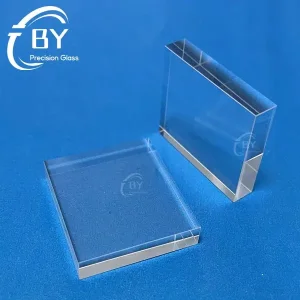
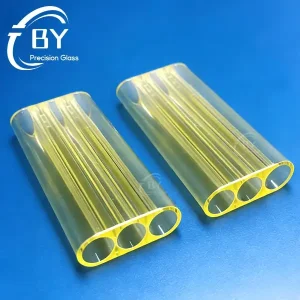
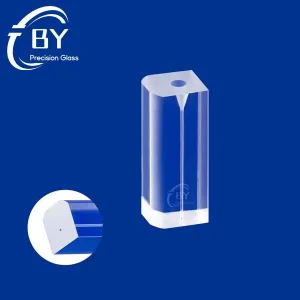
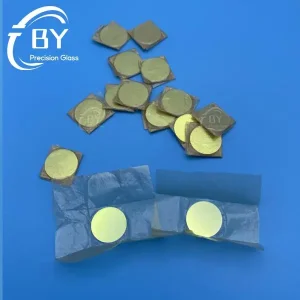
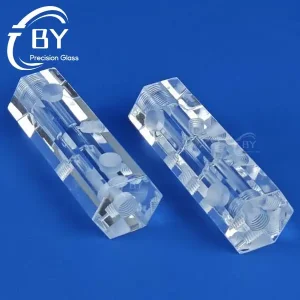
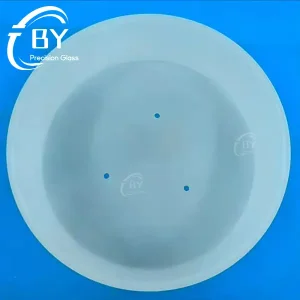
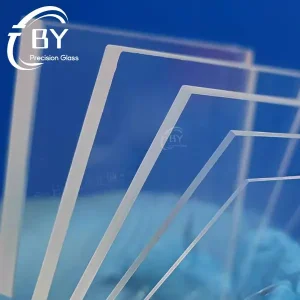
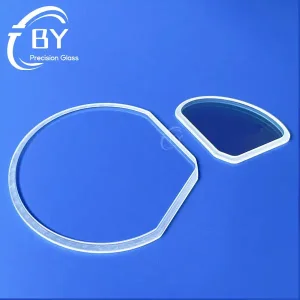
From single-crystal sapphire IPL blocks to vacuum coating substrates and samarium-doped filtration optics, explore our extended manufacturing capabilities.
Frequently Asked Questions (FAQ)
Everything OEM project managers and procurement specialists need to know regarding specifications, lifetimes, and customization.
Why is a ceramic cavity preferred over a gold-coated elliptical metal cavity?
Gold-plated metallic cavities rely on specular (mirror-like) reflection, which generates localized hot spots, requires precise alignment, and suffers from thin-film blistering, flaking, or tarnishing over time in cooling water. High-purity alumina ceramic cavities utilize diffuse volumetric scattering, which guarantees perfectly uniform multi-angle illumination of the laser rod, higher laser threshold efficiency, and zero risk of metallic oxidation or peeling.
What is the key functional difference between unglazed and glazed ceramic cavities?
Unglazed ceramic exhibits slightly higher diffuse reflectance but retains microscopic porosity, making it susceptible to absorbing non-pure water, coolant additives, or laser dyes. Glazed cavities have an ultra-smooth, vitreous borosilicate layer baked over the inner bore surfaces. This seals the pores, blocks chemical infiltration, allows high-flow laminar deionized cooling, and facilitates effortless cleaning during routine system servicing.
Can you manufacture aftermarket-compatible cavities for Candela, Cynosure, or Fotona systems?
Yes. We produce high-precision compatible replacement ceramic heads, triple-bore cavities, and flow plates matching original equipment manufacturer (OEM) geometries, optical properties, and fluid mechanics. Dimensional accuracy on center-to-center distances and bore diameters is certified via high-resolution optical CMM inspection.
How does BY Photonics ensure zero dimensional cracking during post-sinter CNC grinding?
Sintered alumina possesses extreme hardness (Mohs 9). To eliminate micro-fracturing and internal stress risers, our facility employs 5-axis ultrasonic-assisted diamond tooling with active chiller flood lubrication. This delivers mirror-grade bore finishes down to Ra 0.2 µm and holds concentricity tolerances well within ±0.02 mm.