High-Precision Optical & Capillary Component Solutions
Direct supply from precision hot-working furnaces and high-speed multi-axis CNC optical processing facilities.
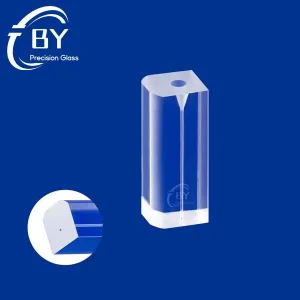
Custom Fiber Optic Glass Ferrules Supplier, Factories
View Specifications →
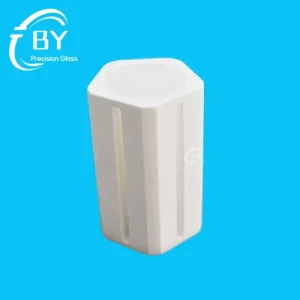
Wholesale Candela VBeam Laser 6" White Cavity Ceramic Reflector 2 Pk Manufacturer, Suppliers
View Specifications →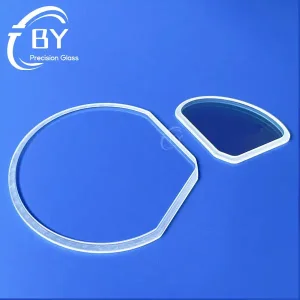
High-Quality Sapphire Viewing Plates for Harsh Chemical Environments Suppliers, Factories
View Specifications →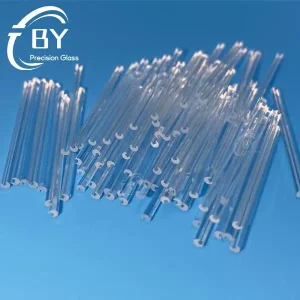
High-Quality Quartz Substrate Groove Use For Optical Fiber Coupler Suppliers, Factories
View Specifications →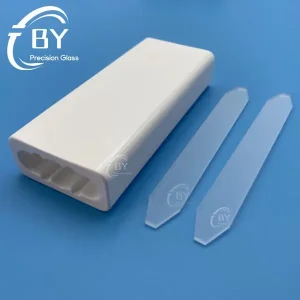
Wholesale Ceramic Cavity Reflector use for DEKA Laser Manufacturers, Supplier
View Specifications →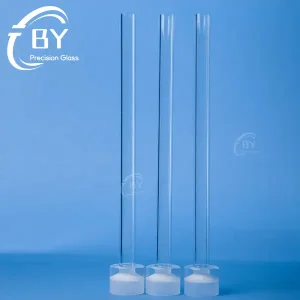
High-Quality Chemical Resistant Custom Quartz Glass Parts Fabrication Supplier, Factories
View Specifications →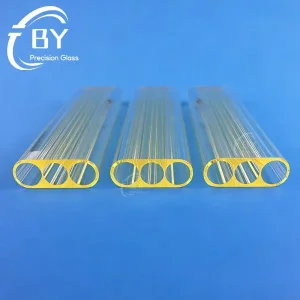
Custom Laser Cavity Flow Tubes & Filters Made from Samarium-doped Glass Supplier, Suppliers
View Specifications →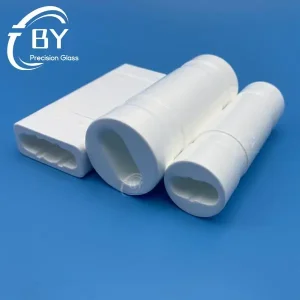
Wholesale Ceramics Reflecor for Semiconductor Lasers Suppliers, Factory
View Specifications →Engineering Borosilicate 3.3 for High-Stress Capillary Architectures
In analytical instrumentation, microchip packaging, microfluidics, and optoelectronic interconnects, borosilicate 3.3 capillary tubing and solid rods provide an optimal convergence of mechanical stability, hydrolytic endurance, and dimensional precision.
Thermal & Dynamic Shock Resistance
Engineered with a low linear thermal expansion coefficient (α = 3.3 × 10⁻⁶ K⁻¹ between 20°C and 300°C), our capillary tubes eliminate thermal cracking risks during rapid thermal cycling, flame sealing, autoclave cycles, and high-frequency laser fusion splices.
Chemical Hydrolytic Inertness
Compliant with ISO 719 (Class HGB 1) and ISO 720 hydrolytic resistance standards, our borosilicate formulations protect sub-microliter samples from ionic leaching, alkali ion extraction, and particulate shedding under continuous exposure to acidic or neutral buffers.
Concentricity & Geometry Stability
Utilizing high-stability vertical down-draw and precision redraw towers equipped with non-contact multi-axis laser gauges, our manufacturing facilities guarantee tight bore concentricity (<1.5%) and inside diameter repeatability down to ±0.002 mm.
Material Performance Matrix: Borosilicate 3.3 vs. Competing Glasses
A data-backed comparative assessment for OEM specification engineers selecting between Borosilicate 3.3, Synthetic Fused Silica (JGS1), and Soda-Lime Glass.
| Physical / Chemical Property | Borosilicate 3.3 (Precision Drawn) | Synthetic Fused Silica (JGS1 / Fused Quartz) | Soda-Lime Glass (Standard Drawn) |
|---|---|---|---|
| Coefficient of Thermal Expansion (20-300°C) | 3.3 × 10⁻⁶ K⁻¹ | 0.54 × 10⁻⁶ K⁻¹ | 9.0 × 10⁻⁶ K⁻¹ |
| Transformation Temperature (Tg) | 525 °C | 1,120 °C | 530 °C |
| Softening Point (Littleton Point) | 825 °C | 1,680 °C | 720 °C |
| Refractive Index (nd at 589.3 nm) | 1.473 | 1.458 | 1.518 |
| Hydrolytic Resistance (ISO 719) | Class HGB 1 (Ultra-Resistant) | Class HGB 1 (Inert) | Class HGB 3 (Leaching Risk) |
| Acid Resistance (ISO 1776) | Class 1 | Class 1 | Class 2-3 |
| UV-VIS-NIR Cutoff Transmittance | 310 nm to 2,500 nm | 185 nm to 2,500 nm (Deep UV) | 380 nm to 2,200 nm |
| Cost / Scalability Ratio | Balanced / Highly Cost-Effective | Premium / High-Temperature Specialized | Low Cost / Lower Precision Stability |
Chinese Factory Supply Chain Advantages in Precision Glass Production
Combining primary melting furnace integration, automated secondary redraw processing, and vertically controlled CNC optical finishing under one centralized facility in Tianjin, China.
Vertical Upstream Raw Material Mastery
Our Tianjin supply chain partners directly with primary high-purity borosilicate tube drawing furnaces. By eliminating third-party intermediaries, we ensure uninterrupted raw cullet availability, consistent glass batch chemistry, and direct accountability from batch mixing through cold-pack shipment.
Total Cost Optimization & High-Volume Redraw
Our standardized 3,000+ m² workshop runs continuous multi-lane capillary redrawing towers with minimal human intervention. This automated scalability translates into substantial unit-cost savings (30% to 50% relative to Western counterparts) while supporting rapid volume ramp-ups for global OEMs.
Dedicated Engineering & DFM Feedback in <24h
With an engineering team spanning optical mechanics, flame chemistry, and metrology, we conduct rigorous Design for Manufacturability (DFM) reviews on custom STEP/DWG files within 24 working hours, preemptively flagging micro-crack hazards and bore deformation constraints.
Enterprise Sourcing Demands, Localization & Quality Compliance
Enterprise procurement professionals need more than low prices; they demand audited traceability, documented compliance, and guaranteed risk mitigation across international logistics borders.
RoHS & REACH Compliance
Full spectroscopic and chemical assay documentation confirming zero content of restricted heavy metals (lead, cadmium, mercury, hexavalent chromium) and SVHCs.
Custom Engineered Packaging
Capillary tubes and fragile glass rods ship in sealed, static-dissipative, vacuum-nitrogen blisters and custom-molded cellular foam sleeves that absorb shock across sea and air freight.
Buffer Warehousing & VMI Support
We work with international logistics hubs to support Vendor-Managed Inventory (VMI), blanket purchase agreements with quarterly drawdowns, and customized barcode batch tracking.
Flexible Incoterms & Local Customs
We provide full EXW, FOB, CIF, DAP, and DDP export documentation, simplifying tariff classification (HS Code 7002.32 for borosilicate glass tubing) and customs clearance across North America, Europe, and Asia.
Localized Industry Scenarios & Implementation Engineering
Real-world integration examples demonstrating how borosilicate capillary tubing and precision rods resolve specific engineering and mechanical challenges.
Capillary Electrophoresis (CE) & Blood Sampling
In automated clinical chemistry analyzers and hematocrit measurement, precise interior bore dimensions ensure reproducible capillary draw velocities. Flame-polished tips prevent hemolysis, while high chemical durability prevents buffer salting out.
Fiber Optic Packaging, Ferrules & Splice Sleeves
Borosilicate tubes serve as low-expansion guide sleeves and ferrule blanks for telecommunication links and optical transceivers. Matching thermal expansion characteristics to standard silicon optical benches minimizes coupling insertion losses under fluctuating temperatures.
Gas Chromatography & Microfluidic Manifolds
With an optically transparent wall and straight uniform inner bore, borosilicate capillaries are widely integrated as reaction channels, flow restrictors, and chromatographic columns, resisting solvents like chloroform, DMSO, and saline wash protocols.
Industry Trends: The Next Frontier in Precision Capillary Engineering
Market movements shaping OEM specifications over the next five years, driven by lab-on-a-chip miniaturization and optical telecommunications.
Multi-Bore & Non-Circular Geometries
Beyond traditional single circular tubes, high-throughput microfluidics now demands dual-bore, triple-bore, and square profile capillary designs. These geometries allow co-axial laminar flow, parallel sample interrogation, and integrated sheath fluidics without complex chip interconnects.
In-Line AI Laser Metrology Systems
Modern redraw towers are integrating automated AI machine-vision feedback systems. Continuous, 360-degree laser micrometer arrays scan outer diameter, wall thickness, and elliptical deviation simultaneously, dynamically modulating draw pulling speed in real time.
Functional Surface Modification & Silanization
OEMs increasingly seek ready-to-assemble capillaries with pre-treated inner wall chemistries. Factory-level treatments like fluorosilane vapor functionalization create controlled hydrophobic/hydrophilic surfaces, reducing protein adhesion and sample loss in molecular diagnostic devices.
Frequently Asked Questions: Sourcing Borosilicate Capillaries & Rods
Essential guidance covering precision tolerances, drawing capabilities, chemical compatibility, and minimum order quantities.
What are the tightest dimensional tolerances achievable for custom borosilicate capillary tubing?
How does Borosilicate 3.3 differ from Quartz (Fused Silica) in capillary applications?
Can you provide custom end-face finishes such as fire-polishing, beveling, or precision dicing?
What is the typical Minimum Order Quantity (MOQ) and sample lead time for custom drawn profiles?
How do you guarantee that capillaries do not suffer from stress birefringence or micro-fractures during transit?
Specialized Glassware, Substrates & Laser Components
Complete precision optical fabrication from semiconductor diffusion boats to UV laser cavity components.
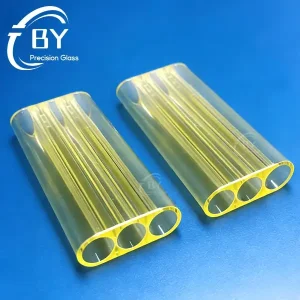
Wholesale Samarium-doped Quartz Triple Bore for Medical Laser Manufacturer, Supplier
View Specifications →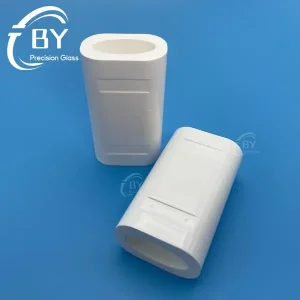
High-Quality Ceramic Cavities For Nd YAG Laser Supplier, Factories
View Specifications →
Custom Fiber Optic Glass Ferrules Supplier, Factories
View Specifications →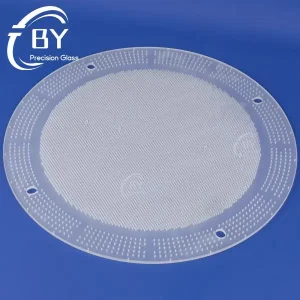
Custom Custom Optical Quartz Gas Distribution Plate Manufacturer, Suppliers
View Specifications →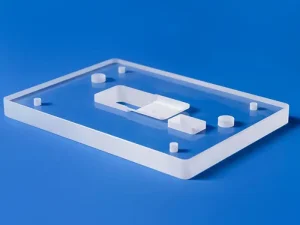
High-Quality Factory Supply Precision Quartz Glass Machining Plate Supplier, Suppliers
View Specifications →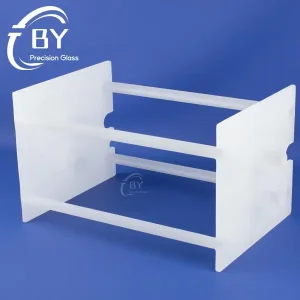
Wholesale Quartz Diffusion Boat for Semiconductor Suppliers, Factories
View Specifications →
Custom UV Block Yellow Quartz Tube for IPL Lamp Flow Handle Manufacturer, Factories
View Specifications →