
Featured Optical & Semiconductor Components
Engineered glass components fabricated to micrometer-level geometric tolerances. Browse our primary production runs below.
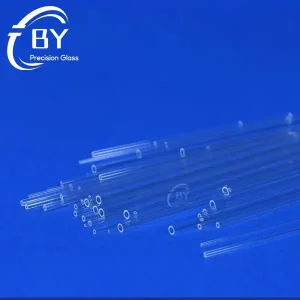
Wholesale Fluorine-Doped Fused Silica Capillary Tube
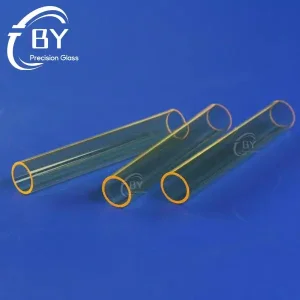
Custom UV Block Yellow Quartz Tube for IPL Lamp Flow Handle
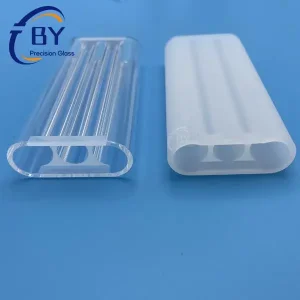
High-Quality Candela Laser Head Triple Bore Old & New Version
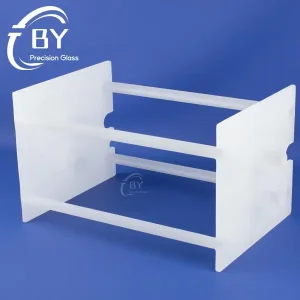
Wholesale Quartz Diffusion Boat for Semiconductor Suppliers
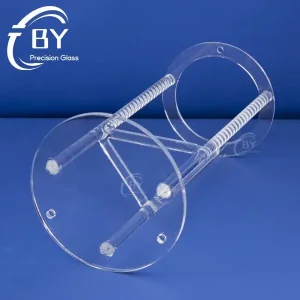
Wholesale Quartz Wafer Carriers for Semiconductor Processing
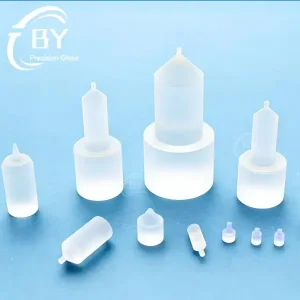
High-Quality Customized Quartz Fiber End Caps for QBH
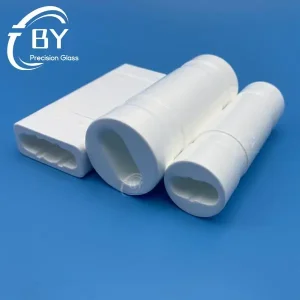
Wholesale Ceramics Reflector for Semiconductor Lasers
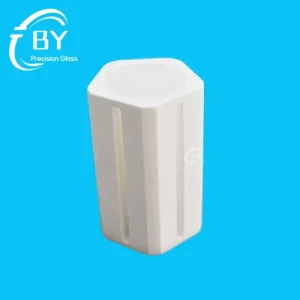
Diffuse High-Reflectivity PTFE Reflectors for Diode Cavities
Fluorine-Doped Silica Capillaries: Material Physics & Industrial Necessity
Exploring the physics of refractive-index depression, numerical aperture engineering, and photochemical resistance in micro-scale optical waveguides.
Index-Depressed Waveguiding
Doping high-purity synthetic silica ($SiO_2$) with fluorine atoms disrupts the silicon-oxygen tetrahedral lattice, directly lowering the refractive index relative to pure silica. This material anomaly provides an all-silica depressed cladding layer without using polymer coatings, enabling pristine internal total reflection.
Extreme Solarization Resistance
Unlike standard fused quartz or germanium-doped glass, fluorine-doped fused silica exhibits unmatched immunity to deep ultraviolet (DUV) color center formation (such as $E'$ centers). This ensures consistent transmission at 193 nm and 248 nm under intense excimer laser irradiation.
Micron-Scale Dimensional Rigidity
Manufactured on high-tension precision redrawing towers with dual-axis laser micrometer feedback, our capillary tubes achieve inner and outer diameter tolerances down to ±0.001 mm, maintaining strict concentricity and inner bore surface roughness below $Ra < 0.5$ nm.
| Property Parameter | Standard Fused Silica (JGS1) | Fluorine-Doped Silica (F-SiO2) | Engineering Benefit |
|---|---|---|---|
| Refractive Index ($n_D$ @ 589 nm) | 1.4585 | 1.4390 – 1.4520 (Tunable) | Enables pure-silica core waveguides with native cladding boundaries |
| Refractive Index Delta ($\Delta$) | Reference Baseline (0%) | -0.5% to -1.5% | High numerical aperture control without thermal expansion mismatches |
| DUV Absorption @ 214 nm | Moderate Solarization Decay | Zero Defect Band Formation | Permanent transmission stability in HPLC & Capillary Electrophoresis |
| Softening Temperature | ~1,730 °C | ~1,650 °C – 1,690 °C | Improved melt viscosity flow for intricate microfluidic redrawing |
| Bore Surface Roughness ($Ra$) | < 1.2 nm | < 0.5 nm (Flame-Drawn) | Eliminates analyte adsorption and chromatographic peak tailing |
Global Commercial & Industrial Landscape
An empirical evaluation of worldwide demand across life sciences, semiconductor wafer processing, and defense-grade photonic integration.
North America & EU Life Sciences
The rapid expansion of biopharmaceutical discovery, capillary electrophoresis (CE), and CE-MS interfaces across the United States, Germany, and Switzerland has accelerated demand for fluorine-doped capillary assemblies. By replacing polyimide-coated capillaries with intrinsically index-cladding silica, life-science instrument makers eliminate autofluorescence in laser-induced fluorescence (LIF) detection modules.
Asia-Pacific Laser Manufacturing Hub
China, Japan, and South Korea dominate the manufacturing of high-power kilowatt-class double-clad fiber lasers. Fluorine-doped capillary sleeves act as essential low-index cladding tubes, cladding mode strippers (CMS), and fiber end-cap splicing housings. They safely guide or strip secondary cladding light to prevent catastrophic thermal destruction in beam delivery couplers (such as QBH and Q+ cables).
Semiconductor Lithography & EUV Support
Within semiconductor fabrication equipment, fluorine-doped capillary nozzles deliver ultra-pure gas delivery under deep ultraviolet (DUV) and extreme ultraviolet (EUV) photolithography environments. Conventional silicate glasses generate particulate flaking through photochemical degradation; fluorine-doped capillaries remain chemically inert to halogen etchants and ozone purging.
Fluorosilicate Synthesis & Precision Redrawing Physics
Inside Tianjin BY Photonics' advanced hot-working facility: transforming chemical vapor deposited preforms into high-tolerance capillary microstructures.
Chemical Vapor Deposition (MCVD/VAD)
High-purity silicon tetrachloride ($SiCl_4$) and freon ($CF_4$ or $SiF_4$) gas streams undergo high-temperature vapor-phase hydrolysis. Fluorine ions replace oxygen sites within the glass matrix, establishing a homogeneous, depressed refractive-index profile across the preform core or jacket.
Ultrasonic Micro-Core Drilling & Honing
For heavy-wall capillary tubes or multi-bore optical ferrules, preforms undergo diamond ultrasonic core boring. The interior cylinder surface is mechanically honed and chemically polished with hydrofluoric (HF) chemical etch passes to eliminate micro-fractures prior to thermal redraw.
Vertical Precision Redraw Tower
Preforms are loaded into an enclosed, inert-gas purged oxyhydrogen induction furnace operating between 1,800 °C and 2,050 °C. Closed-loop servo capstans maintain downward feed rates coordinated with dual-axis laser scanning micrometers measuring inner and outer diameters at 1,000 Hz.
Stress-Relief Annealing & Cleanroom Cut
Drawn capillaries undergo controlled cooling through an in-line annealing tunnel to eliminate residual frozen stresses. Parts are cut via thermal shock or high-speed diamond wafer saws, followed by nitrogen purging and ISO Class 6 cleanroom hermetic packaging.
Technology Roadmap: 2025 – 2035
Anticipating the convergence of quantum micro-optics, microfluidic genomics, and multi-kilowatt coherent beam combination.
Ultra-High NA Mismatch Control
Next-generation fiber laser systems operating beyond 20 kW require steeper refractive index differentials ($\Delta n > 0.030$). Advances in plasma-enhanced chemical vapor deposition allow our engineering teams to dope up to 5 mol% fluorine, achieving numerical apertures that safely strip high-order cladding leakage modes without phase jitter.
Optofluidic Lab-on-a-Chip Integration
Micro-total analysis systems ($\mu TAS$) demand capillary channels that function simultaneously as fluid delivery conduits and optical waveguides. By maintaining a lower refractive index than water ($n_{water} \approx 1.33$), liquid-core optical waveguides (LCOW) fabricated from custom-doped materials achieve internal total reflection within aqueous solutions.
Hollow-Core Anti-Resonant Fiber (ARF) Shells
Hollow-core photonic crystal fibers and nodular anti-resonant fibers require capillary jackets with high geometrical symmetry. Fluorine-doped capillary sleeves minimize acoustic-wave reflections and backscatter in high-repetition-rate ultrafast picosecond and femtosecond laser processing setups.
Industrial & Scientific Problem-Solving Cases
Real-world deployment scenarios illustrating how our specialized glass parts solve critical operational bottlenecks.
1. Capillary Zone Electrophoresis (CZE) Detection Windows
The Challenge: Standard capillaries rely on polyimide coatings for mechanical flexibility. However, polyimide burns and degrades under UV absorbance detectors, while manual window burning leaves charred residues and fragile stress-notch fracture points.
The Solution: BY Photonics provides all-silica fluorine-doped capillary tubing featuring transparent fluoropolymer or native silica claddings. Detection windows offer 100% transmission across 200–800 nm without burning, reducing baseline drift during high-throughput peptide mapping.
2. High-Power Fiber Laser Cladding Mode Stripping
The Challenge: Unabsorbed pump light inside the inner cladding of active double-clad fibers can overheat protective polymer jackets, causing catastrophic fiber burns at multi-kilowatt beam delivery points.
The Solution: Our factory manufactures fluorine-doped silica sleeves with an index precisely matched to extract high-angle cladding light into an integrated conduction-cooled heat sink block, preserving optical beam quality ($M^2 < 1.15$).
3. Semiconductor Ozone & Corrosive Gas Dosing
The Challenge: Atomic layer deposition (ALD) and wafer cleaning equipment require precise micro-dosing of hot ozone ($O_3$) and anhydrous hydrochloric acid ($HCl$). Metallic nozzles corrode, shedding metal contaminants onto silicon wafers.
The Solution: Drawn from high-purity synthetic fused quartz and fluorosilicate glass, our micro-capillary tubes feature chemical inertness with zero metallic contamination (Fe, Cu, Ni < 0.1 ppm), ensuring cleanroom-grade process reliability.
Tianjin BY Photonics: Full Spectrum Manufacturing Capabilities
Consolidating cold machining, hot flame processing, redrawing, and quality inspection under one roof since 2010.
Multi-Material Stocking
We stock and process JGS1 (UV synthetic), JGS2 (optical visible), JGS3 (low-OH infrared), samarium/cerium-doped filter glasses, sapphire ($Al_2O_3$), sintered PTFE reflectors, and laser engineering ceramics.
Multi-Axis CNC Glass Machining
Equipped with ultrasonic CNC milling stations for precision hole drilling, micro-slotted diffusion boats, wafer carriers, triple-bore laser cavity tubes, and custom end-face angles polished to 8° AR finishes.
Precision Redrawing Towers
Dedicated drawing towers with micro-furnace heating zones support custom bore geometries, including circular, rectangular, square, and hexagonal capillary cross-sections with inner diameters from 10 µm to 5 mm.
Metrology & Interferometry
Comprehensive QC protocols include Zygo phase-shifting laser interferometers (measuring flatness down to $\lambda/10$), optical coordinate measuring machines (CMM), spectrophotometers, and laser micrometer arrays.
Frequently Asked Technical Questions
Everything you need to know about material selection, custom tolerances, and supply chain logistics.
What is the physical principle behind fluorine doping in fused silica glass?
What dimensional tolerances can BY Photonics maintain on drawn capillaries?
How does fluorine-doped silica perform under deep UV (DUV) laser radiation?
Can you produce non-circular capillary geometries, such as square or multi-bore profiles?
What is the minimum order quantity (MOQ) and sample lead time for custom drawings?
How are precision capillaries packaged to prevent damage and contamination during international transit?
Specialized Laser Cavities, Filters & Quartzware
Explore our complementary product line, engineered for medical lasers, aesthetic aesthetic tools, and high-temperature vacuum coating furnaces.
Wholesale Fluorine-Doped Fused Silica Capillary Tube
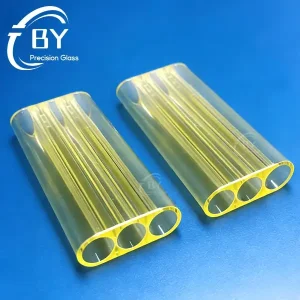
Wholesale Samarium-Doped Quartz Triple Bore for Medical Lasers
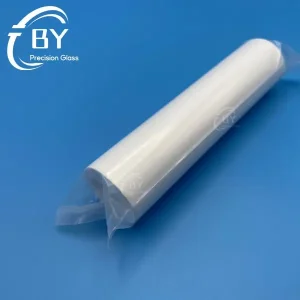
Wholesale Candela VBeam Laser 6" Ceramic Reflector Cavity
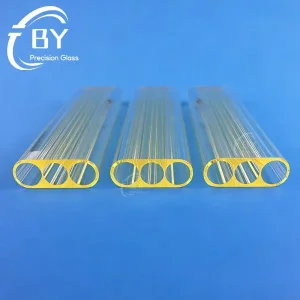
Custom Laser Cavity Flow Tubes & Filters (Samarium-Doped Glass)
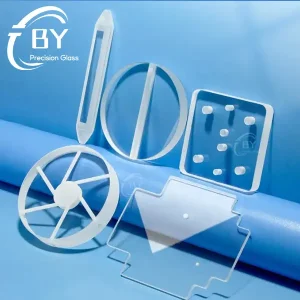
Wholesale High-Temperature Custom Quartz Glass Fabrication
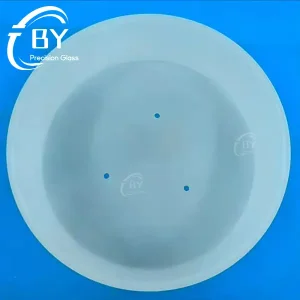
Custom Quartz Glass Components for Vacuum Coating Applications
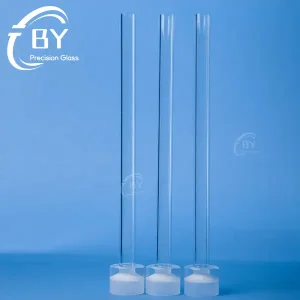
High-Quality Chemical-Resistant Custom Quartz Glass Parts
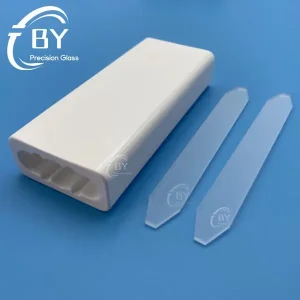
Wholesale Ceramic Cavity Reflector for DEKA Medical Lasers
Consult With Our Optical Engineering Team
Whether you require standard fluorine-doped capillary tubing or a custom-engineered multi-bore optical ferrule assembly, our engineering department reviews your drawings under strict NDA and delivers a DFM manufacturability assessment within 24 hours.