
Engineered Quartz & Laser Cavity Components
Explore our precision-machined quartzware and specialized optical cavity profiles, produced according to DIN ISO 10110 standards with stringent geometric tolerances.
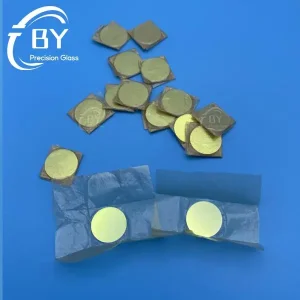
High-Quality Candela Laser Distance Gauge Slider Windows With coating 755 and 1064nm
View Specifications
High-Quality Custom Fabrication of Quartz Glass Precision Components Supplier, Factory
View Specifications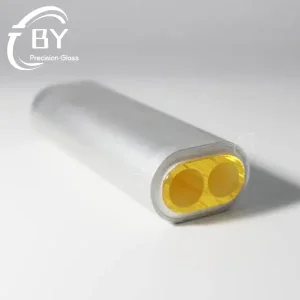
Custom Packed Laser Cavity Flowtubes for Laser Head Manufacturers, Suppliers
View Specifications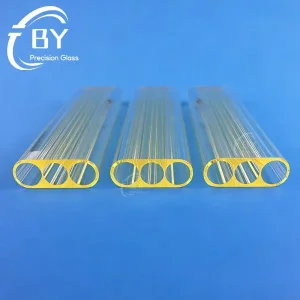
Custom Laser Cavity Flow Tubes & Filters Made from Samarium-doped Glass Supplier, Suppliers
View Specifications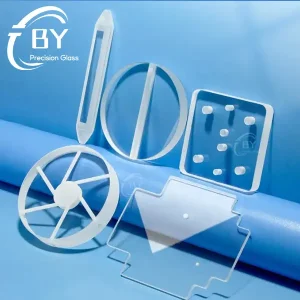
Wholesale High Temperature Custom Quartz Glass Fabrication Suppliers, Factories
View Specifications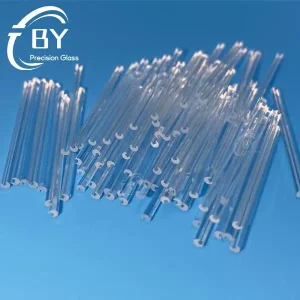
High-Quality Quartz Substrate Groove Use For Optical Fiber Coupler Suppliers, Factories
View Specifications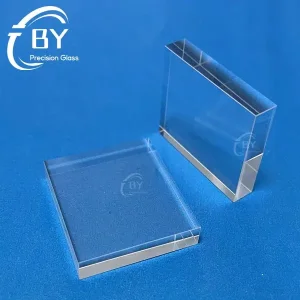
Custom Sapphire IPL Light Guide Block Used for Laser IPL Hair Removal Handle Manufacturer
View Specifications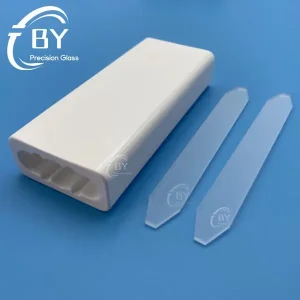
Wholesale Ceramic Cavity Reflector use for DEKA Laser Manufacturers, Supplier
View SpecificationsGlobal Commercial & Industrial Landscape of Non-Circular Quartz Tubing
Analyzing the technological migration from standard cylindrical fused silica capillaries toward customized geometric cross-sections across advanced semiconductor, medical, and photonic ecosystems.
Geometric Specialization
Traditional round quartz glass tubes inherently create optical aberration and mechanical rotational instability when coupling with planar semiconductor chips, diode arrays, and planar fluidic systems. Non-circular quartz tubing—specifically square, rectangular, D-shaped, elliptical, and multi-bore geometries—eliminates cylindrical lensing errors. This profile optimization enables direct surface-to-surface thermal heat-sinking and laminar hydrodynamic flow patterns that circular bores cannot achieve.
Semiconductor & Lithography Boom
The global wafer fabrication equipment (WFE) sector demands high-purity fused silica (SiO₂ purity ≥ 99.999%) capable of resisting toxic halogen plasma corrosion (such as NF₃ and CF₄) at continuous temperatures surpassing 1,150°C. Non-circular quartz furnace sleeves, multi-channel carrier sleeves, and flat-profile processing chambers allow tighter cleanroom envelope integration, boosting batch wafer throughput per thermal cycle.
Optofluidics & Diagnostics
Modern flow cytometry, DNA capillary electrophoresis, and HPLC detector cells depend on flat optical window planes. Square and rectangular quartz capillaries present zero curvature along optical detection axes, yielding ultra-low signal scatter, higher signal-to-noise ratios, and diffraction-limited UV transmittance down to 185 nm when utilizing synthetic JGS1 grade silica.
China Factory Efficiency: Precision Redrawing & Scale Economy
Operating from our specialized manufacturing base in Tianjin, China, BY Photonics bridges high-tolerance bespoke engineering with mass wholesale volume economics.
Integrated Hot & Cold Lines
Unlike western boutique machine shops that outsource tube drawing to secondary convertors, our facility executes vertical redraw towers, automated oxyhydrogen flame sealing, 5-axis CNC ultrasonic diamond grinding, and dual-side chemical-mechanical polishing (CMP) under one continuous roof.
Total Cost Parity
Wholesale procurement benefits from direct access to domestic high-purity natural silica sands and synthetic silane feedstock. Reduced supply chain fragmentation yields 35% to 50% capital savings on custom non-circular redraw profiles compared to European and North American suppliers.
Rapid DFM & Tooling Turnaround
Our internal graphite and tungsten-carbide mold tooling division produces precision preform shaping mandrels in-house within 72 hours. This eliminates the standard 6-to-8-week redraw lead time typical of conventional international quartz conversion plants.
Cleanroom Batch Traceability
Every batch of non-circular quartz tubing undergoes 100% optical laser micrometer verification for outer wall squareness, wall thickness uniformity, polariscopic residual stress mapping, and vacuum packaging inside Class 1,000 cleanroom environments.
Mission-Critical Industrial Applications & Procurement Demands
Across photonics, analytical biology, chemical engineering, and advanced metallurgy, non-circular fused silica tubing addresses challenging structural and optical requirements.
UV-C Flow Chambers & Photoreactors
Square and rectangular quartz flow tubes serve as continuous-flow disinfection channels for municipal drinking water, ultrapure pharmaceutical water loops, and chemical synthesis reactors. The perpendicular flat external faces allow UV LED arrays (emitting at 265 nm and 280 nm) to sit flush against the tube wall, maximizing photon transfer without refraction angles.
Laser Pump Cavities & Flow Tubes
High-energy solid-state and excimer laser systems utilize custom D-shaped and oval quartz flow tubes to house flashlamps and crystal laser rods (such as Nd:YAG or Alexandrite). The geometric contour optimizes coolant velocity across thermal hot spots while acting as a selective filter when doped with Cerium or Samarium to suppress parasitic ASE.
Capillary Electrophoresis & Microfluidics
Multi-bore rectangular capillary ribbons allow multiplexed DNA sequencing, droplet microfluidics, and in-line spectroscopy. Planar quartz external surfaces eliminate background scatter during laser-induced fluorescence (LIF) detection, preserving signal integrity across nano-liter internal fluid streams.
Semiconductor CVD & Diffusion Liners
Flat-faced rectangular quartz liners provide compact process envelopes inside low-pressure chemical vapor deposition (LPCVD) and atomic layer deposition (ALD) mini-batch furnaces. The non-circular profile accommodates silicon wafer carriers with minimal dead gas volume, reducing process gas consumption.
High-Temperature Sight Glasses & Pyrometry
Heavy-wall square fused quartz tubes provide visual inspection ports and infrared pyrometry windows in high-vacuum induction melt furnaces. Flat viewing faces offer distortion-free camera alignment without requiring post-assembly flat glass window welding.
Fiber Optic Preform Collapsing & Sleeving
Polarization-maintaining (PM) optical fiber fabrication requires non-circular (e.g., panda, bow-tie, or rectangular) inner geometry sleeves to mechanically constrain stress-applying rods around the transmission core during preform drawing.
Optical & Thermal Properties of Fused Silica Grades
Precision non-circular tubing must match exact wavelength transmission profiles and environmental operating parameters. Compare our primary production grades below.
| Optical Material Grade | Spectral Transmission | Typical OH Content | Refractive Index (nd) | Max Continuous Temp | Recommended Industrial Applications |
|---|---|---|---|---|---|
| JGS1 (Synthetic UV Silica) | 185 nm – 2,500 nm | < 5 ppm to 1,200 ppm | 1.4585 | 1,100 °C | Deep UV Optics Excimer lasers, UV-C reactors, flow cytometry |
| JGS2 (Optical Fused Quartz) | 220 nm – 2,500 nm | < 30 ppm | 1.4585 | 1,150 °C | General Photonics Laser flowtubes, furnace viewports, sight glass |
| JGS3 (Infrared Fused Quartz) | 260 nm – 3,500 nm | < 5 ppm (Water-free) | 1.4585 | 1,200 °C | IR & Semiconductor IR heating lamps, pyrometry windows, thermal liners |
| Samarium-Doped Quartz | Blocks < 400 nm & 1064 nm | Custom Doped | 1.4620 | 1,050 °C | Laser Engineering Medical & industrial Nd:YAG flashlamp flow tubes |
| High-Purity Borosilicate | 320 nm – 2,500 nm | N/A (Standard) | 1.4730 | 450 °C | Economy Fluidics Chemical capillary columns, level gauges, disposable cells |
Global Enterprise Sourcing & Quality Verification Framework
What procurement directors, optical engineers, and supply chain auditors need to evaluate before ordering non-circular quartz tubing in volume.
1. Corner Radius & Wall Geometry
In square and rectangular quartz redraw tubing, internal and external corner radii are critical engineering parameters. Drawing physics dictates an inherent minimum corner radius (typically 0.2 mm to 1.5 mm depending on wall thickness). When zero-radius internal 90° corners are mandatory, our facility supplements thermal redrawing with multi-axis diamond-head ultrasonic CNC milling and subsequent acid etching to eliminate micro-crack propagation points.
2. Surface Defect & Inclusion Limits
Industrial tube suppliers frequently overlook micro-bubbles (seed inclusions) and draw lines (striae). For laser and optofluidic applications, our wholesale shipments comply with MIL-PRF-13830B standards (Scratch-Dig 40-20 or 20-10 on polished faces) and ISO 10110-3 bubble classes (0/10). Tubing faces are inspected under high-intensity collimated green LED illumination to guarantee zero scattering center defects.
3. Stress Birefringence & Annealing
Asymmetrical cross-sections experience non-uniform cooling rates across edges compared to center wall sections during redrawing. Unless properly relieved, residual mechanical stresses cause catastrophic failure under thermal cycling. BY Photonics runs all non-circular tubing through automated programmable electric annealing kilns up to 1,140°C, holding optical path difference (OPD) below 5 nm/cm.
Frequently Asked Technical & Procurement Questions
Direct, practical answers from our engineering desk regarding non-circular quartz tube tolerances, thermal performance, and manufacturing limits.
What non-circular profile geometries can your factories manufacture?
We manufacture precision square, rectangular, triangular, D-shaped (flat side with convex dome), elliptical, hexagonal, octagonal, and customized multi-bore tubing (double-bore, triple-bore, and asymmetrical flow channels). We also engineer custom profiles according to customer CAD STEP or DXF files.
How do you maintain dimensional accuracy on square corners during redrawing?
We utilize precision-machined high-density graphite redrawing dies paired with closed-loop laser gauge monitoring. As the softened quartz preform passes through the redrawing furnace under vacuum or nitrogen purge, multi-axis optical sensors continuously regulate pulling tension, thermal profile, and feed speeds to keep outer dimensions within ±0.01 mm.
Can you optically polish the exterior or interior walls of square quartz tubes?
Yes. Outer flat walls can be lapped and polished to an optical window grade (surface roughness Ra < 0.5 nm, Scratch-Dig 20-10, and flatness up to λ/4 per 25 mm). For internal bore polishing, we use chemical-mechanical polishing (CMP) and fire-polishing techniques depending on bore cross-section and length.
What is the standard minimum and maximum size capability?
Our redraw lines produce micro-capillaries with inner dimensions as small as 0.1 mm × 0.1 mm up to large-scale structural quartz furnace ducts measuring 300 mm × 300 mm with wall thicknesses from 0.15 mm up to 25 mm. Standard lengths range from 10 mm cut pieces up to 2,500 mm continuous canes.
How does non-circular quartz perform under thermal shock?
Due to the ultra-low coefficient of thermal expansion of fused silica (CTE approx. 5.5 × 10⁻⁷ /°C from 20°C to 1,000°C), non-circular quartz components easily survive severe thermal shock, such as heating to 1,100°C followed by immediate water quenching, provided edge stress concentrations are mitigated through annealing.
What documentation and inspection certificates are included with wholesale shipments?
Every delivery includes a Certificate of Conformance (CoC), raw material purity analysis (spectrographic assay for trace metals in ppm), dimensional inspection reports (CMM / optical laser micrometer), and, upon request, spectrophotometer UV-Vis-NIR transmission curves and interferometric flatness test reports.
Semiconductor, Laser & Precision Quartz Assembly Line
Precision fused silica parts, custom wafer carriers, ceramic reflectors, and spectrophotometer cuvettes manufactured for global OEMs and research laboratories.
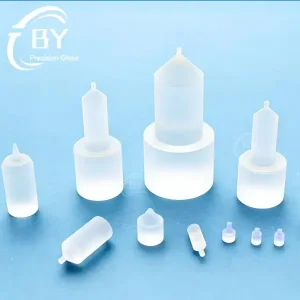
High-Quality Customized Quartz Fiber End Caps for QBH Manufacturer, Factory
View Specifications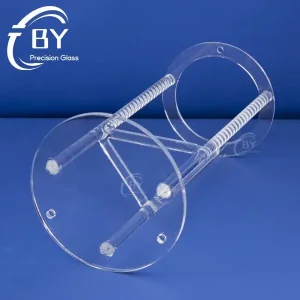
Wholesale Quartz Wafer Carriers for Semiconductor Supplier, Suppliers
View Specifications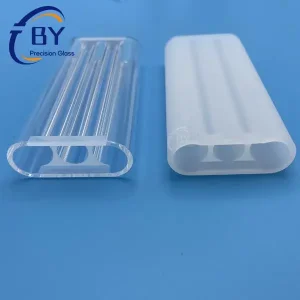
High-Quality Candela Laser Head Triple Bore Old and New Version In Stock Manufacturer
View Specifications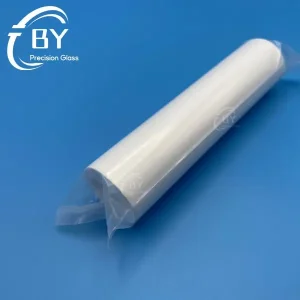
Wholesale Candela VBeam Laser 6" White Cavity Ceramic Reflector 2 Pk Manufacturer
View Specifications
Wholesale Customize Quartz Cuvette for Spectrophotometer Supplier, Factory
View Specifications
Custom Borofloat 33® Glass Wafers for Semiconductor Manufacturers, Factories
View Specifications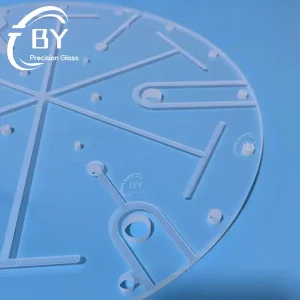
High-Quality Custom Precision Quartz Glass Fabrication Supplier, Suppliers
View Specifications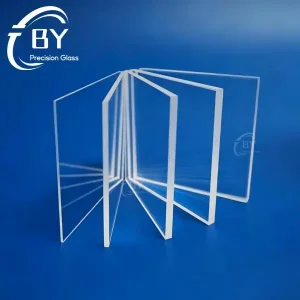
High-Quality JGS1 UItraviolet (UV) Grade Fused Silica Plate Supplier, Factory
View SpecificationsRequest a Technical DFM Review & Wholesale Factory Quote
Submit your CAD files (STEP, IGES, DWG, DXF) or dimensioned PDF drawings. Our optical engineering team provides comprehensive manufacturability feedback, material grade recommendations, and wholesale pricing within 24 hours.