Engineered Laser & Optical Quartz Core Components
Direct wholesale export lines machined under ISO 9001:2015 protocols. Certified surface finish, ultra-pure synthetic fused silica, and custom optical paths verified by spectrophotometric interferometry.
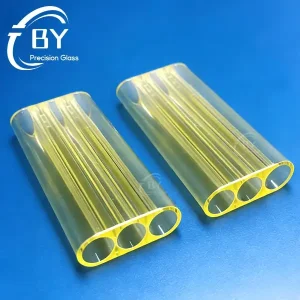
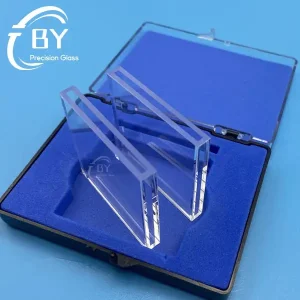
Engineered UV Quartz Cuvettes: Metrology, Material Physics & Optical Purity
In high-resolution spectrophotometry and HPLC detection, the analytical cell represents the optical boundary between light source and photodetector. Our engineering white paper outlines how molecular-level glass synthesis eliminates photometric drift.
Synthetic JGS1 vs JGS2 Fused Silica
For genuine UV spectrum work (190 nm – 380 nm), synthetic silica (JGS1 grade) synthesized via chemical vapor oxidation of SiCl4 is paramount. Unlike natural quartz, JGS1 maintains negligible metallic impurities (Fe < 0.1 ppm, Al < 0.5 ppm), preventing absorption edges down to 185 nm and mitigating dark solarization.
Direct Oxyhydrogen Molecular Fusion
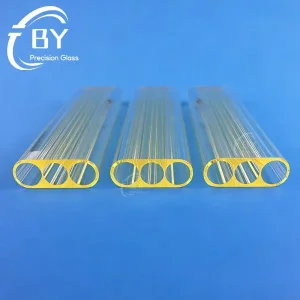
Commercial adhesive or epoxy joints fail catastrophically under aggressive organic solvents (DMSO, THF, Acetonitrile) and UV photochemical breakdown. BY Photonics deploys zero-adhesive thermal bonding at 1,150°C, unifying the 4 optical windows into an isotropic monolithic molecular block free of baseline-bleeding resins.
Interferometric Pathlength Tolerances
Deviations in Beer-Lambert absorbance quantitation ($A = \epsilon \cdot c \cdot l$) stem directly from pathlength error. Our precision double-sided planetary polishing controls interior optical pathlength to an uncompromising ±0.005 mm (or ±0.001 mm upon request), holding window parallelism within 10 arcseconds.
| Optical Substrate | Usable Spectral Range | Hydroxyl (OH) Content | Thermal Shock Resist | Typical Analytical Function |
|---|---|---|---|---|
| JGS1 (UV Fused Silica) | 185 nm – 2,500 nm | High OH (800 – 1200 ppm) | ΔT = 1,000 °C without crack | Far-UV Spectrophotometry, DNA/Protein Quant, Fluorometry |
| JGS2 (Fused Quartz) | 220 nm – 2,500 nm | Standard OH (150 – 200 ppm) | ΔT = 900 °C | General UV-Vis Absorption, Routine QC Benchtop Metrology |
| JGS3 (Infrared Quartz) | 260 nm – 3,500 nm | Low OH (< 5 ppm, dry) | ΔT = 1,100 °C | Near-IR Spectroscopy, Solvent O-H Vibrational Analysis |
| Optical Glass (Crown/B270) | 340 nm – 2,200 nm | N/A | ΔT = 150 °C | Visible Range Colorimetric Assays & Educational Labs |
Enterprise Solutions Tailored for Critical Analytical Environments
From industrial pharmaceutical continuous release to municipal wastewater ultra-trace TOC quantification, BY Photonics supplies OEM cuvettes engineered to survive corrosive matrices and continuous photon excitation.
1. Biopharmaceutical & Oligonucleotide QA/QC
Micro-volume UV quartz cuvettes and sub-micro flow cells configured for 260 nm and 280 nm protein/nucleic acid verification. Black quartz masking minimizes stray light and cross-reflection down to 0.05% T, ensuring accurate A260/A280 purity ratios even when sample volumes drop to 2 μL.
2. High-Performance Liquid Chromatography (HPLC/UHPLC)
Pressurized flow cell bodies utilizing fused silica windows mechanically compressed with custom inert PEEK or titanium housings. Engineered to withstand continuous fluidic pulses up to 100 bar without window deflection or refractive index shifting.
3. Online Water Quality, TOC & Environmental Monitoring
Long-pathlength flow cuvettes (up to 100 mm) optimized for continuous ozone, nitrate, COD, and TOC analyzers. Fabricated with fire-polished internal flow chambers that resist biological fouling, biofilm scaling, and aggressive chlorine cleaning regimens.
4. Flow Cytometry & Microfluidic Sorting Cells
Non-fluorescent synthetic quartz flow channels featuring high numeric aperture windows for laser-induced fluorescence (LIF) detection. Internal channel geometry is precision ultrasonic-machined and polished to minimize hydrodynamic shear stress on live cells.
Tianjin BY Photonics: Vertical Supply Chain Integration & Precision Execution
Operating continuously since 2010 in Tianjin, China, BY Photonics fuses automated CNC multi-axis cold machining with master oxyhydrogen glassmithing to slash OEM procurement costs by 35–55% while exceeding Western optical standards.
Direct Ingot Control
We source raw, high-purity synthetic ingot boules directly from accredited primary melters, performing in-house polarimeter inspection to verify zero internal strain and bubble class 0 certification.
Robotic CNC Center
Equipped with 120+ specialized glass machining tools, including ultrasonic milling machines and 5-axis CNC centres capable of cutting complex internal flow channels with sub-10 μm dimensional repeatability.
Class 10,000 Cleanroom
Ultrasonic solvent degreasing, multi-stage DI water cascade washing (18.2 MΩ·cm), optical transmission scanning, and cleanroom vacuum blister packing prevent particulate contamination before shipping.
DFM Engineering Rapid Desk
Engineers review complex custom drawings within 24 hours, returning design-for-manufacturability feedback, optical simulation notes, and tooling optimization that mitigates scrap rates.
Global Enterprise Sourcing Protocols & Regulatory Safeguards
Purchasing wholesale UV cuvettes requires rigorous verification to avoid batch inconsistency, spectral variance, and regulatory non-conformance. Here is how BY Photonics structures B2B supply agreements.
Matched Pair Sorting (ΔT ≤ 0.5%)
Double-beam spectrophotometers require paired cells with identical absorbance characteristics. Every wholesale batch undergoes computer-indexed sorting at 200 nm, 220 nm, and 260 nm, ensuring matched pairs possess optical transmission variances within ΔT ≤ 0.5% (or ≤ 0.3% for research-grade).
Pharmacopoeia Compliance (USP & EP)
Fabrication standards fully satisfy the stringent stray light, pathlength accuracy, and wavelength calibration protocols dictated by USP <857> and European Pharmacopoeia (Ph. Eur. 2.2.25), ensuring complete qualification for GLP/GMP pharmaceutical audit environments.
Zero-Breakage Global Logistics
Every cuvette is packed in anti-static, shock-absorbing hermetic cases, nested inside high-density foam cushioning with desiccants, packaged in impact-resistant export cartons. We support door-to-door DDP, DAP, and air freight across North America, Europe, Japan, and Southeast Asia.
Technical Roadmap: Next-Gen Optical Materials & Automated Metrology
Analytical instruments are evolving toward ultra-low volumes, extreme vacuum UV wavelengths, and automated robotic handling. BY Photonics is engineering tomorrow's photonic boundaries today.
Vacuum UV & DUV Down to 170 nm
Developing specialized fluorine-doped fused silica modifications that push optical transmittance into the vacuum ultraviolet (VUV) spectrum, enabling deep protein secondary structure circular dichroism (CD) spectroscopy down to 170 nm with zero excimer laser solarization.
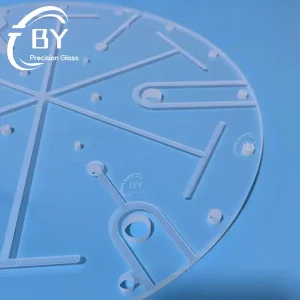
Laser-Etched Microfluidic Quartz Chips
Migrating conventional flow cells into hybrid monolithic quartz microfluidic chips utilizing in-house femtosecond laser 3D internal engraving, yielding fluidic channels as narrow as 20 μm for next-generation single-molecule DNA sequencing.
AI-Powered Automated Wavefront QC
Implementing robotic computer-vision interferometry on the production line to measure 100% of finished windows for wavefront distortion (≤ λ/10) and sub-surface damage, providing digital inspection twins for every serialized production unit.
Frequently Asked Questions: Technical Engineering & Sourcing
Essential guidance compiled by BY Photonics optical engineers for procurement officers, lab directors, and instrument designers.
How do I distinguish synthetic UV fused silica cuvettes from standard optical quartz or glass?
Why is fire fusion (thermal bonding) superior to adhesive/glue assembly?
What tolerances do you hold for optical path length and window parallelism?
What is the recommended cleaning protocol for high-purity quartz cuvettes?
Can BY Photonics fabricate custom cuvettes and micro-aperture flow cells from CAD drawings?
What are the standard lead times for wholesale OEM batches and prototype sampling?
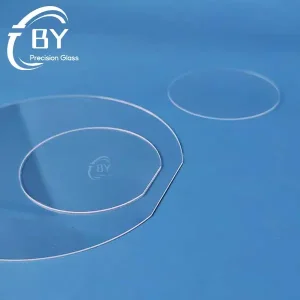
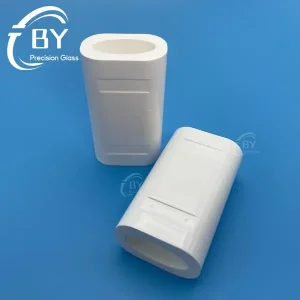
Specialized Spectrophotometer Cuvettes, Wafers & Reflector Cavities
Explore additional core products manufactured at our Tianjin facility. All items feature custom material choices, strict surface accuracy, and worldwide wholesale shipping.