Semiconductor & Lithography
Certified optical plates, deep-UV fused silica substrates, and high-transmission viewports configured for harsh ambient and vacuum environments across the Riyadh Province.

Under the ambitious framework of Saudi Vision 2030, the Kingdom of Saudi Arabia is orchestrating one of the most comprehensive industrial pivots in modern economic history, positioning Riyadh as the advanced manufacturing capital of the Middle East.
The transformation of Riyadh's industrial ecosystem spans far beyond conventional hydrocarbon processing. With strategic investments pouring into the MODON Industrial Cities (Riyadh 2nd and 3rd Industrial Cities), the King Abdulaziz City for Science and Technology (KACST), the National Industrial Development and Logistics Program (NIDLP), and satellite innovation districts such as the King Abdullah Petroleum Studies and Research Center (KAPSARC), Riyadh has emerged as a high-density consumer of specialized photonic components. Precision synthetic fused silica and quartz plates represent vital technological foundations across four critical regional sectors:
Refining complexes and polymer synthesis facilities throughout the central Riyadh corridor depend on extreme-pressure optical viewports. Quartz and borosilicate windows allow continuous spectroscopic analysis (FTIR, Raman, UV-Vis) of volatile hydrocarbon streams at elevated pressures and temperatures up to 1,100°C without mechanical failure or chemical hazing.
Saudi Arabia’s National Renewable Energy Program (NREP) demands rigorous durability. Quartz plates serve as solar simulator pyrometer windows, concentrating solar power (CSP) receivers, and optical thermal barriers capable of withstanding intense UV radiation and rapid thermal cycles without solarization or degradation.
Driven by the Saudi Semiconductor Hub initiative, local fabrication and packaging facilities require semiconductor-grade quartzware. From diffusion furnace tube viewports to photolithography exposure windows and wafer carrier plates, ultra-pure synthetic fused silica eliminates trace heavy-metal contamination across nanoscale nodes.
Procurement officers and optical engineers in multinational EPCs, defense contractors, and analytical laboratories operating in Riyadh face stringent standards when sourcing precision quartzware.
Global supply chain friction in high-purity fused silica often traces back to upstream ingot synthesis and volatile lead times. Precision quartz fabrication requires stable access to tier-1 synthetic silica (such as JGS1, Corning HPFS, Suprasil) and electrically or flame-fused natural quartz (JGS2, JGS3). For Riyadh-based industrial operators, unforeseen delays in viewport replacements or semiconductor reactor quartzware can result in severe downtime costs.
By establishing streamlined engineering channels, localized packaging compliance, and dedicated production lines with vertically integrated cold and hot glass machining, BY Photonics provides guaranteed production schedules, full chemical melt traceability, and direct-to-Riyadh air freight routing through King Khalid International Airport (RUH).
In high-stress Saudi environments, choosing cheaper commercial soda-lime or low-grade quartz glass inevitably causes premature component failure. Thermal expansion mismatches induce mechanical stress around viewport flanges, while OH-radical impurities lead to solarization and signal attenuation in laser and spectroscopic applications.
Our engineering-first approach analyzes the exact operational envelope—including chemical contact, pressure differentials (PVP ASME calculations), thermal shock parameters, and spectral transmission bands—ensuring Riyadh clients achieve extended component service lifetimes and minimal maintenance cycles.
| Optical Material Grade | Spectral Range | OH Content | Key Mechanical & Optical Properties | Typical Riyadh Applications |
|---|---|---|---|---|
| JGS1 Synthetic Fused Silica UV-Grade Synthetic |
185 nm – 2,500 nm | ≤ 1200 ppm | Zero bubble inclusions; extreme UV transmission (>90% @ 193nm); high laser-induced damage threshold (LIDT). | Photolithography optics, excimer laser windows, laboratory spectroscopy, medical laser instrumentation. |
| JGS2 Optical Fused Quartz Natural Crystal Fused |
220 nm – 2,500 nm | ≤ 30 ppm | Excellent visible and NIR clarity; high mechanical strength; low thermal expansion (0.54×10⁻⁶/K). | Industrial viewports, furnace sight glasses, petrochemical process observation, solar thermal collectors. |
| JGS3 Infrared Quartz Water-Free / IR Grade |
260 nm – 3,500 nm | ≤ 5 ppm | Virtually eliminated absorption band at 2.73 μm; superior mid-wave infrared transmission. | Gas chromatography analyzers, IR pyrometry windows, thermal imaging enclosures, atmospheric sensors. |
| Borosilicate 3.3 Glass Low-Expansion Float |
320 nm – 2,500 nm | N/A | Coefficient of thermal expansion 3.3×10⁻⁶/K; superior chemical acid resistance; cost-effective flat glass. | Bulk industrial viewports, explosion-proof light covers, wastewater processing sight glass, pipeline sight indicators. |
| Single-Crystal Sapphire Synthetic Al₂O₃ |
170 nm – 5,500 nm | Zero | Mohs hardness 9; service temp up to 2,000°C; extreme abrasion resistance against sandblasting. | High-pressure petrochemical sensors, military avionics, aesthetic laser light guides, harsh desert sensors. |
Achieving deterministic optical wavefront accuracy and mechanical hermetic sealing across demanding industrial applications in Saudi Arabia requires multi-stage CNC cold processing and interferometric validation.
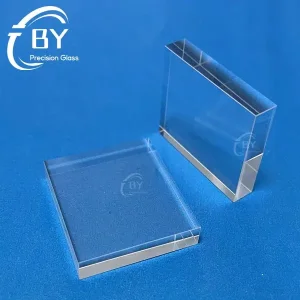
Using advanced double-sided planetary lapping and chemical-mechanical polishing (CMP), our optical quartz plates achieve surface roughness (Ra) down to < 0.5 nm and scratch-dig ratings as tight as 10-5 per MIL-PRF-13830B, eliminating scattered light in laser lithography and analytical sensors.
Every critical optical window undergoes transmission and reflection testing on Zygo GPI phase-shifting laser interferometers. We routinely guarantee transmitted wavefront distortion (TWD) and surface flatness down to λ/10 (λ = 632.8 nm) with parallelism under 5 arcseconds for distortion-free beam paths.
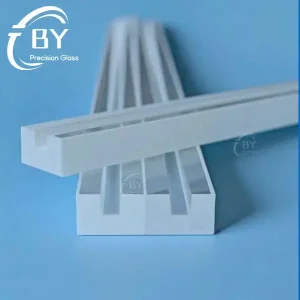
For non-standard geometry viewports, countersinks, bevels, and micro-grooves, ultrasonic-assisted diamond CNC machining eliminates micro-cracking and sub-surface fracture zones. This enhances mechanical break-strength under intense hydrostatic pressures in downhole oilfield testing.
In accordance with DIN 7080 and ASME Section VIII Pressure Vessel Codes, industrial sight glasses deployed in Riyadh refineries must maintain minimum safety factors of 8:1 to 10:1. The formula below governs the calculation of minimum plate thickness (t) for a circular clamped viewport:
t = d × √ [ (C × P) / σ_allow ]
Where d is the unsupported viewport diameter, P represents the maximum design pressure, C is the clamping coefficient (typically 0.55 for elastomeric gaskets), and σ_allow is the allowable tensile bending stress for high-purity quartz glass (50 MPa, factoring in environmental safety margins). BY Photonics offers custom pressure calculation engineering sheets with every tailored viewport assembly.
Anticipating the technological progression of Riyadh’s manufacturing sectors over the next decade: from extreme ultraviolet (EUV) lithography substrates to integrated photonics.
As Saudi industrial fabrication centers transition to multi-kilowatt fiber laser cutting and metal 3D printing (DMLS), the demand for high-threshold protective quartz slide windows (operating at 1064 nm and 1070 nm) is surging. Inclusions and metallic impurities inside the glass matrix are eliminated to achieve laser damage thresholds (LIDT) exceeding 15 J/cm² at 10 ns pulses, preventing catastrophic thermal blooming.
Riyadh’s alignment with global semiconductor fabrication demands quartz diffusion furnace tubes, quartz wafer boats, and photolithography mask blanks with alkali and transition metal contamination strictly below parts-per-billion (ppb) levels. Synthetic chemical vapor deposition (CVD) silica processes are advancing to support 7nm and smaller lithographic exposure requirements.
Next-generation molten salt CSP and green hydrogen cracking facilities require transparent optical windows that function continuously above 900°C under severe particulate friction. Research is focusing on fused silica substrates reinforced with nanostructured anti-soiling and anti-abrasion coatings to repel fine Arabian desert dust without loss of optical transmission.
Collaborative research across Riyadh universities (including KSU and Prince Sultan University) is exploring monolithic fused silica microfluidic chips, ion-trap quantum computing viewports, and optical resonators fabricated using precision femtosecond laser direct writing and selective chemical etching.
Ensuring rapid, frictionless clearance through Saudi Customs and flawless component integration into Class 100/1000 cleanroom environments in Riyadh.
We support local Saudi importers by providing certified Harmonized System (HS) documentation, technical product sheets, and testing reports aligned with SASO (Saudi Standards, Metrology and Quality Organization) and the electronic SABER clearance system, eliminating customs clearance bottlenecks.
To prevent optical contamination during international transit, components undergo multi-stage deionized ultrasonic cleaning, drying, and hermetic vacuum packaging inside Class 100 (ISO Class 5) cleanrooms with anti-static, moisture-barrier packaging tailored for Riyadh's arid climate.
Every shipment includes complete Quality Inspection Sheets (QIS), spectrophotometer UV-Vis-NIR transmission curves, and Certificate of Conformance (CoC) matching melt numbers to guarantee zero variance between prototype and production batches.
Direct answers addressing technical parameters, material selection, customs logistics, and precision fabrication inquiries from Saudi procurement teams.
Explore our custom fabrication portfolio supplying research institutes, laser clinics, and high-tech fabs throughout Riyadh and the wider GCC region.