ISO 9001 Certified Optical Engineering · Global Medical & Industrial Supply

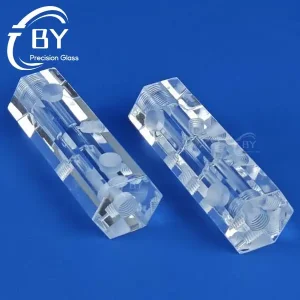
IPL Light Guide Block Manufacturer & Factories Serving London

Precision-engineered sapphire and synthetic fused silica (JGS1) light guides tailored for London aesthetic device OEMs, clinical maintenance hubs, and global electro-optic integrators.

Immediate Sourcing Selection

High-Spec Light Guides & Core Laser Components for London Systems

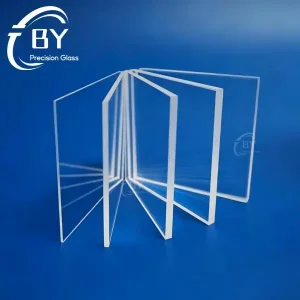
Direct factory delivery of ultra-flat, high-transmission sapphire crystals and laser-machined optical waveguides supporting London clinics and European OEM assemblies.
Regional Market Assessment

London Aesthetic Optics Landscape: High Standards, Critical Thermal Demands

London represents one of the dense commercial centers for medical dermatology and laser aesthetics globally. Anchored by the internationally acclaimed Harley Street Medical Area (W1G), Kensington private surgical centers, and regional medtech clusters extending into Surrey and the Thames Valley, treatment volumes demand zero-failure photonics.

UK clinical practitioners utilize high-fluence Intense Pulsed Light (IPL) platforms for advanced hair removal, vascular lesions, telangiectasia, and pigment photo-rejuvenation. In these clinical operating handpieces, the IPL Light Guide Block is the single critical interface directly coupling broad-spectrum xenon flashlamp photons into patient dermal tissue while executing sub-zero epidermal contact cooling.

However, despite extraordinary clinical demand, Greater London and the broader United Kingdom maintain scarce indigenous capacity for raw synthetic single-crystal sapphire boule cultivation or ultra-precision cold-end lapping of optical blocks. Regional medical device service companies, laser distributors, and refurbishment engineers throughout Enfield, Park Royal, and Dartford frequently encounter steep lead times (often 8 to 14 weeks) and massive supply premiums from secondary trading intermediaries across Europe.

The Engineering Friction in London's Aesthetic Supply Chain

Local clinical maintenance hubs operate under tight turnaround requirements. When an IPL handpiece experiences delamination of its multi-layer optical coating, thermal cracking from dry flash firing, or edge chipping, replacements must arrive rapidly with certified dimensional tolerance (±0.02 mm) and impeccable surface quality (Scratch-Dig 20/10).

  • High cost per replacement from domestic UK optical stockists.
  • Inconsistent thermal conductivity in non-traceable glass substitutes.
  • Need for localized custom geometries: rectangular, tapered, curved tips.
  • Demanding UK health and safety inspections requiring biocompatible edge chamfering.
Global Macro Analysis

Global Medical Aesthetics & Electro-Optic Guide Architecture

The global intense pulsed light and aesthetic laser equipment market is projected to exceed $3.8 billion, driven by the expansion of home-use consumer IPL gadgets and high-throughput multi-wavelength medical consoles.

Synthetic Single-Crystal Sapphire Domination

Industrial consensus has pivoted aggressively from BK7 optical glass toward synthetic crystalline sapphire (Al₂O₃). With high thermal conductivity (~35 W/(m·K)) and mechanical Mohs hardness of 9, sapphire facilitates rapid conductive heat extraction from human skin to Peltier elements, preventing epidermal burns while handling high laser fluences.

JGS1 Fused Silica for High-Energy Pulses

For deep ultraviolet to near-infrared wideband transmission (185–2500 nm) where absolute thermal expansion must approach zero (~5.5×10⁻⁷ /°C), synthetic UV-grade fused silica (JGS1) remains the global standard for non-contact fractional IPL applications and metrology excitation chambers.

Advanced Optical Coating Integrity

Modern clinical guidelines dictate strict wavelength filtering. Global manufacturers integrate dielectric thin-film optical coatings: long-pass cutoff filters (e.g., 530 nm, 560 nm, 590 nm, 640 nm, 690 nm to 1200 nm) deposited by Ion-Assisted Deposition (IAD) to withstand tens of thousands of intense xenon flash pulses without peeling.

Substrate Material Thermal Conductivity Transmission Band Mohs Hardness Laser Damage Threshold (LIDT) Key Clinical Application
Optical Monocrystalline Sapphire ~35 W/(m·K) @ 25°C 170 nm – 5,500 nm 9.0 > 25 J/cm² @ 1064 nm (10 ns) Direct Contact Cooling Hair Removal & Vascular IPL
JGS1 Synthetic UV Fused Silica ~1.4 W/(m·K) 185 nm – 2,500 nm 6.5 > 35 J/cm² @ 1064 nm (10 ns) High-Power Flashlamp Windows, UV Light Guides
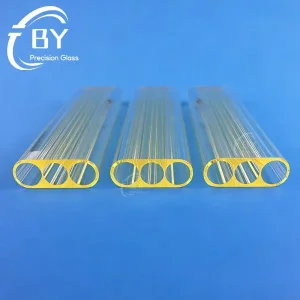
JGS2 Optical Fused Quartz ~1.38 W/(m·K) 220 nm – 2,500 nm 6.5 > 20 J/cm² @ 1064 nm (10 ns) Flow Tubes, Laser Chambers, Protective Shields
Standard Optical Glass (K9 / N-BK7) ~1.11 W/(m·K) 350 nm – 2,000 nm 5.5 < 10 J/cm² @ 1064 nm (10 ns) Low-Cost Home-Use IPL Handpieces (Limited Lifespan)
Manufacturing Excellence

Chinese Direct Factory Synergy: Why Global & London Buyers Source from Tianjin BY Photonics

As an optical components manufacturer established in 2010, Tianjin BY Photonics Co., Ltd. bridges the gap between high-precision optical prototyping and massive scalable production. Our 3,000+ m² facility integrates raw crystal slicing, CNC 5-axis ultrasonic diamond milling, precision double-sided lapping, and automated thin-film coating inside Class 1,000 cleanrooms.

By eliminating multiple tiers of distributors, trading agents, and subcontractor markups, we deliver optical light guide blocks directly to London engineering firms and European medical brands with decisive advantages:

  • 40% to 60% Cost Efficiency: Complete raw boule inventory and in-house cold fabrication bypass inflated Western procurement markups.
  • Sub-Nanometer Surface Roughness: Precision CMP (Chemical Mechanical Polishing) achieves Ra < 0.5 nm and Scratch-Dig 20/10 or 10/5.
  • Rapid Turnaround to the UK: Full DFM (Design for Manufacturability) engineering reviews within 24 hours; prototype dispatch in 5–7 days via expedited air transit directly to London Heathrow or Gatwick.
  • Batch Consistency: 100% optical inspection using Zygo GPI interferometers and PerkinElmer Lambda 1050+ spectrophotometers ensures zero optical variance.
15+ Years Precision Optics Machining
< 24h Engineering Drawing DFM Review
±0.02mm Critical Dimensional Tolerance
λ/10 Maximum Surface Flatness
Applications & Roadmaps

Localized Applications Across London & Industry Trends

From high-volume aesthetic clinics in Central London to medical laser maintenance companies across the UK, light guide blocks play an instrumental role across multiple clinical and technical disciplines.

Clinical Handpiece Refurbishment (London Service Hubs)

London service centers frequently repair premium IPL systems (Lumenis, Candela, DEKA, Alma). Replacing burned, scratched, or delaminated OEM light guide prisms with custom BY Photonics sapphire blocks restores original energy delivery and epidermal cooling efficiency at a fraction of factory repair costs.

Painless Contact Cooling (Next-Gen Aesthetic Ergonomics)

Modern clinical trends in Mayfair and Harley Street clinics prioritize patient comfort. Combining sapphire blocks with advanced Peltier thermoelectric coolers ensures real-time skin chilling down to 0°C to -5°C, suppressing pain receptors while allowing higher therapeutic fluences.

Total Internal Reflection (TIR) Waveguides

To eliminate hotspot burn risks, modern IPL optical waveguides utilize 4-sided optically polished perimeters. This geometry leverages Total Internal Reflection (TIR) to homogenize the non-uniform output from xenon arc discharges into a uniform flattop beam across the output aperture.

Procurement Specification Protocol

Global B2B Procurement Standards for Optical Light Guides

When tier-1 medical OEMs and laser engineering facilities issue Request for Quotations (RFQs), optical components must pass rigorous inspection benchmarks to guarantee patient safety and laser longevity.

Core Technical Specifications Required by Global QA:

  • Surface Figure & Flatness: Both entrance and emission faces must achieve λ/4 to λ/10 per inch @ 632.8 nm to prevent refractive wavefront distortion.
  • Surface Quality (MIL-PRF-13830B): 20/10 Scratch-Dig on active optical faces; 40/20 or commercial polish on TIR side walls.
  • Dimensional Tolerances: Length, width, and thickness maintained within ±0.02 mm; angular tolerances within ±1 to 3 arc minutes.
  • Edge Beveling & Safety Chamfers: Uniform 45° protective chamfers (0.1 mm to 0.3 mm) to eliminate micro-chips and prevent laceration during direct skin glide treatments.
  • Coating Durability: Dielectric hard coatings tested for humidity resistance (MIL-C-675C) and severe abrasion (eraser rub test).

Traceability & Material Quality Assurance

Tianjin BY Photonics provides full lot traceability with each shipment to the United Kingdom and global destinations. Every production order includes:

  • CofC (Certificate of Conformance) confirming optical material authenticity.
  • Spectrophotometer spectrophotometric transmission curves (UV-Vis-NIR).
  • Interferometer surface topography inspection reports.
  • CMM (Coordinate Measuring Machine) dimensional verification reports.
Complete Precision Catalogue

Precision Quartz, Reflector & Substrate Solutions for London & Worldwide

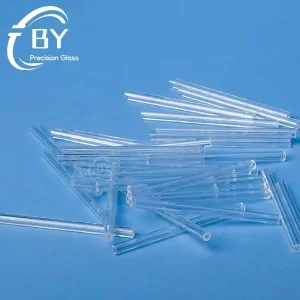
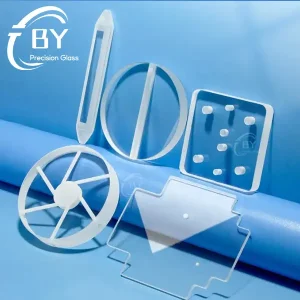
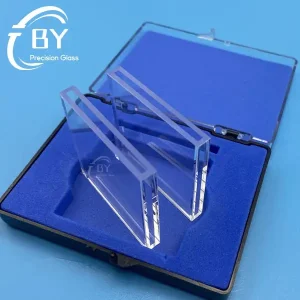
Explore our specialized range of custom-machined fused silica, high-temperature quartz, and optical filtration assemblies engineered strictly to your manufacturing drawings.
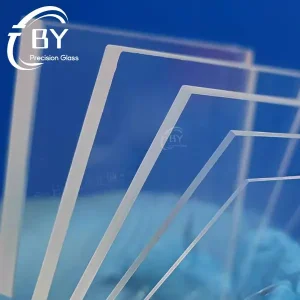
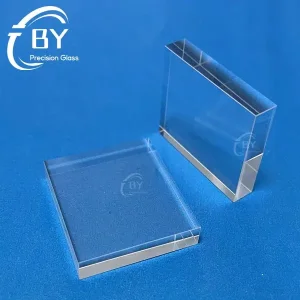
JGS1 Ultraviolet Grade Fused Silica Plate for UK Electro Optics
UV Fused Silica

JGS1 Ultraviolet UV-Grade Fused Silica Optical Plates for UK Metrology

Explore Specifications
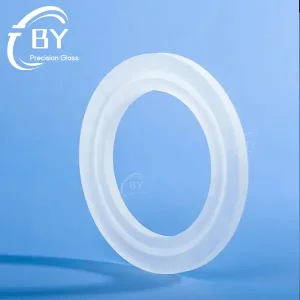
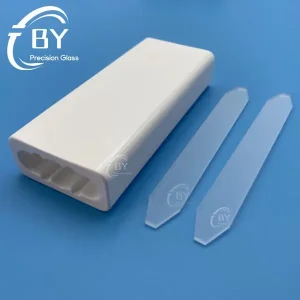
Custom Fabrication Quartz Precision Components London
Custom Fabrication

Custom Precision Quartz Fabrication for London Scientific Hardware

Explore Specifications
Knowledge Base & FAQ

Frequently Asked Questions on IPL Light Guide Sourcing

In-depth answers covering material physics, optical coatings, London delivery, and custom manufacturing parameters.

Why is synthetic sapphire preferred over quartz or BK7 in clinical IPL light guides?
Sapphire (Al₂O₃) has a thermal conductivity of ~35 W/(m·K) at room temperature, which is roughly 25 to 30 times higher than fused quartz (~1.4 W/(m·K)) and BK7 glass (~1.1 W/(m·K)). In an IPL treatment handpiece, the crystal is actively cooled by a Peltier thermoelectric module. Sapphire’s rapid heat conduction pulls thermal energy away from the patient’s epidermis almost instantaneously, preventing skin blistering while maintaining high energy fluences. Additionally, sapphire’s Mohs hardness of 9.0 prevents scratches from repetitive contact and cleaning.
Can you manufacture custom dimensions and tapered light guides to fit specific handpieces?
Yes. We produce fully customized geometries according to customer drawings (STEP, IGES, DXF, or PDF). Standard clinical configurations range from 8×40 mm, 10×45 mm, 12×30 mm, to 15×50 mm. We also manufacture tapered (pyramidal) light guides for concentrated spot fluences and curved or beveled tips specifically designed for ergonomic facial, vascular, and periorbital treatments.
How do you ensure optical coatings do not peel under high-fluence flashlamp exposure?
We use Ion-Assisted Deposition (IAD) and electron-beam evaporation inside high-vacuum coating chambers. This method ensures exceptionally dense, stoichiometric dielectric oxide layers that withstand mechanical stress, high humidity, and repeated thermal shock from Xenon pulses without delaminating. All coatings comply with MIL-C-675C adhesion and moderate abrasion standards.
What is the standard delivery timeline for clinics and OEMs based in Greater London?
For standard stock sizes and raw sapphire blanks, parts dispatch within 48 to 72 hours. Custom machined light guide blocks requiring specific bevels, cut-off dielectric filters, or AR coatings generally require 2 to 3 weeks for tooling, precision polishing, and coating. Shipments to London are dispatched via priority air express (DHL/FedEx/UPS), arriving at London Heathrow (LHR) within 3 to 5 business days with full customs documentation.
What is the difference between JGS1, JGS2, and JGS3 quartz substrates?
JGS1 is synthetic UV-grade fused silica free from bubbles, offering excellent transmittance from 185 nm up to 2500 nm, making it ideal for deep UV optics and excimer applications. JGS2 is standard fused quartz with high transmission in the visible spectrum (220–2500 nm), typically applied in standard viewports and flow tubes. JGS3 is infrared-grade fused quartz with ultra-low hydroxyl (OH⁻ < 2 ppm) content, transmitting continuously from 260 nm to 3500 nm without OH absorption dips around 2.7 µm.
Can you provide small batches for prototypes or laser clinic maintenance replacements?
Yes. We accommodate small-volume prototyping and individual clinical repair batches (from 5–10 units) up to volume production runs exceeding 10,000 units per month for international medical device OEMs. Every batch undergoes the exact same interferometric, surface roughness, and dimensional inspection protocols.
Fast-Track Engineering Desk

Request Your Custom IPL Light Guide Quotation Today

Send your CAD models or dimensioned drawings. Our precision optical engineers provide comprehensive DFM evaluations, material recommendations, and firm manufacturing quotes within 24 hours.