
Precision Laser Cavity & Optical Glass Assemblies
In-stock and custom-fabricated optical geometries manufactured under ISO 9001:2015 process controls.

Macro-Industry Solutions: The Science of High-Reflectance Diffuse Ceramics
Overcoming specular degradation, localized thermal hot-spots, and pump non-uniformity in high-flux solid-state laser resonators.
Lambertian Scattering Dynamics
Unlike metallic specular coatings (such as electroplated gold or polished silver) which reflect light at discrete angles ($\theta_r = \theta_i$), high-purity micro-porous alumina ceramic reflectors behave as near-perfect Lambertian surfaces. When pumping Nd:YAG, Alexandrite, Ruby, or Er:YAG laser crystals, isotropic pump ray redistribution eliminates severe thermal lensing, suppresses transverse mode distortions, and guarantees uniform population inversion across the complete gain medium diameter.
Our engineered porosity matrix (typically 12% to 18% volumetric micro-void distribution) induces multi-scale volumetric Rayleigh-Gans optical scattering. Incoming photons experience hundreds of non-absorbing refractive index mismatches between the corundum grains ($n \approx 1.76$) and trapped microscopic sub-micron gas voids, achieving total integrated diffuse reflectance exceeding 98.2% across the critical 600 nm to 1,064 nm absorption spectrum.
Elimination of Solarization & Blistering
In high-repetition-rate flashlamp and continuous diode arrays, intense ultraviolet radiation (wavelengths below 380 nm) rapidly photolytically degrades organic coatings, synthetic polymer reflectors (such as PTFE/Spectralon), and un-passivated metal substrates. Metal-backed coatings regularly suffer from thermal blistering, chemical delamination in turbulent deionized water flow, and catastrophic reflectance drops.
BY Photonics manufactures ceramic diffuser reflectors from 99.7% ultra-pure alpha-alumina ($\alpha\text{-Al}_2\text{O}_3$). Sintered at temperatures reaching 1,650°C, the resulting inorganic crystal matrix exhibits exceptional chemical inertia and complete resistance to solarization. Even under megawatt-level optical pump cycles, our ceramics demonstrate zero photolytic darkening, maintaining stable spectral characteristics over thousands of operating hours.
Thermal Shock Resilience & Glazing
Pump chamber reflectors must simultaneously withstand localized temperatures exceeding 400°C inside the bore and sub-ambient cooling fluid dynamics. Our proprietary dual-zone manufacturing process allows selective internal bore glazing. An amorphous, high-temperature glass glaze seals the water-contacting cooling passages, completely inhibiting coolant penetration into the porous ceramic substrate.
This impervious glaze layer prevents bacterial formation, algae entrapment, and trace metal ion leaching into ultra-pure deionized (DI) cooling loops, preventing electrical conductivity spikes. Simultaneously, the unglazed external or bulk structural sections preserve peak diffuse reflection, delivering an uncompromised balance between fluid containment and optical efficiency.
Chemical Composition: 99.7% α-Al₂O₃ (Corundum Phase) | Trace Impurities: Fe₂O₃ < 0.01%, SiO₂ < 0.08%, Na₂O < 0.04%
Bulk Density: 3.10 - 3.25 g/cm³ | Porosity Volume: 14.8% ± 1.5% Controlled Open/Closed Pores
Reflectance @ 600 - 1100 nm: ≥ 98.4% (Lambertian Diffuse) | Reflectance @ 400 - 600 nm: ≥ 96.5%
Thermal Conductivity (25°C): 28 - 32 W/(m·K) | Thermal Expansion (20-1000°C): 7.8 × 10⁻⁶ / K
Dielectric Breakdown Voltage: > 15 kV/mm | Fluid Glaze Resistance: Zero Absorption @ 10 Bar DI Water Cycling
Global Commercial Landscape: Selecting the Optimal Laser Reflector
A rigorous engineering comparison between Alumina Ceramic, Gold-Plated Metallic, and PTFE Spectralon cavities across harsh industrial environments.
In the global photonics ecosystem, laser system designers face critical trade-offs between optical pumping efficiency, mechanical rigidity, thermal dissipation, and lifecycle replacement costs. For decades, OEM manufacturers in North America and Western Europe relied on electroplated gold metallic reflectors. However, as industrial duty cycles pushed solid-state lasers toward round-the-clock operation and aesthetic medical lasers transitioned to high-joule pulse profiles, gold-plated cavities revealed severe failure modes: micro-cracking due to mismatched thermal expansion, rapid blister peeling from cooling fluids, and catastrophic optical absorption whenever copper or nickel flash layers oxidized.
| Performance Parameter | BY Photonics Alumina Ceramic | Gold-Plated Metal (Cu/Brass) | Sintered PTFE (Spectralon-Grade) |
|---|---|---|---|
| Diffuse Reflectance (700 - 1100 nm) | 97.8% - 98.6% (Lambertian) | 94.0% - 96.5% (Specular Only) | 98.5% - 99.2% (Lambertian) |
| Reflectance Degradation (UV Flashlamp) | Negligible (< 0.2% after 100M pulses) | Rapid if base coat oxidizes | Severe yellowing / ablation under direct UV |
| Thermal Operating Limit | > 1,400 °C | ~ 280 °C (Gold flaking threshold) | ~ 260 °C (Melts / deforms) |
| DI Water Coolant Resistance | Immune (When glaze-sealed) | Susceptible to galvanic corrosion | Absorbs moisture, micro-algae fouling |
| Mechanical Rigidity & Machining | High Vickers hardness (HV 1400) | Ductile, easily scratched | Soft, creeps under compression clamping |
| Typical Lifespan in Medical / Aesthetic | 50,000 - 100,000 hours | 10,000 - 20,000 hours | 5,000 - 12,000 hours |
OEM Retrofit Market Leadership
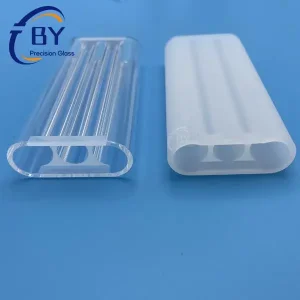
Worldwide healthcare clinics and aesthetic laser maintenance providers require dependable drop-in replacement cavities for prominent systems like Candela (GentleLase, GentleYag, VBeam, Mini GentleLase), Cynosure, and Lumenis. BY Photonics holds precision CNC tooling and diamond lapping jigs matching exact original equipment specifications. Our replacement triple-bore, dual-bore, and single-cavity ceramic blocks meet or exceed original OEM pump transfer efficiencies at substantial cost savings.
Resilient Supply Chain Architecture
Geopolitical turbulence and rare-metal volatility make gold-plating processes increasingly erratic in pricing and environmental compliance. BY Photonics controls a 100% vertically integrated Chinese manufacturing line in Tianjin: from raw sub-micron alumina powder prep, cold isostatic pressing (CIP), pre-sinter green machining, to 1,650°C atmospheric firing and 5-axis ultrasonic CNC diamond finishing. Our clients enjoy absolute pricing stability and zero raw-material choke points.
Custom Form-Factors & Monolithic Slabs
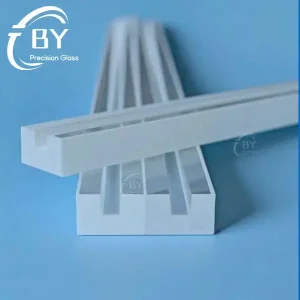
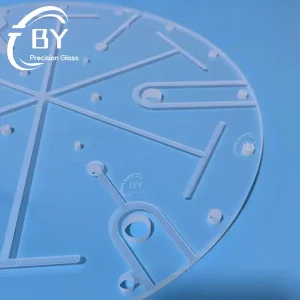
Beyond traditional cylindrical dual-bore cavities, modern diode side-pumped laser modules demand intricate rectangular, segmented, and polygonal geometries. We custom machine coolant bypass manifolds, O-ring seal grooves, thermocouple access ports, and precision locating pins directly into the ceramic monolithic body before final sintering, eliminating downstream assembly stack-up errors.
End-to-End Factory Capabilities: From Raw Alumina to Sub-Micron Precision
Combining high-pressure slip-casting, high-temperature sintering, and ultrasonic diamond tooling under one quality management system.
Slip Casting & CIP
We blend high-purity α-Al₂O₃ powder (sub-micron particle size distribution, D50 ~ 0.6 µm) with proprietary organic binders and dispersants. Components are consolidated through Cold Isostatic Pressing (CIP) at pressures exceeding 200 MPa, ensuring isotropic structural density and eliminating directional shrinkage defects during thermal processing.
Green-State CNC
Prior to full densification, pressed blanks undergo pre-sintering "biscuit" firing at 950°C to achieve optimal green strength. In this state, multi-axis high-speed CNC machining centers cut complex internal pump chambers, flow splitters, and mounting brackets with exact volumetric shrinkage allowance algorithms (typically 16.5% to 18.2% volumetric compensation).
Atmospheric Sintering
Final refractory densification occurs in computer-controlled electric kilns at 1,600°C to 1,680°C under strict oxidizing atmospheres. This multi-day soaking cycle drives uniform grain growth (2 to 5 µm crystallite sizing) while maintaining the precise micro-porosity distribution required for diffuse optical scattering, achieving a Vickers hardness over HV 1400.
Glaze & Diamond Lapping
Selective internal pump bores are glazed with low-expansion aluminosilicate frit and re-fired to achieve a vitreous, non-porous finish. Outer surfaces, reference datums, and sealing planes undergo final diamond grinding, rotary lapping, and coordinate measuring machine (CMM) dimensional verification to hold ±0.02 mm tolerances.
Localized Engineering Support & Global Compliance Assurance
Comprehensive design-for-manufacturability reviews, international standard certifications, and zero-defect quality controls.
24-Hour DFM Engineering Feedback
When you send us your CAD files (STEP, IGES, DWG, DXF, or dimensioned drawings), our senior ceramic tooling engineers perform a rigorous Design For Manufacturability (DFM) review within 24 working hours. We analyze shrinkage vectors, wall thickness ratios, stress concentration points in sharp inner corners, and glaze edge transitions to ensure high production yields and reliable field performance.
RoHS, REACH & ISO 9001 Compliance
All raw ceramic powders and low-expansion glaze compounds are certified free of toxic heavy metals, lead (Pb), cadmium (Cd), and hexavalent chromium (Cr VI). Our full production cycle adheres to RoHS Directive 2011/65/EU and EU REACH Regulation (EC 1907/2006). Production operates under a certified ISO 9001:2015 quality management infrastructure, complete with batch traceability certificates and full spectrometer test records.
Export Shock-Proof Packaging
Ceramic components possess extreme compressive strength but remain brittle when subjected to shear impacts during intercontinental freight. We utilize custom-molded high-density anti-static polyethylene foam inserts, vacuum-sealed barrier pouches to prevent atmospheric moisture absorption, and rigid reinforced wooden or composite outer shipping crates, guaranteeing 100% zero-breakage transit to North America, Europe, and Asia-Pacific destinations.
Precision Ceramic Diffusers Across Critical Industries
From dermatological surgical suites to defense target acquisition and heavy industrial laser fabrication.
Aesthetic & Dermatological Lasers
In high-intensity aesthetic laser platforms—such as 755 nm Alexandrite, 1064 nm Nd:YAG, and Intense Pulsed Light (IPL) vascular therapy devices—diffuse ceramic reflectors encase the flashlamp and crystal rod. By delivering a uniform, homogeneous pump field, our ceramic cavities prevent localized crystal hot spots, avoiding skin-treatment fluence spikes while maximizing lamp electrical-to-optical conversion efficiency.
Industrial Material Processing
High-power lamp-pumped and diode-pumped solid-state lasers used for aerospace titanium welding, deep diamond cutting, and additive laser cladding rely on high-durability ceramic cavities. Sintered alumina reflectors resist aggressive coolant erosion from high-flow turbulent DI water loops and operate continuously at high duty cycles without requiring routine maintenance shutdowns.
Aerospace, Defense & LIDAR
For military-grade rangefinders, airborne laser designators, and coherent Doppler LIDAR systems, operational stability under extreme vibrational and thermal shocks (-40°C to +85°C ambient) is critical. Ceramic pump cavities do not warp, creep, or lose alignment over time, ensuring tight beam divergence and consistent laser pulse energy across mission-critical airborne and tactical land deployments.
Technology Roadmap & Future Outlook: 2026–2035
Pioneering advancements in functionally graded laser ceramics, additive manufacturing, and spectral filtering matrices.
Functionally Graded Porosity (FGP)
Current research at BY Photonics centers on functionally graded ceramic architectures. By varying pore sizing across the component cross-section, the internal bore achieves high-density, low-porosity impermeable barriers without requiring secondary glazing frits, while the outer core maintains micro-porous optical back-scattering. This eliminates interfacial thermal expansion stress between glaze and substrate.
Ceramic Additive Manufacturing (3D Printing)
Utilizing high-resolution stereolithography (SLA) ceramic printing with sub-micron alumina resin slurries, we are developing conformal cooling channels directly integrated within the reflector walls. Conformal cooling improves thermal dissipation by up to 35%, eliminating fluid stagnation zones and allowing laser designers to increase pump drive power without risking cavitation damage.
Rare-Earth Doped Selective Absorption
To bypass separate samarium-doped flow tubes or filters, our next-generation ceramics incorporate selective rare-earth oxide dopants (e.g., Samarium, Cerium) directly into the ceramic crystal lattice. The resulting ceramic cavity reflects beneficial pump bands (700 - 900 nm) with 98% efficiency while absorbing parasitic UV and unwanted 1,064 nm amplified spontaneous emission (ASE), dramatically streamlining cavity design.
Frequently Asked Engineering & Procurement Questions
Direct answers from our ceramic materials specialists and photonic integration engineers.
What is the fundamental difference between diffuse ceramic reflectors and specular gold reflectors?
Why is internal bore glazing essential for liquid-cooled solid-state laser cavities?
What dimensional tolerances can BY Photonics maintain on custom-machined ceramic reflectors?
Can BY Photonics reproduce obsolete or legacy laser cavities from physical samples?
What is the operational service life of an alumina ceramic reflector compared to PTFE/Spectralon?
What file formats and parameters are required to receive an engineering feasibility review?
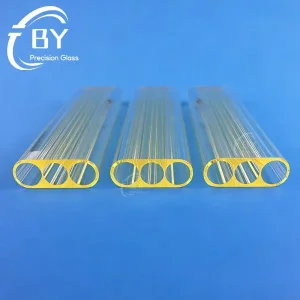
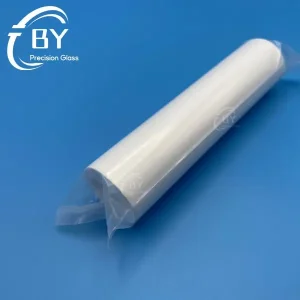
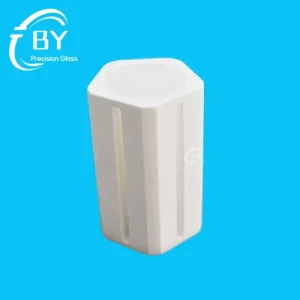
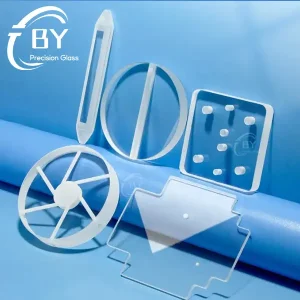
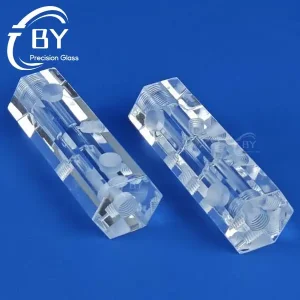
Specialized Laser Optics, Flow Tubes & Ceramic Cavities
Integrate our precision ceramic reflectors with doped filter tubes, flow plates, and micro-machined quartz substrates.

Accelerate Your Laser Cavity Development Cycle
Send your CAD models or detailed drawings directly to our engineering desk. Receive a comprehensive manufacturability assessment, glaze boundary recommendations, and volume production quotes within 24 working hours.