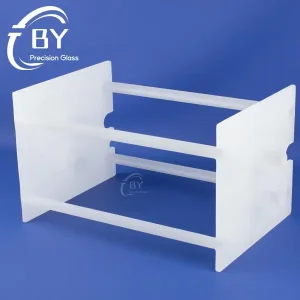
Industrial Laser & Precision Optics Showcase
Explore our specialized cerium, samarium, and sapphire-engineered flow systems built to high-energy optical tolerances.
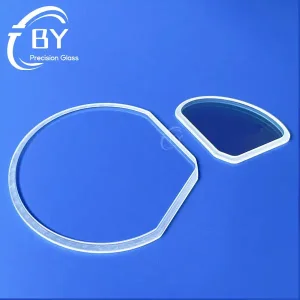
High-Quality Sapphire Viewing Plates for Harsh Chemical Environments
Explore Details →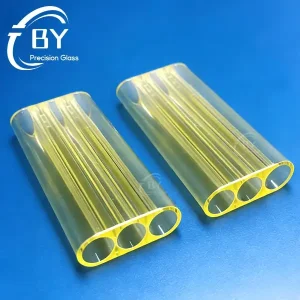
Wholesale Samarium-doped Quartz Triple Bore for Medical Laser
Explore Details →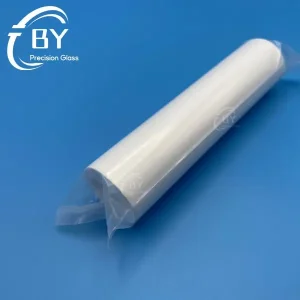
Candela VBeam Laser 6" White Cavity Ceramic Reflector 2 Pk
Explore Details →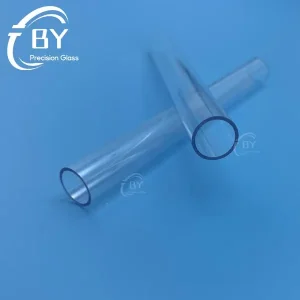
Wholesale Cerium Doped Quartz Tube Blocked UV Wavelength
Explore Details →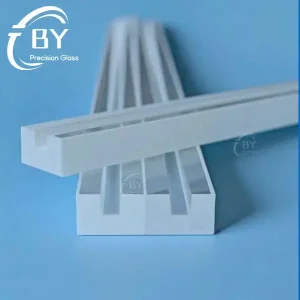
High-Quality Square Groove Quartz Substrate for Fiber Couplers
Explore Details →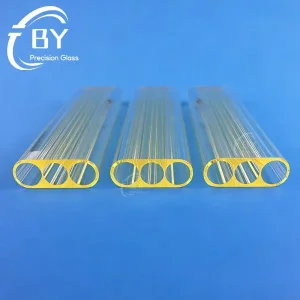
Custom Laser Cavity Flow Tubes & Filters Made from Samarium-doped Glass
Explore Details →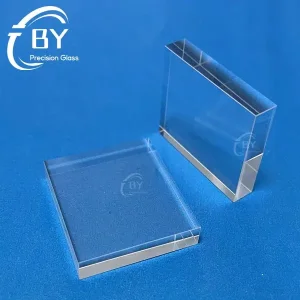
Custom Sapphire IPL Light Guide Block Used for Laser IPL Handle
Explore Details →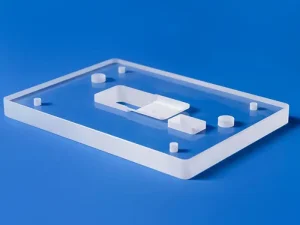
Precision Quartz Glass Machining Plate High-Quality Factory Supply
Explore Details →Global Commercial Landscape of Cerium-Doped Optical Glass
A rigorous review of rare-earth doping mechanics, market dynamics, and operational reliability in mission-critical environments.
Rare-Earth Valency Dynamics (Ce³⁺ / Ce⁴⁺)
Cerium-doped glass utilizes trivalent (Ce³⁺) and tetravalent (Ce⁴⁺) cerium states to form an extraordinarily sharp optical absorption threshold in the deep ultraviolet spectrum. The 4f-5d transitions absorb photon energy under 380–400 nm, mitigating color-center development in laser media.
Radiation Hardening & Anti-Browning
Standard synthetic silica rapidly solarizes and browns under gamma, X-ray, or intense excimer radiation via the formation of non-bridging oxygen hole centers (NBOHC). Cerium acts as a permanent electron trap, neutralizing high-energy radiolytic precursors.
Precision Laser Thermal Management
Flashlamp-pumped Nd:YAG and Alexandrite lasers face extreme thermal lens distortions caused by non-lasing UV excitation wavelengths. Cerium filter sleeves cut these bands off cleanly, suppressing thermal lensing and preventing laser crystal solarization.
Global Industrial Implementations & Work Environments
From European medical laser heads to American aerospace sensor shields and East Asian semiconductor lithography lines.
Dermatology & Surgical Laser Cavities
High-energy flashlamp medical systems (Alexandrite 755nm, Nd:YAG 1064nm, and pulsed dye lasers) deploy custom cerium-doped quartz flow tubes directly surrounding the discharge lamp. They completely arrest 200–350 nm UV emissions that degrade surrounding deionized water systems, coolant seals, and solid-state laser rods.
Radiation-Shielded Satellite Optical Windows
Outer space instrumentation encounters continuous cosmic radiation and solar UV fluxes. Cerium-doped optical glass flats function as front-facing viewports for star trackers and earth imaging lenses, retaining over 90% visible transmission over decade-long orbital lifetimes.
UV Photolithography Inspection Ports
In wafer inspection chambers where deep UV light sources operate concurrently with human-monitored vision systems, custom cerium-doped viewport filters absorb ionizing wavelengths, protecting inspection camera sensors from destructive spectral leakage.
Technical Route, Fabrication Precision & Material Roadmap
A systematic overview of furnace dopant synthesis, oxyhydrogen flame processing, and next-generation rare-earth formulations.
Phase 1: Pure Synthetic Silica Sol-Gel & Fusion Doping
Moving beyond crude oxide crucible melting, modern manufacturing integrates high-purity CeO₂ precursors during chemical vapor deposition (CVD) or sol-gel soot vitrification, achieving sub-ppm homogeneity and eliminating micro-striations.
Phase 2: Oxyhydrogen Lathe Redrawing & Precision CNC
Forming tubular filter jackets demands tight concentricity tolerances (<±0.05 mm) through computerized oxyhydrogen flame redrawing, followed by ultrasonic diamond core drilling for complex multi-bore cooling geometries.
Phase 3: Thermal Annealing & Stress Relief Profiling
To withstand extreme pulsing duty cycles (>50 J/cm² pulses), components undergo a 72-hour controlled annealing profile, ensuring zero residual birefringence and thermal shock thresholds exceeding 1000°C.
Phase 4: Multi-Rare-Earth Co-Doping (Ce + Sm + Eu)
Emerging research converges on dual- and triple-doped matrices. Co-doping cerium (for deep UV suppression) with samarium (for 1064nm parasitic amplified spontaneous emission suppression) yields all-in-one solid-state filter jackets.
Fabrication Tolerances
Every custom cerium-doped component fabricated at our facility adheres to certified metrological standards:
- Surface Quality: Down to 20-10 Scratch-Dig (MIL-PRF-13830B)
- Transmitted Wavefront Error: λ/4 to λ/10 @ 632.8 nm
- Parallelism / Wedge: ≤ 10 arcseconds
- Dimensional Tolerances: ±0.02 mm for CNC-milled parts
- Bubble & Inclusion Class: DIN ISO 10110 Grade 0/0
| Material / Doping Type | UV Cut-Off Range (λc) | Visible Transmission (T%) | Radiation Threshold | Primary Industrial Utility |
|---|---|---|---|---|
| Cerium Doped Fused Quartz (Standard) | < 380 nm | > 90% (450 - 2000 nm) | 10⁶ Rad (Co-60) | IPL handpieces, Xenon flashlamp flow tubes |
| High-Concentration Ce⁴⁺ Silicate Glass | < 400 nm | > 88% (480 - 2200 nm) | 10⁷ Rad (Co-60) | High-energy pulsed laser pump cavity sleeves |
| Ce / Sm Co-Doped Synthetic Silica | < 380 nm + 1064 nm Trap | Selective Bandpass | 10⁶ Rad (Co-60) | Nd:YAG laser suppression of ASE and parasitic modes |
| Radiation-Resistant Borosilicate (Ce) | < 350 nm | > 91% (400 - 1800 nm) | 10⁸ Rad (Gamma) | Nuclear hot-cell viewport windows, space sensors |
Integrated Turnkey Solutions for OEM Optics Integrators
Eliminate procurement bottlenecks with complete in-house mechanical, thermal, and optical manufacturing from a single source.
Direct CAD-to-Part Rapid Prototyping
We work directly with customer STEP, DWG, and IGES engineering models. Our optical engineers conduct preliminary finite element analysis (FEA) for fluidic flow, thermal boundary resistance, and clamping pressure distribution before cutting raw ingot blanks.
Hermetic Glass-to-Metal & Ceramic Sealing
For custom pump chamber manifolds, we execute precision brazing, Kovar metal transitions, and diffuse reflector bonding. This ensures leak-free operations at coolant pressures exceeding 6 bar in closed-loop laser conditioning units.
Spectral & Environmental Verification
Every production batch is certified using dual-beam spectrophotometers (190 nm – 3200 nm), laser interferometers, and thermal cycling shock testing (-40°C to +300°C), accompanied by complete DIN/ISO material compliance documentation.
Frequently Asked Questions (FAQ)
Key technical and procurement insights for sourcing cerium-doped quartz, filters, and custom optical assemblies.
What is the exact physical mechanism behind cerium-doped glass UV blocking?↓
How does cerium-doped quartz compare to samarium-doped glass?↓
Can cerium-doped glass withstand high temperatures and rapid coolant cycles?↓
What custom geometries, diameters, and tolerances can your factory manufacture?↓
What documentation is supplied with custom aerospace or medical batches?↓
Advanced Substrates, Flow Plates & Semiconductor Quartzware
Complementary precision optics, JGS1 fused silica plates, and semiconductor tooling engineered for extreme durability.
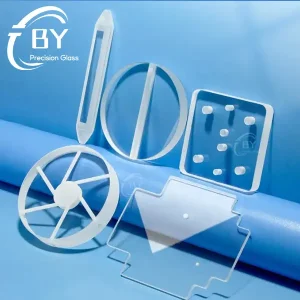
Wholesale High Temperature Custom Quartz Glass Fabrication
Explore Details →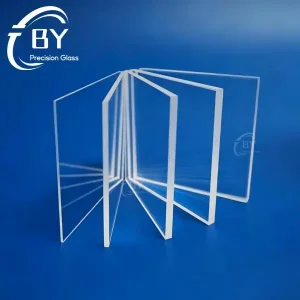
High-Quality JGS1 Ultraviolet UV Grade Fused Silica Plate
Explore Details →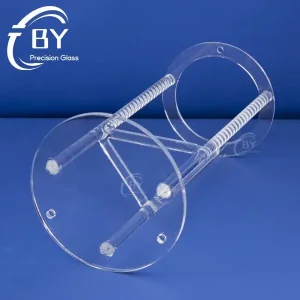
Wholesale Quartz Wafer Carriers for Semiconductor
Explore Details →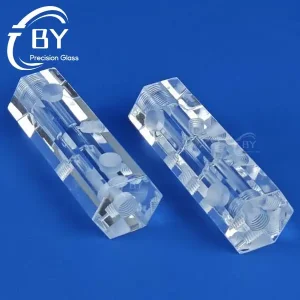
Custom Fabrication of Quartz Glass Precision Components
Explore Details →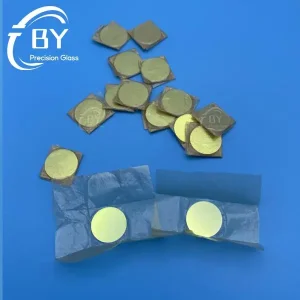
Candela Laser Distance Gauge Slider Windows (755 & 1064nm)
Explore Details →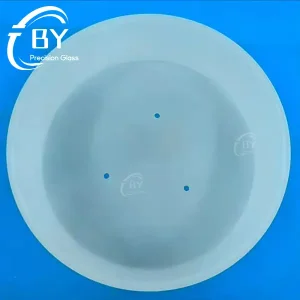
Custom Quartz Glass Components for Vacuum Coating
Explore Details →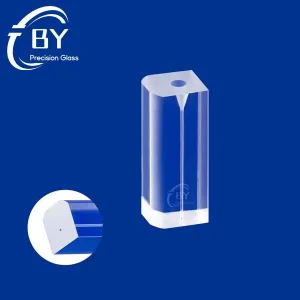
Custom Fiber Optic Glass Ferrules Supplier & Factory
Explore Details →