
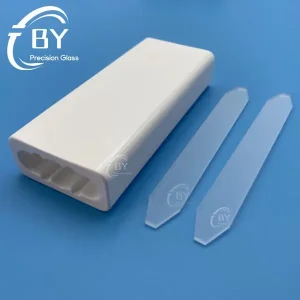
Wholesale Ceramic Cavity Reflector use for DEKA Laser Manufacturers, Supplier
View Product DetailsEngineered at our core production center in Tianjin, serving high-throughput analytical laboratories, medical laser systems, and semiconductor fabrication tools worldwide.
Wholesale Ceramic Cavity Reflector use for DEKA Laser Manufacturers, Supplier
View Product Details
High-Quality Chemical Resistant Custom Quartz Glass Parts Fabrication Supplier, Factories
View Product Details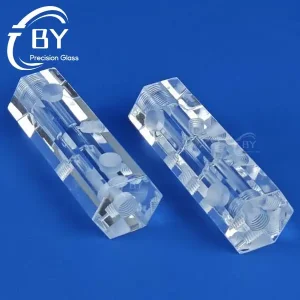
High-Quality Custom Fabrication of Quartz Glass Precision Components Supplier, Factory
View Product Details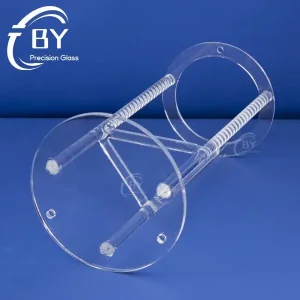
Wholesale Quartz Wafer Carriers for Semiconductor Supplier, Suppliers
View Product Details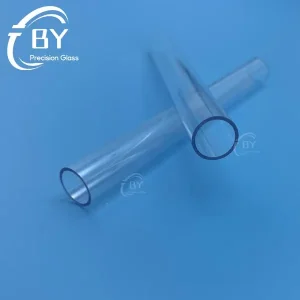
Wholesale Cerium Doped Quartz Tube Blocked UV Wavelength Manufacturer, Manufacturers
View Product Details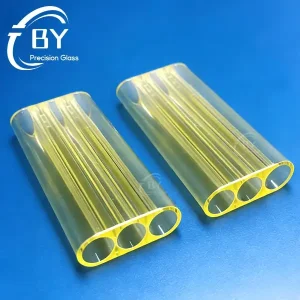
Wholesale Samarium-doped Quartz Triple Bore for Medical Laser Manufacturer, Supplier
View Product Details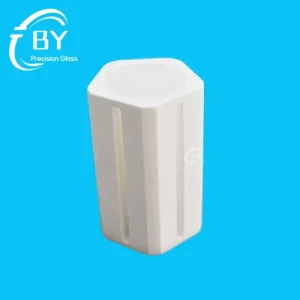
Wholesale Diffuse High‑Reflectivity PTFE Reflectors for Diode‑Pumping Chambers Suppliers, Factory
View Product Details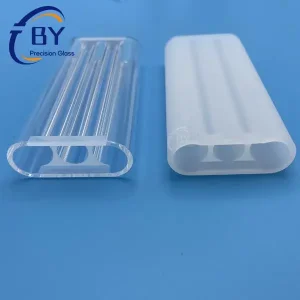
High-Quality Candela Laser Head Triple Bore Old and New Version In Stock Manufacturer, Factory
View Product DetailsIn quantitative spectrophotometry, micro-volume absorption cells, and HPLC detection arrays, the cuvette is not a passive fluid vessel—it represents the primary optical transfer standard governing spectral baseline stability, stray light rejection, and photometric linearity according to the Beer-Lambert law.
UV cut-off boundaries dictate spectral purity. We engineer our UV spectrophotometer cuvettes using synthetic JGS1 fused silica produced by chemical vapor deposition (SiCl₄), achieving near-zero bubble classification (DIN 58927 Class 0) and high optical transmission extending from deep ultraviolet (185 nm) across the NIR spectrum (2,500 nm). Unlike standard crown glass or low-grade quartz, JGS1 exhibits zero detectable solarization under prolonged 254 nm D2 lamp radiation.
Traditional multi-piece cuvettes relying on organic epoxies or low-temperature adhesives degrade upon exposure to aggressive organic solvents such as dichloromethane, acetonitrile, dimethyl sulfoxide (DMSO), and concentrated acids. BY Photonics executes high-vacuum thermal sintering (diffusion bonding) at temperatures exceeding 1,150°C. Window plates coalesce through solid-state atomic cross-diffusion, producing joint-free monoliths immune to solvent delamination.
Deviation in internal pathlength (b) proportionally corrupts absorbance values (A = εbc). Our multi-axis computerized CNC grinding and planetary double-sided chemical mechanical planarization (CMP) ensure absolute nominal pathlength accuracy within ±0.005 mm for standard 10 mm cells, and ±0.002 mm for sub-micro flow cells, maintaining wavefront distortion under λ/4 @ 632.8 nm and parallelism below 15 arcseconds.
| Substrate Material | Effective Spectral Bandwidth | Refractive Index (nd @ 589.3nm) | OH Content (PPM) | Primary Industrial / Laboratory Application |
|---|---|---|---|---|
| JGS1 Synthetic Fused Silica | 185 nm – 2,500 nm | 1.4585 | < 1,200 | UV-Vis spectroscopy, DNA/RNA purity (A260/A280), micro-spectrophotometry |
| JGS2 Optical Fused Quartz | 220 nm – 2,500 nm | 1.4584 | < 30 | Routine photometric assays, environmental wastewater analysis, laser flow cells |
| JGS3 Infrared Optical Silica | 260 nm – 3,500 nm | 1.4580 | < 5 | NIR absorption spectroscopy, organic functional group identification, Petrochem |
| Optical Borosilicate (Borofloat 33) | 350 nm – 2,000 nm | 1.4714 | N/A | Visible light (Vis) colorimetric analysis, clinical chemistry analyzers, teaching labs |
| Single-Crystal Optical Sapphire | 170 nm – 5,500 nm | 1.7680 | N/A | Extreme high-pressure HPLC flow cells, corrosive fluoride monitoring, abrasive slates |
As a dedicated optical quartz components manufacturer in Tianjin since 2010, Tianjin BY Photonics integrates raw quartz ingot refinement, computerized CNC cold processing, hot oxyhydrogen precision sealing, and robotic polishing lines in a single facility.
By establishing upstream partnerships with high-purity polysilicon chemical synthesis plants across China, we eliminate overseas raw material logistics surcharges. Every batch of synthetic quartz is verified via vacuum UV-NIR spectrophotometric scanning to eliminate hydroxyl absorption bands and heavy metal inclusion.
Our Tianjin factory operates more than 120 dedicated precision glass processing machines, including custom-tooled multi-axis ultrasonic CNC milling centers. Complex internal micro-chambers (down to 10 μL inner fluid volumes), aperture black quartz masking, and laser flow tube geometries are machined with tooling turnaround in days, not months.
Whether delivering a custom 1-piece capillary cuvette for academic synchrotron research or ramping to 50,000 serialized flow cells per quarter for multinational IVD diagnostic instrumentation, our manufacturing layout allows instantaneous tool re-indexing and rigorous statistical process control (SPC).
The analytical instruments market is experiencing rapid miniaturization and automation. Optical cuvette design must evolve alongside detector sensitivity, automated liquid handlers, and high-frequency analytical workflows.
With precious nucleic acid, protein therapeutics, and rare active pharmaceutical ingredient (API) assays, sample conservation is critical. The industry is transitioning from standard 3.5 mL cells to 10 μL, 5 μL, and sub-microliter z-shaped quartz flow cells that retain 10 mm pathlengths while drastically reducing sample consumption.
High-sensitivity HPLC UV detectors and multichannel spectrophotometers demand low stray light. We apply self-masking black quartz fusing directly around optical clear apertures, replacing surface coatings with permanent glass-matrix light absorption that never flakes or degrades in aggressive mobile phases.
Modern analytical instrumentation combines simultaneous UV-Vis absorption, steady-state fluorescence emission, and temperature-controlled Peltier blocks into a unified reading module. Cuvette architectures require four optically clear polished windows with anti-reflection (AR) thin-film coatings.
From industrial wastewater effluent monitoring to point-of-care clinical diagnostic analyzers, our custom-engineered optical cuvettes provide stable measurement platforms.
Challenge: DNA/RNA quantification at 260 nm and protein quantification at 280 nm suffer baseline drift due to solvent adhesion and UV-induced solarization.
Solution: JGS1 synthetic UV fused silica cuvettes polished to 20-10 scratch-dig, featuring hydrophobic optical chamber treatments that eliminate cross-contamination and meniscus errors.
Challenge: Industrial UV-Vis spectrometers analyzing chemical oxygen demand (COD), ammonia, and heavy metal concentrations operate continuously in harsh field environments.
Solution: Thermal-sintered fused quartz flow cells engineered with sapphire optical windows that resist abrasive suspended solids and chemical corrosion across pH 0 to 14.
Challenge: High back-pressures in HPLC and UHPLC UV detector flow cells can cause optical window ruptures and turbulent flow artifacts.
Solution: Diffusion-bonded quartz flow cells with internal fluid geometries pressure-tested up to 50 bar, engineered with parabolic flow channels that eliminate eddy currents and bubble entrapment.
Tier-1 laboratory instrument manufacturers and precision optomechanical system integrators rely on defined acceptance criteria when auditing prospective cuvette manufacturing partners.
Verify 100% spectrophotometer matching. Standard commercial matching requires cell transmission variance within ΔT < 0.5% at 200 nm, 220 nm, and 260 nm.
Audit for flame-welded or thermal diffusion molecular bonds. Rejection criteria must clearly prohibit organic adhesives for UV analytical compliance.
Demand certified MIL-PRF-13830B or ISO 10110 surface quality metrics (standard 40-20 or high-precision 20-10 scratch-dig) to eliminate background noise.
Opt for cleanroom ultrasonic deionized water cleaning and vacuum anti-static dust-proof packaging to allow direct line feeding in instrument assembly.
Comprehensive engineering clarifications addressing materials, tolerances, chemical compatibility, and customization parameters.
Explore additional high-purity quartz and sapphire fabrication capabilities engineered at our Tianjin factory for global technical applications.
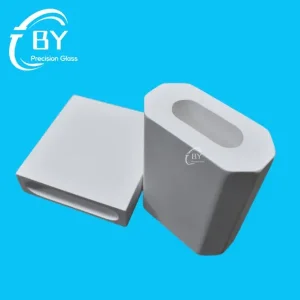
High-Quality Diffuse Reflectors Made of Spectralon‑Grade PTFE for Diode‑Pumping Chambers Manufacturer, Suppliers
View Product Details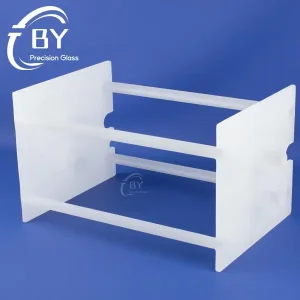
Wholesale Quartz Diffusion Boat for Semiconductor Suppliers, Factories
View Product Details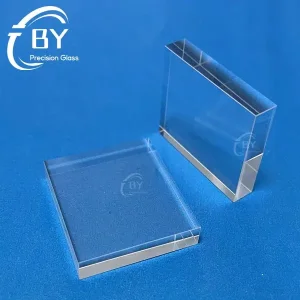
Custom Sapphire IPL Light Guide Block Used for Laser IPL Hair Removal Handle Manufacturer, Manufacturers
View Product Details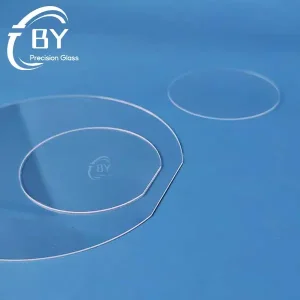
Custom Borofloat 33® Glass Wafers for Semiconductor Manufacturers, Factories
View Product Details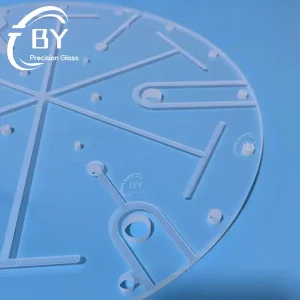
High-Quality Custom Precision Quartz Glass Fabrication Supplier, Suppliers
View Product Details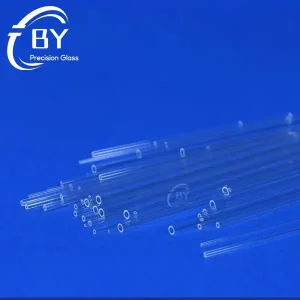
Wholesale Fluorine-Doped Fused Silica Capillary Tube Manufacturer, Factories
View Product Details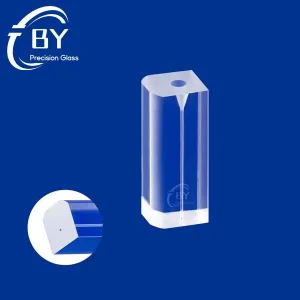
Custom Fiber Optic Glass Ferrules Supplier, Factories
View Product Details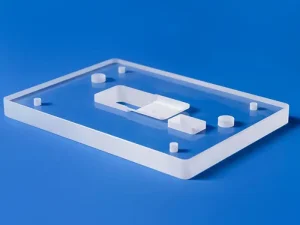
High-Quality Factory Supply Precision Quartz Glass Machining Plate Supplier, Suppliers
View Product DetailsOur optical engineering desk reviews technical drawings directly. Receive feedback on tolerance feasibility, substrate selection (JGS1, JGS2, Sapphire), chemical compatibility, and quantity-tiered pricing.