Precision Quartzware & Capillary Components Showcase
Engineered cold machining, hot-flame welding, and micro-capillary redrawing manufactured directly to drawing specifications.
-
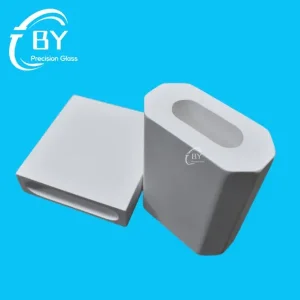
Wholesale Ceramic Cavity Reflector use for DEKA Laser Manufacturers, Supplier
-
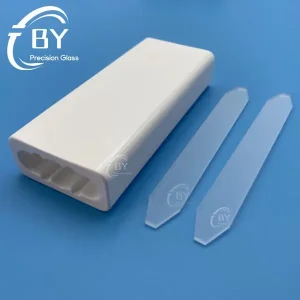
High-Quality Customized Quartz Fiber End Caps for QBH Manufacturer, Factory
-
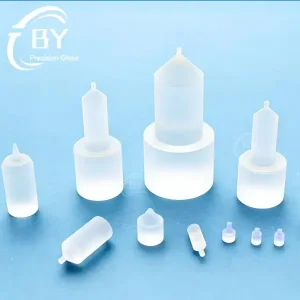
High-Quality Custom Fabrication of Quartz Glass Precision Components Supplier, Factory

-
Wholesale Cerium Doped Quartz Tube Blocked UV Wavelength Manufacturer, Manufacturers
-
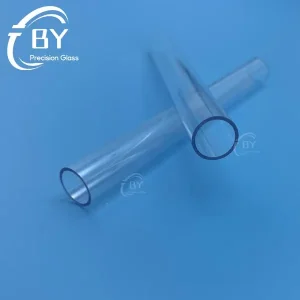
High-Quality Precision Custom Quartz Glass Components for Semiconductor Manufacturers, Supplier
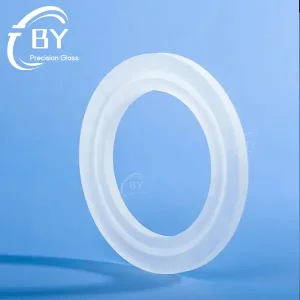
-
Custom Borofloat 33® Glass Wafers for Semiconductor Manufacturers, Factories
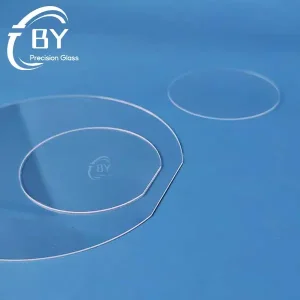
-
Custom Fiber Optic Glass Ferrules Supplier, Factories
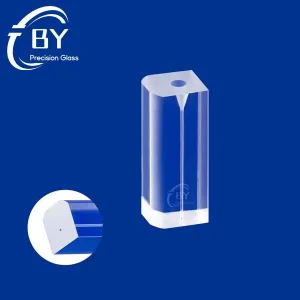
-
Wholesale Diffuse High‑Reflectivity PTFE Reflectors for Diode‑Pumping Chambers Suppliers, Factory
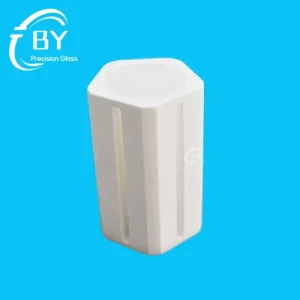
Global Enterprise Sourcing Demands & Industrial Realities
Strategic analysis of capillary redrawing and high-purity quartz rod sourcing in cutting-edge industries.
Next-Gen Semiconductor Metrology
Modern semiconductor foundries running 3nm/2nm lithography lines utilize custom synthetic fused silica capillaries within ultra-clean gas delivery, wafer edge cleaning, and chemical dispensing units. High mechanical stiffness and extreme chemical inertness prevent trace ionic contamination during aggressive etching chemistries.
- Trace element impurities controlled below ppb levels
- Sub-micron bore uniformity prevents cavitation in wet processes
- Zero chemical leachables in hydrofluoric & nitric acid arrays
High-Precision Life Sciences & CE
Capillary Electrophoresis (CE), Nano-Liquid Chromatography (nano-LC), and genomic sequencing platforms demand tight internal diameter (ID) geometries. Our drawn micro-capillaries ensure flat baseline stability, controlled electroosmotic flow (EOF), and seamless polyimide or optical coating adhesion.
- Inner diameters calibrated down to 2 µm ± 0.5 µm
- Smooth fire-polished internal surface eliminating peak tailing
- Synthetic fused silica (JGS1) with near-zero autofluorescence
Photonics & Laser Transmission Couplers
Fiber optic splices, beam delivery collets, and collimation rods require tightly toleranced fused quartz capillaries and solid rods. Precision outer diameter (OD) and inner bore concentricity ensure low insertion loss and high thermal damage thresholds under multi-kilowatt CW or pulsed laser conditions.
- Concentricity held within ≤ 1.5% of wall thickness
- Laser-grade end polishing up to 20-10 Scratch-Dig
- High damage thresholds exceeding 10 J/cm² @ 1064 nm
Material Science, Drawing Towers & Processing Routes
From preform synthesis to precision thermal redrawing: how Tianjin BY Photonics controls geometrical stability.
Preform Preparation
Initial selection of ultra-pure synthetic fused silica or natural quartz preforms. Ultrasonic chemical cleaning and fire-polishing remove surface micro-voids prior to thermal necking.
Vertical Tower Redrawing
Multi-story vertical redrawing furnaces utilize non-contact laser diameter gauges and servo feedback loops to dynamically maintain ID/OD ratios under continuous nitrogen purging.
Precision Dicing & Cleaving
Specialized diamond blade sawing or non-stress CO2 laser cleaving ensures splinter-free perpendicular end-faces with edge chips controlled within tight tolerances.
Metrology & Annealing
Polarimetric stress testing followed by high-vacuum thermal annealing guarantees complete relief of internal drawing stress, followed by automated optical bore inspection.
| Material Grade | Transmission Bandwidth | OH- Content | Thermal Expansion (CTE) | Primary Industrial Use-Case |
|---|---|---|---|---|
| JGS1 (Synthetic Silica) | 185 nm – 2,500 nm (Deep UV to NIR) | < 5 ppm to ~1200 ppm (Grade Spec) | 5.5 × 10⁻⁷ / °C | Spectroscopy flow cells, CE capillaries, excimer laser viewports |
| JGS2 (Fused Quartz) | 220 nm – 2,500 nm (Standard Optical) | < 30 ppm | 5.5 × 10⁻⁷ / °C | Semiconductor carriers, sight glasses, lamp jackets |
| JGS3 (Infrared Quartz) | 260 nm – 3,500 nm (Water-free IR) | < 5 ppm (Zero 2.73µm peak) | 5.5 × 10⁻⁷ / °C | IR pyrometry tubes, gas chromatography, high-temperature heaters |
| Fluorine-Doped Silica | Custom matched NA profile | Application specific | Controlled refractive index | Capillary cladding, specialized photonic sensors, capillary ferrules |
| Borosilicate 3.3 | 350 nm – 2,500 nm | N/A | 3.3 × 10⁻⁶ / °C | Fluidic channels, diagnostic sample tubes, economical sight gauges |
Enterprise Supply Chain Integrity & International Compliance
Addressing engineering risk management, export-grade packaging, and verifiable raw material purity.
Geometric Metrology & Interferometry
Every custom capillary batch undergoes non-contact optical micrometer verification, inner bore profilometry, and laser interferometry for surface flatness up to λ/10. Surface quality is verified against strict MIL-PRF-13830B standards.
Cleanroom Cleaning & Export Packaging
Fragile capillary tubes and micro-rods receive multi-stage ultrasonic degreasing and Class 1,000 cleanroom nitrogen purge packaging. Vacuum double-blister enclosures and custom foam suspension boxes prevent capillary breakage during international transit.
Full Chemical & RoHS/REACH Audit
Complete traceability documentation accompanies every batch: raw glass ingot batch certificates, spectrographic transmission curves, RoHS, and REACH compliance declarations, securing OEM validation for medical and aerospace supply networks.
Frequently Asked Questions on Custom Quartz Redrawing
Essential guidance for design engineers and OEM purchasing teams specifying custom tubing and rods.
What is the practical minimum ID achievable for custom capillary redrawing?
Through our precision vertical redrawing towers, we routinely produce single-bore and multi-lumen quartz capillaries with inner diameters as small as 2 µm to 10 µm, holding dimensional repeatability within ±0.5 µm for microfluidic and nano-LC instruments.
How do you guarantee concentricity between the inner bore and outer diameter?
Concentricity begins with high-precision CNC preform boring followed by controlled rotating thermal redrawing. Multi-axis online laser scanning ensures wall thickness variation does not exceed 1% to 2% of total wall thickness over long cane runs.
When should an engineer specify JGS1 over standard natural quartz (JGS2)?
Choose JGS1 (synthetic fused silica) when the application involves UV wavelengths between 185 nm and 260 nm, laser-induced damage thresholds, or where deep UV transmission and low autofluorescence are critical (e.g., DNA sequencing and excimer optics).
Can you provide custom geometric profiles, such as square or D-shape bores?
Yes. By machining preforms with custom external or internal profiles, the geometry is proportionally maintained during drawing. We manufacture square bore, rectangular, oval, and multi-bore (2 to 7+ channels) capillaries with precision symmetry.
Precision Laser Cavities, Substrates & Custom Glassware
Explore additional manufactured components supporting laser engineering, aesthetic optics, and scientific vacuum setups.
-
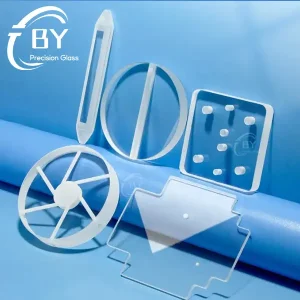
High-Quality Custom Precision Quartz Glass Fabrication Supplier, Suppliers
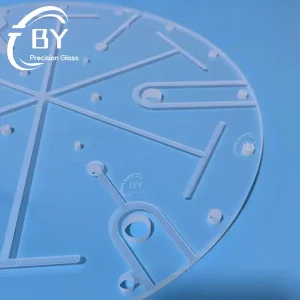
-
Custom Laser Cavity Flow Tubes & Filters Made from Samarium-doped Glass Supplier, Suppliers
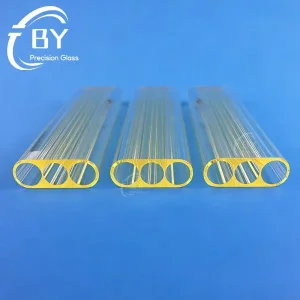
-
High-Quality Borosilicate Windows and Plates for Viewports Suppliers, Factory

-
High-Quality Candela Laser Head Triple Bore Old and New Version In Stock Manufacturer, Factory
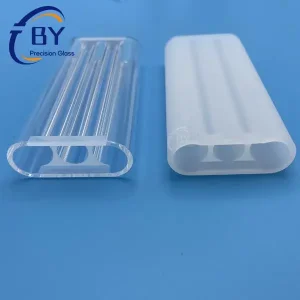
-
High-Quality Sapphire Viewing Plates for Harsh Chemical Environments Suppliers, Factories
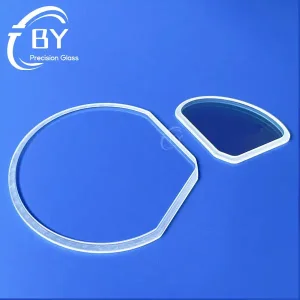
-
Wholesale Customize Quartz Cuvette for Spectrophotometer Supplier, Factory

-
Wholesale High Temperature Custom Quartz Glass Fabrication Suppliers, Factories
-
High-Quality Diffuse Reflectors Made of Spectralon‑Grade PTFE for Diode‑Pumping Chambers Manufacturer, Suppliers