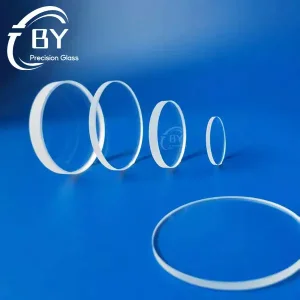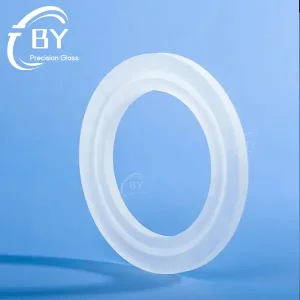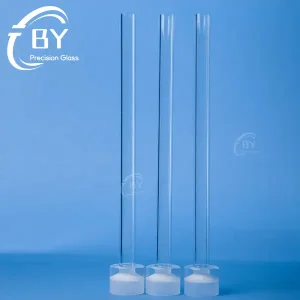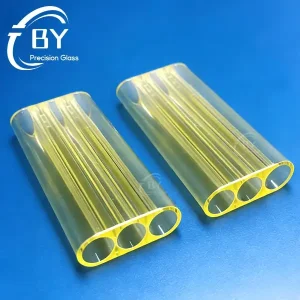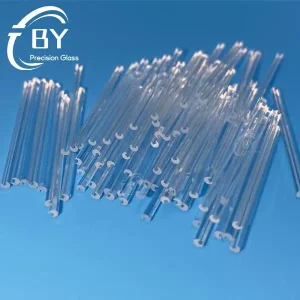
Precision Portfolio
Featured Optical & Micro-Capillary Glass Solutions
Explore high-performance quartz substrates, doped silica tubing, and custom laser flow components manufactured under stringent metrology controls in our Tianjin cleanroom facility.
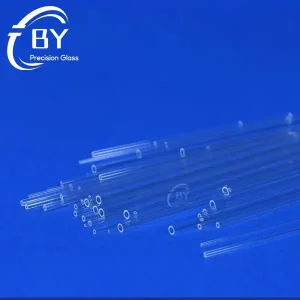
Technical White Paper
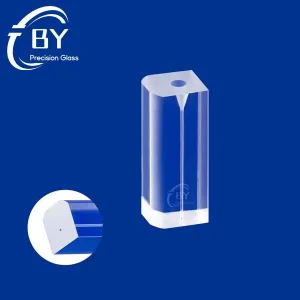
Engineering Precision Square Glass Quartz Capillary Tubes
A rigorous examination of geometric configuration, refractive index matching, oxyhydrogen thermal redrawing, and non-distorting square bore fluidics for next-generation analytical science.
Planar Optical Elimination of Lens Effect
Unlike cylindrical capillary tubes whose curved outer wall acts as a cylindrical convex lens causing severe optical aberrations and focal distortion, square quartz capillary tubes present 100% planar parallel external faces. This flat interface ensures orthogonal beam delivery without refraction distortion, elevating SNR in laser-induced fluorescence (LIF) detection.
- Planar parallel tolerance: < 0.003 mm
- Zero cylindrical aberration for laser flow inspection
- Direct orthogonal excitation and side emission detection
Synthetic Fused Silica vs Fused Quartz
We machine and redraw high-purity synthetic fused silica (JGS1 / Corning 7980 equivalent) with trace metal impurities below 1 ppm. Its near-zero bubble content and superior deep ultraviolet (DUV) transparency down to 185 nm prevent background autofluorescence, making it indispensable for single-molecule genomics and high-sensitivity HPLC detectors.
- DUV transmission > 90% @ 200 nm - 2500 nm
- OH content engineered from < 5 ppm to 1200 ppm
- Purity level exceeding 99.9999% SiO₂
Sub-Micron Dimensional Stability
Using proprietary thermal redrawing towers combined with dual-axis laser scanning micrometer feedback, our capillary tubing achieves wall thickness uniformity within ±1.5% and internal square aperture dimension tolerances down to ±0.001 mm. Square corners maintain controlled internal radii (R ≤ 0.015 mm) to eliminate laminar flow dead volume.
- Internal square profiles: 50 μm × 50 μm up to 5 mm × 5 mm
- Internal corner radius precision control: R ≤ 10 μm
- Birefringence retardation: ≤ 5 nm/cm
Supply Chain Excellence
Direct China Factory Competitiveness & Manufacturing Mastery
Combining world-class raw synthetic silica supply with specialized precision cold and hot working under one roof in Tianjin, eliminating multi-tier subcontractor overheads.
Vertical In-House Integration
From preform machining, oxyhydrogen vertical thermal drawing towers, diamond-wheel high-speed dicing, and inner ultrasonic acid cleaning to high-resolution optical inspection, all steps occur in our 3,000+ m² facility. Full vertical integration guarantees zero cross-contamination and direct batch trace documentation.
- End-face precision lapping: Flatness λ/4 @ 632.8 nm
- Scratch-Dig 20-10 optical quality on external windows
- Class 10,000 dust-free packaging rooms
Cost Efficiency & Agile Prototyping
Global instrumentation OEMs benefit from 40% to 60% procurement cost advantages without sacrificing geometric tolerances. Our dedicated engineering desk supports small-batch custom prototyping (10 to 50 pcs) within 5 working days, expediting R&D proof-of-concept before multi-thousand volume scaling.
- No costly tooling charges on standard redrawn matrices
- Custom ID/OD ratio modification in rapid 7-day turnarounds
- Direct engineering-to-engineering CAD/DFM collaboration
Stringent Metrology & Clean Packaging
Each batch is subjected to laser micrometer non-contact OD measurement, polarized strain testing for thermal annealing verification, and microscopic bore dimensional validation. Capillaries are flushed with high-purity DI water, vacuum dried, and sealed in antistatic gel boxes for safe global courier shipment.
- 100% video dimensional inspection with calibration certs
- RoHS, REACH, and purity chemical declarations
- Over 15 years export experience to North America and Europe
Quality Metrics
Engineering Limits & Metrology Specifications
Verified physical properties and tolerances delivered on square and multi-bore quartz capillaries.
±0.001mm
Bore Dimension Precision (ID)
≥92.5%
Spectral Transmission (260-1100 nm)
1100°C
Continuous Working Temperature
≤0.5nm
Surface Roughness Ra (Superpolished)
| Parameter | Standard Precision | High-Precision Grade | Ultra-Precision Laser Grade |
|---|---|---|---|
| Internal Square Bore (ID) | 0.10 mm – 10.0 mm (±0.010 mm) | 0.05 mm – 5.0 mm (±0.003 mm) | 0.02 mm – 3.0 mm (±0.001 mm) |
| External Square Profile (OD) | 0.30 mm – 15.0 mm (±0.020 mm) | 0.20 mm – 10.0 mm (±0.005 mm) | 0.10 mm – 8.0 mm (±0.002 mm) |
| Corner Internal Radius (R) | ≤ 0.05 mm | ≤ 0.025 mm | ≤ 0.010 mm (Sharp Square) |
| External Wall Surface Quality | 60-40 Scratch-Dig | 40-20 Scratch-Dig | 20-10 / 10-5 Laser Quality |
| Wall Uniformity (Concentricity) | ≤ 3.0% of nominal wall | ≤ 1.5% of nominal wall | ≤ 0.8% of nominal wall |
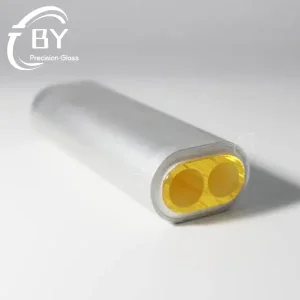
| Available Material Types | JGS2 Optical Fused Quartz | JGS1 Synthetic Silica / Corning 7980 | Fluorine-Doped / Titanium-Doped Silica |
Technological Roadmap
Emerging Trends & Macro Industry Solutions
How square micro-bore quartz architecture is solving fundamental thermodynamic and optical bottlenecks across high-growth scientific sectors.
Next-Gen Micro-Flow Cytometry & Cell Sorting
Flow cytometry demands hydrodynamic focusing where cells pass one-by-one through a laser interrogation window. Traditional round capillaries generate severe side scattering. By implementing square quartz capillary channels, fluid shear force remains consistent across parallel planar walls, enabling uniform illumination and laser excitation with zero peripheral flare.
Capillary Electrophoresis (CE) & DNA Sequencing
In capillary electrophoresis, Joule heating creates radial temperature gradients that broaden analyte bands. The high thermal conductivity of synthetic fused silica (1.4 W/m·K) paired with thin-wall square designs optimizes heat dissipation into peltier cooling jackets, delivering ultra-sharp electropherogram peaks and superior resolution in genomic screening.
Miniaturized In-Line UV/Vis Spectroscopy Cuvettes
Transitioning from static macroscopic quartz cuvettes to dynamic continuous-flow analysis requires micro-volume flow cells. Square capillary tubes function directly as micro-optical detection chambers with optical pathlengths from 0.05 mm to 2.0 mm, eliminating sample waste and bubble trapping in high-pressure microfluidic circuits.
Semiconductor Wafer-Level Optical Interconnects
In silicon photonics and micro-optic transceivers, square capillary sleeves act as precision structural alignment fixtures for fiber arrays. The square internal cavity aligns ribbon fibers with repeatable angular orientation, providing physical isolation and thermal expansion coefficients (0.54 × 10⁻⁶/°C) matched to silicon.
Procurement Engineering
Global Enterprise Buyer's Guide & Technical RFQ Criteria
A comprehensive checklist for optical engineers, procurement heads, and quality assurance officers when commissioning custom square quartz capillary profiles.
1. Geometric Configuration Protocol
Explicitly define the profile pairing: Square OD / Square ID (uniform wall thickness), Round OD / Square ID (for mechanical rotary fittings), or Square OD / Round ID. Specify critical tolerances on both the outer envelope and the internal fluidic aperture to balance cost and performance.
- State nominal wall thickness and acceptable concentricity
- Define corner radius max threshold (e.g., R ≤ 15 μm)
- Specify cut length and end-face finish (scribe cut vs optical polish)
2. Spectral & Autofluorescence Selection
For UV absorbance detectors below 240 nm or fluorescence applications excited by 266 nm or 355 nm lasers, specify JGS1 Synthetic Fused Silica to avoid native luminescence centers. For non-optical capillary fluid transport or visible-range thermal processes, economical JGS2 quartz glass delivers significant budget savings.
- State target interrogation wavelength (e.g., 214 nm, 488 nm)
- Specify maximum allowable bubble class (Class 0 / Din 58927)
- Request transmission certification spectrophotometer traces
3. Mechanical Pressure & Chemical Durability
High-pressure liquid chromatography (UHPLC) operations subject capillary walls to internal hydrostatic pressures surpassing 500 bar. Quartz offers a compressive strength of over 1,100 MPa. Calculate bursting pressure using Lamé’s thick-wall cylinder equations to specify wall thickness with a 3x safety factor.
- Define working pressure & chemical medium (acids, solvents)
- Evaluate hydrofluoric (HF) acid exposure restrictions
- Confirm flame-polished fire glaze vs mechanically lapped edges
Technical Clarifications
Frequently Asked Questions (FAQ)
Expert engineering insights regarding thermal properties, corner radiuses, and customization capabilities for custom square quartz capillaries.
Why choose a square quartz capillary tube over a traditional round quartz tube?
+
Traditional round capillary tubes behave as cylindrical lenses, refracting transverse incident light and introducing severe optical distortions, astigmatism, and background scattering. A square quartz capillary tube provides completely flat, parallel exterior and interior optical surfaces. This eliminates the lens effect entirely, allowing orthogonal laser excitation and detection in applications like flow cytometry, capillary electrophoresis, and micro-spectroscopy. Additionally, planar faces simplify mechanical mounting, alignment, and gluing without rotational displacement.
What is the tightest internal dimension tolerance your factory can maintain on square profiles?
+
Through high-precision thermal redrawing towers integrated with dynamic multi-axis laser micrometer feedback loops, we consistently maintain internal square aperture dimensions (ID) down to ±0.001 mm (±1 μm) on small bore profiles (≤ 0.50 mm × 0.50 mm) and ±0.003 mm on profiles up to 5.0 mm × 5.0 mm. Outer dimension (OD) tolerances are routinely held within ±0.002 mm to ensure precision slip-fit inside laser assemblies and ferrule sleeves.
Can the internal corners be perfectly 90 degrees sharp, or is there a radius?
+
Because quartz glass is drawn under high temperatures where surface tension naturally rounds sharp edges, a microscopic internal corner radius is physically present. However, by strictly controlling furnace thermal zones, draw speeds, and preform geometries, BY Photonics can limit the internal corner radius to R ≤ 0.010 mm – 0.015 mm for ultra-sharp microfluidic channels. This effectively minimizes hydrodynamic dead volume and prevents sample particle accumulation in cell-sorting assays.
What is the difference between JGS1, JGS2, and JGS3 quartz when applied to capillary tubing?
+
JGS1 is synthetic fused silica made from silicon tetrachloride vapor deposition. It offers superior optical transmission across the deep UV spectrum (185 – 2500 nm) and has near-zero bubble density and no bubble inclusions, making it essential for UV lasers and fluorescence detectors. JGS2 is optical fused quartz manufactured from natural quartz crystals; it transmits well in the visible and near-IR regions (220 – 2500 nm) and is the cost-effective choice for standard fluidic and thermal applications. JGS3 is infrared-grade fused quartz with ultra-low hydroxyl (OH ≤ 5 ppm) content, preventing strong OH absorption bands at 2.73 μm and allowing transmission up to 3500 nm for mid-IR applications.
Can you supply custom end-face preparation such as optical polishing or chamfering?
+
Yes. Beyond standard diamond scribe snap-cutting, we provide flat mechanical optical polishing on capillary end faces (achieving surface roughness Ra < 1 nm and perpendicularity within ±0.5°), fire-polished rounded safety ends, funnel-shaped capillary inlet flares, and precision micro-chamfers to facilitate easy insertion of optical fibers or fluidic tubing without chipping.
Complete Component Spectrum
Specialized Machined Quartzware & Optical Glass Assemblies
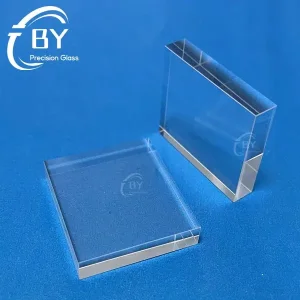
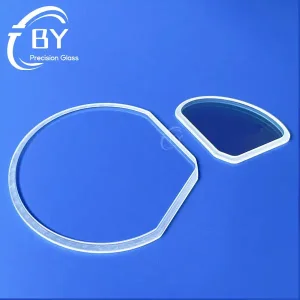
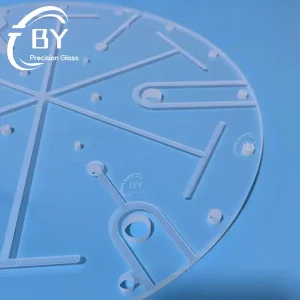
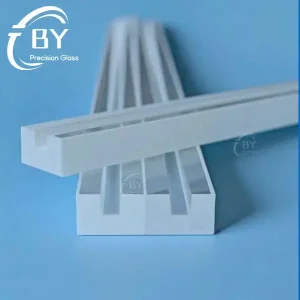
Review additional precision engineered components manufactured to CAD specifications for aerospace, semiconductor lithography, and medical laser platforms.