
Standard & Custom Fabricated Quartz Components
Explore our integrated optical manufacturing solutions ranging from synthetic UV fused silica substrates to laser cavity flow components.
-
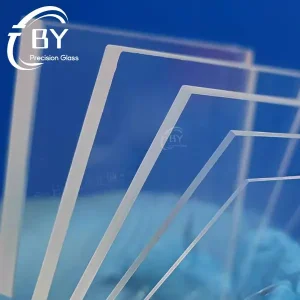
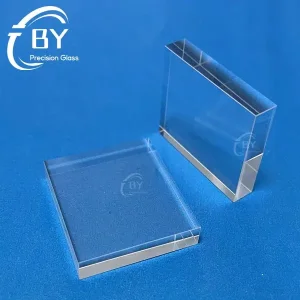
High-Quality Borosilicate Windows and Plates for Viewports Suppliers, Factory
-
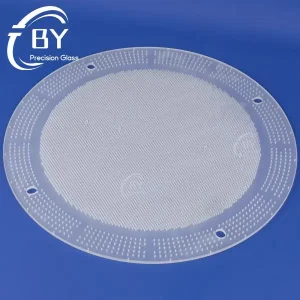
Custom Custom Optical Quartz Gas Distribution Plate Manufacturer, Suppliers
-
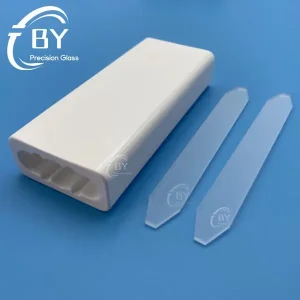
Wholesale Ceramic Cavity Reflector use for DEKA Laser Manufacturers, Supplier
-
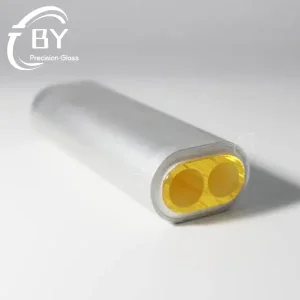
Custom Packed Laser Cavity Flowtubes for Laser Head Manufacturers, Suppliers
-
-
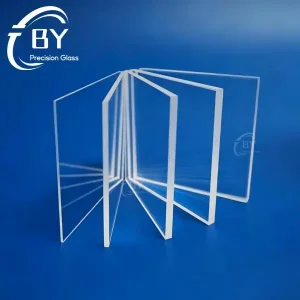
High-Quality JGS1 UItraviolet (UV) Grade Fused Silica Plate Supplier, Factory
-
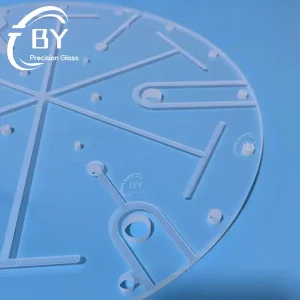
High-Quality Custom Precision Quartz Glass Fabrication Supplier, Suppliers
-
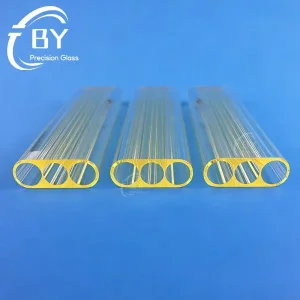
Custom Laser Cavity Flow Tubes & Filters Made from Samarium-doped Glass Supplier, Suppliers
Precision Quartz Capillary Redrawing: Engineering Tolerances, Rheology & Material Purity
A comprehensive examination of thermodynamic drawing parameters, synthetic silica classifications, and structural integrity for advanced fluidic and photonics systems.
1. Fundamentals of Precision Capillary Redrawing
Quartz glass capillary tubes represent the pinnacle of vitreous silica engineering. Unlike standard glass fabrication, capillary tubes require an ultra-controlled thermal environment to soften mother preforms without inducing structural devitrification or inner bore collapse. Operating in state-of-the-art vertical draw towers, our facility utilizes proprietary closed-loop optical micrometer control combined with constant gas pressure balancing to draw capillary channels down to inner diameters (ID) as fine as 5 microns, while maintaining outer diameter (OD) concentricity within <1.5%.
The core thermo-mechanical challenge during capillary pulling is managing the viscosity transition of pure fused quartz ($10^{7.6}$ Poise at the softening point of ~1,680°C). By leveraging oxyhydrogen thermal zones and carbon-free induction furnaces, we eliminate microscopic bubble formation (seeds) and minimize hydroxyl ion ($OH^-$) re-absorption. The result is an ultra-smooth internal lumen surface with a typical roughness profile of $Ra < 0.5\text{ nm}$, which prevents analyte adsorption in high-resolution analytical chromatography.
2. Material Comparison: Synthetic Fused Silica (JGS1) vs. Fused Quartz (JGS2/JGS3) vs. Borosilicate
Selecting the precise glass material dictates chemical inertia, UV-VIS cut-offs, refractive indexes, and thermal shock thresholds. The table below outlines empirical performance variables crucial for optical and fluidic instrumentation engineers:
| Property Parameter | Synthetic Fused Silica (JGS1) | Optical Fused Quartz (JGS2) | IR Fused Quartz (JGS3) | Borosilicate Glass 3.3 |
|---|---|---|---|---|
| SiO2 Purity (%) | ≥ 99.9999% (Electronic Grade) | ≥ 99.99% | ≥ 99.995% | ~ 81% (with B2O3, Na2O) |
| Spectral Window | 185 nm – 2,500 nm (Deep UV) | 220 nm – 2,500 nm | 260 nm – 3,500 nm (No OH band) | 350 nm – 2,500 nm |
| OH Content (ppm) | < 5 to ~ 1,200 (Customizable) | 30 – 150 | < 5 (Ultra-dry) | N/A |
| Coefficient of Thermal Exp. (CTE) | $5.5 \times 10^{-7} / \text{K}$ | $5.5 \times 10^{-7} / \text{K}$ | $5.4 \times 10^{-7} / \text{K}$ | $3.3 \times 10^{-6} / \text{K}$ |
| Dielectric Strength (kV/mm at 20°C) | 25 – 40 | 25 – 35 | 25 – 40 | 15 – 20 |
| Primary Application Spectrum | Capillary Electrophoresis, DUV Optics | Sight Flowtubes, Analytical Probes | Infrared Pyrometry, CO2 Lasers | Standard Medical Fluidics, TLC |
China Factory Supply Chain Advantages for Global OEMs
How vertically integrated domestic refining, precision cold-and-hot processing, and high-volume scalability drive cost-efficiency and delivery reliability.
Full Upstream-to-Downstream Control
By coupling raw silicon tetrachloride ($SiCl_4$) gas synthesis and natural crystal feedstock processing directly with CNC cold cutting, multi-axis profile grinding, and redrawing operations in Tianjin, we eliminate sub-tier contractor markups and maintain complete material lot traceability.
Rapid Tooling & Iterative Prototyping
Our dedicated R&D engineering cells convert custom client CAD prints (STEP, IGES, DXF) into manufactured samples within 3 to 5 business days. We bridge the gap between initial low-volume prototyping and multi-thousand kilometer rollouts without re-tooling delays.
Economies of Scale & Yield Optimization
High-capacity drawing towers running 24/7 allow automated thermal compensation and continuous diameter feedback. This automation reduces yield loss down to under 2.8%, passing significant raw material and energy savings directly to international procurement teams.
Localized Support & Regulatory Framework Compliance
Ensuring frictionless international trade, documented cleanroom cleaning, and compliance with strict environmental and medical standards.
RoHS, REACH & Biocompatibility (USP Class VI)
Every batch of fused quartz and synthetic silica capillary tubing undergoes stringent ICP-MS elemental analysis to certify non-leachability. Our capillaries comply with EU RoHS Directives 2011/65/EU, REACH regulations (EC 1907/2006), and meet inert biological profile criteria for in-vitro medical fluid routing.
Cleanroom Cleaning & Static-Neutral Vacuum Packaging
Precision micro-capillaries are vulnerable to particulate blockage. We operate Class 1,000 (ISO 6) ultrasonic washing stations followed by multi-stage ultra-pure deionized (DI) water cascading and nitrogen drying. Parts are encapsulated in cleanroom-grade antistatic packaging to guarantee zero lint ingress.
Direct Engineering-to-Engineering Integration
Global clients eliminate technical miscommunications by working directly with our optical and mechanical engineering desks. We provide tolerance-stack analyses, polyimide/aluminum protective coating specifications, and customized bevel-end or cleaving parameters prior to pilot sign-off.
Emerging Market Trends & Localized Application Scenarios
How next-generation biomedical sensing, micro-flow chemical reactors, and telecommunication photonics are driving capillary design.
Genomic Sequencing & Microchip Electrophoresis
Sanger and next-generation sequencing (NGS) depend on arrayed capillary bundles for fast DNA fragment migration. The extreme optical transparency of synthetic silica allows zero background fluorescence during automated laser-induced fluorescence (LIF) scanning.
Continuous Flow Micro-Reactors & Lab-on-a-Chip
Micro-volume synthetic chemistry requires channels capable of handling hyper-exothermic reactions, aggressive fuming acids, and operating pressures reaching 500 bar. Quartz capillaries deliver complete corrosion resistance without swelling or metal leaching.
Fiber Optic Ferrules & Multi-Bore Collimation
As 800G and 1.6T datacom interconnects demand precise physical core-to-core alignment, multi-bore (2-hole, 4-hole, 7-hole, and custom hexagonal) fused silica capillaries provide matching thermal expansion properties to glass fibers, preventing thermal drift over industrial temperature ranges.
Frequently Asked Questions (FAQ)
Direct technical answers addressing dimensioning, bursting pressures, thermal annealing, and custom fabrication inquiries.
What are the minimum and maximum dimensions possible for custom quartz capillary tubes?
How do you calculate bursting pressure ratings for high-pressure fluidic capillaries?
What protective coatings are available to mitigate brittle glass fracture?
What quality assurance documentation accompany standard export shipments?
Can capillary end-faces be custom-machined or modified post-drawing?
Engineered Quartz & Optical System Solutions
Review our specialized laser cavities, semiconductor ware, and ultra-high-purity quartz tubing configurations.
-
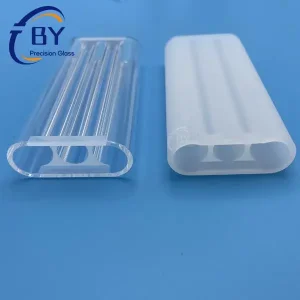
High-Quality Candela Laser Head Triple Bore Old and New Version In Stock Manufacturer, Factory
-
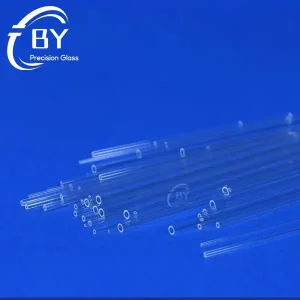
Wholesale Fluorine-Doped Fused Silica Capillary Tube Manufacturer, Factories
-
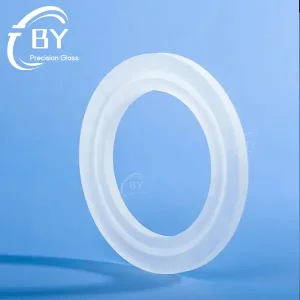
High-Quality Precision Custom Quartz Glass Components for Semiconductor Manufacturers, Supplier
-
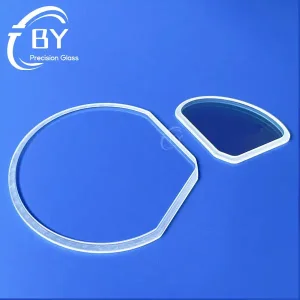
High-Quality Sapphire Viewing Plates for Harsh Chemical Environments Suppliers, Factories
-
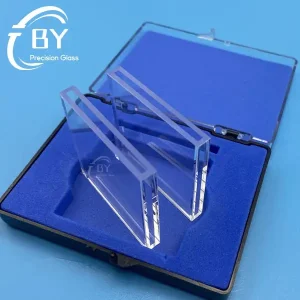
Wholesale Customize Quartz Cuvette for Spectrophotometer Supplier, Factory
-
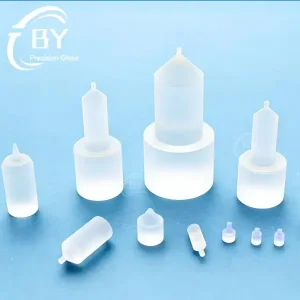
High-Quality Customized Quartz Fiber End Caps for QBH Manufacturer, Factory
-
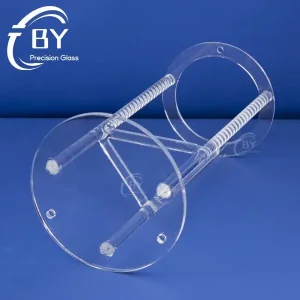
Wholesale Quartz Wafer Carriers for Semiconductor Supplier, Suppliers
-
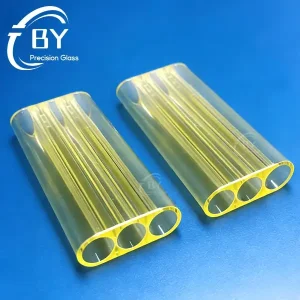
Wholesale Samarium-doped Quartz Triple Bore for Medical Laser Manufacturer, Supplier