Featured Optical & Quartz Solutions
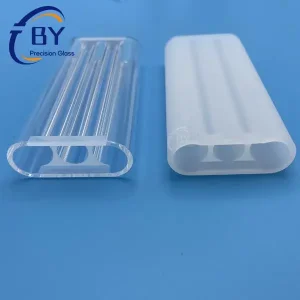
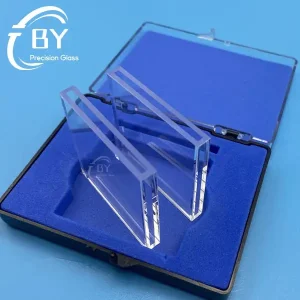
Standard & Custom Synthesized Quartz Glass Ware
Precision components engineered from optical-grade JGS1, JGS2, and JGS3 raw fused silica matrices, delivering thermal shock resilience and exact dimensional stability.
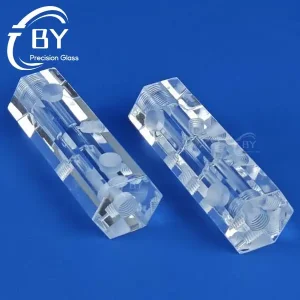
Custom Fabrication Quartz Glass Precision Components
View Product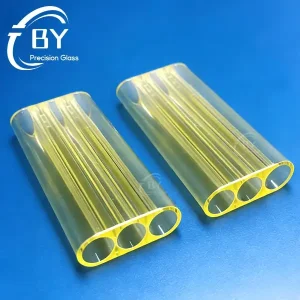
Samarium-doped Quartz Triple Bore for Medical Laser
View Product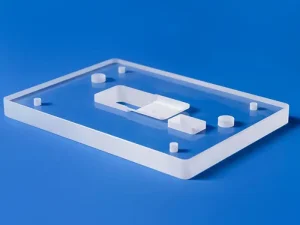
Precision Quartz Glass Machining Substrate Plate
View Product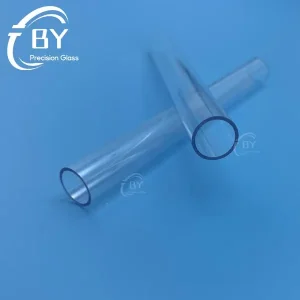
Cerium Doped Quartz Tube Blocked UV Wavelength
View Product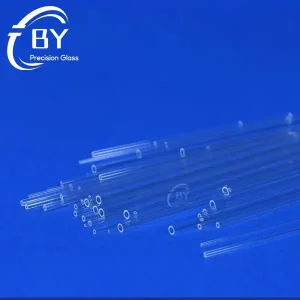
Fluorine-Doped Fused Silica Capillary Precision Tube
View Product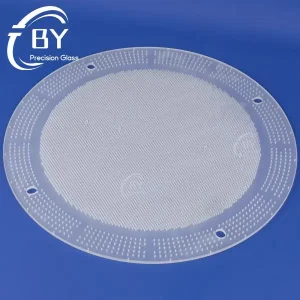
Optical Quartz Gas Distribution Showerhead Plate
View Product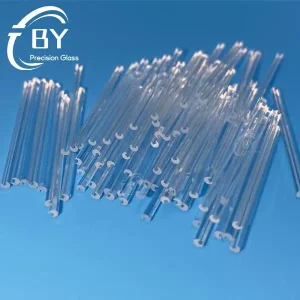
Quartz Substrate Groove For Optical Fiber Coupler
View Product
Industrial Metrology & Market Landscape
The Commercial Realities of Quartz Glass Coil Tubes
A deep dive into why helical quartz tube designs dominate extreme thermal exchange, severe acid digestion, and high-frequency induction heating.
Thermal Shock Immunity
Fused silica coils feature a virtually negligible coefficient of thermal expansion (α ≈ 5.5 × 10⁻⁷ /°C). Unlike borosilicate glass which risks micro-fissuring above 450°C, synthetic quartz coils operate continuously up to 1150°C and handle instantaneous delta drops of over 1000°C without catastrophic structural fatigue.
- Softening Point: 1680°C
- Annealing Point: 1210°C
- Zero structural warping under cyclic cooling
Total Chemical Inertness
Fabricated from ultra-pure silicon dioxide (SiO₂ ≥ 99.998%), our quartz coil tubes show total resistance against virtually all mineral acids including boiling aqua regia, nitric acid, and sulfuric acid at concentration. Contamination vectors such as iron, copper, and alkali ions are strictly locked below parts-per-billion levels.
- Resistant to Halogens and Ozone
- No leaching into ultrapure deionized water
- Exceptional corrosion boundary integrity
Optical Energy Coupling
When deployed within photochemical reactors and photochemical UV-oxidation processes, quartz spiral exchangers exhibit broadband transmissive characteristics ranging from deep ultraviolet (185 nm) to the mid-infrared spectrum (3500 nm), optimizing photon coupling efficiency without thermal absorption losses.
- UV Transmission ≥ 90% @ 254 nm
- Low internal bubble content (Class 0/1)
- Minimal stray light scatter
Material Metrology & Processing Standards
Manufacturing Benchmarks: JGS1 vs. JGS2 vs. JGS3 Coil Tubing
Precision oxyhydrogen hot-lathe shaping demands strict adherence to thermal profiles and raw ingot selection. Compare the technical boundaries governing our manufacturing line below.
| Material Classification | SiO₂ Purity (%) | Transmittance Band | OH Radical Residue | Max Working Temp | Target Industrial Application |
|---|---|---|---|---|---|
| JGS1 (Synthetic Fused Silica) | > 99.999% | 185 nm – 2500 nm | ≤ 5 ppm | 1200 °C | Semiconductor Photochemistry, Deep-UV Reactor Coils |
| JGS2 (Optical Grade Quartz) | > 99.995% | 220 nm – 2500 nm | ≤ 30 ppm | 1150 °C | High-temp Acid Exchangers, Industrial Vis-Spectrometry |
| JGS3 (Infrared Fused Quartz) | > 99.992% | 260 nm – 3500 nm | ≤ 2 ppm | 1100 °C | Semiconductor Rapid Thermal Processing (RTP) Heater Coils |
| Ce-Doped Solarized Quartz | > 99.985% | 380 nm – 2500 nm | Variable | 1100 °C | Laser Flash Lamp Cooling, Yellow Selective Flow Condensers |
| Standard Borosilicate (Contrast) | ∼ 81% | 350 nm – 2000 nm | N/A | 450 °C | General Laboratory Condensers, Non-Critical Cooling |
Multi-Sector Integration
Mission-Critical Deployment Scenarios
Our helical quartz structures solve severe operational bottlenecks across high-reliability systems worldwide.
Semiconductor Wet Benches
Critical in recirculating heating loops for RCA clean and piranha etch chemistries (H₂SO₄ + H₂O₂), where metal heaters leach contaminants and polymer coils fail under aggressive thermal gradients.
Photochemical Flow Reactors
Continuous-flow microreactors wrapped tightly around central UV emission sources. The coiled morphology ensures optimized residence times, laminar fluid dynamics, and near-100% photon capture.
Induction & RF Plasma Torches
High-voltage dielectric coils serving as RF insulation tubes and coolants for Inductively Coupled Plasma Mass Spectrometry (ICP-MS) and semiconductor plasma atomic layer deposition systems.
Laser Resonator Heat Sinks
High-duty solid-state laser heads rely on precision quartz coils to route coolant around flashlamps and Nd:YAG crystals without introducing thermal lensing or parasitic optical feedback.
Next-Generation Synthesis
Future Outlook & Technological Roadmap (2026–2030)
Anticipating the stringent demands of sub-2nm semiconductor fabrication nodes and high-yield continuous chemical synthesis.
01
Micro-Channel Redrawing
Transitioning from manual oxyhydrogen coil bending to automated CNC thermal draw towers capable of ±0.01 mm inner diameter concentricity across sub-millimeter quartz capillaries.
02
Atomic Hydroxyl Depletion
Implementing vacuum-assisted secondary annealing to drive OH radical presence below 0.5 ppm, preventing infrared optical attenuation in RTP systems exceeding 1300°C.
03
Direct Laser-Fused Quartzware
Integration of CO₂ laser sintering for seamless joining of coiled capillaries to manifolds, completely eliminating micro-bubbles and structural stress risers typical of torch welding.
04
In-Situ Sensor Embedded Coils
Developing vapor-deposited thin-film platinum RTD sensors bonded directly to fused quartz coil walls for non-invasive, millisecond-response internal fluid thermometry.
Holistic Systems Architecture
Enterprise OEM Delivery & Process Integration
BY Photonics engineers eliminate production hurdles by providing integrated design-for-manufacture (DFM) support and full lifecycle optical qualification.
FEA Thermal Strain Modeling
Before igniting the torch, our engineering team executes finite element analysis (FEA) simulating fluid shear dynamics and localized thermal expansion, optimizing coil pitch and wall thickness for custom flowrates.
Stress-Free Polariscopic Inspection
Every hot-worked quartz coil undergoes automated multi-stage thermal annealing cycles to relieve internal molecular stress. Parts are 100% verified using cross-polarized shadowgraphy to prevent field fractures.
Cleanroom Final Passivation
Coil assemblies are etched with ultra-pure hydrofluoric acid solutions to strip exterior particulate debris, rinsed in 18.2 MΩ·cm DI water, and vacuum-sealed in Class 1000 cleanroom environments ready for fab deployment.
Technical Verification
Frequently Asked Questions: Quartz Coil Tube Sourcing
Clear engineering answers addressing geometry specifications, material purities, and international dispatch safety.
What tolerances can be maintained on coiled quartz outer diameters and pitch?
On automated hot-lathe forming stations, we routinely control overall coil outer diameter (OD) within ±0.5 mm, internal helix pitch within ±0.3 mm, and wall thickness variance within ±5% across the entire active spiral profile.
Can quartz coil tubes handle high-pressure fluid circulating systems?
Yes. Burst pressure is directly correlated to tube outer-to-inner diameter ratios and helix curvature. Heavy-wall fused silica coils with 1.5mm–2.5mm walls typically withstand operational hydraulic pressures between 10 bar and 25 bar safely.
How do you prevent fragile helical tubes from breaking during international shipping?
Every coil tube is custom-fitted into CNC-machined high-density cross-linked polyethylene (EPE) foam cradles that isolate each individual spiral loop. These are enclosed within multi-layer shockproof export cartons or reinforced plywood crates with impact indicators.
Can you attach customized flange connections or ball-and-socket glass joints?
Absolutely. We weld standardized optical quartz KF/NW flanges, ISO-KF fittings, GL threaded glass connectors, standard taper ground joints, or smooth capillary ends directly to the spiral leads per your engineering drawing.
Laser Optics & Advanced Ceramic Cavities
Expanded Optical Subsystems & Flow Components
Comprehensive laser cavity tubes, diffuse reflectors, and extreme-environment viewports supporting high-power photonic devices.
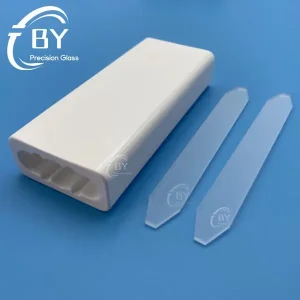
Ceramic Cavity Reflector For DEKA Laser Systems
View Product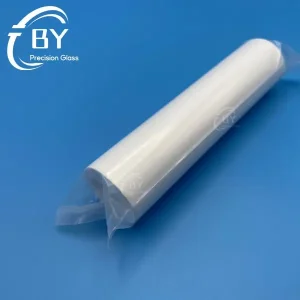
Candela VBeam Laser White Cavity Ceramic Reflector
View Product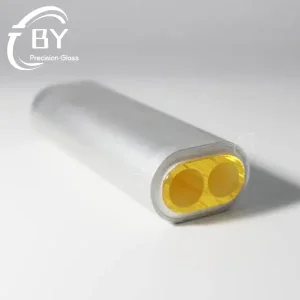
Custom Packed Laser Cavity Flowtubes For Laser Head
View Product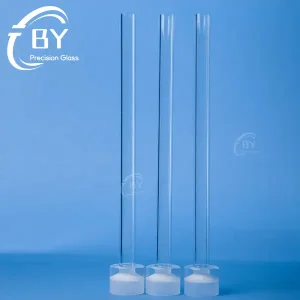
Chemical Resistant Custom Quartz Glass Parts
View Product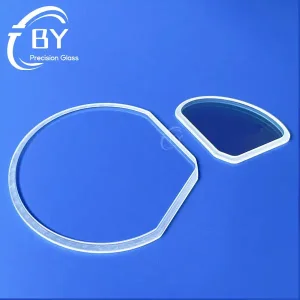
Sapphire Viewing Plates For Harsh Environments
View Product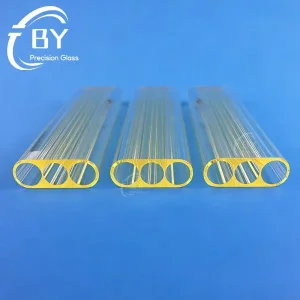
Samarium-Doped Glass Laser Cavity Flow Tubes & Filters
View Product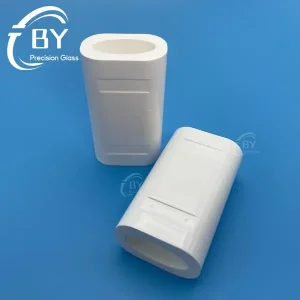
Ceramic Pumping Cavities For Nd:YAG Laser Heads
View Product