
Precision Substrates, Capillaries & Laser Cavity Components
Explore our hot-worked and CNC-machined quartzware engineered with trace metallic impurities < 20 ppm and thermal expansion down to 5.5 × 10⁻⁷/°C.
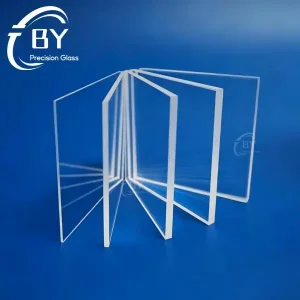
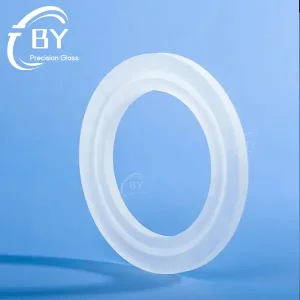
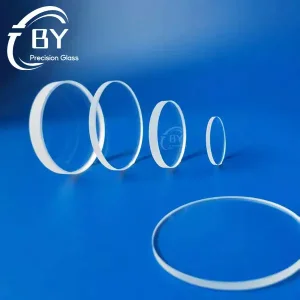

Global Enterprise Sourcing Architecture for Laboratory Quartzware
Industrial procurement workflows require granular metallurgical and spectroscopic compliance. Sourcing high-purity quartz apparatus demands direct mitigation of thermal mechanical fatigue, devitrification risks, and chemical leachables.
Thermal Shock & Devitrification Shielding
Standard borosilicate glass fails catastrophically under extreme temperature differentials. Our fused quartz components maintain an extraordinarily low thermal expansion coefficient (5.5 × 10⁻⁷/°C), withstanding rapid quenching from 1,100 °C into cold water without structural compromise or crystallization.
Spectroscopic Transmission Integrity
Analytical accuracy hinges upon minimal photonic absorption. Sourcing JGS1 synthetic fused silica guarantees > 90% internal transmittance down to 185 nm in deep UV bands, eliminating fluorescence interference in ICP-MS analysis, HPLC detection cells, and laser spectroscopic windows.
Zero-Contamination Leachable Profiles
In semiconductor diffusion and biopharmaceutical reaction vessels, alkali element leaching (Na, K, Li) causes severe product contamination. Our oxyhydrogen fire-polished quartz containers undergo rigorous acid passivation to ensure heavy metal extractables stay strictly below trace ppb thresholds.
Macro Industry Applications & Material Grade Solutions
Review the correlation between laboratory quartzware specifications and mission-critical manufacturing operations across leading industrial sectors.
| Industrial Domain | Operational Challenge | Material Specification | Performance Benchmark |
|---|---|---|---|
| Semiconductor & Photovoltaics | Extreme plasma etching erosion, thermal stress during chemical vapor deposition (CVD), and wafer cassette warping. | High-purity fused quartz (JGS2), electrical fusion grades. Trace alkali < 8 ppm | Continuous operation at 1,150 °C; resistance to HF vapor; zero wafer slot pitch drift. |
| Analytical & Medical Optics | Signal attenuation in UV-Vis spectrophotometry; cuvette degradation in high-intensity laser flow chambers. | Synthetic fused silica (JGS1), samarium-doped optical glass. Deep UV 185–2500 nm | Surface quality 20-10 Scratch-Dig; λ/10 transmission wavefront distortion; 1064 nm parasite absorption. |
| Biopharma & High-Purity Chemistry | Corrosive acid refluxing, autoclaving thermal cycling, and leachables compromising active pharmaceutical ingredients (APIs). | Fire-worked fused silica and borosilicate capillary blends. Class 1 Hydrolytic Resistance | Hydrolytic attack resistance according to ISO 719 Class HGB 1; inert across all acids except HF/hot H₃PO₄. |
| Industrial Laser & High-Temp Furnaces | Localized thermal distortion in flashlamp pumped laser heads; rapid devitrification in oxidizing environments. | Doped quartz flowtubes, sintered diffuse PTFE, laser ceramics. Peak Reflectance > 99% | Enhanced thermal dissipation; UV solarization resistance; lifetime exceeding 15,000 laser hours. |
Advanced Manufacturing Techniques & Industry Trajectory
The progression of nanotechnology and microfluidics requires laboratory glassware manufacturing to evolve beyond conventional blowing into sub-micron machining and hybrid sintering.
5-Axis Ultrasonic CNC
Micro-machining hard, brittle quartz crystals without subsurface micro-fracturing. Ultrasonic-assisted milling reduces cutting forces by up to 40%, yielding pristine edges for microfluidic chips.
Laser-Assisted Flame Welding
Transitioning from traditional manual oxyhydrogen blowtorches to computer-guided laser fusion. Eliminates uneven wall thickness, eliminates internal stress, and prevents micro-bubble formation.
Fluorine & Rare-Earth Doping
Custom chemical alteration of fused quartz matrices. Doping with fluorine tailors refractive index distributions, while samarium and cerium absorb destructive stray UV emissions in laser flow cavities.
Ultra-Precision Redrawing
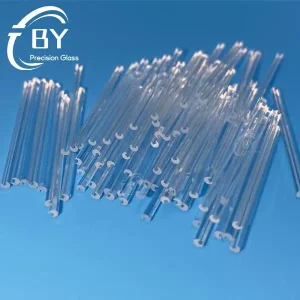
Continuous-draw multi-bore capillaries engineered with concentricity tolerances below ± 0.002 mm, satisfying strict tolerances for photonic alignment sleeves and single-cell cytometry.
International Regulatory Compliance & Factory Verification
Ensuring end-to-end traceability from raw sand refining to cleanroom vacuum packaging across all major regulatory zones.
Material Traceability Certificates
Every delivery batch includes full batch spectrometry documentation confirming metallic impurities (Fe, Al, Ti, Ca, Mg) under 20 ppm, ensuring validation integrity for semiconductor fabs and pharmaceutical cleanrooms.
Cleanroom Export Packaging
All fabricated quartzware undergoes ultra-pure DI water ultrasonic cleaning, followed by cleanroom double-vacuum bagging and custom multi-layer foam packaging to avoid transit shock and electrostatic particulate adhesion.
Global Standards Concordance
Fabrication tolerances and thermal ratings conform to ASTM E438 Type I Class A, DIN ISO 3585, and SEMI guidelines, guaranteeing standard fitment with European, American, and Asian laboratory setups.
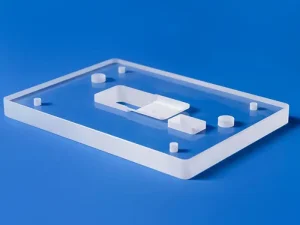
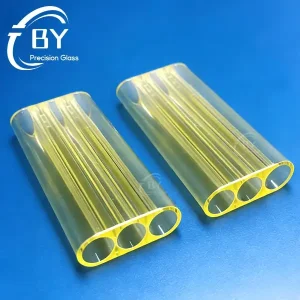
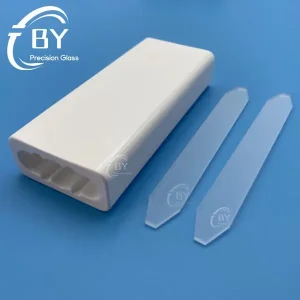
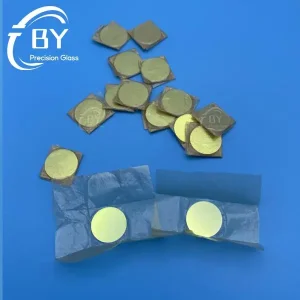
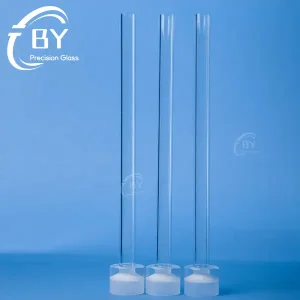
Laser Cavities, Spectrophotometer Cuvettes & Machined Quartzware
Specialized optical components manufactured to exact OEM prints with dedicated metrology reports for surface profile and transmittance.


Engineering Questions Answered by Laboratory Glassware Specialists
Essential guidance covering material grade distinctions, fabrication tolerances, cleaning protocols, and customization options.
How does fused quartz fundamentally differ from standard borosilicate laboratory glassware?
While borosilicate contains roughly 80% SiO₂ alongside boron oxide and sodium fluxes, fused quartz consists of > 99.99% high-purity silicon dioxide. Consequently, fused quartz withstands continuous operating temperatures up to 1,150 °C (annealing point ~1,200 °C) compared to 450 °C for borosilicate, provides virtually zero thermal expansion, and transmits deep UV wavelengths where borosilicate remains completely opaque.
What criteria dictate whether to select JGS1, JGS2, or JGS3 quartz material?
Select JGS1 synthetic silica for deep UV spectroscopy and laser windows requiring optical purity from 185 nm to 2,500 nm without bubble inclusions. JGS2 (fused natural quartz) offers exceptional mechanical resilience and thermal resistance for visible spectrum furnace tubes and wafer carriers (220 nm–2,500 nm). JGS3 is formulated with ultra-low hydroxyl (OH⁻ < 5 ppm) content, eliminating the deep 2,730 nm absorption band for clear infrared transmission up to 3,500 nm.
What tolerances can be guaranteed on custom CNC-machined quartzware?
Our multi-axis diamond CNC machining centers reliably deliver dimensional tolerances down to ± 0.01 mm on ground outer/inner diameters and hole patterns. For polished optical windows and substrates, we achieve surface flatness up to λ/10 per inch @ 632.8 nm, parallelism < 10 arcseconds, and surface roughness down to Ra < 0.5 nm with scratch-dig quality meeting MIL-PRF-13830B 20-10 standards.
How do you clean and prevent devitrification of quartz laboratory apparatus?
Devitrification (transformation from amorphous silica to crystalline cristobalite) begins around 1,000 °C when accelerated by alkali ionic residue like skin oils or mineral salts. Apparatus must be wiped with pure isopropyl alcohol, soaked in a 5% hydrofluoric (HF) or nitric acid bath for de-alkalization, rinsed thoroughly with 18 MΩ deionized water, and dried in a laminar flow bench prior to high-temperature furnace insertion.