
Engineered Optical, Quartz & Crystal Components
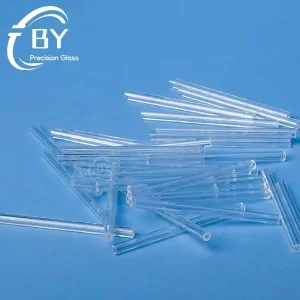
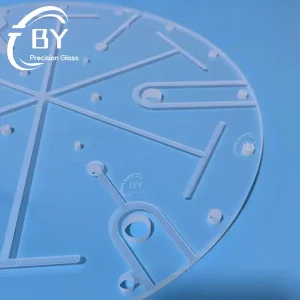
Direct factory production of custom optical ceramics, synthetic fused silica flow plates, doped filter tubing, and sapphire interfaces designed for extreme laser pump chambers.
Engineering Fundamentals of Alumina Ceramic Laser Reflectors
Understanding why porous high-purity α-Al₂O₃ ceramic matrices have superseded metal-plated and specular reflector chambers across solid-state laser heads and diode modules.
The Physics of Diffuse Scattering in Solid-State Laser Cavities
In high-power flashlamp-pumped and diode-pumped solid-state laser (DPSSL) architectures, pump efficiency is directly governed by photon transfer from the emitter to the laser crystal gain medium (such as Nd:YAG, Alexandrite, Er:YAG, or Cr:Tm:Ho:YAG). While gold-coated or silver-coated elliptical specular reflectors deliver directional light, they inevitably produce severe thermal lensing, hotspot distortion, and localized laser crystal saturation.
High-purity porous alumina ceramics (Al₂O₃ ≥ 99.7%) solve this critical bottleneck by operating on the principle of volumetric bulk diffuse reflection (Lambertian scattering). Sub-micron crystalline grain boundaries and uniformly distributed micro-voids act as omnidirectional scatterers. When photons from flashlamps or diode bars enter the porous ceramic body, they undergo multiple refractive scatterings before exiting back into the cavity, yielding an exceptionally homogeneous, uniform pump field across the entire active laser rod volume.
Physical & Dielectric Superiority
- Complete Chemical Inertness: Zero dissolution or ionic contamination in high-purity DI cooling water circuits.
- High Volume Resistivity: Eliminates electrical breakdown, arcing, and discharge leakage from high-voltage flashlamp trigger pulses (exceeding 25 kV).
- Extreme Thermal Shock Resistance: Low coefficient of thermal expansion (∼ 7.8 × 10⁻⁶/K) prevents micro-cracking during rapid cycling.
- Hermetic Glaze Sealing: Vitreous internal glazing seals out moisture absorption while delivering high reflectivity.
| Material Property | Unit / Condition | Standard Unglazed Ceramic | Glazed Laser Ceramic (BY-AL997) | Gold-Coated Copper (Alternative) |
|---|---|---|---|---|
| Alumina Content (Al₂O₃) | % purity | ≥ 99.5% | ≥ 99.7% High Purity | N/A (Cu substrate) |
| Bulk Density | g/cm³ | 3.10 – 3.25 | 3.20 – 3.35 | 8.96 |
| Diffuse Reflectance (at 600–1000 nm) | % (NIR band) | 96.5% – 97.5% | ≥ 97.8% | 94.0% – 96.0% (Specular) |
| Diffuse Reflectance (at 400 nm) | % (Visible UV/Blue) | 92.0% | 94.5% | < 40.0% (Severe Drop) |
| Dielectric Strength | kV / mm | 15 – 20 | ≥ 25 (High Glaze Seal) | 0 (Conductive) |
| Thermal Expansion (20–800°C) | 10⁻⁶ / K | 7.6 – 8.0 | 7.8 | 16.5 (High strain) |
| Cavity Glaze Thickness | μm | None | 60 – 120 (Vitreous seal) | 0.2 – 0.5 μm Au flash |
| Cooling Resistance | DI Water pH 5.5–8.5 | Moderate (Porosity risks) | Indefinite • No leaching | Degrades within 12–24 mos |
Why Global Tier-1 Laser Brands Source From China's Leading Factories
Examining the structural technological clusters, advanced diamond tooling CNC capacity, and vertical raw material synthesis powering Tianjin BY Photonics.
Sub-Micron Slip Casting & Sintering
High-Precision Diamond CNC Tooling
Defect-Free High-Reflectance Glazing
Vertical Integration & Cost Agility
Rigorous Traceability & Metrology
Emerging Technology Trends in Laser Pumping Chambers
How next-generation diode-pumped systems, picosecond aesthetic lasers, and high-brightness industrial sources are redefining ceramic reflector criteria.
Migration to Side-Pumped Diode Modules
Selective Spectral Absorption Doping
Microfluidic Direct-Cooling Architectures
Field-Proven Industrial & Medical Application Scenarios
From premier aesthetic dermatology handpieces to kilowatt-scale diamond machining heads, discover our tailored ceramic pumping cavities.
Medical & Aesthetic Lasers
Wavelengths: 755 nm Alexandrite, 1064 nm Nd:YAG, 532 nm KTP, and 2940 nm Er:YAG.
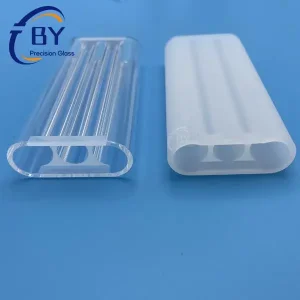
Role: Dual-bore and triple-bore glazed ceramic chambers deliver uniform energy distribution across large spot diameters (up to 24 mm), preventing skin hot-spot burns during laser hair removal and tattoo removal.
Precision Industrial Cutting & Welding
Role: High thermal endurance ensures consistent energy output under continuous 24/7 duty cycles. Eliminates focal spot drift and power degradation caused by cavity warping or mirror degradation in harsh factory environments.
Intense Pulsed Light (IPL) Lamp Blocks
Role: Specially shaped elliptical and semi-cylindrical ceramic reflectors capture wide-angle discharge emission from linear flashlamps, refocusing maximum broad-spectrum visible light directly into light guide blocks.
Scientific & Defense Laser Systems
Role: Customized multi-rod pump heads with low-expansion properties maintain cavity beam stability across extreme operational temperature variations (-40°C to +85°C).
Direct Replacement & OEM Retrofit
Global OEM Sourcing Guidelines: Mitigating Supplier Risks
What photonics design engineers and procurement directors must verify before qualifying a ceramic laser reflector manufacturing partner.
1. Evaluating Glaze Integrity & Cavity Seal
A poorly formulated glaze contains microscopic pinholes and thermal micro-fissures. During months of high-velocity deionized cooling water exposure, water permeates into the porous ceramic substrate. This leads to ionic leaching, electrical conductivity spikes in the coolant, flashlamp arc shorting, and localized algae growth that permanently degrades cavity reflectivity. Ensure your manufacturer utilizes an isostatically fused, lead-free vitreous glaze with zero open surface porosity (tested via rhodamine dye penetration inspection).
2. Spectral Reflectance Verification Protocol
Procurement specifications must mandate integrating sphere spectrophotometry rather than standard specular angle testing. Request documented reflectance curves spanning 400 nm to 1100 nm. High-grade 99.7% Al₂O₃ should maintain ≥94% at 450 nm, climbing smoothly to ≥97.8% across the crucial 700 nm – 980 nm band. Beware of low-cost alumina grades (<95% purity) that show steep reflectivity drop-offs below 650 nm.
3. Geometric Concentricity & Lamp-Rod Alignment
In dual-lamp or triple-bore configurations, the center-to-center distance between the flashlamp flow tube and the laser crystal rod dictates pump symmetry. Any misalignment (> 0.05 mm) creates uneven population inversion across the rod cross-section, causing beam astigmatism and lower mode quality (M² factor). Sourcing from a factory with closed-loop 5-axis CNC diamond grinding and coordinate verification guarantees inter-bore parallelism within 0.02 mm.
4. Thermal Shock & High-Voltage Arc Proofing
Laser heads operate under extreme instantaneous thermal gradients: flashlamps ignite at thousands of degrees while chiller fluid circulates at 20°C. Ceramic reflectors must undergo factory thermal cycling verification (consecutive air bake to water dip cycles) without mechanical fracturing or glaze spalling. Furthermore, dielectric insulation must withstand 25 kV ignition pulses without internal punch-through dielectric breakdown.
Frequently Asked Questions by Laser Engineers
Comprehensive engineering responses addressing cavity selection, optical longevity, maintenance routines, and custom manufacturing processes.
What is the functional difference between glazed and unglazed alumina ceramic laser reflectors? +
A glazed ceramic reflector features an ultra-thin, smooth, high-purity glass glaze fused over the internal fluid channel surfaces at high temperature (> 1200°C). The glaze provides an impenetrable hermetic barrier against liquid absorption and chemical degradation while maintaining exceptional diffuse reflectivity (≥ 97.8%). For flooded cooling chambers, glazed ceramic is universally required.
Why do alumina ceramic reflectors outperform gold-plated metal cavities in solid-state lasers? +
Alumina ceramic acts as an ideal Lambertian diffuse reflector, scattering pump energy homogeneously into every angle of the laser rod. This yields superior transverse beam profiles, reduced thermal stress, and higher output stability. Crucially, ceramic cannot tarnish, blister, or oxidize, providing an operational lifespan that easily exceeds 10 to 15 years.
What drawing formats and specifications are required for a custom laser cavity quote? +
- Critical bore diameter and center-to-center pitch tolerances (e.g., ±0.02 mm).
- Glazing zones (specify fully glazed, bore-only glazed, or selective masking).
- Operational cooling medium (deionized water, glycol mixture, or forced dry gas).
- Target laser wavelength (e.g., Nd:YAG 1064 nm, Alexandrite 755 nm, or broad IPL).
How do ceramic reflectors handle high-voltage flashlamp ignition without arcing? +
What is the recommended cleaning procedure for contaminated ceramic reflectors? +
Can BY Photonics fabricate direct replacements for branded laser heads (e.g., Candela, Cynosure)? +
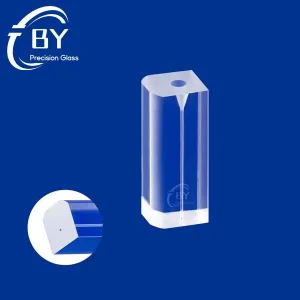
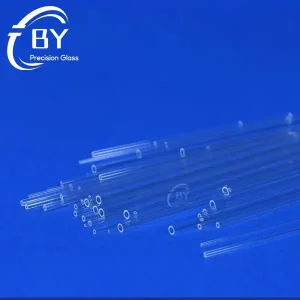
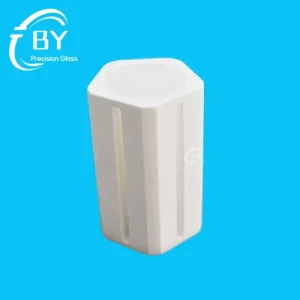
Specialized Laser Cavity Optics & Precision Glassware
Explore complementary high-durability optical products manufactured strictly to client technical prints and OEM specifications.
Ready to Optimize Your Laser Pumping Efficiency?
Submit your CAD drawings or cavity concept today. Our Senior Process Optical Engineers review tolerances, recommend glaze specifications, and provide a comprehensive DFM feasibility report within 24 hours.