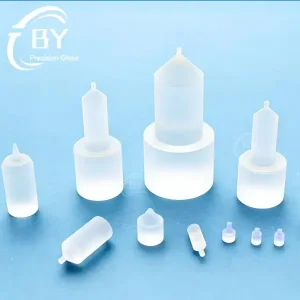
Precision Quartz & Optical Substrates Portfolio
Explore high-spec quartz parts, custom doped tubes, and laser cavity components manufactured under strict dimensional control in Tianjin, China.
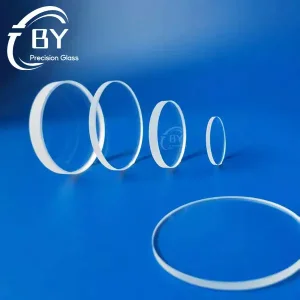
Quartz Optical Windows for Semiconductor Lithography Equipment
View Product Specs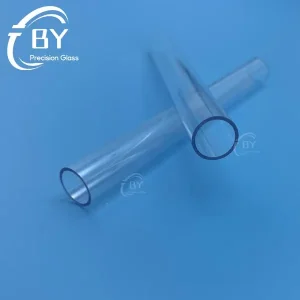
Cerium Doped Quartz Tube Blocked UV Wavelength
View Product Specs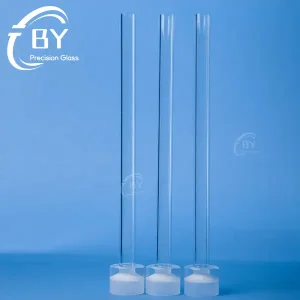
Chemical Resistant Custom Quartz Glass Parts Fabrication
View Product Specs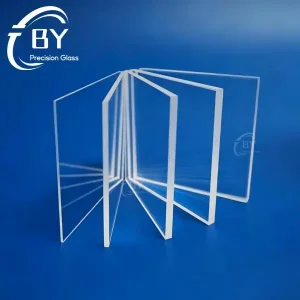
JGS1 Ultraviolet (UV) Grade Fused Silica Plate
View Product Specs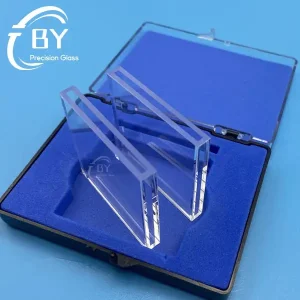
Customize Quartz Cuvette for Spectrophotometer
View Product Specs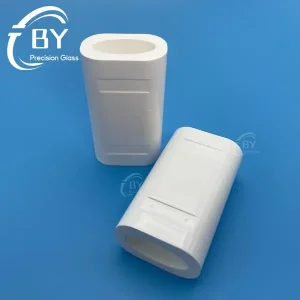
Ceramic Cavities For Nd YAG Laser Systems
View Product Specs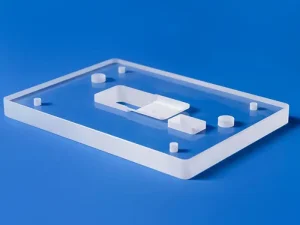
Precision Quartz Glass Machining Plate & Substrate
View Product Specs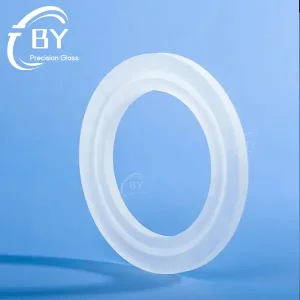
Precision Custom Quartz Glass Components for Semiconductor
View Product SpecsEngineering Superiority: Glass Fiber Termination Ferrules
Why modern fiber optic terminations, pigtail connectors, and high-power collimators are migrating from zirconia ceramics to precision synthetic fused silica and borosilicate glass ferrules.
Thermal Expansion Matching (CTE)
Standard zirconia ferrules exhibit a high mismatch with silica fiber cores under variable temperatures (ΔCTE > 9×10⁻⁶/K). High-purity synthetic fused silica (JGS1) termination ferrules offer identical thermal coefficient of expansion (0.55×10⁻⁶/K), eliminating adhesive shear stress and insertion loss drift across -40°C to +125°C.
Sub-Micron Concentricity & Bore Finish
By employing in-house precision capillary redrawing and sub-micron centerless ultrasonic lapping, BY Photonics delivers concentricity ≤0.5 μm with inner hole roundness tolerances within 0.2 μm. This ensures near-zero insertion loss (IL < 0.1 dB) during single-mode polarization-maintaining (PM) fiber assembly.
UV Laser & High-Power Damage Threshold
Fused silica termination ferrules allow transparent, direct visual inspection and UV laser curing through the ferrule wall. Featuring laser-induced damage thresholds (LIDT) exceeding 10 J/cm2 at 1064 nm (10 ns pulse), they prevent core-burning in kW-class industrial laser delivery and QBH beam launch heads.
China Supply Chain Agility & Scalable Fab Production
Combining integrated cold machining, high-purity preform redrawing, and cleanroom metrology in Tianjin to eliminate middleman markups and shorten prototyping-to-volume delivery cycles.
Vertical Raw Material Sourcing
Direct supply contracts with domestic high-purity natural and synthetic silicon tetrachloride refineries ensure uncompromised raw ingot consistency (OH-content control from <5 ppm for JGS3 to synthetic JGS1 >1200 ppm), safeguarding supply security and stable cost control against global market volatility.
Under-One-Roof Processing
From capillary drawing towers and high-speed CNC wire-slicing to dual-sided optical lapping and oxyhydrogen flame annealing, all processes are executed in our 3,000+ m² production site. Eliminating external subcontractor hand-offs prevents secondary handling contamination and tolerance drift.
Class 1,000 Cleanroom Packaging
All finished optical glass ferrules undergo multi-stage ultrasonic degreasing, ultra-pure DI water rinsing (18.2 MΩ·cm), vacuum baking, and 100% video-microscope endface inspection before clean-pack seal, fulfilling medical instrument and optoelectronic packaging standards.
Global Enterprise Requirements & Regulatory Compliance
Engineered to meet the stringent export verification, supply security, and localized technical documentation expected by photonics OEMs across North America, Europe, and Asia-Pacific.
RoHS, REACH & Conflict-Free
Every delivery batch is accompanied by comprehensive Certificates of Conformance (CoC), fully compliant with EU RoHS Directive 2011/65/EU and REACH regulations. Glass matrices contain zero lead, cadmium, mercury, or toxic flux agents.
Telcordia GR-326-CORE Testing
Designed to withstand standardized environmental endurance cycles: damp heat (85°C / 85% RH for 2,000 hours), thermal cycling (-40°C to +85°C), vibration shock, and multiple mating durability cycles with zero ferrule cracking.
Custom OEM/ODM Batch Traceability
Full lot traceability from initial silica ingots to finished laser-cut capillaries. Support for custom outer diameter chamfers (45°, 8° angled APC faces), multi-bore geometries (dual-fiber, 4-core, hexagonal arrays), and customer-designated laser marking.
Precision Ferrule & Capillary Material Benchmarks
Detailed performance benchmarks between synthetic fused silica, borosilicate, and traditional zirconia for fiber optic termination and collimation.
| Performance Parameter | JGS1 Fused Silica Ferrule | Borosilicate Glass Ferrule | Zirconia (ZrO²) Ferrule |
|---|---|---|---|
| Coefficient of Thermal Expansion (CTE) | 0.55 × 10⁻⁶ / K (Matches Silica Fiber) | 3.25 × 10⁻⁶ / K | 9.6 × 10⁻⁶ / K (Mismatch) |
| Inner Diameter (ID) Tolerance | ±0.5 μm (Precision Redrawn) | ±1.0 μm | ±0.7 μm (Extruded/Sintered) |
| Optical Transmission Range | 185 nm – 2500 nm (High UV & IR) | 350 nm – 2000 nm | Opaque (Zero Visual Inspection) |
| UV Light Cure Capability | Yes (Full 360° Optical Adhesive Curing) | Yes (Visible to Near UV) | No (Heat-cure Only, Slow Cycle) |
| Laser Damage Threshold (LIDT @ 1064nm) | >10 J/cm2 (Ideal for kW Fiber Lasers) | ∼3 J/cm2 | Medium (Absorbs stray beam) |
| Endface Polishability & Surface Quality | Scratch-Dig 10-5, Ra < 0.5 nm | Scratch-Dig 20-10, Ra < 1.0 nm | Ra ∼ 5.0 nm (Higher Scatter) |
Localized Applications & Next-Gen Photonics Trends
From co-packaged optics in hyperscale datacenters to laser endoscopic scalpels, glass ferrules are unlocking unprecedented optical density and thermal reliability.
AI Datacenter Co-Packaged Optics (CPO)
Next-generation 800G and 1.6T optical transceivers demand multi-fiber glass capillary arrays and pitch-matched silicon photonic interfaces. Fused silica ferrules provide exact refractive index matching and stable laser coupling in ultra-compact board-level packages.
Medical Laser Surgery & Endoscopy
Holmium (Ho:YAG) and Thulium fiber laser surgical probes require non-toxic, bio-compatible glass termination tips that resist intense back-reflection heat without charring, ensuring safe lithotripsy and soft-tissue ablation in clinical environments.
Subsea & Harsh Downhole Sensing
Oil & gas optical fiber sensors, distributed temperature sensing (DTS), and underwater telecom repeaters rely on borosilicate and quartz termination sleeves to endure pressures up to 15,000 psi and corrosive hydrogen sulfide without micro-cracking.
Frequently Asked Procurement Questions
Comprehensive engineering insights for optical design teams, quality auditors, and supply chain managers.
What is the standard tolerance range for custom glass ferrule capillary bores?
Our redrawn fused silica and borosilicate capillaries achieve standard ID tolerances of ±0.5 μm, with premium batches calibrated to ±0.25 μm upon request. Outer diameter (OD) concentricity relative to the bore axis is held within ≤1.0 μm.
Why choose fused silica ferrules over ceramic zirconia for fiber laser pigtails?
Fused silica matches the optical fiber's refractive index and thermal expansion coefficient exactly. Furthermore, silica allows full 360-degree UV light curing of epoxies, significantly accelerating production cycle times and eliminating micro-void formation.
Can you provide custom chamfers, funnel entries, and anti-reflective coatings?
Yes. We machine internal cone lead-ins (smooth funnel entries from 10° to 45°) for easy fiber insertion, produce 8° angled physical contact (APC) endfaces, and deposit hard dielectric AR coatings (λ = 850/1310/1550 nm, R < 0.2%) via electron-beam evaporation.
What is the typical turnaround time for custom prototype ferrules?
Engineering DFM feedback is provided within 24 hours of receiving your 2D/3D CAD drawing. Custom prototype tooling and redrawing runs take 7 to 10 working days, with mass volume supply capacity scaling to hundreds of thousands of pieces per month.
High-Performance Quartzware & Laser Optics
Explore our specialized range of candela gauge windows, ceramic reflectors, doped triple bores, and fiber end caps manufactured strictly to customer drawings.
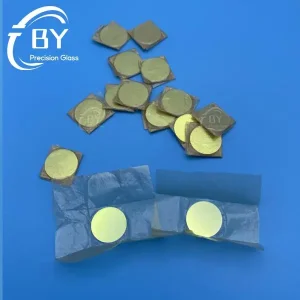
Candela Laser Distance Gauge Slider Windows (755/1064nm)
View Product Specs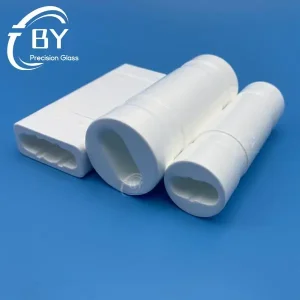
Ceramics Reflector for Semiconductor Lasers
View Product Specs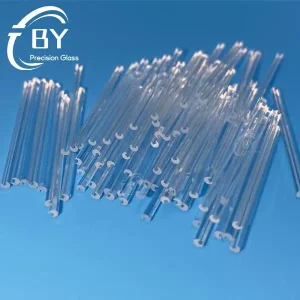
Quartz Substrate Groove for Optical Fiber Coupler
View Product Specs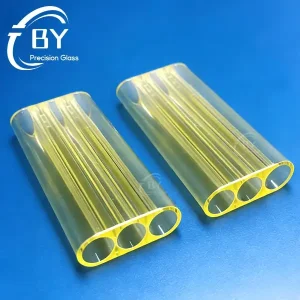
Samarium-doped Quartz Triple Bore for Medical Laser
View Product Specs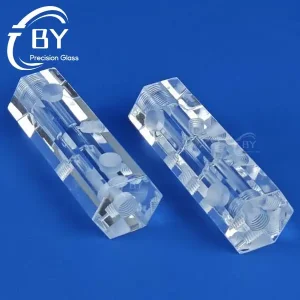
Custom Fabrication of Quartz Glass Precision Components
View Product Specs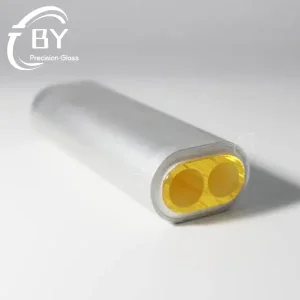
Packed Laser Cavity Flowtubes for Laser Head
View Product Specs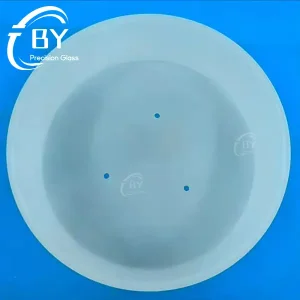
Custom Quartz Glass Components for Vacuum Coating
View Product Specs