Laser Optics • Filtration
Configure Specs
Verified pressure tolerance up to 50 MPa with optical grade surface lapping and precise dimensional concentricity for mission-critical industrial assemblies.
A rigorous examination of synthetic silica dynamics, Lamé formula burst stress models, and the international shift toward continuous CVD/VAD tube drawn configurations.
Modern industrial processing systems are increasingly operating under extreme combined thermodynamic conditions: multi-megapascal pressures combined with temperatures exceeding 1,000°C in chemically aggressive environments. Standard fused quartz manufactured via conventional electrical fusion often exhibits microscopic inclusions, striae, and structural hydroxyl (OH-) radicals that initiate micro-fractures under alternating hydraulic loads.
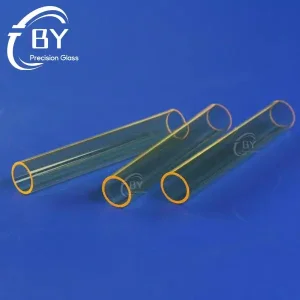
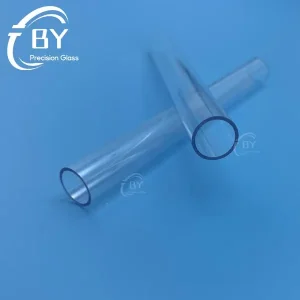
As an elite wholesale high pressure quartz tube supplier, BY Photonics manufactures tubes that utilize ultra-pure synthetic silica (SiO₂ ≥ 99.999%). By utilizing vertical continuous drawing, high-temperature thermal annealing, and precision grinding, we maintain geometric circularity (out-of-roundness < 0.5%) and wall thickness consistency (±0.02 mm), minimizing localized stress concentrations during peak operational transients.
P = σ × (OD² - ID²) / (OD² + ID²)
Where P represents maximum permissible internal burst pressure, σ represents tensile strength (typically taken as 48-50 MPa for fire-polished quartz with safety factor coefficients applied), and OD/ID represent outer and inner diameters. High-pressure tube reliability relies not solely on sheer wall thickness, but fundamentally on eliminate surface micro-flaws via chemical etching and fire-polishing.
Global demand for high-pressure quartz tubes has surged due to sub-3nm node semiconductor diffusion processes and ultra-high-pressure xenon UV sterilizers. Wholesale suppliers are under pressure to balance raw natural quartz scarcity (e.g., Spruce Pine pegmatites) with high-efficiency chemical vapor deposition (CVD) synthetics.
With an extremely low coefficient of thermal expansion, quartz can survive abrupt quenching from 1,100°C into cold water without shattering. However, internal fluid pressures induce tangential hoop stresses that mandate stress-relieved fire-polished edges to avoid sudden brittle failure modes.
We deploy high-resolution transmission interferometers, stress polarimeters, and automated helium leak detection (tight to < 1×10⁻¹⁰ mbar·l/s) to ensure zero striations, bubbles, or inclusions according to ISO 10110 optical inspection parameters.
Anticipating the technological milestones in extreme fluidics, atomic-layer processing, and optical doping capabilities.
Transitioning from pure silica to customized multi-element doping. By introducing Samarium (Sm³⁺), Cerium (Ce⁴⁺), or Titanium directly into the glass batch, tubes selectively block 1064nm parasitic laser feedback or completely eliminate solarizing UV without lowering pressure boundaries.
Micro-cracks smaller than 1 micrometer on tube inner walls act as starting points for burst failures. The next generation of wholesale manufacturing combines magnetorheological finishing (MRF) and HF gas phase etching to produce atomic-smooth finishes (Ra < 0.5 nm), doubling dynamic burst thresholds.
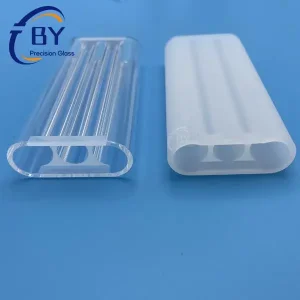
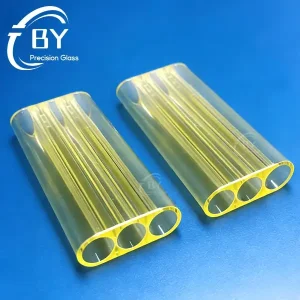
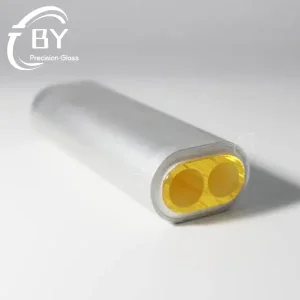
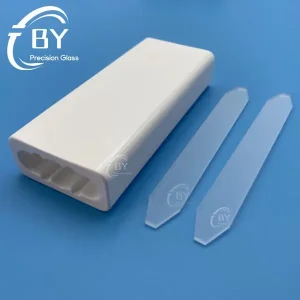
Moving from conventional single-bore tubes to integrated multi-bore and multi-capillary geometries. Precision hot redraw technologies allow for asymmetric internal pathways capable of carrying opposing fluids under independent pressure gradients without thermal or physical cross-contamination.
| Performance Parameter | JGS1 Synthetic Silica (UV) | JGS2 Optical Quartz (Vis) | JGS3 Low-OH Quartz (IR) | Standard Borosilicate 3.3 |
|---|---|---|---|---|
| Usable Spectral Range | 185 nm – 2,500 nm | 220 nm – 2,500 nm | 260 nm – 3,500 nm | 310 nm – 2,200 nm |
| Hydroxyl (OH-) Content | < 2 ppm to 1200 ppm (Opt) | < 30 ppm | < 5 ppm | N/A (Multi-component) |
| Max Short-Term Temperature | 1,300 °C | 1,250 °C | 1,200 °C | 500 °C |
| Dynamic Tensile Burst Stress | 54 MPa | 49 MPa | 48 MPa | 35 MPa |
| Thermal Shock Resilience (ΔT) | > 1,000 °C rapid quench | > 1,000 °C rapid quench | > 950 °C rapid quench | ~ 150 °C rapid quench |
From advanced semiconductor fabs in East Asia to aerospace propulsion testing facilities in North America, our tubes solve tough pressure-boundary challenges.
Supplying wholesale heavy-wall reaction tubes resistant to thermal ramping and high-vacuum degassing. Prevents trace metal ion migration (< 0.1 ppb) into high-purity wafer batches.
Providing precision flow tubes that channel high-velocity DI water around lamp envelopes under continuous dynamic pulsing without hydraulic cavitation or fracture failure.
Viewport and sight tubes rated for supercritical conditions (P > 25 MPa, T > 350°C) offering clear optical access for spectroscopy, extraction, and synthesis observation.
Heavy-wall level sight gauges engineered to withstand high vibration and sudden hydraulic pressure surges, maintaining clear visibility in harsh turbine environments.
Direct answers from our engineering desk regarding safety factors, custom tolerances, bursting equations, and logistics.
Working pressure is calculated from the Lamé equation using an ultimate tensile strength of 48-50 MPa, factoring in a mandatory safety coefficient (typically 4:1 to 7:1) based on temperature, pressure cycling, and mounting style.
For standard wholesale redrawn tubes, outer and inner diameters are held to ±0.05 mm to ±0.10 mm. Through post-draw grinding, lapping, and fire-polishing, we can maintain tolerances down to ±0.01 mm with ≥95% wall concentricity.
Sawing or mechanical diamond scoring leaves microscopic sub-surface cracks. Fire-polishing melts these edge flaws into smooth, continuous glass boundaries, stopping stress cracks from traveling along the tube body under high hoop tension.
Fused silica has almost zero thermal expansion, but sustained operating temperatures above 1,050°C cause devitrification (forming cristobalite). This reduces mechanical strength during cooling, so safety factors must be adjusted for high-heat systems.
Yes. We supply Cerium-doped quartz to block UV below 380 nm, Samarium-doped glass to absorb 1064 nm parasitic emission, and titanium-doped ozone-free quartz tubing for safe UV sterilizing equipment.
Every wholesale batch includes a Certificate of Conformance (CoC), raw material spectral traces, polariscopic stress relief records, and 100% dimensional inspection reports. Hydrostatic pressure testing is available upon request.
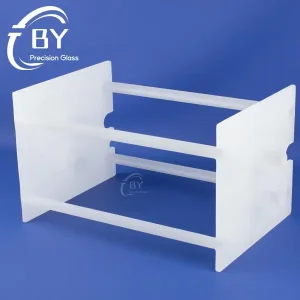
Complete precision optical assemblies, semiconductor-grade quartz carriers, and diffuse cavity optics built directly to drawing specifications.