
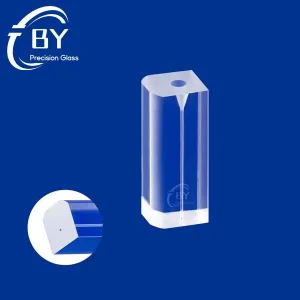
High-precision borosilicate and quartz ferrule blanks designed for tight concentricity optical fibre alignment.
Custom Fiber Optic Glass Ferrules Supplier, FactoriesFeatured optical assemblies and capillary redrawn profiles deployed across Kuwait’s energy laboratories and advanced testing facilities.
High-precision borosilicate and quartz ferrule blanks designed for tight concentricity optical fibre alignment.
Custom Fiber Optic Glass Ferrules Supplier, Factories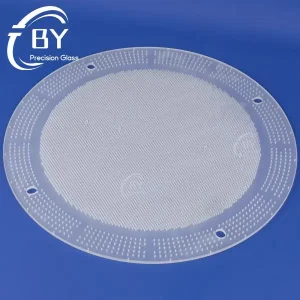
Engineered quartz flow plates engineered for gas chromatography and plasma-etch processing integrity.
Custom Custom Optical Quartz Gas Distribution Plate Manufacturer, Suppliers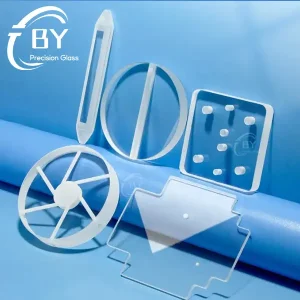
Oxyhydrogen hot-worked thermal sightware providing continuous temperature resistance up to 1,100 °C.
Wholesale High Temperature Custom Quartz Glass Fabrication Suppliers, Factories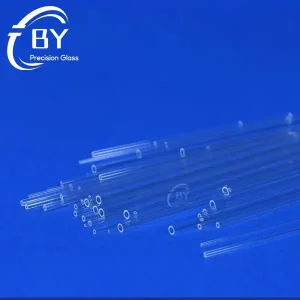
Refractive-index tuned capillaries designed for deep-UV capillary electrophoresis and specialized sensing.
Wholesale Fluorine-Doped Fused Silica Capillary Tube Manufacturer, FactoriesAligning critical precision glass components with Kuwait National Vision 2035 and large-scale industrial modernization.
Kuwait's massive refining nodes, including Al-Zour and Mina Al-Ahmadi, process highly sour crude requiring rigorous fluidic analysis. Borosilicate 3.3 capillary columns and sampling tubes serve as the backbone for gas and liquid chromatography (GC/HPLC), sustaining extreme hydrocarbon corrosion resistance without leaching ions.
With water scarcity demanding continuous multi-stage flash (MSF) and reverse osmosis (RO) plants, local laboratories monitor mineral salinity and chemical additives. Our precision borosilicate rods and calibrated capillaries are integrated into optofluidic monitoring probes, withstanding ambient desert temperatures and saline shock.
Institutes like the Kuwait Institute for Scientific Research (KISR) are driving concentrated solar thermal (CSP) and hydrogen production systems. Precision redrawn borosilicate tubing provides the required optical transmittance (over 91% from 380 nm to 2,200 nm) and minimal thermal expansion (3.3 × 10⁻⁶ /K) to avoid stress fractures.
Understanding internal geometry tolerances, thermal expansion profiles, and hydrolytic stability for engineering design.
| Performance Vector | Borosilicate Glass 3.3 | Synthetic Fused Silica (JGS1) | Soda-Lime Commercial Glass |
|---|---|---|---|
| Coefficient of Thermal Expansion (CTE) | 3.3 × 10⁻⁶ /K (Low thermal shock risk) | 0.54 × 10⁻⁶ /K (Zero thermal shock) | 9.0 × 10⁻⁶ /K (High thermal shock risk) |
| Chemical Durability (ISO 719) | Class 1 Hydrolytic Resistance | Class 1 Supreme Inertness | Class 3 Base Resistance |
| Maximum Working Temperature | ~450 °C (Continuous), 500 °C (Short term) | ~1,100 °C (Continuous), 1,200 °C (Peak) | ~150 °C |
| Bore Precision & Tolerance (ID) | ±0.005 mm achievable via thermal redrawing | ±0.002 mm via multi-stage redrawing | ±0.05 mm standard drawing |
| Commercial Cost Efficiency | High cost-to-performance sweet spot | Premium specialized pricing | Low cost, low chemical performance |
How BY Photonics’ automated thermal redraw towers and digital inspection overcome lead-time disruptions.
Our dual-axis non-contact laser micrometer arrays verify Outer Diameter (OD) and Inner Diameter (ID) at 200 Hz continuously along the redraw tower. Any variation beyond ±0.005 mm triggers automatic drawing-speed adjustments, eliminating wall concentricity drift.
Capillary tubing for analytical and biomedical instruments undergoes ultrasonic solvent cleaning, deionized water cascading rinses, and vacuum-sealed nitrogen purged tubular packaging to ensure zero particulate contamination upon delivery to Kuwaiti cleanrooms.
Every shipment is accompanied by complete batch traceability certificates: 3.1 Material Test Reports, Spectrophotometer transmission scans, dimensional CMM inspection reports, and pre-export verification aligned with the Kuwait Conformity Assurance Scheme (KUCAS).
Explore our manufacturing capabilities supporting scientific instruments, laser cavities, and semiconductor processing worldwide.
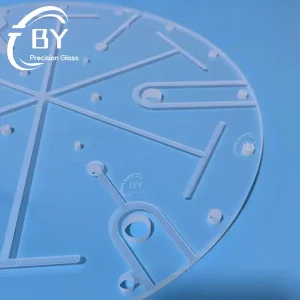
Custom CNC milled and polished quartz components configured for harsh industrial chambers.
High-Quality Custom Precision Quartz Glass Fabrication Supplier, Suppliers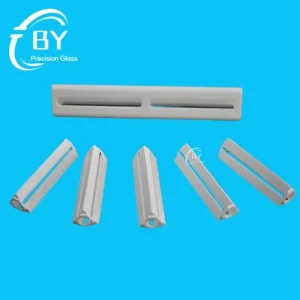
PTFE diffuse reflection cavities maximizing pump efficiency across solid-state laser heads.
High-Quality Diode‑Pumping Chamber Diffuse Reflectors PTFE‑based Supplier, Suppliers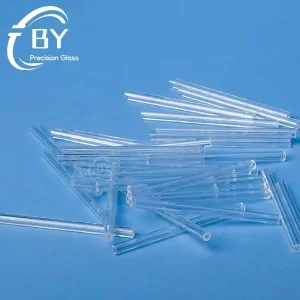
Ultra-narrow micro-bore quartz capillary tubing for high-performance separation sciences.
High-Quality Custom Precision Quartz Capillary Tubes Manufacturers, Suppliers
Precision inner channel glass ferrule blocks providing stable thermal expansion matching optical fibers.
Custom Fiber Optic Glass Ferrules Supplier, Factories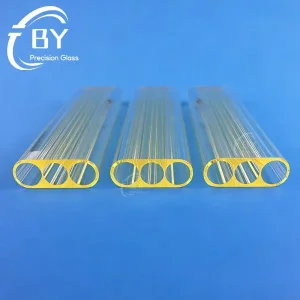
Selective 1064 nm absorption filter flow tubes protecting Nd:YAG crystals from parasitic oscillations.
Custom Laser Cavity Flow Tubes & Filters Made from Samarium-doped Glass Supplier, Suppliers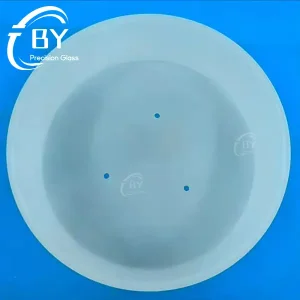
Thermal evaporation and PVD optical coating monitor crystals, shields, and structural tooling.
High-Quality Custom Quartz Glass Components for Vacuum Coating Supplier, Factories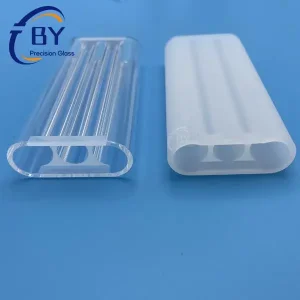
Multi-bore laser pump chambers manufactured for medical aesthetic replacements with immediate dispatch.
High-Quality Candela Laser Head Triple Bore Old and New Version In Stock Manufacturer, Factory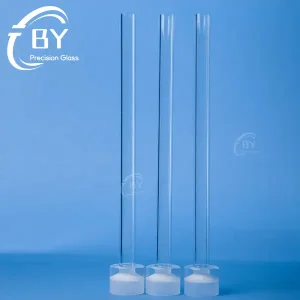
Heavy-duty corrosion-resistant quartz reactor vessels, sensors, and fluidic manifolds for chemical plants.
High-Quality Chemical Resistant Custom Quartz Glass Parts Fabrication Supplier, FactoriesTechnical and commercial answers addressing Kuwait customs, material tolerances, and factory direct shipping.