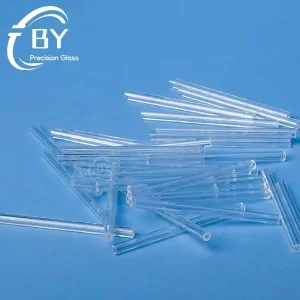
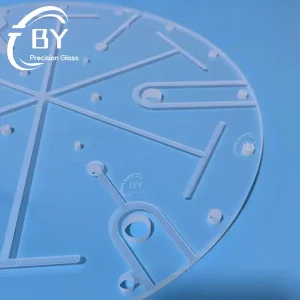
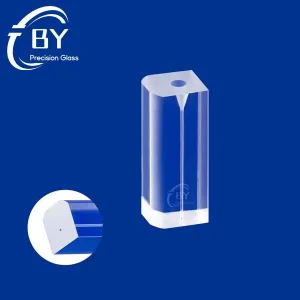
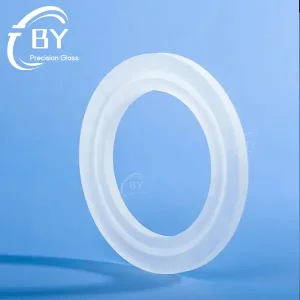
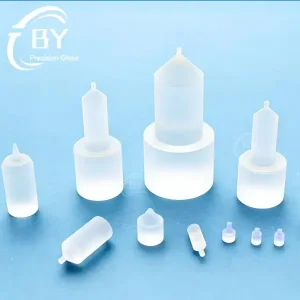
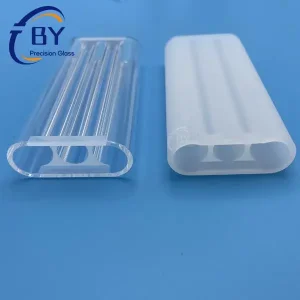
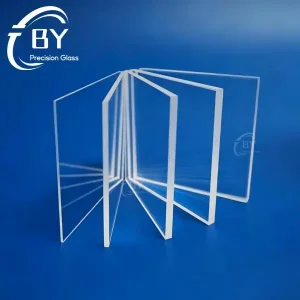
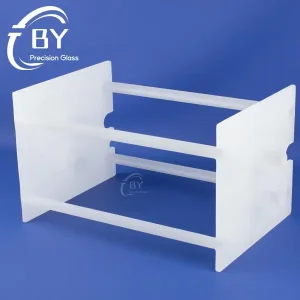
Precision Optoelectronic & Vacuum Coating Substrates
Engineered to integrate seamlessly with custom collimation sleeves, laser head pumps, and fiber packaging arrays across telecommunications, defense, and analytical laboratories.

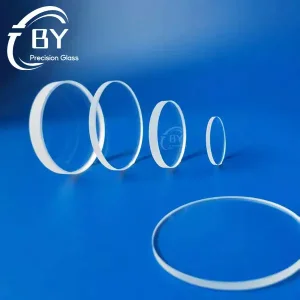
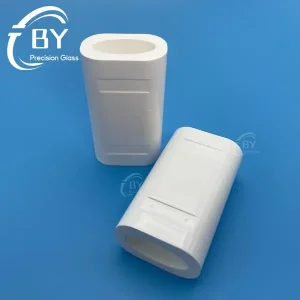
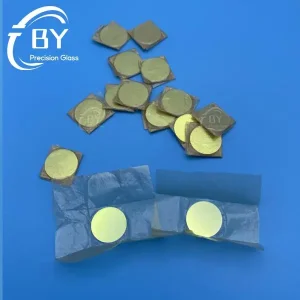
Global Enterprise Sourcing Trends for Fiber Optic Glass Collimator Sleeves
In high-density optical interconnects, co-packaged optics (CPO), and laser beam shaping, miniature glass sleeves serve as the physical baseline for passive alignment and high-reliability beam expansion.
As global data centers rapidly transition toward 800G, 1.6T, and future 3.2T optical transceivers, conventional metallic or standard zirconia ferrule alignment sleeves increasingly exhibit thermal expansion mismatch and angular pointing errors. Modern micro-optic systems rely on Custom Fiber Optic Glass Collimator Sleeves—engineered from synthetic UV-grade fused silica (JGS1) or high-borosilicate glass—to anchor graded-index (GRIN) lenses, C-lenses, and precision glass ferrules.
Furthermore, the surge in autonomous LiDAR sensor arrays, biomedical endoscopes, and coherent optical satellite communications demands customized bore configurations, including dual-fiber capillaries, square-profile alignment channels, and anti-reflective chamfered entry profiles. BY Photonics addresses these critical industry demands through proprietary thermal redrawing and multi-axis CNC cold diamond honing.
Thermal Expansion Homogeneity
By utilizing fused silica sleeves with a Coefficient of Thermal Expansion (CTE) of 0.55 × 10⁻⁶/K, the thermal expansion behavior perfectly mirrors that of standard single-mode (SMF-28) and polarization-maintaining (PM) fibers. This eliminates epoxy stress, microscopic beam tilt, and thermal-induced optical return loss drift.
- Zero thermal mismatch with quartz glass ferrules
- Telcordia GR-1221-CORE environmental cycle qualified
- Unaffected by high-power CW laser heating
Macro-Industry Optical Solutions & Glass Collimator Engineering
Comprehensive engineering analysis of how custom glass collimator sleeves resolve geometric misalignments, laser damage degradation, and chromatic aberrations.
Sub-Micron Coaxial Precision
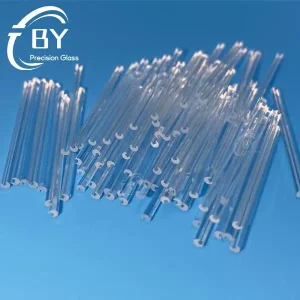
Single-mode fiber collimation hinges upon precise alignment between the fiber core (8.2–9.0 µm diameter) and the focal center of the collimating lens. BY Photonics achieves inner diameter (ID) cylindricity and concentricity < 0.5 µm using micro-redrawing and progressive laser diamond reaming.
- Outer diameter (OD) concentricity < 1.0 µm
- Eliminates lateral beam displacement errors
- Maintains absolute angular collinearity (< 0.15°)
High Laser Damage Threshold (LDT)
For high-power fiber laser delivery systems (1064 nm Nd:YAG / Yb:doped fiber lasers), organic polymers or metallic sleeves produce outgassing and burn spots. Our JGS1 fused silica sleeves offer bulk laser damage thresholds exceeding 15 J/cm² @ 1064 nm (10 ns pulse), ensuring operational stability in multi-kilowatt systems.
- Hydroxyl content (OH⁻) customizable (< 2 ppm to > 1200 ppm)
- Zero chemical outgassing in high-vacuum environments
- Compatible with high-temperature glass solder sealing
Hermetic Packaging & UV Curability
Unlike opaque ceramic or metallic ferrules, high-purity glass collimator sleeves provide full optical transparency throughout the ultraviolet and visible spectrum (185 nm – 2500 nm). This enables 360-degree ultraviolet (UV) adhesive curing during fiber alignment, slashing cycle times in automated assembly lines.
- Immediate 360° UV adhesive curing in automated jigs
- Laser weldable with CO₂ laser glass sealing processes
- Helium leak rate qualified < 1 × 10⁻⁹ Pa·m³/s
| Material Class | Refractive Index (1064nm) | CTE (× 10⁻⁶ / K) | Optical Transmission Band | Surface Roughness (Ra) | Primary Industrial Use Case |
|---|---|---|---|---|---|
| Synthetic Fused Silica (JGS1) | 1.4496 | 0.55 | 185 nm – 2,500 nm | < 0.2 nm (Polished) | UV/IR Collimators, Laser End Caps, Coherent Telecommunication |
| Optical Fused Quartz (JGS2) | 1.4495 | 0.54 | 220 nm – 2,500 nm | < 0.4 nm | Standard Telecommunication Sleeves, Multi-Mode Couplers |
| Low-OH IR Fused Quartz (JGS3) | 1.4494 | 0.55 | 260 nm – 3,500 nm | < 0.4 nm | Mid-IR Gas Sensors, Surgical Lasers, Defense Optics |
| Borosilicate Glass (D263 / BK7-type) | 1.5065 | 3.25 – 7.2 | 350 nm – 2,000 nm | < 0.5 nm | Cost-Effective Passive Alignment, Consumer Fiber Connectors |
| Fluorine-Doped Silica Capillaries | Custom Depressed n | 0.58 | 400 nm – 2,100 nm | < 0.3 nm | Cladding-Mode Stripping, Medical Micro-Endoscopy Probes |
Technology Roadmap: The Next Decade in Micro-Optic Packaging
Strategic advancements shaping the design, fabrication, and integration of glass collimation assemblies through 2030 and beyond.
1. Co-Packaged Optics (CPO) & Multi-Core Fiber Sleeves
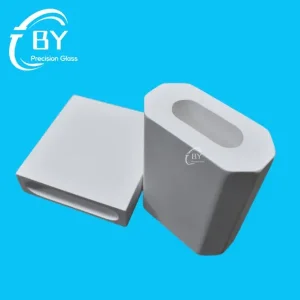
As switch ASICs exceed 51.2 Tbps, board-level electrical trace loss dictates that optical engines be mounted adjacent to silicon chips. BY Photonics is pioneering multi-bore glass collimator capillary blocks capable of anchoring 4-core, 7-core, and ribbon fibers with sub-500nm pitch pitch repeatability.
2. Integrated Anti-Reflective Nano-Structures
Traditional thin-film dielectric AR coatings degrade under extreme thermal cycling or ultra-intense laser flux. Future glass collimation sleeves integrate direct femtosecond-laser etched sub-wavelength anti-reflective structures (moth-eye nanostructures) directly onto the glass facet, achieving transmission > 99.9% without thin-film delamination risk.
3. Automated Vision-Guided Machine Feeding
Modern cleanroom assembly lines demand seamless integration with high-speed surface-mount technology (SMT) pick-and-place robots. We provide customized tape-and-reel and waffle-pack carriers for glass sleeves, pre-cleaned to Class 100 cleanroom protocols with chamfered inner guide funnels for frictionless fiber threading.
Commercial Dynamics, Supply Chain Resilience & Regulatory Quality
Ensuring mission-critical delivery for multinational defense contractors, tier-one transceiver vendors, and medical device manufacturers.
Industrial Landscape & Dual-Sourcing Strategy
Recent geopolitical and regional disruptions have prompted tier-one telecommunication and photonics OEMs to re-examine single-source dependency. High-precision glass redrawing requires extensive capital expenditure and deeply specialized thermodynamic craft. Tianjin BY Photonics provides an audited, stable primary manufacturing node with dedicated production lines capable of scaling from quick-turn prototype batches (under 50 units) to multi-million unit monthly runs.
Our established supply chains in North America, Europe, Japan, and Southeast Asia are supported by standardized international shipping logistics, moisture-proof vacuum nitrogen packaging, and real-time electronic batch traceability.
Rigorous Testing & Compliance Standards
Every production batch of custom fiber optic glass collimator sleeves undergoes stringent verification protocols conforming to international photonics criteria:
- ✓ Telcordia GR-326-CORE: Mechanical durability, thermal cycling (-40°C to +85°C), and humidity aging.
- ✓ RoHS & REACH Compliance: 100% free of hazardous heavy metals, compliant with EU Directive 2011/65/EU.
- ✓ Laser Interferometric Metrology: End-face flatness verified to λ/10; inner bore non-contact pin-gauge and laser diffraction calibrated.
- ✓ ISO 9001:2015 Certified Facilities: Traceable optical glass ingot origins with full melt batch documentation.
Frequently Asked Questions on Custom Glass Collimator Sleeves
In-depth engineering answers to technical queries encountered during product design, tolerancing, and system integration.
Why choose fused silica over ceramic (zirconia) for fiber collimator sleeves?
What are the tightest inner diameter (ID) and outer diameter (OD) tolerances BY Photonics can achieve?
Can you manufacture custom dual-hole, multi-bore, or D-shaped collimation sleeves?
What surface quality and end-face angle polishing options are available?
How does BY Photonics ensure zero micro-cracks along the drawn capillary bore?
Precision Capillaries, Ferrules & High-Temperature Assemblies
Complementary precision glass solutions engineered strictly to customer drawings, from micro-capillary fiber ferrule blanks to high-capacity semiconductor processing boats.