
Featured Solid-State Pumping Chamber & Laser Core Components
Direct manufacturer catalog of precision-machined fused silica, customized ceramic reflectors, and selective absorption filter assemblies engineered for extreme laser power density.
State of Flash Lamp Pumped Solid-State Laser (LPSS) Architectures
While diode-pumped solid-state (DPSS) systems have expanded across micro-machining, flash lamp pumped solid-state lasers remain the unmatched gold standard where ultra-high pulse energy, deep penetration depth, and cost-effective gigawatt peak power are vital.
High Peak Energy Regimes
Flash lamp excitation harnesses high-capacity pulsed xenon and krypton arc lamps capable of delivering hundreds of joules per pulse. For heavy industrial laser shock peening (LSP), nuclear fusion diagnostics, and deep material drill applications, flash lamps remain significantly more robust and economical against laser back-reflections than sensitive semiconductor diode bars.
Thermal Lensing Management
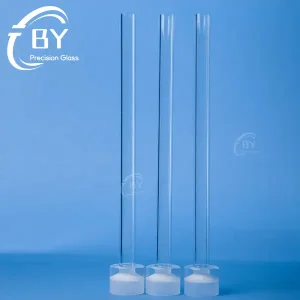
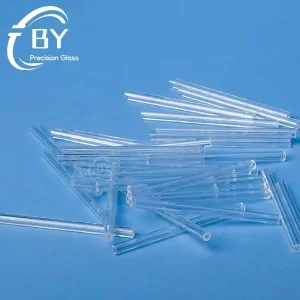
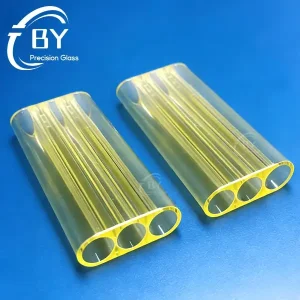
The broad spectral output of arc lamps deposits non-lasing infrared and ultraviolet heat into the active crystal (e.g., Nd:YAG, Er:YAG, Alexandrite, Ruby). Precision cavity flow engineering—utilizing customized samarium-doped filter tubes and high-coolant turbulence multi-bore channels—is mandatory to suppress parasitic oscillations and prevent optical wavefront distortion.
Diffuse Pumping Efficiencies
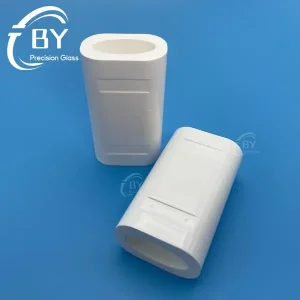
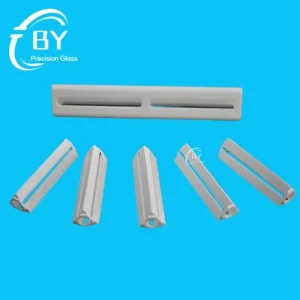
Maximizing optical coupling from linear lamps to cylindrical or slab laser rods demands diffuse reflectance higher than 99% across 600–1000 nm. Advanced high-density alumina ceramics and microporous PTFE reflect radiation uniformly throughout the crystal, mitigating localized hot spots and improving laser output beam quality (M² factor).
Why Tier-1 Laser Integrators Select Our Tianjin Facility
Combining upstream synthetic silica ingot sourcing, specialized rare-earth glass melting, diamond grinding, multi-axis ultrasonic CNC, and laser interferometry testing in one integrated location.
Single-Roof Vertical Integration
By eliminating third-party sub-contracting for grinding, boring, flame polishing, and ceramic glazing, we cut standard lead times from 10 weeks to 15 days. Engineers control thermal stress annealing directly alongside precision cold grinding, guaranteeing structural integrity under continuous thermal shock cycles.
Certified Material Traceability
Every delivery includes spectrophotometric transmittance curves, chemical composition sheets, and dimensional CMM inspection reports. Our optical quartz components utilize synthetic high-purity JGS1/JGS2, eliminating bubble inclusions and providing baseline damage thresholds exceeding 10 J/cm² @ 1064nm (10ns pulse).
Substantial BOM Cost Reduction
Western and European medical and defense procurement teams frequently face excessive overheads when purchasing replacement laser cavities. Our automated multi-axis grinding and streamlined cleanroom assembly yield a 30% to 55% BOM savings without sacrificing surface finish (20-10 scratch-dig) or mechanical tolerances.
Cavity Material Performance Matrix for Solid-State Systems
Engineered optical substrates and reflector media designed for extreme UV blocking, thermal shock stability, and selective fluorescent absorption.
| Material Classification | Transmission / Reflectance | Thermal Expansion (CTE) | Primary Role in LPSS Lasers | Inspection Standard |
|---|---|---|---|---|
| Samarium-Doped Glass (Sm3+ 10%/15%) | Blocks < 400 nm & 1064 nm; Transmits pump band | 10.4 × 10⁻⁶ / K | Flow tubes & filters; suppresses 1064nm parasitic ASE in Nd:YAG | Spectrophotometer Transmission @ 1064nm < 0.1% |
| Porcelain-Grade 99.7% Al₂O₃ Ceramic | > 97.8% Diffuse Reflectance @ 600–1000 nm | 8.0 × 10⁻⁶ / K | Reflector cavities for Candela, Cynosure, and industrial laser heads | Surface Ra < 0.4 µm, Zero-Porosity Glaze |
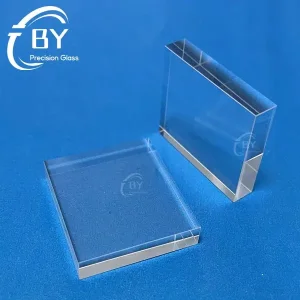
| JGS1 Synthetic Fused Silica | 185 nm – 2500 nm (> 92% internal) | 0.54 × 10⁻⁶ / K | UV Excimer/Flash lamp sleeves, ultra-low thermal lensing viewports | Laser Interferometry Flatness λ/10 @ 632.8 nm |
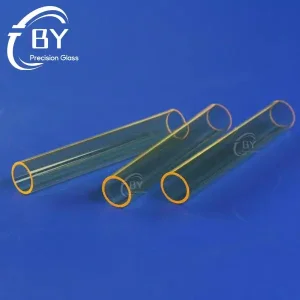
| Cerium-Doped / Yellow Quartz | Cut-off below 380 nm; high visible transmission | 0.55 × 10⁻⁶ / K | IPL handpieces & lamp envelopes; eliminates damaging UV-C/B solarization | UV Cutoff Verification < 380nm T% < 0.01% |
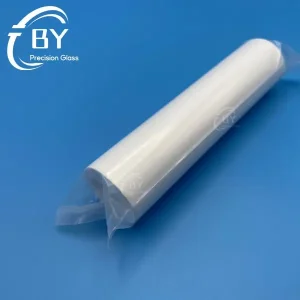
| Microporous Sintered PTFE Cavities | > 99.2% Diffuse Reflectance (Lambertian) | High (Cryogenic to 260°C) | High-uniformity pump chambers for high-energy diode & arc lamp heads | Spectral Reflectance Standard Traceable |
Engineered Integration Across Demanding Operational Scenarios
Our custom laser components operate in high-precision installations across North America, Europe, East Asia, and the Middle East.
Dermatology & Aesthetic Medical Consumables
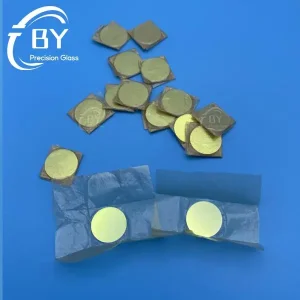
Alexandrite (755 nm) and Nd:YAG (1064 nm) aesthetic systems (e.g., Candela GentleLase/VBeam, Cynosure) rely on our replacement ceramic cavities, dual-wavelength coated slider windows, and yellow UV-blocking flow tubes. High glaze quality prevents deionized water mineral scaling, preserving output joules and client safety.
Aerospace Laser Shock Peening (LSP)
Cold-working metal turbine blades and aircraft airframes requires ultra-high energy Q-switched flash lamp lasers delivering 10–20 Joules in nanosecond bursts. Our samarium-doped double and triple bore glass tubes prevent spontaneous amplified emission, maximizing energy storage in massive Nd:Glass amplifier rods.
High-Reflectance Metal Spot Welding
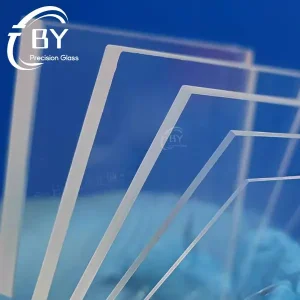
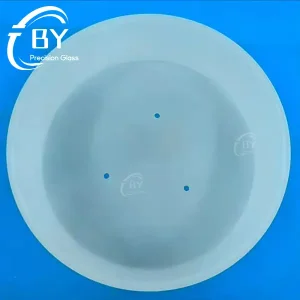
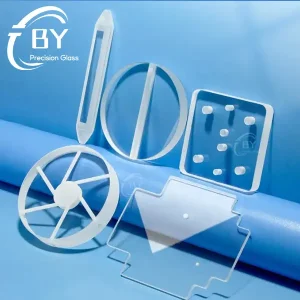
In EV battery tab assembly and precious metal jewelry welding, the broad operational tolerance and high peak powers of pulsed Nd:YAG lasers accommodate varying surface reflectivity. We provide custom quartz flow plates and high-temperature viewport glass to protect the optical cavity from spatters and high ambient heat.
Market Outlook & Enterprise Procurement Requirements
How the resurgence of pulsed lamp systems in medical dermatology and defense drives demand for tighter glass tolerances and consolidated manufacturing.
Demand for Multi-Bore Consolidation
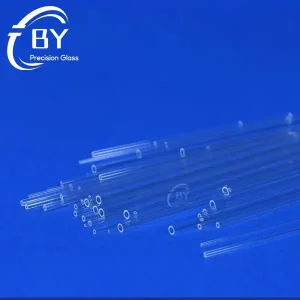
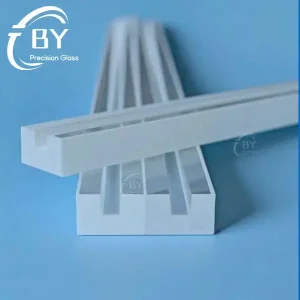
Modern laser design favors monolithic multi-bore flow tubes (incorporating lamp, crystal rod, and coolant bypass channels within a single fused silica cane). This eliminates alignment mechanical drift, halves O-ring leak failure points, and reduces laser head enclosure dimensions by up to 35%.
Aftermarket Consumable Security
Global hospital chains, aesthetic laser clinic franchises, and industrial service providers seek independent, OEM-equivalent suppliers. Procurement teams require audited clean-room production, batch-to-batch consistency, and unbranded neutral packaging for drop-shipping across international borders.
Turnkey Drawing-to-Part Capability
Engineering departments are shifting away from fragmented vendors. Sourcing demands a partner capable of assessing STEP/CAD models, optimizing DFM (Design for Manufacturability), grinding custom sapphire contact tips, and producing laser-sintered ceramic reflectors in a unified workflow.
High-Precision Cavity Spares & Optical Assemblies
Full catalog of custom sapphire light guides, high-temperature quartz components, and precision diffuse pump reflectors tailored to global OEM configurations.
Frequently Asked Questions
Clear, engineer-verified answers regarding tolerances, material testing, custom tooling, and global shipping protocols.