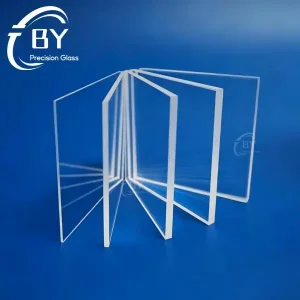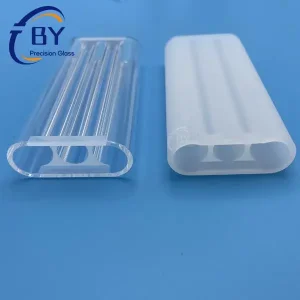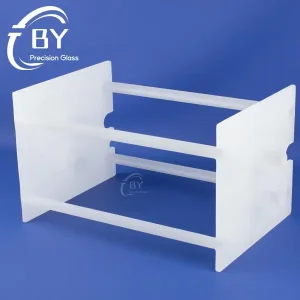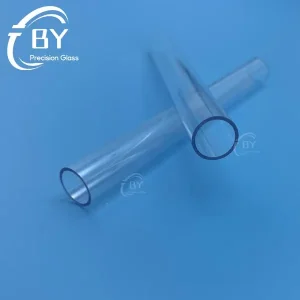
High-Quality Custom Precision Quartz Glass Fabrication
Request Specification Sheet
Factory-calibrated optical and quartz components engineered strictly to mechanical prints, optimized for laser pump chamber uniformity and severe thermal gradients.
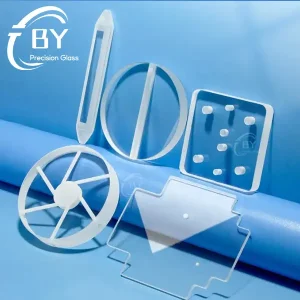
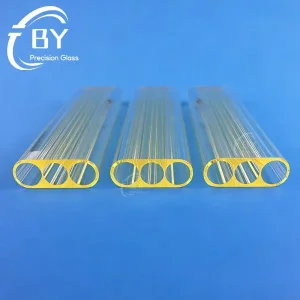
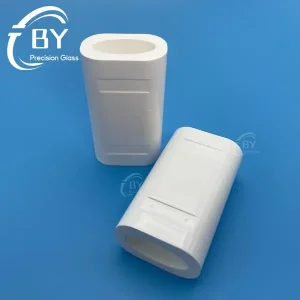
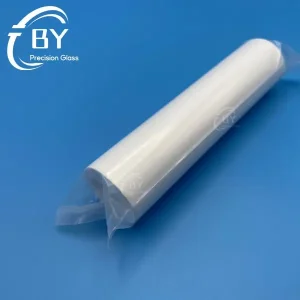
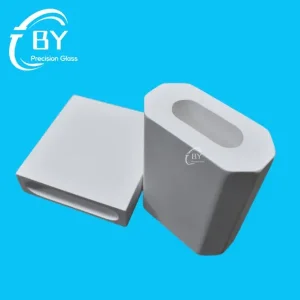
Solid-state laser efficiency depends directly on pump cavity coupling efficiency and optical endurance. Below is an engineering comparison of primary diffuse reflector substrates under continuous high-fluence exposure.
In high-power solid-state lasers (DPSSL and lamp-pumped), the pump cavity reflector serves a dual role: maximizing the transfer of pumping photons into the active gain medium (e.g., Nd:YAG, Nd:YLF, Alexandrite, or Ti:Sapphire) while dissipating waste heat and suppressing parasitic oscillations (ASE - Amplified Spontaneous Emission). Optical degradation in the reflector causes thermal lens distortion, output energy droop, and catastrophic thermal breakdown.
| Substrate Material Class | Reflectance @ 500-1100 nm | Thermal Conductivity (W/m·K) | Coeff. Thermal Expansion (CTE) | Coolant Compatibility | Primary Application Focus |
|---|---|---|---|---|---|
| High-Purity Alumina Ceramic (99.7% Al₂O₃) | 97.2% – 98.4% (Diffuse) | 28 – 35 | 7.2 × 10⁻⁶ / K | Deionized Water, Glycol-mix | Lamp-Pumped Medical & Industrial Systems |
| Spectralon®-Grade Micro-porous PTFE | 99.1% – 99.6% (Lambertian) | 0.25 – 0.30 | 100 – 120 × 10⁻⁶ / K | Dry Gas, Inert Fluid only | Diode-Pumped Solid-State (DPSSL) Modules |
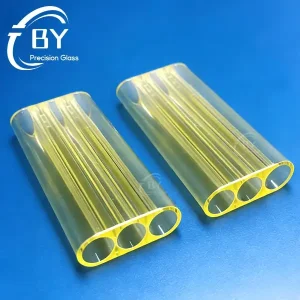
| Samarium-Doped (Sm-Glass / Sm-Quartz) | Selective Filtering >95% | 1.38 | 0.55 × 10⁻⁶ / K | Direct Coolant Sheath Flow | 1064nm Cut-off Flow Tubes & Multi-Bores |
| Cerium-Doped Fused Quartz (UV Block) | High Transmittance >400nm | 1.40 | 0.54 × 10⁻⁶ / K | Direct Coolant Sheath Flow | Aesthetic IPL Lamps & Flashlamp Flow Sleeves |
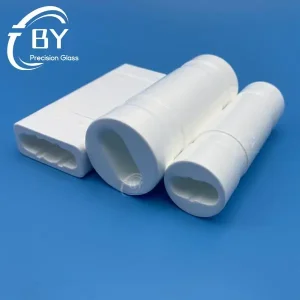
Our porous ceramic pump chambers achieve 97.8% Lambertian reflectance through sub-micron grain sintered alumina, eliminating hotspots and guaranteeing homogeneous excitation across the laser crystal core.
Integrated Samarium (Sm³⁺) doping specifically absorbs 1064nm parasitic amplified spontaneous emission while exhibiting high transmission at pump excitation bands, stabilizing Q-switch pulse peak power.
Cavity interior walls are treated with proprietary high-temperature glass-glazing, isolating the porous ceramic from deionized water leaching and preventing solarization discoloration under high-flux UV.
By Photonics eliminates cross-tier subcontractor margin stacking and tolerance drift by unifying raw material synthesis, precision CNC machining, and inspection in Tianjin.
Direct raw stockpiles of synthetic JGS1, JGS2, JGS3 quartz ingots, and 99.7% Al₂O₃ powder protect global clients from raw silica geopolitical disruptions.
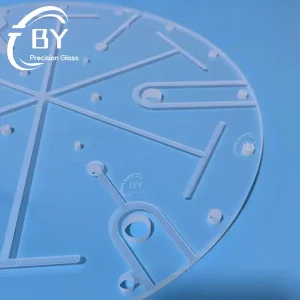
Ultrasonic diamond grinding machines process complex asymmetric pump cavities, multi-bore drillings, and internal coolant O-ring seat channels with ±0.01mm repeatability.
Proprietary hydrogen-oxygen flame welding and computerized stress-relieving lehrs ensure laser quartz assemblies operate without micro-fissuring under continuous pulsing.
Spectrophotometer transmission logs, coordinate measuring machine (CMM) reports, and helium leak tests accompany each production lot prior to dispatch.
Navigating cross-border medical device and precision photonics supply chains requires stringent regulatory compliance, rigorous material certification, and flexible localized inventory buffering.
For medical laser manufacturers (dermatology, urology, ophthalmology), components provide complete batch traceability, RoHS/REACH compliance documentation, and biocompatible material affidavits.
We bridge the R&D gap: initial 2-piece proof-of-concept prototypes fabricated in 7–10 days, seamlessly transitioning to high-volume recurring lots backed by annual blanket purchase orders (BPOs).
Brittle optical reflectors and quartz triple bores are cleaned via ultrasonic immersion, sealed in dust-free nitrogen packaging, and crated in shock-mitigating packaging for safe global express transit.
From replacement chambers in hospital aesthetic suites to extreme-duty industrial additive manufacturing heads, custom cavity reflectors adapt to critical operational demands.
Deployment: Drop-in replacement ceramic chambers and samarium flow tubes for Candela GentleLase, VBeam, Cynosure, and Alma platforms. Resists solarization and protects laser rods from flashlamp UV degradation.
Deployment: Compact diode-pumped Nd:YAG and Er:Glass rangefinders. Machined PTFE cavities ensure stable diffuse pump reflectivity across broad operating temperatures (-40°C to +85°C) without thermal warping.
Deployment: Laser annealing, wafer dicing, and PCB micro-via drilling heads. High-durability glazed ceramic reflectors withstand high pulse frequencies (>100 kHz) under continuous duty cycles.
Historic laser cavity architectures relied heavily on gold- or silver-electroplated copper reflectors. While exhibiting high specular reflectance initially, metallic plating experiences catastrophic blistering, tarnishing from coolant cavitation, and abrasive erosion during maintenance flushes. The industry has made a definitive paradigm shift toward monolithic diffuse sintered alumina ceramics and PTFE. These materials exhibit zero coating delamination, superior lifetime resistance to UV degradation, and uniform multi-direction pump recycling, lowering overall total cost of ownership (TCO) by over 60% across the equipment life cycle.
Detailed technical answers to common queries regarding laser cavity materials, dimensional limits, and custom engineering feasibility.
Precision-crafted flow control tubes, UV-blocking quartz elements, and semiconductor quartzware manufactured to optical drawing tolerances.