Core Product Line 01
Precision Substrates & Laser Cavity Components
Engineered to withstand rigorous operational thresholds across fiber laser generation, semiconductor fabrication, and aesthetic beam delivery.
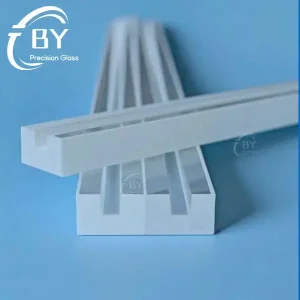
High-Quality Square Groove Quartz Substrate for Fiber Couplers Supplier, Factories
Explore Specifications
High-Quality Customized Quartz Fiber End Caps for QBH Manufacturer, Factory
Explore Specifications
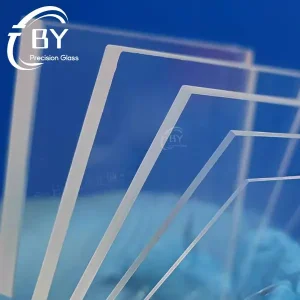
Wholesale Quartz Optical Windows for Semiconductor Lithography Equipment Suppliers, Factories
Explore Specifications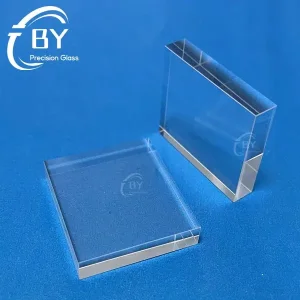
Custom Sapphire IPL Light Guide Block Used for Laser IPL Hair Removal Handle Manufacturer, Manufacturers
Explore Specifications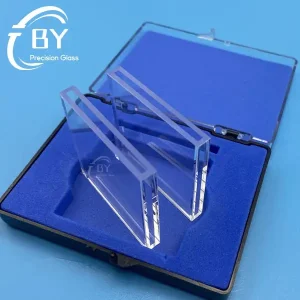
Wholesale Customize Quartz Cuvette for Spectrophotometer Supplier, Factory
Explore Specifications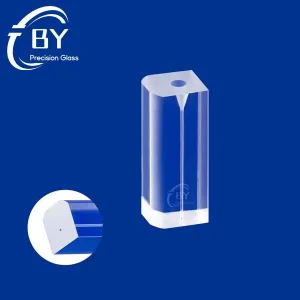
Custom Fiber Optic Glass Ferrules Supplier, Factories
Explore Specifications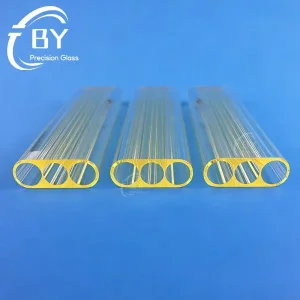
Custom Laser Cavity Flow Tubes & Filters Made from Samarium-doped Glass Supplier, Suppliers
Explore Specifications
Whitepaper Chapter 01
Engineering Fundamentals of Industrial Laser Focusing Optics
Achieving diffraction-limited spot focus, minimizing thermal lensing, and maintaining high LIDT (Laser-Induced Damage Threshold) under multi-kilowatt CW and ultrafast pulse regimes.
Thermal Lensing Elimination
Thermal focal drift in multi-kilowatt fiber laser systems directly impacts cut kerf width and weld penetration depth. By selecting ultra-pure synthetic fused silica (JGS1) characterized by an ultra-low absorption coefficient (< 3 ppm/cm at 1064 nm) and minimal thermo-optic coefficient (dn/dT), our custom focusing lenses prevent focal shift across continuous operation cycles.
Substrate Micro-Homogeneity
Optical uniformity is critical for avoiding beam aberrations in diffraction-critical assemblies. Our fabrication processes utilize 3D-annealed fused silica substrates classified under Striae Class A and Homogeneity Class H4 (ISO 10110). This eliminates internal refractive index variations, ensuring uniform wavefront transmission and predictable spot circularity.
IBS Low-Loss Dielectric Coatings
Leveraging Ion Beam Sputtering (IBS) and advanced magnetron sputtering deposition, our Anti-Reflective (AR) coatings achieve typical reflectance R < 0.1% per surface. IBS coating technology yields non-porous, high-density, stoichiometric dielectric layers that resist moisture adsorption and maintain high Laser-Induced Damage Thresholds (LIDT > 25 J/cm² @ 1064nm, 10ns).
Industry Roadmap & Commercial Landscape
Macro Trends & Next-Generation Focusing Architectures
How the global pivot toward gigawatt ultrafast micromachining and high-power additive manufacturing reshapes optics design.
Ultrafast Picosecond & Femtosecond Lenses
Standard geometric optics suffer from Group Velocity Dispersion (GVD) and spatial chirping when handling pulse widths under 10 ps. Modern technical roadmaps demand custom telecentric f-theta configurations with optimized broadband coatings (1030 nm to 1060 nm), preserving ultra-short pulse integrity for cold ablation in medical device and semiconductor micromachining.
30kW+ Ultra-High Power Sheet Metal Processing
Global industrial manufacturing has accelerated from 12kW to 30kW-60kW fiber cutting setups. Such extreme power densities lead to instant failure if the optic exhibits micro-inclusions or residual polishing contamination. Sourcing requires pristine chemical mechanical planarization (CMP) and sub-surface damage (SSD) mitigation.
Additive Manufacturing & Multi-Beam Optics
In Laser Powder Bed Fusion (LPBF), industrial systems are scaling from single-laser engines to arrays of 16+ synchronized lasers. Custom focusing assemblies must deliver ultra-flat telecentricity across large print volumes (e.g., 600x600mm) without edge distortion, necessitating tight beam-pointing stability.
Semiconductor Lithography & DUV Focusing
Deep-ultraviolet (DUV, 193nm/248nm) lithography and wafer inspection tools require synthetic fused silica lenses (JGS1 equivalent / excimer grade) treated for solarization resistance. Form error control within < 0.05 μm is mandatory to ensure nanometer pattern fidelity.
Application Engineering
Localized Industrial Use Cases & Operating Regimes
Custom laser focusing optics customized for targeted manufacturing environments and international equipment standards.
Automotive EV Battery Cell Splicing
Focusing lenses deployed inside automated prismatic and cylindrical battery production cells must resist harsh vaporized copper and aluminum back-spatter. Incorporating specialized double-sided AR protective cover glasses and high-purity fused silica plano-convex or doublet sets ensures stable focal depths during 24/7 continuous seam welding.
Precision Microfluidic Laser Ablation
Medical diagnostics platforms and lab-on-a-chip assemblies necessitate channel widths down to 10 μm. Our UV-grade aspherical focusing systems focus 355nm and 266nm solid-state lasers with zero spherical aberration, enabling direct cold etching of cyclic olefin copolymer (COC), glass, and quartz substrates without edge micro-cracking.
Aerospace Superalloy Drilling & Cladding
Drilling cooling holes in nickel superalloy turbine blades requires short laser bursts with high peak intensities. Custom focusing optical trains incorporate air-spaced achromatic doublets that maintain tight focal consistency despite atmospheric heating within laser processing heads operated in severe industrial environments.
Supply Chain Integrity
China Factory Scalability, Precision Metrology & Efficiency
Vertical integration from raw material ingot synthesis to final interferometer certification under one facility in Tianjin.
Full-Chain Domestic Ingot Sourcing
By controlling the direct supply channels for raw synthetic fused silica, crystalline quartz, optical borosilicate, and high-purity sapphire boule stock, Tianjin BY Photonics isolates OEM customers from raw material bottlenecks, guaranteeing complete material traceability and uniform batch lots.
Cold Machining & Advanced Metrology
Equipped with 120+ specialized optical production instruments, including multi-axis CNC grinding centers, high-speed double-sided planetary polishers, and oxyhydrogen hot-working lathes. Optical performance is verified using Zygo phase-shifting laser interferometers and PerkinElmer Lambda spectrophotometers.
Cost Efficiency & Agile Prototyping
Combining engineering DFM (Design for Manufacturability) analysis with localized supply ecosystems allows us to transition from rapid prototype verification (< 10 days) to volume batch manufacturing (10,000+ units/month) while maintaining a strict 30-40% cost advantage over Western optical foundries.
| Material Category | Transmission Bandwidth | Refractive Index (nd) | Abbe Number (Vd) | Max Working Temp | Optimal Focusing Scenario |
|---|---|---|---|---|---|
| JGS1 Synthetic Silica | 185 nm – 2500 nm | 1.458 | 67.8 | 1100 °C | High-Power CW Fiber & UV Laser Systems |
| JGS2 Fused Quartz | 220 nm – 2500 nm | 1.458 | 67.8 | 1050 °C | Industrial Cutting, Marking, Sensor Windows |
| JGS3 Low-OH Quartz | 260 nm – 3500 nm | 1.458 | 67.8 | 1100 °C | Mid-Infrared Optics & Laser Cavity Windows |
| Optical Sapphire (Al₂O₃) | 170 nm – 5500 nm | 1.768 | 72.2 | 1800 °C | High-Pressure / Abrasive Medical & IPL Handpieces |
| Borosilicate (D263 / BK7 equiv.) | 350 nm – 2500 nm | 1.517 | 64.2 | 450 °C | Cost-Effective Visible Metrology & Sight Glasses |
Global Assurance
International Compliance & Regional Engineering Support
Navigating strict ISO protocols, export guidelines, and custom logistics packaging to safeguard fragile optical assemblies.
ISO 9001:2015 & Cleanroom Packaging
Every optical component undergoes ultrasonic multi-stage detergent cleaning followed by DI-water cascades. Parts are packaged in Class 1,000 cleanroom zones using vacuum-sealed membrane boxes or lint-free nitrogen packaging, eliminating particulate contamination before mounting.
RoHS, REACH & Conflict-Free Materials
Full compliance with European Union directives including RoHS (2011/65/EU) and REACH (EC 1907/2006). Comprehensive material declarations and ICP analytical test reports are supplied with each export consignment to simplify European and North American customs clearance.
Direct OEM Engineering Desks
Technical support desks staffed by optical engineers who review STEP, DWG, and Zemax ray-trace models directly. Rapid DFM turnarounds within 24 business hours enable international hardware innovators to lock in specifications without communication delays.
Knowledge Base
Frequently Asked Technical Questions (FAQ)
In-depth insights into tolerances, optical coating configurations, and custom fabrication feasibility.
What is the key advantage of JGS1 Synthetic Fused Silica over standard BK7 for laser focusing?
JGS1 synthetic fused silica delivers zero bubble class, superior optical transmission down to 185 nm, and virtually undetectable OH-absorption bands. Crucially, its coefficient of thermal expansion (CTE 0.54 × 10⁻⁶/K) is approximately one-twelfth that of N-BK7 (7.1 × 10⁻⁶/K), making JGS1 immune to thermal cracking and thermal focus drift in multi-kilowatt laser cutting and welding systems.
What surface tolerances can Tianjin BY Photonics achieve on custom meniscus and plano-convex lenses?
We regularly achieve surface accuracy of λ/10 per 25mm diameter at 632.8nm, surface roughness Ra < 0.5 nm via CMP polishing, and scratch-dig ratings of 10-5 or 20-10 per MIL-PRF-13830B. Centration tolerances are maintained below 1 arcminute, with edge thickness variation (ETV) controlled within ±0.01 mm.
How do you measure and certify Laser-Induced Damage Threshold (LIDT)?
LIDT testing complies with ISO 21254-1/2/3 standards utilizing automated Nd:YAG single-mode laser test stations. We perform 1-on-1 and S-on-1 exposure tests (e.g., 1064nm, 10ns, 20Hz repetition rate). Full graphical damage probability curve certificates are available upon contract specification.
Can you provide custom anti-reflective (AR) coatings for dual or triple wavelength systems?
Yes. Using advanced Ion Assisted Deposition (IAD) and Ion Beam Sputtering (IBS), we manufacture dual-band AR coatings (e.g., 1064nm cutting laser combined with 635nm red pilot alignment laser) and multi-band coatings across UV-VIS-NIR regimes with reflectance below 0.25% across all designated wavelengths.
Core Product Line 02
Advanced Flowtubes, Reflectors & Machined Quartzware
Engineered components tailored for high-power laser pump cavities, thermal process chambers, and specialized photonic assemblies.
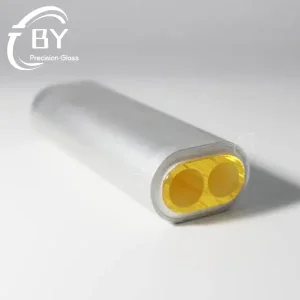
Custom Packed Laser Cavity Flowtubes for Laser Head Manufacturers, Suppliers
Explore Specifications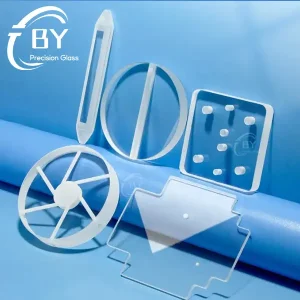
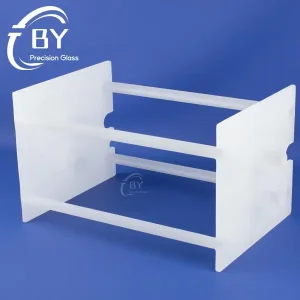
Wholesale High Temperature Custom Quartz Glass Fabrication Suppliers, Factories
Explore Specifications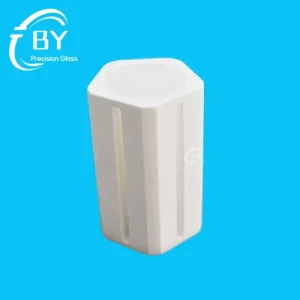
Wholesale Diffuse High‑Reflectivity PTFE Reflectors for Diode‑Pumping Chambers Suppliers, Factory
Explore Specifications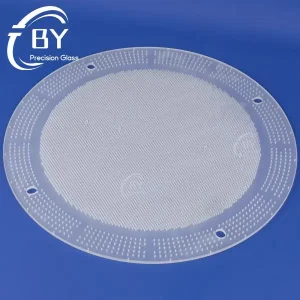
Custom Custom Optical Quartz Gas Distribution Plate Manufacturer, Suppliers
Explore Specifications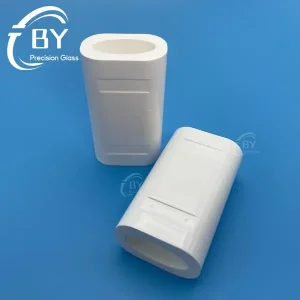
High-Quality Ceramic Cavities For Nd YAG Laser Supplier, Factories
Explore Specifications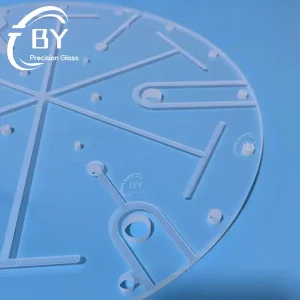
High-Quality Custom Precision Quartz Glass Fabrication Supplier, Suppliers
Explore Specifications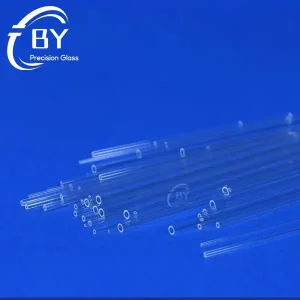
Wholesale Fluorine-Doped Fused Silica Capillary Tube Manufacturer, Factories
Explore Specifications