
Precision Catalog · Stream 01
Primary Semiconductor & Optical Glass Assemblies
High-spec thermal-shock proof, deep-UV fused silica, and precision-bored substrates configured for high-throughput instrumentation and semiconductor fabrication environments.

Technical White Paper · Material Science
Engineering Narrow Diameter Glass Tubes: Physical Boundaries & Capillary Dynamics
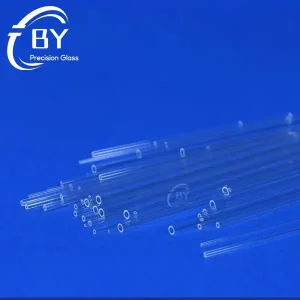
Narrow diameter glass tubes (internal diameter ranging from 0.05 mm to 3.0 mm) function at the intersection of microfluidics, analytical spectroscopy, optoelectronics, and medical diagnostic delivery. Sourcing precision narrow bore tubes requires strict thermal-rheological control.
Thermal Redraw Viscosity Ratios
Thermal stability requires maintaining glass melt temperatures within ±0.5°C in clean vertical draw towers. Precise feed-to-draw ratios prevent elliptical collapse, ensuring inner lumen concentricity below 1.5% total indicator reading (TIR).
Laminar Flow Micro-Hydrodynamics
In high-pressure liquid chromatography (HPLC) and capillary electrophoresis, internal wall roughness directly determines Poiseuille flow uniformity. Gas flame-polishing produces flame-fused surfaces with Ra < 0.5 nm, preventing sample dispersion.
Optical Transmission & OH Attenuation
Depending on synthetic JGS1, JGS2, or JGS3 selection, narrow capillary walls exhibit distinct hydroxyl absorption spikes. Low-OH synthetic fused silica stops infrared absorption at 2730 nm, while high-OH options guarantee UV transmission down to 185 nm.
| Substrate Material | Outer Diameter (OD) Scope | Inner Diameter (ID) Scope | Tolerance (Std / Custom) | Refractive Index (nd) | Thermal Coeff. (CTE) |
|---|---|---|---|---|---|
| JGS1 Synthetic Fused Silica | 0.30 mm – 8.00 mm | 0.05 mm – 5.00 mm | ±0.010 mm / ±0.002 mm | 1.458 | 5.5 × 10⁻⁷ / °C |
| JGS2 / Optical Quartz | 0.50 mm – 12.0 mm | 0.10 mm – 9.00 mm | ±0.015 mm / ±0.004 mm | 1.458 | 5.5 × 10⁻⁷ / °C |
| Borosilicate 3.3 Glass | 0.40 mm – 15.0 mm | 0.08 mm – 12.0 mm | ±0.020 mm / ±0.005 mm | 1.473 | 3.3 × 10⁻⁶ / °C |
| Fluorine-Doped Silica (F300) | 0.50 mm – 6.00 mm | 0.10 mm – 4.00 mm | ±0.008 mm / ±0.002 mm | 1.440 – 1.450 | 5.2 × 10⁻⁷ / °C |
| Samarium Doped Glass (1064nm Cut) | 1.00 mm – 14.0 mm | 0.50 mm – 10.0 mm | ±0.025 mm / ±0.005 mm | 1.520 | 8.2 × 10⁻⁶ / °C |
Supply Chain Superiority
Why Tier-1 Global OEMs Source Custom Narrow Glass Tubes from China
China's consolidated high-purity glass supply chain combines raw mineral refinement with automated redraw draw towers and advanced CNC cold-machining, offering substantial advantages in lead times and scalability.
Integrated Ingot-to-Bore Pipeline
Direct access to ultra-low impurity natural quartz sand and domestic synthetic tetrachloride precursors reduces ingot casting costs while maintaining sub-ppb transition metal impurity ceilings.
Dual Hot/Cold Engineering Ecosystem
Tianjin optical machining clusters house oxyhydrogen flame sealing alongside 5-axis ultrasonic CNC grinding in the same facility, eliminating multi-vendor subcontracting and preventing tolerance stacking.
100% In-Line Laser Metrology
Continuous dual-axis laser diameter monitoring on draw towers provides real-time dimensional feedback, guaranteeing every millimeter of capillary tubing meets tight OEM specifications.
±0.002 mm
Bore Tolerance Precision
1,100 °C
Continuous Working Temp
< 24 Hrs
DFM Engineering Turnaround
100%
Birefringence Stress Relieved
Application Engineering
Enterprise Solutions: From Subsea Telecom to Nanofluidic Diagnostics
Specialized industrial environments demand tailored geometric, optical, and thermal profiles. Discover how our custom narrow-diameter tubes integrate into mission-critical systems.
Fiber Optic Ferrules & Collimators
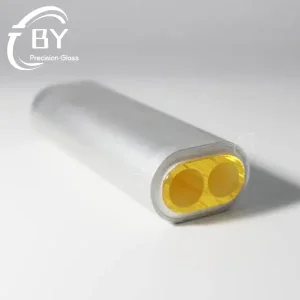
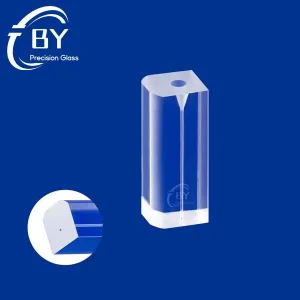
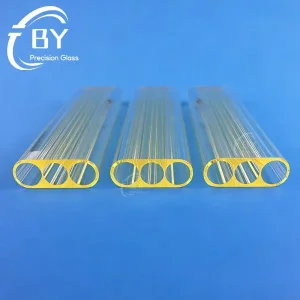
Multi-bore capillaries and micro-ferrules require precise single-mode and multi-mode fiber core alignments. Custom chamfers and anti-reflective polished facets eliminate return loss (RL > 60 dB).
Gas Chromatography & Mass Spectrometry
Narrow tubes lined with deactivation coatings serve as non-reactive transport paths for volatile organic compounds (VOCs). Chemically inert quartz prevents sample carryover or cross-contamination.
Medical Laser Cooling Jackets
Samarium-doped and cerium-doped narrow tubes filter unneeded UV/infrared wavelengths, preventing optical breakdown and protecting dermatological flash lamp cavities during continuous pulsed firing.
Precision Catalog · Stream 02
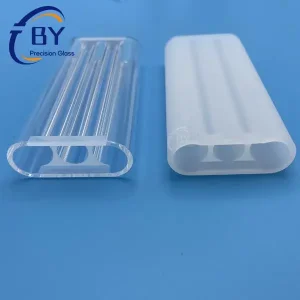
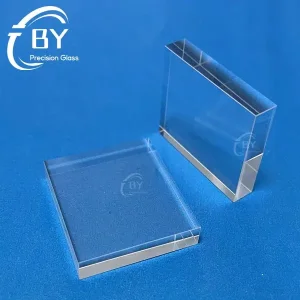
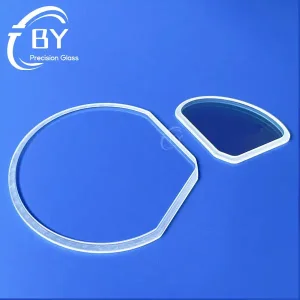
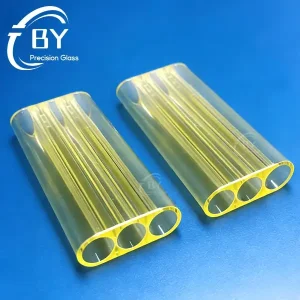
Advanced Optical Sapphire, Laser Cavities & Custom Quartzware
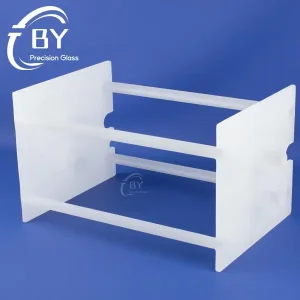
Specialized aesthetic light guides, laser head bores, and chemically stable crystalline sapphire viewing plates manufactured for high-reliability industrial operations.
Procurement & Technical FAQ
Frequently Asked Questions on Custom Narrow Glass Tubes
Key information covering tolerances, materials, pressure ratings, and production workflows to help streamline procurement and engineering reviews.
What are the minimum achievable inner diameter and wall thickness for custom glass tubes?
Using precision micro-redrawing, we can produce internal bores down to 0.05 mm (50 μm) with wall thicknesses as low as 0.08 mm. Custom dimensions down to ±0.002 mm can be produced on request, verified using non-contact optical gauges and calibrated pin gauges.
How do you maintain straightness and concentricity across narrow capillary tubes?
Concentricity is maintained by using preforms with uniform wall geometry, diamond-cored and honed before redrawing. Vertical redraw towers with closed-loop optical feedback reduce gravity sag, typically keeping camber (total bow) under 0.5 mm per meter.
Which material is best suited for high-pressure microfluidics: Quartz, Borosilicate, or Sapphire?
For pressures above 5,000 PSI, single-crystal sapphire offers the highest tensile yield (Mohs 9 hardness) with chemical resistance to alkaline solutions. For analytical spectrometry, synthetic fused silica (JGS1) provides an ideal balance of burst pressure ratings, UV transmission, and cost-effective redraw tolerances.
What edge finishes and end-face treatments are available for narrow glass tubes?
Options include standard diamond-wheel score-and-snap, precision mechanical cuts with 45° or 30° chamfering, optical lap polishing (80/50 to 20/10 Scratch-Dig), and oxyhydrogen flame glazing to eliminate micro-chips and micro-fractures on fragile tube ends.
How are fragile, narrow-diameter glass tubes packed for secure international delivery?
Tubes are packed in static-free, lint-free paper, heat-sealed in protective polyolefin sleeves, and secured within slotted grooved PVC trays or high-density polyethylene (HDPE) tubing. The trays are then encased in suspended foam within shock-resistant, export-grade plywood crates, maintaining safe transit to customers across North America, Europe, and Asia.