
Precision Laser Filters & Specialty Flow Tubes (Set 1)
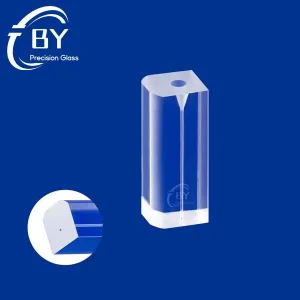
Manufactured to rigid ISO 10110 standards, providing spectral stability, parasitic 1064nm ASE absorption, and extreme thermal shock endurance.

Global Commercial & Industrial Landscape of Solid-State Laser Filters
Understanding the interplay between high pump-energy conservation, thermal lensing mitigation, and spectral selectivity across Nd:YAG, Alexandrite, and Er:YAG laser systems.
In high-power diode-pumped solid-state (DPSS) and flashlamp-pumped optical gain architectures, the performance ceiling of laser output is fundamentally dictated by thermodynamic and spectral efficiency within the pump chamber. As global demand surges across industrial micromachining, aesthetic dermatology, and defense photonics, the solid-state laser cavity filter has transformed from a passive protective sleeve into a critically tuned spectral control mechanism. Without proper optical cavity filtration, optical pumping media are subjected to severe parasitic oscillations, intense infrared gain saturation, and catastrophic UV-induced solarization.
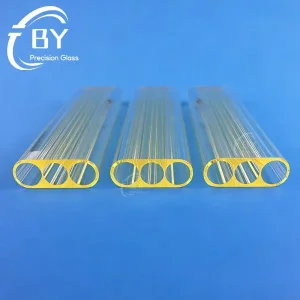
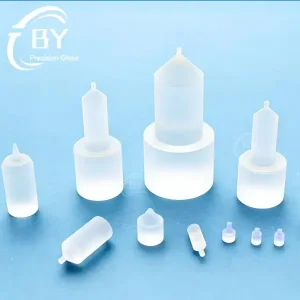
Modern solid-state lasers operating around 1064nm (such as Nd:YAG and Nd:glass) suffer from severe depopulation of upper-state energy levels when spontaneous emission triggers amplified spontaneous emission (ASE). By deploying Samarium-doped glass (Sm3+) filters and multi-bore flow tubes, laser cavity designers achieve high optical transmission across the standard pump bands (typically between 720nm and 880nm for flashlamp excitation) while completely blocking and attenuating parasitic radiation at 1064nm. Simultaneously, trivalent samarium and tetravalent cerium doping agents exhibit exceptional cutoff capabilities against deep ultraviolet radiation below 400nm, thereby preventing core laser rod degradation, crystal color centering, and coolant fluid decomposition.
Solarization Resistance
Cerium-doped quartz and Sm3+ borosilicate glasses intercept energetic UV emission (<380nm), completely inhibiting color center formation in laser crystals and eliminating de-ionized water coolant breakdown.
ASE & Parasitic Suppression
Samarium ions exhibit intense ground-state absorption at 1064nm, absorbing sideways-propagating transverse laser energy before it can trigger amplified spontaneous emission inside high-gain flash heads.
Thermal Stress Mitigation
By absorbing idle non-radiative pump spectra outside the excitation window, custom optical filters dramatically decrease thermal loading on crystalline rods, minimizing thermal lensing distortions and beam divergence.
Chinese Manufacturing Efficiency & Precision Optics Engineering
How BY Photonics leverages vertically integrated glass synthesis, ultra-precision cold CNC machining, and proprietary oxyhydrogen flame drawing under one unified facility.
In traditional European and North American optical manufacturing chains, fabricating a single custom samarium-doped laser flow tube involves multiple subcontractors: raw glass casting is performed by one company, precision ultrasonic coring by a second, inner/outer cylindrical polishing by a third, and multi-layer anti-reflective (AR) coating by an external thin-film coater. This disjointed workflow leads to long lead times (often 12–16 weeks), high scrap rates, and cumulative tolerance errors.
Based in Tianjin, China, Tianjin BY Photonics Co., Ltd. (established in 2010) operates over 3,000 square meters of standardized fabrication cleanrooms featuring four fully unified internal manufacturing pipelines. By combining JGS1/JGS2/JGS3 fused silica sourcing, precision CNC glass grinding, oxyhydrogen torch fire-polishing, and capillary redrawing under one roof, BY Photonics delivers custom laser cavity components within 2 to 3 weeks while cutting unit acquisition costs by 35% to 50% for international OEMs.
Multi-Axis CNC Shaping
Tolerances held within ±0.01mm for inner/outer diameters, chamfers, custom notches, and eccentric fluid channels across hard and brittle optical glasses.
Oxyhydrogen Flame Polishing
Stress-relieved, perfectly clear flow surfaces eliminating internal micro-cracks, ensuring mechanical durability under continuous 1.5 MPa hydraulic coolant pressure.
Capillary Drawing Precision
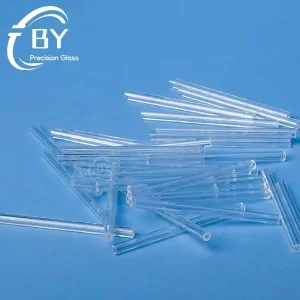
High concentricity and ultra-thin wall uniformity (>98%) achieved via continuous furnace drawing for specialized multi-bore liquid cooling jacket assemblies.
End-to-End Metrology
Interferometric surface testing (Zygo), spectrophotometric verification (PerkinElmer Lambda 1050+), and 100% optical micrometer dimensional validation.
Optical & Physical Properties of Laser Filter Substrates
Engineers must cross-examine refractive index, absorption peaks, thermal expansion, and laser-induced damage thresholds (LIDT) prior to drawing sign-off.
| Substrate Material | Transmission Band | Key Absorption Peak | LIDT (@ 1064nm, 10ns) | CTE (10⁻⁶/K) | Typical Cavity Application |
|---|---|---|---|---|---|
| Samarium-Doped Glass (10% Sm2O3) | ~420 – 1000 nm | 1064 nm (OD > 3.0), UV < 400nm | > 7.5 J/cm² | ~8.5 | Nd:YAG Cavity Flow Tubes & ASE Absorbers |
| Cerium-Doped Fused Quartz | ~380 – 2200 nm | Deep UV < 370 nm (Zero UV solarization) | > 12.0 J/cm² | 0.54 | Flashlamp Sleeves & High-Duty IPL Handpieces |
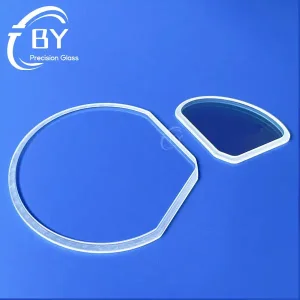
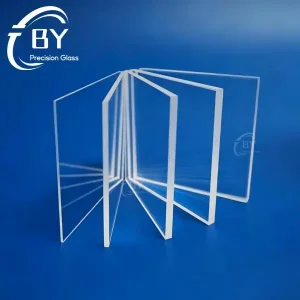
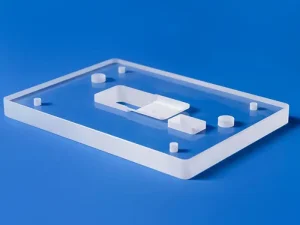
| JGS1 Synthetic Fused Silica | 185 – 2500 nm | None (High UV Purity, Zero Bubble) | > 15.0 J/cm² | 0.55 | Laser Debris Shields, Flow Plates, Excimer Windows |
| JGS2 Fused Quartz | 220 – 2500 nm | Standard UV Cutoff < 210nm | > 10.0 J/cm² | 0.54 | Standard Cooling Tubes, Chemical Sight Windows |
| Synthetic Single-Crystal Sapphire | 170 – 5500 nm | Deep UV / Far IR Edge | > 18.0 J/cm² | 5.8 | Extreme Wear Windows, Cryogenic Viewports, IPL Guides |
| Spectralon-Grade Sintered PTFE | 250 – 2500 nm | None (>99% Diffuse Reflection) | Bulk Scattering | ~100 | DPSS Diode Pump Chambers & Integrating Cavities |
Engineered Application Scenarios & Field Implementations
From high-uptime medical laser dermatology to ultra-clean semiconductor wafer inspection environments.
Medical & Aesthetic Systems
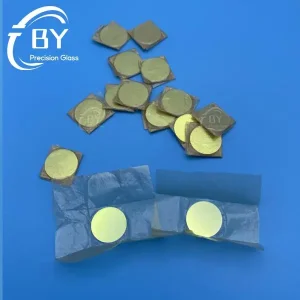
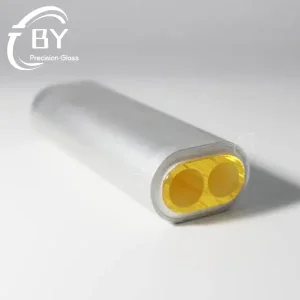
Crucial for Candela GentleLase and VBeam systems. Sm-doped flow tubes and yellow quartz blocks filter harsh flashlamp radiation, preserving 755nm Alexandrite and 1064nm Nd:YAG beam homogeneity during long hair removal and vascular procedures.
Semiconductor & Lithography Inspection
Ultra-pure synthetic JGS1 quartz components machined into wafer carrier boats, diffusion vessels, and laser illumination viewports, guaranteeing zero heavy metal contamination and thermal integrity up to 1,150°C.
High-Power Industrial Cutting & Cladding
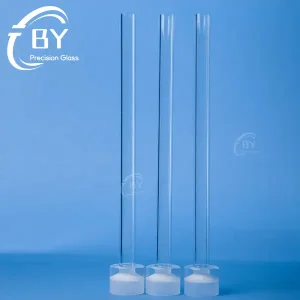
High-reflectivity PTFE diffuse chambers paired with packed concentric laser flow tubes distribute multi-kilowatt diode pumping power evenly into the Nd:YAG or Yb:YAG crystalline medium with zero hot-spot damage.
Global Sourcing Demands & Solid-State Laser Filter Trends
Addressing the shifting landscape toward ultrafast picosecond/femtosecond oscillators, harmonic separators, and closed-loop custom fabrication.
Global procurement teams across North America, Germany, Japan, and Israel have shifted their vendor evaluation criteria from simple unit cost toward Design-for-Manufacturability (DFM) verification, batch-to-batch spectral consistency, and certified optical packaging. Key market demands shaping this sector include:
1. Transition Toward High-Power Ultrafast Laser Machining
The proliferation of picosecond and femtosecond lasers in smartphone glass dicing, EV battery foil cutting, and medical stent fabrication demands laser filters capable of enduring extreme electric field peak powers. Optical filters are now required to maintain surface roughness under 0.5nm Ra with super-polished finishes (10-5 scratch-dig) to prevent sub-surface micro-cracking from seeding catastrophic dielectric breakdown.
2. Stringent Environmental & Chemical Endurance
Laser cavity cooling water contains active de-ionizing resins and anti-corrosion additives that circulate at elevated temperatures and pressures. Traditional coated optical filters experience thin-film delamination and pinhole oxidation over 1,500 hours of operation. Modern procurement specifications dictate bulk-doped samarium and cerium substrates where the spectral absorption properties reside inside the glass matrix itself, completely immune to fluidic stripping or film peel-off.
3. Direct Engineering Communication & Rapid Rapid Prototyping
System designers require rapid design turns. BY Photonics pairs client engineers directly with a senior process optical engineer, delivering complete manufacturability reviews within 24 hours of STEP, DWG, or PDF drawing receipt. This feedback ensures that radius transitions, flow notch depths, and chamfer profiles are optimized for diamond tooling before raw glass stock is cut.
Engineered Quartz, Sapphire & Reflector Components (Set 2)
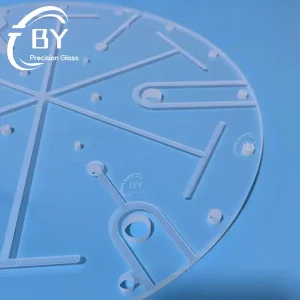
Explore custom quartz fabrication, high-purity semiconductor boats, QBH end caps, and ceramic diffuse reflectors crafted to exact OEM prints.

Engineering Questions Answered by BY Photonics Specialists
Detailed insights on material specifications, custom samarium concentrations, tolerances, and quality certifications.
Request an Engineering Feasibility Review Within 24 Hours
Send your CAD files or technical PDF drawings directly to our optical engineering desk. Receive immediate DFM feedback, material grading advice, and scalable volume factory pricing.