Precision Optical Components Portfolio
Explore high-performance optical glass, diffuse reflectors, and specialized laser hardware manufactured in our facility.
Technical Whitepaper: Diffuse Ceramic Cavity Reflectors
Comprehensive engineering insights on why porous high-purity alumina ceramics supersede metallic gold plating in continuous-wave and pulsed solid-state laser pump modules.
1. Optical Coupling Mechanisms & Lambertian Scattering
In solid-state laser engineering (Nd:YAG, Alexandrite, Er:YAG, and Ruby lasers), the pumping cavity reflector is tasked with coupling flashlamp or laser diode radiation into the active gain medium with minimal energy dissipation. Conventional specular reflectors (e.g., polished metal or gold coatings) rely on directional reflection, which frequently induces optical aberrations, hot-spot generation, and thermal lensing along the gain crystal's diameter.
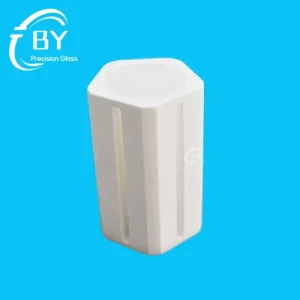
BY Photonics manufactures porous ceramic cavity reflectors based on high-purity 99.7% Al₂O₃ (Alumina) with an engineered controlled micro-porosity (15% to 22%). This internal microstructure causes multi-path volumetric refraction and reflection, generating true Lambertian diffuse reflection. The pump light envelope distributes symmetrically around the laser rod, eliminating non-uniform gain saturation, mitigating thermal birefringence, and drastically enhancing laser beam quality (M² factor).
2. Glazed vs. Unglazed Reflective Surface Optimization
To meet diverse mechanical and optical demands across medical and military environments, we offer both fully glazed and unglazed cavity reflectors:
Glass-Glazed Ceramics
Sealed with a chemically inert, high-refractive-index glass glaze. Impervious to deionized cooling fluids, preventing mineral particle deposition and coolant leaching. Ideal for long-pulse flashlamp systems.
Unglazed Diffuse Ceramic
Offers the absolute highest bulk diffuse reflectance (up to 99.2% across 600-1100 nm). Excellent for dry diode-pumped systems and sealed cavities where maximum photon recycling is mandatory.
Custom Multi-Bore Blocks
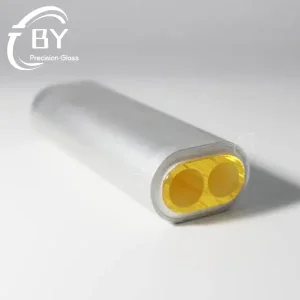
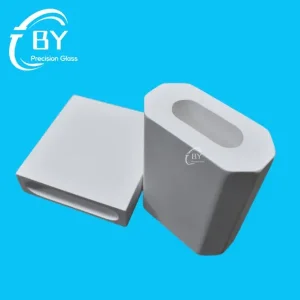
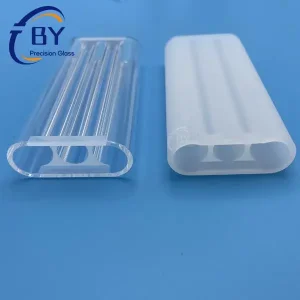
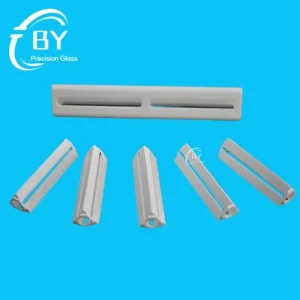
Monolithic engineering supporting single, double, triple, or quadruple bores. Accommodates simultaneous routing of flashlamps, flow tubes, pyrometers, and active crystal rods.
3. Physical & Optical Material Properties Reference
| Physical / Optical Parameter | Standard Specification | BY Photonics Enhanced Metric |
|---|---|---|
| Al₂O₃ Purity Level | 95.0% - 97.0% | ≥ 99.7% (Trace Fe/Ti < 50 ppm) |
| Diffuse Reflectance (500–1200 nm) | 95.0% - 97.0% | ≥ 98.5% - 99.2% |
| Bulk Density (g/cm³) | 3.60 - 3.75 | 3.10 - 3.25 (Optimized Porosity) |
| Thermal Conductivity (W/m·K @ 20°C) | 18 - 22 | 25.0 - 28.0 |
| Dielectric Strength (kV/mm) | > 10 | ≥ 18.0 (High-voltage flash breakdown proof) |
| Dimensional Machining Tolerance | ±0.1 mm | Down to ±0.02 mm via Diamond CNC |
Localized Application Scenarios
Engineered ceramic cavities tailored to localized industrial standards, healthcare compliance, and advanced research worldwide.
Aesthetic & Medical Clinics
Critical core inside 755nm Alexandrite and 1064nm Nd:YAG hair removal and tattoo clearance consoles (e.g., Candela, Cynosure replacement blocks). Sustains continuous pulse duty cycles without yellowing or thermal degradation.
Aerospace & Defense LIDAR
Integrated into diode-pumped solid-state (DPSS) target designators and rangefinders. Survives extreme mechanical vibration, -40°C to +85°C thermal shocks, and high-altitude radiation environments.
Industrial Laser Micro-Processing
Delivers exceptional gain consistency for thin-metal seam welding, precision jewelry engraving, and solar cell scribing systems operating 24/7 on high-throughput manufacturing lines.
Semiconductor Metrology & Inspection
Integrated in deep ultraviolet (DUV) and laser-sustained plasma light sources where thermal dissipation, chemical inertness, and zero organic outgassing are strictly enforced under high vacuum.
Supply Chain Resilience & Tianjin Factory Scale
Combining vertically integrated raw powder synthesis, precision isostatic pressing, vacuum sintering, and CNC diamond milling under one roof.
Raw Material Security
Direct supply contracts with ultra-pure alumina mineral producers eliminate upstream raw material volatility. Our factory stockpiles over 6 months of structural ceramics and fused silica reserves.
Comprehensive Quality Traceability
Every cavity block is assigned a distinct lot identification tracking its green body density, sintering temperature profile, and coordinate measuring machine (CMM) dimensional verification report.
Speed to Market (DFM to Pilot)
Our localized tooling and mold prototyping workflow compresses sample turnarounds from months to days. Rapid iterative pilot runs allow western OEMs to derisk new designs rapidly.
Global Commercial & Industrial Landscape
Market dynamics, supply chain transition trends, and strategic OEM procurement insights.
Shift Away from Precious Metals
Rising gold prices and environmental regulations governing electroplating baths have accelerated the transition of medical and industrial laser builders toward recyclable, durable diffuse ceramic cavity reflectors.
Surging Aesthetic Laser Aftermarket
With millions of aesthetic hair removal machines installed across North America and Europe requiring maintenance, certified aftermarket replacement chambers provide OEM-grade fidelity at 40-60% lower ownership cost.
Strategic Dual-Sourcing Mandates
Tier-1 photonics enterprises are systematically diversifying outside of single European ceramic suppliers, establishing audited direct-factory agreements with qualified Chinese precision manufacturers like BY Photonics.
Technology Roadmap & Future Outlook
Pioneering advancements in advanced laser ceramics and composite optical thermal management.
Phase 1: Nanoscale Sintering
Implementing sub-micron raw Al₂O₃ powders to achieve tighter pore dimension distribution, enhancing mechanical flexural strength above 350 MPa without compromising diffuse reflectivity.
Phase 2: Rare-Earth Doped Glazes
Formulating specialized glazes incorporating Samarium (Sm) and Cerium (Ce) ions directly into the glaze layer to absorb harmful UV and 1064nm amplified spontaneous emission (ASE) within a single component.
Phase 3: Ceramic 3D Printing
Pioneering Stereolithography (SLA) additive manufacturing for alumina ceramics, allowing conformal fluid cooling channels inside monolithic cavity bodies impossible with conventional tooling.
Phase 4: Silicon Nitride Hybrids
Researching hybrid ceramic matrices pairing high diffuse reflectivity with the fracture toughness and extreme thermal shock tolerance of Si₃N₄ for high-kilowatt defense and industrial engines.
Localized Support & Global Regulatory Compliance
Ensuring complete peace of mind through strict technical documentation, export safeguards, and environmental adherence.
RoHS & REACH Directives
All ceramics, sealing glasses, and optical glazings undergo rigorous third-party SGS/TÜV testing, certifying complete absence of lead, cadmium, mercury, and toxic volatile substances.
Inspection & CMM Certificates
Shipments are accompanied by comprehensive dimensional inspection records, spectrophotometric reflectance charts, and surface roughness interferometry profiles per request.
Custom Engineered Cushion Packing
Brittle ceramic components are packed in custom CNC-milled anti-static high-density EPE foam cradles and vacuum-sealed packaging to guarantee zero micro-fracturing during global transit.
Dedicated Engineering Support
Collaborate directly with our senior process engineers. We evaluate your STEP, IGES, or DXF files to optimize cavity radii, lamp-rod separations, and mounting flange configurations before production.
Frequently Asked Technical Questions (FAQ)
Precise engineering and procurement answers for optical system integrators.
Why is a ceramic cavity reflector preferred over gold-coated or silver-coated metallic cavities?
What is the standard manufacturing lead time for custom prototype ceramic cavities?
How does the glaze layer affect the diffuse reflectance performance?
Can BY Photonics machine complex cooling channels and sensor ports directly into the ceramic block?
What file formats and parameters are needed for a comprehensive DFM review?
Specialized Laser Cavity & Semiconductor Quartzware
Explore additional manufactured components supporting industrial lasers, semiconductor wafer processing, and optical metrology.