High-Precision Capillaries & Laser Core Components
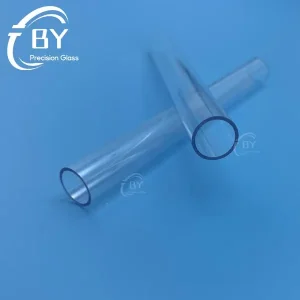
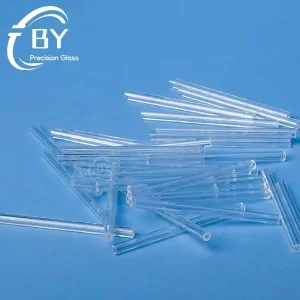
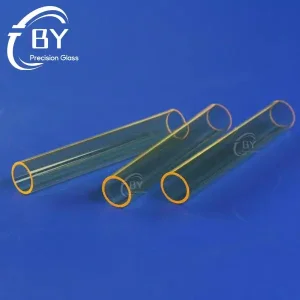
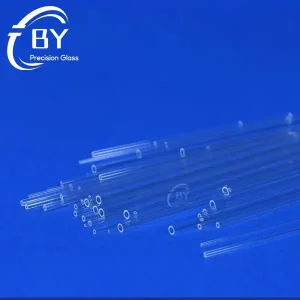
Direct supply from state-of-the-art redrawing towers and optical cold-working facilities. Browse our primary engineered capillary solutions and specialized laser cavity components.
Engineering Fundamentals: Optical Physics of Fluorine-Doped Capillaries
Fluorine acting as an electronegative substitutional dopant inside amorphous silica networks radically alters glass physics. Understanding down-doping behavior is vital for designing high-power fiber optic combiners, inner-cladding light strippers, and bio-photonic waveguides.
Refractive Index Depressed Cladding
By substituting bridging oxygen atoms in SiO₂ tetrahedral clusters with monovalent fluorine atoms (Si-F), the polarizability of the glass network drops. This down-dopes the refractive index (Δn ranging from -0.003 to -0.025 relative to pure synthetic quartz), creating ideal low-index cladding tubes for double-clad fiber assemblies.
Radiation Hardness & Solarization Defiance
Standard synthetic silica with high hydroxyl (OH) or chlorine radicals suffers solarization defects under deep UV and gamma radiation. Homogeneous fluorine doping passivates strained bonds within the glass lattice, preventing color-center formation (E' centers) in aggressive ultraviolet radiation environments.
Thermomechanical Structural Integrity
Precision redrawn fluorine-doped fused silica tubes retain a near-zero thermal expansion coefficient (~5.5 × 10⁻⁷ /°C). This matching coefficient eliminates thermal shock fracture during high-temperature capillary fusion splicing, glass-to-glass collapsing, and high-vacuum baking processes.
Commercial Status: Industrial Laser Escalation & Microfluidics Boom
The global demand for down-doped capillaries has surged by 18.4% CAGR over recent cycles. As kilowatt-class fiber laser outputs climb toward 20kW+ and single-cell genomic sequencing demands zero-fluorescence analytical conduits, high-purity fluorine capillary fabrication represents an essential strategic commodity.
| Industrial Sector | Core Application Mode | Primary Technical Requirement | Key Advantage of Fluorine Doping |
|---|---|---|---|
| Multi-Kilowatt Laser Processing | (N+1)×1 Pump Combiners & Cladding Light Strippers (CPS) | Ultra-low insertion loss, zero absorption at 915/976 nm pump bands | Guarantees total internal reflection within the silica core; eliminates pump leak burning |
| Biomedical Flow Cytometry | Hydrodynamic Cell Sorting & Fluorescence Detection Flow Cells | Zero autofluorescence under 355 nm / 405 nm excitation lasers | Pure synthetic glass base avoids background photon noise; flawless laser polishing |
| Capillary Electrophoresis (CE) | On-column Spectrophotometric Separation & Bio-analytical Assay | Precision bore roundness (ID 20 µm to 100 µm) & chemically inert inner wall | Prevents sample wall-adsorption; maintains linear flow kinetics across micro-channels |
| Extreme Harsh Environment Sensing | Distributed Acoustic & Downhole Fiber Sensor Packaging | Hermetic sealing, chemical resistance against H₂S and high hydrostatic pressure | Radiation hardened and zero hydrogen darkening compared to germanium-doped silica |
Why Tier-1 Global Integrators Partner with BY Photonics in China
Combining raw synthetic soot chemistry with advanced redrawing towers in Tianjin, we eliminate overseas supply bottlenecks. Our specialized cold and hot glassworking infrastructure delivers unrivaled production velocity, stringent quality control, and scalable cost-efficiency.
Vertical Upstream Preform Integration
We source directly from high-purity synthetic plasma chemical vapor deposition (PCVD) soot bodies, controlling the radial fluorine gradient before redrawing. This in-house synthesis bypasses third-party rod markup, guaranteeing consistent index uniformity across batch melts.
Multi-Axis Laser Intercept Redrawing
Our Tianjin redrawing lines utilize non-contact online multi-axis laser micrometer gauge feedback. Microprocessor systems adjust take-up capstans dynamically within milliseconds, maintaining tight sub-micron tolerances for ID and OD across hundreds of meters.
Dual Cold-CNC & Oxyhydrogen Finishing
Unlike simple pulling shops, we host 5-axis ultrasonic CNC machinery and precision oxyhydrogen micro-torches under one roof. We deliver capillaries with ultra-flat cleaved, polished angle facets (0° to 8°), funnel flared inputs, or sealed optical ends.
Overcoming Common OEM Failure Modes in High-Power Assemblies
Global procurement teams transition to our specialized fluorine capillaries to resolve recurring production failure modes. Here is how our production techniques prevent common manufacturing defects.
Failure Mode: Interface Micro-Bubbles During Splicing
The Cause: Non-uniform fluorine distribution or residual air entrapment during manual bundling leads to thermal bubble nucleation at 1650 °C fusion temperatures.
BY Photonics Solution: Surface fire-polishing with controlled gas-phase chemical etching eliminates microscopic micro-voids, yielding 100% blister-free collapse during fiber combiner fusing.
Failure Mode: High Optical Loss at Cladding Strippers
The Cause: Refractive index drift (Δn offset) along the longitudinal tube axis causes unexpected mode leakage and destructive thermal hotspots.
BY Photonics Solution: Continuous refractive-profiler monitoring confirms refractive index consistency within ±0.0003 across every production spool, protecting assemblies against catastrophic burnouts.
Failure Mode: Flawed Fluidic Chromatography Alignment
The Cause: Ovality and inner diameter bore eccentricity warp laminar flow profiles and alter light-path calculations in UV capillary spectrometers.
BY Photonics Solution: Micro-geometric roundness controls keep inner bore roundness errors below 0.5%, matching high-performance HPLC and CE chromatography requirements.
Frequently Asked Questions on Fluorine-Doped Capillaries
Technical guidance direct from our engineering desk covering optical doping, precision tolerances, and manufacturing capabilities.
Our standard production achieves down-doped refractive index steps of Δn = -0.005, -0.010, and -0.015 relative to undoped pure synthetic fused silica. Upon specialized engineering requests, deep-fluorine doping techniques can yield a Δn depression down to -0.025 to achieve higher numerical apertures in cladding structures.
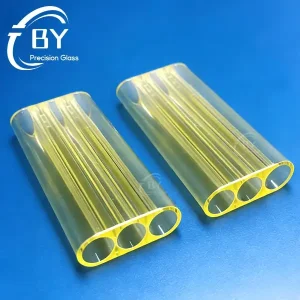
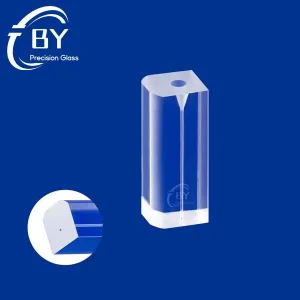
Yes. Beyond standard round single-bore capillary tubes, our hot-working and precision redrawing towers produce square, rectangular, D-shaped, hexagonal inner bores, and multi-bore (2 to 7 bore) configurations tailored directly to CAD manufacturing drawings.
Standard profile samples with existing tooling require 7 to 10 days. Fully customized redrawn profiles involving dedicated preform tooling, bespoke dopant concentrations, and tight optical polishing are delivered within 3 to 4 weeks worldwide, supported by complete CMM and optical transmission reports.
Unlike standard fused quartz which exhibits accelerated solarization and UV absorption degradation at 248 nm or 193 nm, our high-purity fluorine-doped silica suppresses structural defect precursors. This enables extended service lifetimes in excimer laser optics, semiconductor lithography, and analytical instruments.
Complementary Laser Cavity, Quartzware & Optical Components
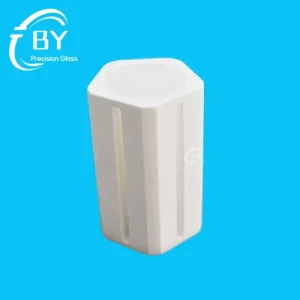
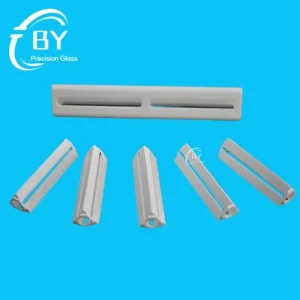
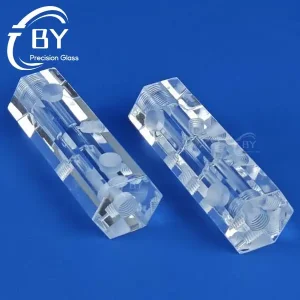
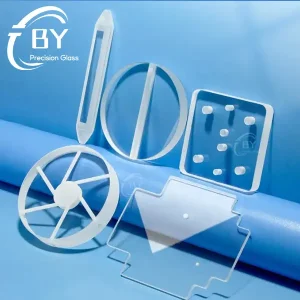
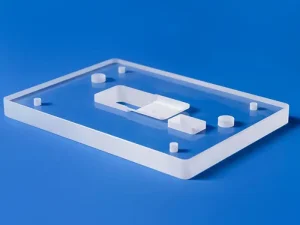
Explore our extended catalog of advanced quartzware, UV-blocking flow tubes, diffuse pump reflectors, and precision optical assemblies manufactured in our certified facility.