
Standard & Custom Optical Quartz Components
Engineered to survive extreme UV exposure, high thermal gradients, and aggressive chemical environments.
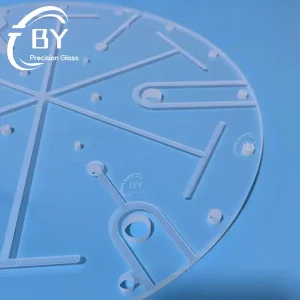
High-Quality Custom Precision Quartz Glass Fabrication
View Specifications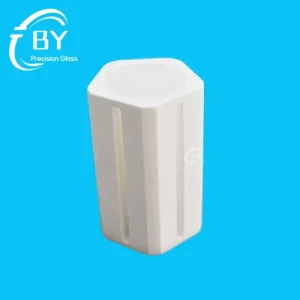
Diffuse High‑Reflectivity PTFE Reflectors for Diode Chambers
View Specifications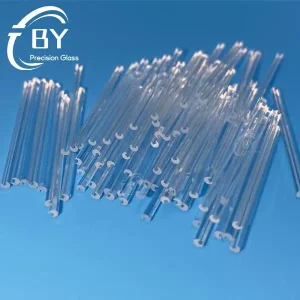
Quartz Substrate Groove For Optical Fiber Coupler
View Specifications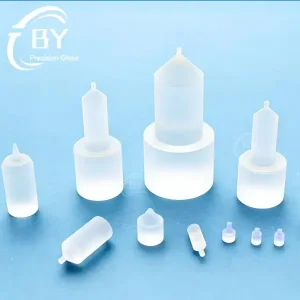
Customized Quartz Fiber End Caps for QBH Systems
View Specifications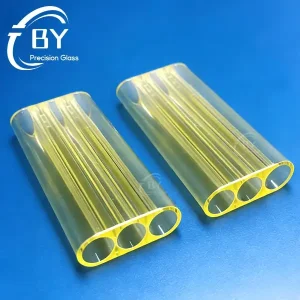
Samarium-doped Quartz Triple Bore for Medical Laser
View Specifications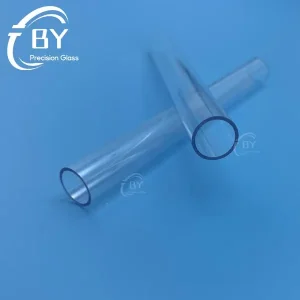
Cerium Doped Quartz Tube (Blocked UV Range)
View Specifications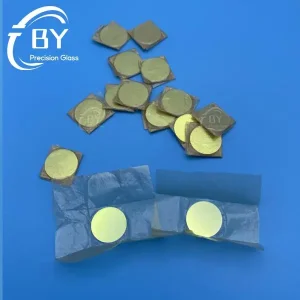
Laser Distance Gauge Slider Windows (755/1064nm)
View Specifications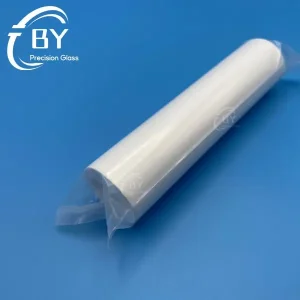
VBeam Laser Cavity Ceramic Reflector Assemblies
View SpecificationsMacro-Industrial Dynamics of Machining Quartz Glass
Analyzing high-precision fused silica supply chains, yield bottlenecks, and semiconductor-driven demands.
Semiconductor Fab Scale & Scaling
Global semiconductor fabrication is driving unprecedented demand for machined quartz consumables. High-aspect diffusion boats, etching rings, and chemical vapor deposition (CVD) injectors require zero trace metal contamination (<0.1 ppm) to maintain yield tolerances in sub-7nm node manufacturing.
Thermal Shock & Plasma Resilience
Synthetic fused silica (JGS1) and electrically fused natural quartz (JGS2/JGS3) display a coefficient of thermal expansion (CTE) of approximately 5.5 × 10⁻⁷ /°C. This allows machined windows and carriers to withstand thermal shock from 1100°C to ambient water quench without micro-fracturing or dimensional creep.
Precision Subsurface Damage (SSD) Control
Unlike standard borosilicate or optical crowns, mechanical glass removal via diamond grinding creates subterranean microcracks. Leading-edge aerospace and laser cavity designs now enforce ultra-low SSD specifications, demanding a multi-tier cycle of ultrasonic-assisted grinding, fine chemical lapping, and stress-relieving oxyhydrogen flame polishing.
Why Tier-1 OEM Engineers Rely on BY Photonics
Integrating raw boule sourcing, hot oxyhydrogen blowing, and 5-axis CNC machining under one roof in Tianjin.
Unified Hot & Cold Workflows
Most Western machine shops outsource either the hot flame welding or the deep CNC boring. BY Photonics combines automated CNC multi-axis milling, diamond wheel slotting, chemical lapping, and hand-blown oxyhydrogen furnace fusion under an ISO-controlled factory environment, drastically reducing cumulative lead times.
Total Raw Ingot Vertical Integration
We maintain an active registry and stockpile of optical-grade raw stocks: synthetic JGS1 (deep UV transmission down to 185nm), fused quartz JGS2, and anhydrous JGS3 (low hydroxyl content <2 ppm for infrared laser stabilization up to 3500nm). This eliminates supply volatility and ensures rapid prototype turnover.
Aggressive DFM & Engineering Speed
Our cross-disciplinary CAD/CAM engineers review critical tolerance budgets within 24 hours of submission. We provide automated suggestions on radius reliefs, kerf lines, surface bevels, and crack propagation inhibitors to transform theoretical laboratory prints into robust, volume-manufacturable optical hardware.
Machining Quartz vs. Alternative Hard Substrates
A multi-parameter evaluation matrix for optical physicists and procurement directors.
| Substrate Material | Transmission Band | Thermal Expansion (CTE) | Mohs Hardness | Critical Machining Vulnerabilities | Primary Industrial Applications |
|---|---|---|---|---|---|
| JGS1 Synthetic Fused Silica | 185 – 2500 nm | 0.55 × 10⁻⁶ /K | 5.5 – 6.5 | Subsurface microcracking from mechanical feed | Excimer laser optics, lithography masks, UV cuvettes |
| JGS2 Fused Quartz (Natural) | 220 – 2500 nm | 0.55 × 10⁻⁶ /K | 5.5 – 6.0 | Gas bubble seeds, striation lines | Furnace diffusion tubes, sight ports, laser cavities |
| JGS3 Infrared Grade Quartz | 260 – 3500 nm | 0.55 × 10⁻⁶ /K | 5.5 – 6.5 | OH absorption bands (must stay <5 ppm) | IR spectroscopy, thermal pyrometers, gas detectors |
| Single-Crystal Sapphire (Al₂O₃) | 170 – 5500 nm | 5.8 × 10⁻⁶ /K | 9.0 | Extreme tool wear, crystallographic cleavage | IPL skin contact blocks, ultra-high pressure windows |
| Borosilicate (Borofloat 33) | 350 – 2500 nm | 3.25 × 10⁻⁶ /K | 6.0 | Thermal shock failure above 450°C | Capillary fluidics, low-stress sight glasses |
Mission-Critical Use Cases in Advanced Systems
Custom geometries deployed globally in extreme operating environments.
Aesthetic & Medical Solid-State Lasers
Solid-state Nd:YAG, Alexandrite, and Holmium laser heads require specialized cooling manifolds. We machine Samarium-doped (Sm-doped) triple bore and flow tube filters that attenuate 1064nm parasitic oscillations and suppress unwanted 400nm flashlamp lines, preventing premature thermal blooming and laser crystal degradation.
Semiconductor Front-End Wafer Racks
Modern diffusion furnaces require quartz boats and wafer carriers fabricated with tight slot pitch tolerances (±0.05 mm) to avoid wafer jamming during automatic robotic loading. Oxyhydrogen fire polishing removes edge serrations to prevent particle dusting during repeated 1000°C thermal cycles.
Microfluidic & Analytical Capillary Arrays
Utilizing high-precision multi-bore redrawing towers, our factory processes single, double, triple, and hexagonal bore capillaries with inner bore tolerances controlled to <1.5 microns. These components are vital for capillary electrophoresis, DNA sequencing arrays, and fiber optic array splitters.
Emerging Trends & Global Procurement Drivers
Strategic directions impacting engineering specifications and delivery timelines through 2030.
Shift to Plasma-Resistant Doped Silica
Halogen etching gases (NF₃, CF₄) degrade conventional fused silica window surfaces, causing premature clouding and particle shedding. Next-generation fabs are shifting toward rare-earth and nitrogen-doped silica alloys that show up to a 300% extension in service lifetimes within aggressive dry-etch chambers.
Integration of Spectralon & PTFE Cavities
Laser pump efficiency demands the substitution of gold-coated metal cavities with sintered diffuse PTFE and high-purity laser ceramics. Offering diffuse reflectance rates above 99.2% from 400nm to 1100nm, these reflectors remove uneven pumping hot spots and resist chemical oxidation.
Digital Traceability & Clean Packaging
Global procurement teams now require cleanroom level-100 handling, ultrasonic surfactant washing, and vacuum heat-sealed nitrogen packaging directly from the manufacturer. Full material pedigree records, along with spectrophotometer transmission curve charts, are standard for every production lot.
Frequently Asked Questions by Optical Engineers
Clear, direct guidance covering critical properties, tolerances, and procurement options.
What is the definitive functional difference between JGS1, JGS2, and JGS3?
JGS1 is synthetic fused silica manufactured via silicon tetrachloride hydrolysis. It offers zero bubble inclusion, high transmission down to 185nm (Deep UV), and low fluorescence. JGS2 is melted natural quartz crystals for high-temperature visible and near-UV use (down to 220nm). JGS3 is electrically fused in a vacuum, reducing hydroxyl (OH⁻) content to <2-5 ppm. This eliminates the strong 2730nm absorption band, making it ideal for Mid-IR lasers and sensors.
How do you mitigate chipping and micro-cracking during CNC milling of quartz?
We use high-speed electroplated diamond tooling alongside multi-axis ultrasonic vibration machining (USM). Ultrasonic oscillation reduces cutting forces by up to 40%, preventing edge chipping on brittle quartz edges. Finished parts undergo secondary chemical acid etching to eliminate subsurface residual stresses.
Can machined quartz glass components be welded to borosilicate tubes?
Direct welding is not possible due to thermal expansion mismatch (Quartz CTE: 0.55 × 10⁻⁶ /°C vs. Borosilicate CTE: ~3.3 × 10⁻⁶ /°C), which causes catastrophic cracking upon cooling. To join these materials, we create graded-seal glass transitions using multiple intermediate expansion glasses to safely bridge the thermal differential.
What surface finishes can BY Photonics hold on polished custom windows?
We routinely deliver double-sided optical polishing with surface figures of λ/4 to λ/10 per inch @ 632.8nm, surface roughness Ra < 0.5nm (super-polishing), and scratch-dig specifications conforming to MIL-PRF-13830B down to 10-5 for high-energy laser optics.
How are custom quartz components inspected before international dispatch?
Every lot is verified using Zygo phase-shifting laser interferometers for wavefront error, PerkinElmer Lambda UV/Vis/NIR spectrophotometers for transmission verification, coordinate measuring machines (CMM) for 3D profile tolerances, and cross-polarization polariscopes to confirm zero internal thermal stress.
What file formats should be provided for an engineering quotation?
We accept 3D models in STEP (.stp), IGES (.igs), and Parasolid (.x_t) formats alongside 2D engineering PDFs detailing critical datum schemes, geometric tolerances (GD&T), optical surface ratings, and chamfer requirements. Quotations are returned within 24 business hours.
High-Precision Assemblies & Semiconductor Quartzware
Specialty fabrication including laser flow assemblies, lithography windows, and sapphire blocks.
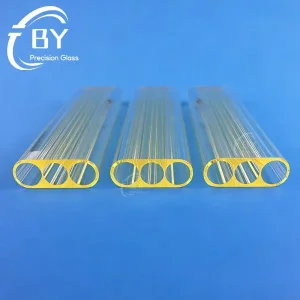
Samarium-Doped Glass Flow Tubes & Filters
View Specifications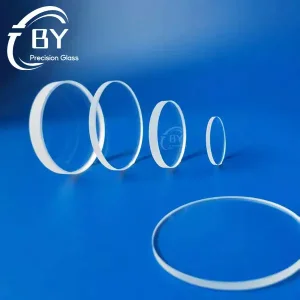
Quartz Optical Windows for Semiconductor Lithography
View Specifications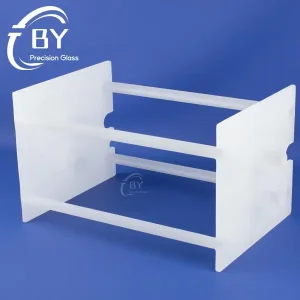
Quartz Diffusion Boat for High-Temp Semiconductor Lines
View Specifications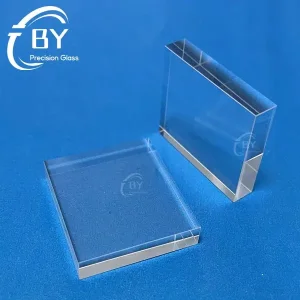
Sapphire IPL Light Guide Block for Aesthetic Handles
View Specifications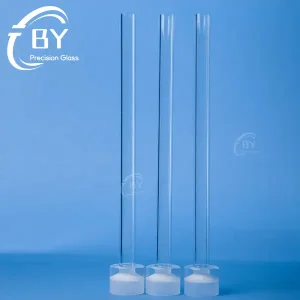
Chemical Resistant Custom Quartz Glass Parts Fabrication
View Specifications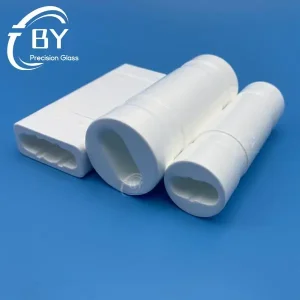
Ceramics Reflector for Semiconductor Diode Lasers
View Specifications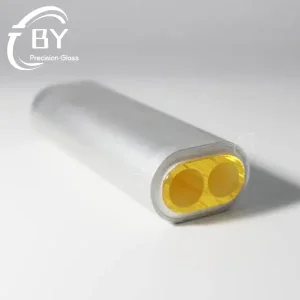
Custom Packed Laser Cavity Flowtubes for Laser Heads
View Specifications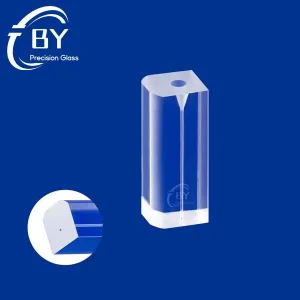
Precision Custom Fiber Optic Glass Ferrules
View SpecificationsRequest an Advanced DFM Engineering Review
Avoid expensive tolerance traps and material re-specifications. Upload your CAD drawings (STEP, IGES, DXF) to our engineering team in Tianjin for a rapid manufacturability check, raw material optimization review, and volume pricing breakdown within 24 business hours.