Precision Micro-Optics & Laser Glass Inventory
Engineered to sub-micron optical tolerance standards for demanding high-temperature, laser excitation, and analytical workflows.

Global Commercial & Industrial Landscape for Precision Quartz Multiwell Plates
A technical overview of material purities, spectroscopic thresholds, and the paradigm shift from polymer disposable substrates to reusable monolithic fused silica.
Deep-UV Optical Transmission
Standard polystyrene and cyclic olefin copolymer (COC) microplates suffer from catastrophic autofluorescence and heavy absorbance cutoffs below 300 nm. Synthetic UV-grade fused silica (JGS1) maintains exceptional transmittance (>90% at 200 nm), enabling direct nucleic acid quantification (A260/A280) and label-free protein assays without background photon interference.
Zero Autofluor & Signal-to-Noise Ratio
In high-content screening (HCS) and single-molecule fluorescence assays, raw background noise limits analytical sensitivity. Optical grade quartz features an amorphous crystalline SiO₂ purity greater than 99.99%, eliminating plasticizers, trace catalysts, and mold-release contaminants that corrupt high-resolution confocal laser scanning microscopy.
Dimensional Stability & ANSI/SLAS Compliance
Engineered strictly to ANSI/SLAS 1-2004 through 4-2004 footprint dimensions. Unlike plastic microplates that warp under thermal cycles, our fused quartz plates maintain mechanical tolerances within ±0.05 mm across temperature swings from -80°C cryogenic storage up to 1,100°C furnace ramp profiles, ensuring zero robotic liquid-handler crash risk.
Localized Application Scenarios & Technology Roadmap
From automated drug discovery suites to high-energy physics calibrations, explore how our quartz 96 well microplates empower modern precision science.
Biopharma & High-Throughput Drug Discovery
Facilitates micro-volume compound evaluation, binding kinetics assays, and UV-induced photochemical stability tests. Compatible with aggressive organic solvents like DMSO, chloroform, acetonitrile, and concentrated ketones that melt conventional polymer plates within minutes.
Direct DNA/RNA & Peptide Quantification
Eliminates the requirement for dye-based fluorescence assays by unlocking unhindered 260 nm and 280 nm absorption photometry. Enables clean, repeatable measurements with complete thermal autoclave sterilization and acid stripping capabilities.
Future Roadmap: Optical Hydrophobic Silanization
Upcoming iterations incorporate chemical vapor deposition (CVD) coatings and microfluidic integration directly on fused silica substrates, preventing sample meniscus distortion and mitigating cross-contamination in picoliter liquid handling workflows.
Supply Chain Resilience & In-House Manufacturing Dominance
Combining vertically integrated raw boule selection, multi-axis micro-ultrasonic milling, and stress-free thermal fusion under one roof in Tianjin, China.
Monolithic Optical Diffusion Bonding
Unlike lower-tier suppliers utilizing UV-curable optical adhesives that leach into samples or degrade under solvent exposure, our 96 well quartz plates feature proprietary molecular diffusion bonding or monolithic high-precision CNC cavity carving, ensuring 100% pure silica integrity across every well junction.
Cost Efficiency & Scalable Batch Turnaround
By coupling localized high-purity synthetic ingot production with automated grinding and chemical mechanical planarization (CMP), we reduce delivery lead times by up to 60% compared to Western optical boutiques, scaling seamlessly from customized prototypes to thousands of batch units.
Rigorous Metrology & Quality Traceability
Every plate undergoes interferometric surface flatness evaluation (Zygo phase-shifting), spectroscopic transmission verification, and laser profilometry to ensure well bottom thickness uniformities within ±10 µm, guaranteeing pristine focal planes across confocal automated imagers.
Localized Support & International Compliance Assurance
Comprehensive engineering documentation, regulatory certifications, and cleanroom export handling for seamless global laboratory integration.
ISO 9001 & Cleanroom Class 1000 Assembly
Manufactured under strict ISO 9001:2015 quality oversight. Microplates undergo ultrasonic multi-stage surfactant cleaning, ultra-pure deionized water rinses (18.2 MΩ·cm), and cleanroom packaging to eliminate particulate residue prior to clinical deployment.
Dedicated OEM/ODM Customization
Need round-bottom (U-well), flat-bottom (F-well), or V-bottom architectures? Looking for custom well depths, black quartz framing to prevent lateral optical crosstalk, or frosted sidewalls? Our technical staff reviews mechanical drawings within 24 hours.
Direct Engineering Channel & Safe Logistics
Direct communication with optical manufacturing engineers without intermediary sales misinterpretations. Packaged in customized shock-absorbing anti-static foam enclosures, ensuring safe transit via DHL, FedEx, or specialized air freight worldwide.
Frequently Asked Questions (FAQ) - Quartz Microplates
Expert clarifications regarding material specifications, cleaning protocols, and operational parameters.
How does fused quartz compare to optical glass (like BK7) in 96 well plates?
While standard optical glass (such as BK7 or Borofloat) operates efficiently in the visible and near-infrared spectrum (350 nm – 2,000 nm), it exhibits total optical opacity below 320 nm. Fused quartz (specifically synthetic JGS1 silica) transmits down to 185 nm in the deep ultraviolet spectrum, exhibits nearly zero background autofluorescence, and has an exceptionally low coefficient of thermal expansion (5.5 × 10⁻⁷ /°C), ensuring immunity to thermal shock.
Can these quartz microplates be autoclaved and reused repeatedly?
Yes. Unlike single-use polymer plates, high-quality monolithic quartz microplates are engineered for hundreds of autoclave sterilization cycles (up to 134°C steam sterilization) or dry-heat baking up to 500°C. They can be cleaned with aqua regia, piranha solution, or concentrated organic solvents without optical clouding, deformation, or chemical degradation.
What bonding method is utilized between the plate body and the bottom window?
We utilize either monolithic CNC ultrasonic milling from a single thick fused silica block or optical-contact high-temperature diffusion bonding. We do not use adhesives, glues, or resins, thereby eliminating the possibility of organic solvent extraction, leachables, or chemical fluorescence contamination in delicate analytical experiments.
Are these plates compatible with automated robotic microplate readers?
Absolutely. All our quartz 96 well plates are fabricated in strict alignment with ANSI/SLAS microplate standards (ANSI/SLAS 1-2004 through 4-2004). They integrate flawlessly with commercial plate readers, automated plate washers, and robotic arms manufactured by Tecan, PerkinElmer, BioTek, Molecular Devices, and Thermo Fisher.
Complementary Custom Glass & Optical Substrates
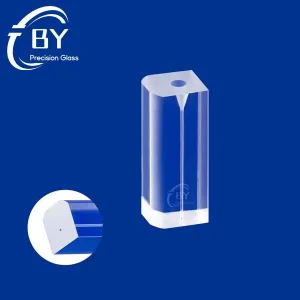
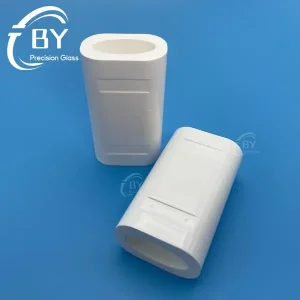
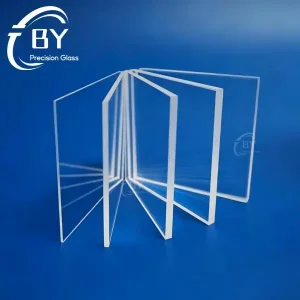
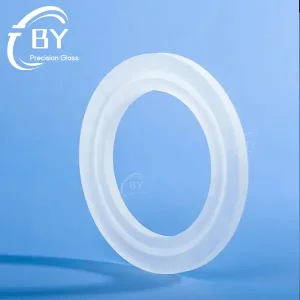
Explore our specialized range of high-temperature quartz fabrications, laser cavity ceramics, and microfluidic components.