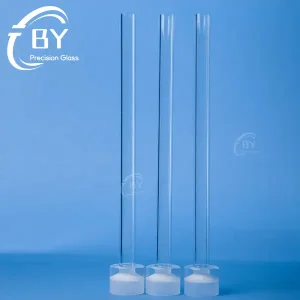
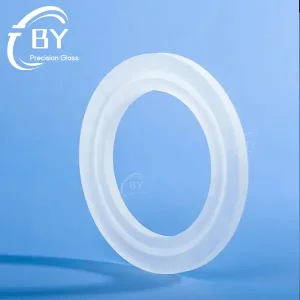
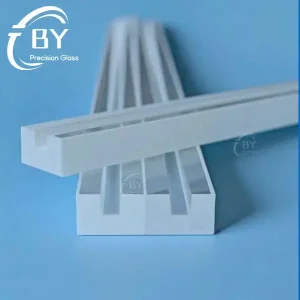
Precision Optical & Quartzware Assemblies
Engineered to extreme tolerances for analytical spectroscopy, laser pumping, and micro-volume fluid handling.

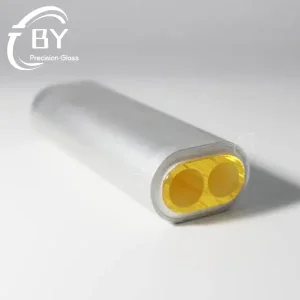
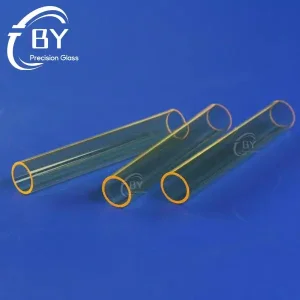
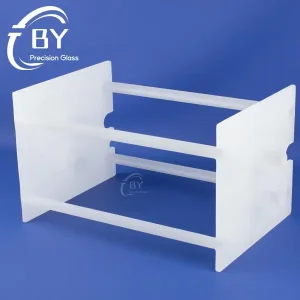
Precision Manufacturing Paradigm of 96-Well Quartz Microplates
High-Throughput Screening (HTS), Next-Generation Sequencing (NGS), and UV-Vis spectrophotometry demand rigorous optical consistency. Conventional polymer-based microplates (polystyrene, cyclic olefin copolymers) often introduce severe background autofluorescence, meniscus distortions, and solvent incompatibility when subjected to short-wavelength deep-UV excitation (190 nm–320 nm). Engineered quartz microplate 96 well assemblies manufactured from synthetic fused silica (JGS1) eliminate these spectral limitations entirely.
Direct-Fusion Thermal Bonding vs. Optical Adhesives
Traditional multi-well plates bonded with epoxy resin frequently fail under organic solvent exposure (such as DMSO, chloroform, or acetonitrile) or during thermal cycling up to 400°C. Leading Chinese quartz manufacturing facilities employ atomic-level molecular direct fusion bonding under high-vacuum hot isostatic pressing. By eliminating adhesive matrices between the polished base plate and the 96 CNC-drilled well sleeves, fluorescence crosstalk is dropped to negligible levels, ensuring absolute baseline linearity across high-sensitivity bioassays.
| Physical Property | Fused Silica JGS1 (Synthetic) | Standard Fused Quartz (JGS2) | Cyclic Olefin (COC/COP) |
|---|---|---|---|
| Deep-UV Cutoff (T > 80%) | 185 nm – 2,500 nm | 220 nm – 2,500 nm | 230 nm (Attenuates below 260nm) |
| Thermal Expansion (CTE) | 5.5 × 10⁻⁷ / °C | 5.5 × 10⁻⁷ / °C | 60 × 10⁻⁶ / °C |
| Autofluorescence (340nm Ex) | Zero / Near Theoretical | Extremely Low | Moderate to High |
| Chemical Compatibility | Universal (Excl. HF/Hot H₃PO₄) | Universal (Excl. HF/Hot H₃PO₄) | Limited (Degrades in Aromatics) |
Well-to-Well Uniformity & Optical Path Length Control
Precision microplate readers operate with tight beam focusing geometries. Variation in bottom plate thickness leads directly to absorbance calculation errors. State-of-the-art factories employ double-sided planetary lapping and chemical-mechanical planarization (CMP) to maintain base flatness within λ/4 per well and thickness tolerance within ±0.02 mm across the entire 127.76 mm × 85.48 mm ANSI/SLAS footprint.
ANSI/SLAS Standard Compliance
Full dimensional compatibility with standard automated microplate readers, robotic liquid handling workstations, and automated plate washers:
- Footprint: 127.76 mm ± 0.25 mm
- Width: 85.48 mm ± 0.25 mm
- Well Pitch: 9.0 mm center-to-center
- Well Bottom Thickness: 1.0 mm / 1.5 mm ± 0.05 mm
- Working Volume: 300 µl – 380 µl per well
- Cleanroom Packaging: ISO Class 6
Why Tier-1 Global Instrument OEMs Partner with Chinese Quartz Factories
Combining complete vertical supply chains, advanced CNC ultrasonic milling, and unmatched cost-efficiency for life science instrument manufacturing.
Upstream Ingot & Boule Synthesis
Direct domestic access to synthetic silicon tetrachloride (SiCl4) raw materials ensures continuous, low-cost production of JGS1 and JGS2 grade fused silica blocks with ultra-low hydroxyl (OH) and bubble class 0 certification.
5-Axis Ultrasonic CNC Machining
Eliminates micro-fractures in brittle quartz. Ultrasonic assisted cutting tools ensure mirror-like well wall finishes, steep perpendicularity, and razor-sharp wall edges, minimizing meniscus reflection artifacts during reading.
Agile OEM & ODM Customization
Rapid prototyping turnaround from initial CAD/STEP models in less than 7 days. Flexible small-batch production for specialized bio-incubator geometries, custom square-to-round wells, or integrated cooling channels.
Macro Industry Solutions & Specialized Application Footprints
Enabling mission-critical data acquisition across drug discovery, genetic synthesis, and laser spectroscopy.
High-Throughput HTS Screening
In compound profiling and enzyme kinetics, 96-well quartz plates resist aggressive solvents like DMSO without leaching plasticizers that skew assay fluorescence.
UV Nucleic Acid Quantification
Enables direct optical density readings at A260/A280 nm for high-throughput DNA/RNA purity evaluation without requiring costly disposable UV-transparent polymer consumables.
Photochemical Synthesis
High thermal stability (up to 1,100°C) allows high-intensity UV irradiation studies, photocatalytic reaction tracking, and in-situ multi-well kinetic testing.
Microfluidic Interface Arrays
Functions as a rigid, low-fluorescence top or bottom manifold for PDMS-quartz microchannel hybrids, droplet digital PCR, and automated cell sorting chips.
Deep-UV Cutoff Wave Range
Precision Well Thickness Tolerance
Surface Flatness Control Per Well
Solvent Chemical Inertness
Navigating Global Sourcing Dynamics for Quartz 96-Well Microplates
Strategic purchasing benchmarks for bio-analytical laboratories, contract research organizations (CROs), and optical device distributors.
Sustainable Reusability Over Disposables
Escalating regulatory scrutiny on single-use plastics in European and North American laboratories has accelerated the procurement of high-durability quartz microplates. When coupled with automated ultrasonic acid cleaning protocols, quartz plates deliver multi-year lifecycle performance, slashing total cost of ownership (TCO) by over 65% compared to recurring premium disposable plates.
Black Quartz Matrix Integration
For ultra-sensitive luminescence and fluorescence assays, optical crosstalk between adjacent wells must be rigorously suppressed. Advanced factories provide opaque black quartz matrix frames thermally fused with clear UV-quartz bottoms, providing complete optical attenuation (>OD 6) between wells without chemical coatings that could delaminate.
Batch Metrology & Quality Traceability
Global procurement teams require comprehensive test certificates. Leading manufacturers provide batch-specific spectrophotometer transmission curves (190 nm to 1,100 nm), 3D optical profilometry surface roughness (Ra < 1.5 nm) reports, and helium leak detection data for sealed quartz structures.
Frequently Asked Questions on Quartz 96-Well Microplates
Direct technical answers addressing dimensional tolerances, material selection, and maintenance.
What is the optical transmission difference between JGS1 and JGS2 quartz in 96-well plates?
How does direct fusion bonding compare to adhesive bonding in quartz microplates?
Are these quartz 96-well microplates compatible with standard automated plate readers?
What is the recommended cleaning procedure for reusable quartz microplates?
Engineered Quartz & Optical System Components
Explore additional high-grade optics and quartzware manufactured in our certified cleanroom facility.