
Precision Engineering Showcase: Section A
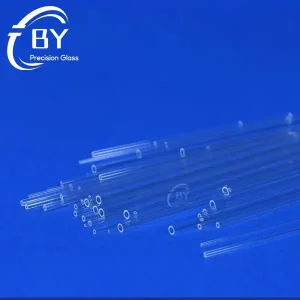
Direct factory supply of precision bore tubes, diffuse reflectors, and specialized doped optical glass ready for OEM system integration.
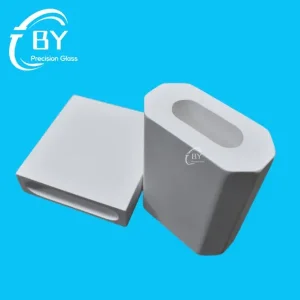
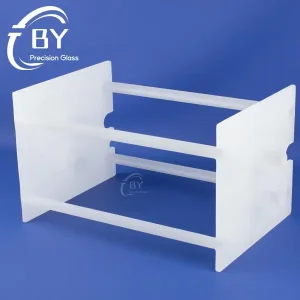
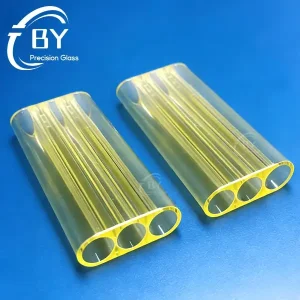
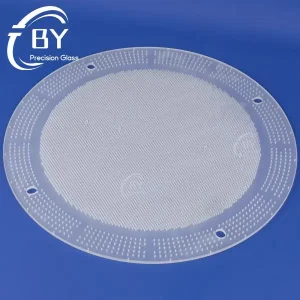
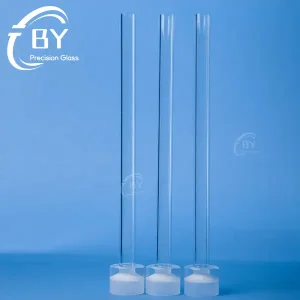
Functional Mechanics of UV Filter Flow Tubes
Eliminating flashlamp-induced solarization, optical degradation, and thermal stress in high-repetition pulsed and continuous laser architectures.
Cut-off Filtration (<380nm & <400nm)
Flashlamps emit intense broadband radiation spanning the deep ultraviolet spectrum. Radiation below 380 nm causes rapid solarization and color-center formation in gain media like Nd:YAG, Cr:Tm:Ho:YAG, and Alexandrite. UV filter flow tubes block destructive actinic radiation while maintaining >90% transmission in peak excitation pumping bands.
Samarium Doping & 1064nm Lasing Suppression
By precision doping quartz or silicate matrices with Samarium Oxide (Sm₂O₃, typically 5% to 10%), the flow tube exhibits high optical absorption around 1064 nm. In high-power medical systems, this prevents amplified spontaneous emission (ASE) and parasitic transverse oscillations from robbing energy away from the main laser output beam.
Hydrodynamic Fluid Boundary Management
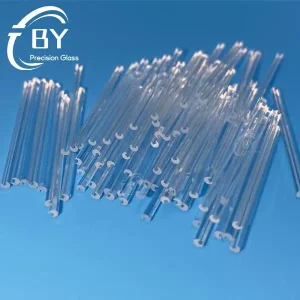
Flow tubes act as fluid pressure channels separating deionized cooling water from optical cavities. Maintaining tight wall runout tolerances (<0.05 mm) and high inside-diameter concentricity prevents turbulent fluid eddies, boundary cavitation, and localized thermal lensing that distorts beam wave-fronts during continuous multi-kilowatt pumping.
The China Manufacturing Ecosystem for Optical Tubes
Combining mineral refining, capillary thermal redrawing, high-purity oxyhydrogen hot-working, and CNC optical machining under one roof in Tianjin.
Rare-Earth Element Direct Integration
China supplies over 70% of global rare-earth refining capacity. Tianjin BY Photonics sources spectroscopic-grade samarium, cerium, and europium directly from high-purity chemical plants. This eliminates international raw-material import tariffs and ensures uniform ion-doping distributions devoid of micro-clustering or thermal hot spots.
Vertical In-House Process Continuity
Unlike Western optical brokers who outsource cold cutting, hot-flame fire polishing, and thin-film anti-reflective (AR) coating to disparate facilities, our 3,000 m² factory controls every phase. Concentricity, fire-edge rounded chamfering, internal mechanical polishing, and Zygo optical metrology happen in a single, accountable pipeline.
Cost Structure & High-Volume Agility
Tooling and custom CNC diamond mandrel costs in China are a fraction of North American or European rates. This enables tier-1 medical OEMs to prototype dual-bore, triple-bore, or flow-plate assemblies in 7 to 10 days, followed by continuous automated batch scaling that reduces unit BOM costs by 35% to 50% without quality degradation.
Comparative Optical Material Matrix for Laser Flow Tubes
Select the optimal substrate based on spectral transmission cutoffs, laser damage threshold (LIDT), and thermal shock parameters.
| Material Grade | UV Cut-Off Range | Primary Laser Interaction | Thermal Expansion (CTE) | Core Industry Applications |
|---|---|---|---|---|
| Sm-Doped Quartz / Glass (10% Sm₂O₃) | Cut-off <380 nm | Suppresses 1064 nm ASE; transmissive to pump bands | 5.5 × 10⁻⁷ / °C | Medical Nd:YAG, Holmium surgical tools, Candela/DEKA systems |
| Cerium / Titanium Doped Quartz | Cut-off <385 nm to 400 nm | Blocks destructive UV radiation; fluorescent pump conversion | 5.4 × 10⁻⁷ / °C | Aesthetic IPL hair removal handles, flashlamp-pumped dye lasers |
| Synthetic Fused Silica (JGS1) | Deep UV Transmitting (>185 nm) | Zero UV absorption; high laser-induced damage threshold (LIDT) | 5.4 × 10⁻⁷ / °C | Excimer laser fluidics, high-purity semiconductor metrology optics |
| Fused Quartz (JGS2 Optical Grade) | Standard UV Cut (>220 nm) | General broadband flashlamp transmission with minimal bubble inclusions | 5.5 × 10⁻⁷ / °C | Industrial laser welding chambers, general flashlamp cooling sleeves |
| Borosilicate (Duran / Pyrex Equiv) | Cut-off <310 nm | Economical UV cutoff; moderate thermal shock endurance | 33 × 10⁻⁷ / °C | Low-power aesthetic instruments, laboratory photochemistry reactors |
Macro Industry Solutions & Localized Application Scenarios
Engineered quartzware and doped glass configurations powering the next wave of industrial, clinical, and semiconductor photonics.
Clinical Dermatology & Surgical Lasers
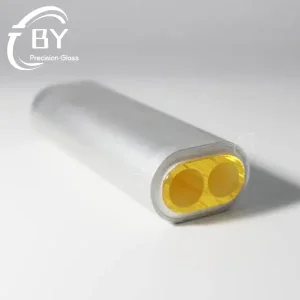
In high-power Alexandrite (755 nm) and Nd:YAG (1064 nm) aesthetic systems (such as Candela GentleLase and DEKA Motus), triple-bore and double-bore samarium-doped tubes serve as precision alignment jackets for the rod and dual flashlamps. They suppress side-mode lasing, isolate high-voltage flash discharges, and provide uninterrupted laminar coolant flow across optical surfaces.
Advanced Semiconductor Wafer Processing
Rapid thermal processing (RTP) and laser spike annealing (LSA) use ultra-high flux flash sources to activate dopants without lattice diffusion. Our ultra-pure titanium-stabilized quartz flow tubes isolate flashlamps from high-vacuum process envelopes, filtering hazardous UV that could induce secondary chemical etching or degrade gate-dielectric interfaces.
Defense, LIDAR & Industrial Machining
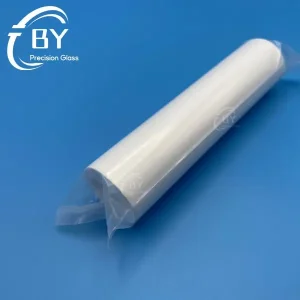
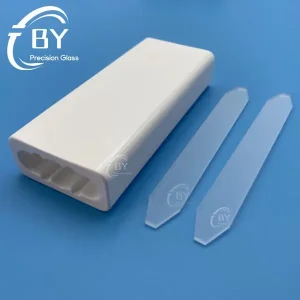
Pulsed laser rangefinders and deep-hole drilling laser heads operate in extreme thermal environments. We produce hardened, chemical-resistant quartz flow jackets and diffuse Spectralon-grade PTFE chambers engineered to withstand high vibrational shocks and continuous heat dissipation cycles exceeding 1,200 watts per linear centimeter.
Addressing Global Tier-1 Procurement Challenges
How our ISO-calibrated manufacturing overcomes the recurring failure modes of budget optical components.
Mitigating Micro-Fractures & Stress Birefringence
The Risk: Inferior flow tubes cut with non-optimized diamond wheels develop sub-surface micro-cracking along edge chamfers. In a pressurized deionized cooling loop, cycling thermal shock causes catastrophic mechanical rupture, flooding the laser cavity.
BY Photonics Mitigation: Every tube undergoes mechanical grinding, flame-edge annealing at 1,150 °C for stress relief, and 100% polariscope birefringence inspection to ensure zero latent crystalline strain.
Concentricity, Wall Uniformity & Beam Drift
The Risk: Wall thickness runout beyond ±0.1 mm turns the cooling tube into an uncontrolled cylindrical lens. As heated coolant passes through, non-symmetrical temperature gradients generate severe beam astigmatism.
BY Photonics Mitigation: Our ultra-precision capillary redrawing lines maintain ID/OD concentricity within ±0.02 mm, supported by dual-axis laser micrometer verification across the entire tube length.
Future Trends in Laser Cooling & Filter Tubes
Next-generation materials and precision architectures evolving to meet ultra-fast kilowatt photonics requirements.
Multi-Dopant Hybrid Glass Matrices
Next-generation clinical lasers increasingly require dual-doping protocols—combining Samarium Oxide (for 1064 nm suppression) with Cerium Oxide (for UV conversion and re-emission at visible wavelengths). This hybrid profile eliminates unwanted ASE while increasing overall electrical-to-optical conversion efficiency by up to 14%.
Integrated Hard-Coating Sputtering (IAD)
Traditional polymer UV filters degrade under prolonged ozone exposure. The market is shifting to pure synthetic silica tubes coated with Ion-Assisted Deposition (IAD) dielectric metal-oxide stacks directly on the inner or outer flow bore. These hard coatings withstand high-temperature turbulent DI water indefinitely without flaking.
Monolithic Complex Microfluidic Shapes
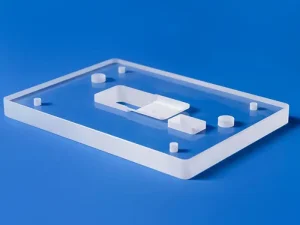
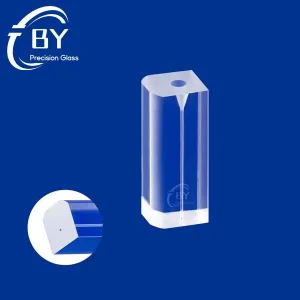
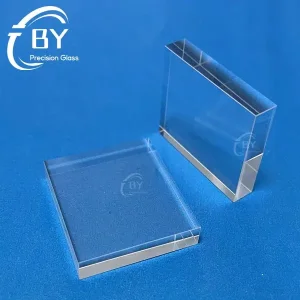
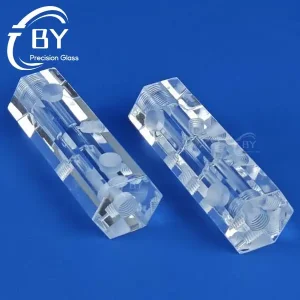
As solid-state lasers shift from circular cylindrical rods to rectangular slabs and thin-disk designs, flow tubes are evolving into custom flat flow plates and polygonal multi-bore structures. CNC 5-axis ultrasonic diamond milling enables BY Photonics to sculpt complex hydrodynamic flow paths inside monolithic glass blocks.
Frequently Asked Questions (FAQ)
In-depth responses covering dimensional tolerances, doping consistency, custom machining, and global delivery guarantees.
What is the key functional difference between Samarium-doped glass and Cerium-doped quartz in laser flow tubes?
What dimensional tolerances and bore geometries can your factory achieve?
How do you ensure cooling water will not crack or pit the flow tube during laser operation?
Can you manufacture replacement flow tubes and reflectors for existing aesthetic laser systems (e.g., Candela, DEKA, Cynosure)?
What documentation and quality verification accompany custom OEM orders?
Precision Engineering Showcase: Section B
Advanced optical substrates, sapphire wave blocks, and cavity components ready for high-reliability application environments.
Direct Engineering Support & CAD Review
Upload your CAD designs (STEP, IGES, DWG) or PDF drawings directly to our engineering desk for an immediate 24-hour design-for-manufacturability evaluation.
Submit Drawings
Send CAD files along with your operational wavelength, cooling fluid specs, and desired batch size to [email protected].
24-Hour Review
Our senior optical fabrication engineers will analyze edge profiles, tolerances, and doping parameters, returning a DFM report within one business day.
Rapid Production
Rapid CNC prototyping in 7 to 10 days, backed by interferometric inspection and export-certified packaging for international transit.