
Engineered Laser Fiber Waveguides & Cavity Optics
Direct factory production of fiber couplers, doped filtration tubes, quartz substrates, and laser head components engineered with sub-micron geometric tolerances.
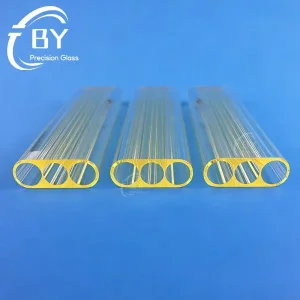
Custom Laser Cavity Flow Tubes & Filters Made from Samarium-doped Glass Supplier, Suppliers
View Product Details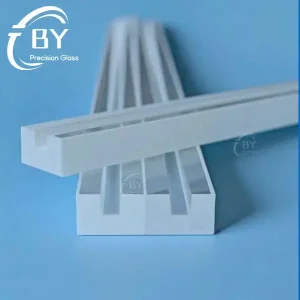
High-Quality Square Groove Quartz Substrate for Fiber Couplers Supplier, Factories
View Product Details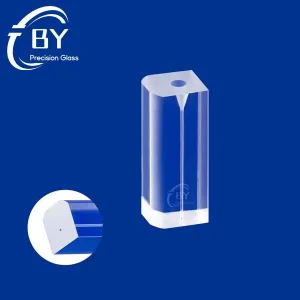
Custom Fiber Optic Glass Ferrules Supplier, Factories
View Product Details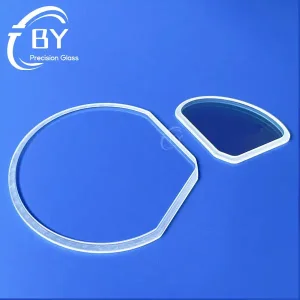
High-Quality Sapphire Viewing Plates for Harsh Chemical Environments Suppliers, Factories
View Product Details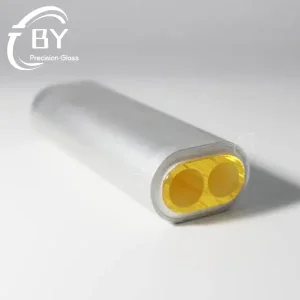
Custom Packed Laser Cavity Flowtubes for Laser Head Manufacturers, Suppliers
View Product Details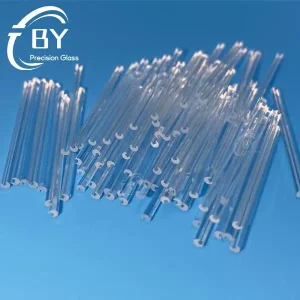
High-Quality Quartz Substrate Groove Use For Optical Fiber Coupler Suppliers, Factories
View Product Details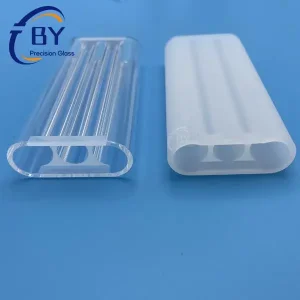
High-Quality Candela Laser Head Triple Bore Old and New Version In Stock Manufacturer, Factory
View Product Details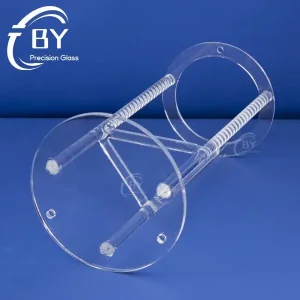
Wholesale Quartz Wafer Carriers for Semiconductor Supplier, Suppliers
View Product DetailsMacro-Trends in Industrial Laser Fiber & Beam Delivery Engineering
As industrial kilowatt ratings transition from 6 kW toward 30 kW+ and ultrafast sub-picosecond regimes, wholesale fiber manufacturing requires breakthrough material purity and thermo-mechanical containment.
Non-Linear Effect Mitigation (SBS & SRS)
As power densities within fused silica cores exceed gigawatt-per-square-centimeter thresholds, Stimulated Brillouin Scattering (SBS) and Stimulated Raman Scattering (SRS) introduce destructive back-reflections. Our wholesale raw preforms utilize precision acoustic velocity tailoring and chirped longitudinal dopant gradients (such as Al-doped, GeO2-suppressed silica) to elevate SBS thresholds by over 6 dB in single-mode fibers.
Large-Mode-Area (LMA) & Polarization Maintenance
To maintain fundamental mode ($TEM_{00}$, $M^2 < 1.15$) beam characteristics without causing dielectric material breakdown, modern wholesale industrial users mandate active fiber designs with core diameters spanning 20 µm to 100 µm with low numerical apertures ($NA \approx 0.06$). Our customized stress-applying Panda and bow-tie geometries maintain extinction ratios exceeding -25 dB across harsh vibration profiles.
Photodarkening Resistance in Yb-Doped Cores
Continuous operation at 1064 nm - 1080 nm wavelengths frequently induces color center formation in ytterbium silicate glasses, decaying output power over operating hours. BY Photonics employs high-purity synthetic JGS1 preform deposition, codoped with phosphorus and cerium, suppressing excess photodarkening losses to under 0.01 dB/m over 10,000 continuous operating hours.
Global Sourcing Requirements for Kilowatt-Class Laser Fiber
Procuring wholesale optical fibers and fused glass assemblies requires stringent supplier validation beyond mere piece pricing. Tier-1 photonics integrators evaluate suppliers on four critical performance pillars.
Core Concentricity & Geometry
Misalignment of fiber core to outer cladding by more than 0.5 µm generates catastrophic insertion losses during automatic fusion splicing. Our drawing towers feature laser shadow gauges with 50-nanometer feedback loops ensuring 99.8% concentricity yields across 50 km production runs.
Thermal Shock & OH Content Control
Water absorption peaks at 1380 nm and 2700 nm degrade mid-IR efficiency and induce localized thermal hot spots. For high-power delivery cables, we specify ultra-dry synthetic silica with hydroxyl ($OH^-$) contents constrained below 0.1 ppm to avoid micro-fracturing under intense heat gradients.
End-Cap Splice Integrity (QBH/QD)
Direct delivery fiber exit facets cannot withstand open-air power density. Wholesale buyers demand laser-grade synthetic fused silica end-caps bonded via diffusion or CO2 laser splicing without index-matching adhesives, expanding the beam waist before the air-dielectric boundary.
Full Lot Traceability & Testing
Each production spool or machined glass component includes optical interferometry scans, spectral transmission graphs, proof testing data (>100 kpsi tensile pull), and certificate of compliance conforming to ISO 9001 and MIL-STD standards.
Optical Glass & Synthetic Substrate Engineering Parameters
Selecting the correct matrix material dictates transmission efficiency, thermal lens coefficient, and catastrophic damage limit. Review our standard material performance specifications.
| Material Designation | Spectral Window | Refractive Index ($n_d$) | Thermal Expansion ($10^{-7}/K$) | OH Content | Key Industrial Fiber Application |
|---|---|---|---|---|---|
| JGS1 Synthetic Silica | 185 nm – 2500 nm | 1.458 | 5.5 | < 1 ppm (Dry) | High-power fiber end-caps, UV lasers, Excimer windows |
| JGS2 Fused Quartz | 220 nm – 2500 nm | 1.458 | 5.5 | 30 – 150 ppm | Flow tubes, protective laser cover slides, sight glasses |
| JGS3 Infrared Silica | 260 nm – 3500 nm | 1.458 | 5.5 | < 5 ppm | Mid-IR beam delivery, Holmium & Thulium fiber conduits |
| Samarium-Doped Glass | Absorption @ 1064 nm | 1.520 – 1.540 | 8.2 | Standard | Parasitic oscillation suppressors, solid-state pump cavity tubes |
| C-Plane Sapphire ($Al_2O_3$) | 170 nm – 5500 nm | 1.768 | 50 – 66 | Zero | Ultra-durable output tips, high-pressure liquid laser cells |
Turnkey Fiber Optic & Optical Subsystem Integration
Our engineering ecosystem bridges raw optical material drawing, cold mechanical processing, precision flame fusion, and finished laser delivery modules for diverse commercial sectors.
Heavy Industrial Sheet Cutting & Welding
For continuous multi-kilowatt laser cutting machines, fiber delivery cables must withstand repeated acceleration g-forces on robotic gantries. We supply armored fiber conduits featuring double-clad silica fibers, copper-alloy conduction ferrule jackets, and integrated water-cooled QBH-compatible quartz end blocks engineered to transfer 20 kW beam loads with zero focal shift.
Medical & Aesthetic Surgical Lasers
Medical laser handpieces (such as Candela, DEKA, and Lumenis systems) operate across dermatological and surgical wavelengths (532 nm, 755 nm, 1064 nm, 2100 nm). We manufacture custom triple-bore pump cavities, Samarium-doped UV/1064nm blocking flow tubes, and biocompatible optical glass ferrules with polished radius faces for bare-fiber medical delivery probes.
Semiconductor Lithography & Wafer Handling
Extreme UV (EUV) and Deep UV (DUV) stepper equipment requires optical glass with virtually non-measurable thermal drift and absolute chemical stability. We manufacture ultra-flat synthetic quartz wafer carriers, diffusion boats, and micro-groove quartz substrates enabling multi-channel optical communication interconnects in cleanrooms.
State-of-the-Art Fabrication: From Preform Drawing to Sub-Nanometer Polish
Operating across 3,000 m² of standardized workshop floor with over 120 precision machines, Tianjin BY Photonics handles cold cutting, CNC profiling, and oxyhydrogen hot-working under one rigorous quality ceiling.
Multi-Axis Ultrasonic CNC
Hard and brittle materials (fused quartz, ruby, sapphire) crack easily under traditional tools. We deploy ultrasonic-assisted CNC spindles operating at 40 kHz, suppressing subsurface micro-fissuring and delivering slot dimensional tolerances within ±0.005 mm.
Oxyhydrogen Flame Welding
To form hermetic, bubble-free junctions in semiconductor quartz carriers and laser flow cells, our master glassblowers use pure oxyhydrogen burners reaching 2,000 °C. Every welded part undergoes computer-controlled annealing cycles to remove internal mechanical stresses.
Sub-Micron Capillary Redrawing
Precision multi-bore capillaries, V-grooves, and hollow core structures require specialized drawing towers with ultra-precise downward feed mechanisms. We hold inner diameter concentricity to 0.002 mm, essential for fiber optic couplers and microfluidics.
Zygo Laser Interferometry
Quality cannot be assumed; it must be optically validated. Finished optical surfaces are inspected using Zygo phase-shifting laser interferometers, ensuring surface figure accuracy up to λ/10, with 10-5 Scratch-Dig cosmetic quality certified in Class 1000 cleanrooms.
Engineering Horizon: 2025 – 2030 Laser Fiber Roadmap
Exploring next-generation transmission paradigms, anti-resonant hollow-core architectures, and AI-governed inline fiber drawing towers for Tier-1 photonics research.
Hollow-Core Anti-Resonant Fiber (AR-HCF)
Solid glass cores inevitably face dielectric breakdown when pulsed with femtosecond and attosecond laser bursts. Our R&D facility is actively producing micro-structured capillary preforms for anti-resonant hollow-core fibers, guiding light in vacuum or gas mediums with 99.9% lower non-linearity and near-light transmission speed for next-gen telecom and high-energy physics.
AI-Driven Closed-Loop Thermal Tuning
During high-speed optical fiber drawing, variations in ambient furnace temperatures cause slight geometric fluctuations. BY Photonics has deployed machine-learning neural networks trained on high-speed imaging arrays, dynamically micro-adjusting tension capstans and heating coils at 500 Hz to eliminate longitudinal mode instability (TMI).
Rare-Earth Dopant Cluster Suppression
To push single-fiber CW power beyond 30 kW without beam quality degradation, our chemical vapor deposition (MCVD) process utilizes chelate gas-phase delivery to distribute ytterbium and erbium ions at atomic spacing, effectively terminating quenching clusters and boosting quantum slope efficiency past 85%.
Precision Quartz, Ceramic Reflectors & Semiconductor Glassware
Wholesale access to Candela distance gauge windows, excimer stepper lithography blanks, high-temperature fabrication, and ceramic laser cavity reflectors.
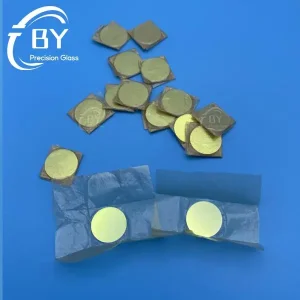
High-Quality Candela Laser Distance Gauge Slider Windows With coating 755 and 1064nm Suppliers, Factories
View Product Details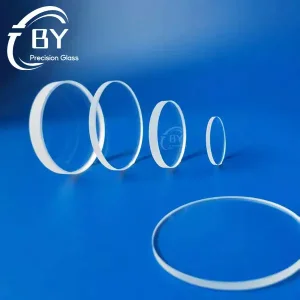
Wholesale Quartz Optical Windows for Semiconductor Lithography Equipment Suppliers, Factories
View Product Details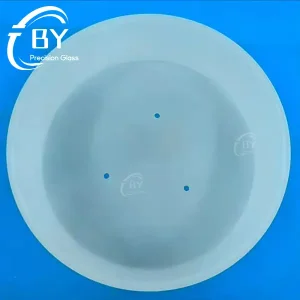
High-Quality Custom Quartz Glass Components for Vacuum Coating Supplier, Factories
View Product Details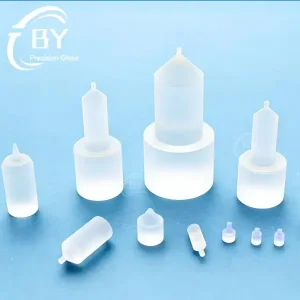
High-Quality Customized Quartz Fiber End Caps for QBH Manufacturer, Factory
View Product Details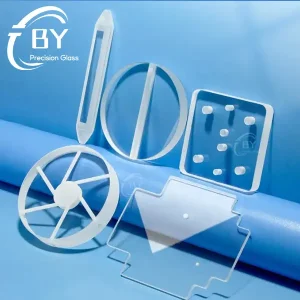
Wholesale High Temperature Custom Quartz Glass Fabrication Suppliers, Factories
View Product Details
High-Quality Diode‑Pumping Chamber Diffuse Reflectors PTFE‑based Supplier, Suppliers
View Product Details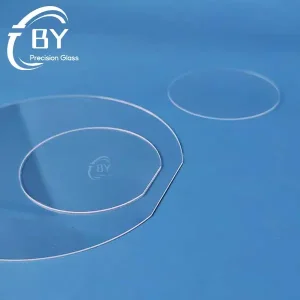
Custom Borofloat 33® Glass Wafers for Semiconductor Manufacturers, Factories
View Product Details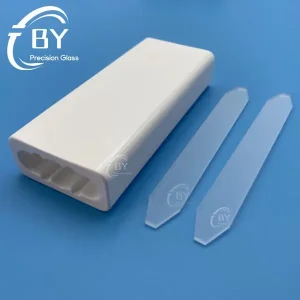
Wholesale Ceramic Cavity Reflector use for DEKA Laser Manufacturers, Supplier
View Product DetailsFrequently Asked Questions: Wholesale Laser Fiber & Custom Optics
Direct answers to the most crucial engineering and procurement inquiries regarding laser fiber specifications, manufacturing tolerances, and international logistics.
What defines a true laser-grade quartz fiber end-cap for high-power beam delivery?
Why are Samarium-doped glass flow tubes critical in solid-state laser pump chambers?
How does BY Photonics maintain tight concentricity in redrawn quartz capillaries and ferrules?
What are the minimum order quantities (MOQ) and lead times for custom CNC glass drawings?
How does synthetic JGS1 silica compare to standard borosilicate glass in laser durability?
Connect Directly with Optical Fabrication Engineers
Bypass intermediary trading companies. Send your CAD models or dimensioned PDF drawings directly to our engineering desk for a comprehensive Design-for-Manufacturability (DFM) review and wholesale pricing within 24 hours.
Submit Drawings for Review