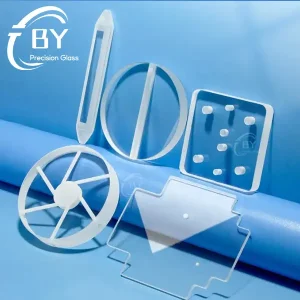
High-Accuracy Fused Silica & Optical Components
Explore standard and fully custom quartz solutions designed for extreme thermal shock resistance, ultra-low bubble inclusions, and micron-level channel concentricity.
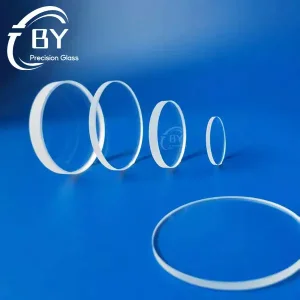
Quartz Optical Windows for Semiconductor Lithography
View Details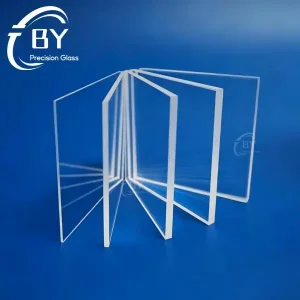
High-Quality JGS1 UV Grade Fused Silica Plate
View Details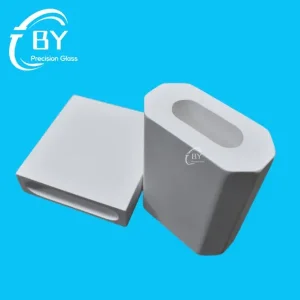
PTFE Spectralon-Grade Diffuse Reflectors
View Details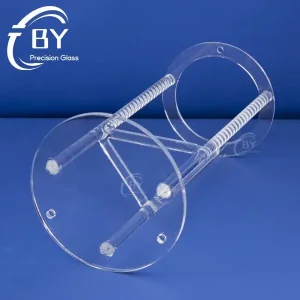
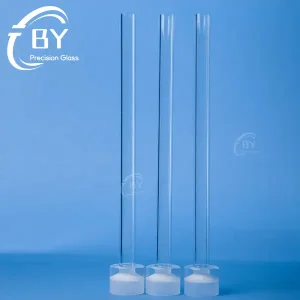
Wholesale Quartz Wafer Carriers for Semiconductor
View Details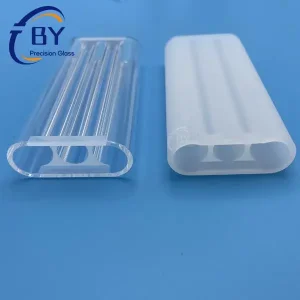
Candela Laser Head Triple Bore Components
View Details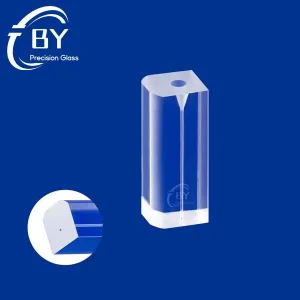
Custom Fiber Optic Glass Ferrules
View Details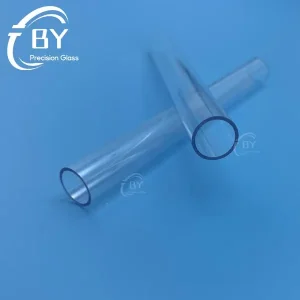
Cerium Doped Quartz Tube (Blocked UV)
View Details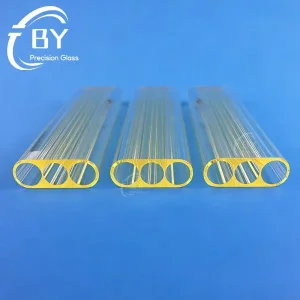
Samarium-Doped Glass Laser Cavity Flow Tubes
View DetailsEvolution & Technological Advancements in Multihole Quartz Capillaries
Analyzing the shift from standard single-bore glass to advanced multi-channel fused silica micro-arrays across global industrial paradigms.
Next-Gen Microfluidic Redrawing
Multihole capillary quartz tubes (multi-bore tubing) represent a breakthrough in down-draw and thermal reforming technology. By utilizing precise CNC preform tooling followed by controlled vertical tension redrawing, multi-lumen profiles achieve sub-micron concentricity essential for parallel analytical chemistry and flow cytometry systems.
Superior Dielectric & Thermal Shock Resistance
Synthetic fused silica (JGS1) and natural high-purity quartz (JGS2/JGS3) boast a near-zero coefficient of thermal expansion (5.5×10⁻⁷ /°C). Unlike borosilicate equivalents, multihole quartz structures can endure rapid cyclic thermal spikes between ambient temperatures and 1,100 °C without stress fractures or channel distortion.
Multichannel Spatial Laser Coupling
Modern telecommunications, multi-core fiber arrays, and laser delivery systems require multi-bore capillaries to secure bare fiber alignments. With high transmission from deep UV (185 nm) through shortwave infrared (3,500 nm), quartz channels function seamlessly as high-power passive delivery matrices without solarization or signal leakage.
Global Enterprise Sourcing & Specification Matrix
Engineered for technical procurement officers, system architects, and supply chain directors requiring reliable volume capacity and flawless batch-to-batch repeatability.
Tier-1 Material Chemistry Verification
Global procurement protocols necessitate 100% trace mineral validation. Enterprise buyers strictly evaluate OH-radical content, alkali trace metals (Na, K, Li < 0.1 ppm), and bubble inclusion classes according to DIN ISO 10110 standards to eliminate premature devitrification under intense UV or corrosive process gases.
Geometric Tolerancing: Bore-to-Bore Uniformity
In multihole arrays (dual-bore, 4-bore, 7-bore honeycomb, or custom multi-lumen), diameter uniformity across the axial length is critical. Enterprise specifications require inner diameter (ID) variations within ±0.003 mm and outside diameter (OD) concentricity within 0.01 mm to ensure robotic pick-and-place sealing compatibility.
End-Face Finish & Surface Polish
Burr-free, fire-polished, or optical flat-polished ends (scratch-dig 20-10, roughness Ra < 0.5 nm) prevent turbulent flow in analytical channels and eliminate localized micro-stresses that trigger cleavage under mechanical clamping during instrument assembly.
| Material Classification | Spectral Range | OH Content | Primary Industrial Use-Case | Thermal Stability |
|---|---|---|---|---|
| JGS1 Synthetic Silica | 185 nm – 2,500 nm | < 5 ppm – 1200 ppm (Grade dependent) | DUV Capillary Electrophoresis, Photolithography, Laser Channels | Continuous 1,100 °C / Peak 1,300 °C |
| JGS2 Fused Quartz | 220 nm – 2,500 nm | < 30 ppm | Semiconductor Process Sensors, Thermal Furnaces, Optical Alignment | Continuous 1,050 °C / Peak 1,250 °C |
| JGS3 Optical Quartz | 260 nm – 3,500 nm | < 5 ppm (Water-free IR) | Infrared Spectrometry, Pyrometric Sighting, Diode Delivery | Continuous 1,100 °C / Peak 1,300 °C |
Comprehensive Industrial Application Architecture
Bridging pure materials science with mission-critical systems across biomedical research, semiconductor manufacturing, and ultra-fast optoelectronics.
Capillary Electrophoresis & DNA Sequencing
Multihole quartz capillary tubes serve as the heart of high-throughput genetic analyzers and chromatographic separation columns. Zero chemical leaching, near-zero baseline UV absorption, and electrically inert inner walls ensure consistent electroosmotic flow and uncompromised measurement resolution.
High-Density Fiber Pigtails & Optocouplers
By precision-drawing multi-bore capillary tubes matching specific optical fiber claddings (such as 125 µm OD fibers), manufacturers create ultra-compact collimators, power combiners, and DWDM splitters. Fused silica sleeves match the thermal expansion of the fiber, preventing insertion loss shifts over wide operating temperature bands (-40 °C to +85 °C).
Gas Chromatography & Micro-Combustion
For industrial emission monitors and trace-gas sniffers, multi-bore fused silica channels isolate reference fluids from sample streams while running through localized flash-heating chambers. Quartz ensures complete immunity to aggressive acidic matrices including HCl, HF-traces, and sulfur dioxide vapors.
Medical Laser Energy Guiding Arrays
Surgical aesthetic apparatuses utilize multihole tubes to simultaneously guide flashlamp cooling fluids and optical fibers. The dual functionality significantly decreases probe footprint, accelerates assembly speed, and insulates clinical handpieces from heat buildup.
Semiconductor Chamber Atmospheric Probes
Vacuum and plasma chambers demand multi-port quartz feedthroughs that provide hermetic seals up to 10⁻⁸ Torr. By redrawing multi-lumen capillaries, engineers create multi-point thermocouple sleeves and gas injection nozzles capable of surviving harsh NF3 and CF4 cleaning plasmas.
Global Quality Assurance & Supply Chain Traceability
Operating in strict alignment with ISO 9001:2015 frameworks, full RoHS/REACH material clearances, and transparent technical logistics.
International Standards & Certifications
Every capillary batch is delivered with certified material test reports (MTR), detailing batch spectrometry, trace chemical assays, and ISO-standard surface inspection logs. All quartz and borosilicate components comply fully with EU RoHS Directives (EU) 2015/863 and REACH Regulation (EC) No 1907/2006.
DFM Engineering & 24-Hour Review Desk
Our rapid-response engineering team provides Design for Manufacturability (DFM) reviews on custom multihole drawings within 24 hours. We evaluate cross-sectional aspect ratios, wall thickness tolerances, thermal stress hotspots, and suggest preform optimizations that reduce production scrap and unit cost.
Shockproof Cleanroom Packaging & Global Transit
Capillaries are ultrasonically cleaned in deionized cascades, vacuum-sealed in Class 100 cleanroom poly bags, and secured in custom shock-absorbing foam inserts. Our export logistics network guarantees zero breakage across air and ocean freight hubs in North America, Europe, and Asia-Pacific.
Engineering Roadmap: Microchannel Densification & Functional Doping
Anticipating industry trends toward photonic crystal fibers, extreme ultraviolet (EUV) beam routing, and multi-analyte lab-on-a-chip architectures.
High-Density Capillary Micro-Arrays (>30 Bores)
Ongoing research focuses on drawing high-density, multi-bore capillaries featuring sub-10 µm channel diameters. These arrays serve as platforms for hollow-core photonic crystal fiber (HC-PCF) preforms, enabling ultra-low latency optical transmission and high-field particle acceleration experiments.
In-Situ Laser Sintering & Internal Wall Functionalization
Integrating CO2 laser finishing directly onto redraw towers facilitates real-time fire-polishing of microscopic bore walls. This completely eliminates sub-surface micro-cracks, elevating channel burst pressure thresholds above 400 bar for extreme ultra-high-pressure liquid chromatography (UHPLC).
Rare-Earth & Transition Metal Doped Multi-Lumen Canes
Advancements in localized doping (Cerium, Samarium, Titanium, Fluorine) permit hybrid multihole structures where individual channels absorb specific parasitic wavelengths while neighboring channels maintain peak UV/VIS transmittance, optimizing integrated laser cavity architectures.
Frequently Asked Questions for Sourcing Multihole Quartz Tubes
Direct technical answers addressing materials, custom fabrication tolerances, minimum order requirements, and engineering lead times.
What is the standard tolerance range for multihole capillary quartz tubes?
For standard precision redraws, we maintain outer diameter (OD) tolerances within ±0.02 mm and inner diameter (bore ID) tolerances within ±0.005 mm. For high-precision fiber optic or chromatography applications, secondary laser-guided redraw processing can tighten bore tolerances to ±0.001 mm.
Can you manufacture asymmetric or customized multihole cross-sections?
Yes. Beyond standard dual-bore (double lumen), 4-bore cross, and 7-bore hexagonal arrays, our CNC ultrasonic machining and precision preform drilling allow us to fabricate custom patterns, non-circular bores, variable wall spacings, and asymmetric hole distributions according to your technical drawings.
How do you choose between JGS1, JGS2, and JGS3 for capillary tubes?
Select JGS1 for deep ultraviolet applications (e.g., UV-VIS detectors, laser flow tubes below 250 nm). JGS2 offers high optical clarity and superior mechanical/thermal performance for standard semiconductor, electronic, and furnace components. Choose JGS3 if your optical instrument works across the near-to-mid infrared band (up to 3,500 nm) where low hydroxyl content is required.
What cutting, finishing, and polishing services are available for ends?
We provide multiple end-finishing options: precision diamond saw cutting (burr-free), beveling/chamfering, micro-flame fire-polishing (rounded, crack-free edges), and optical lap polishing (down to λ/4 flatness and 20-10 scratch-dig) for direct butt-coupling to lenses or optical fiber ribbons.
Precision Quartzware & Laser Cavity Components
Explore our extensive fabrication portfolio, covering custom quartz boats, high-temperature tubes, spectrophotometer flow cells, and specialized laser reflectors.
Chemical Resistant Custom Quartz Glass Parts
View Details
Precision Custom Semiconductor Quartz Components
View Details
UV Block Yellow Quartz Tube for IPL Handles
View Details
Custom Quartz Cuvettes for Spectrophotometer
View Details
Custom Quartz Glass for Vacuum Coating
View Details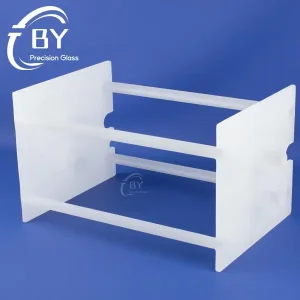
Quartz Diffusion Boat for Semiconductor Fabs
View Details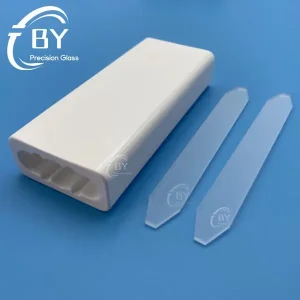
Ceramic Cavity Reflectors for DEKA Laser
View Details