
Featured Photonic & Optical Glass Assemblies (Series A)
Precision-machined substrates, fused silica capillaries, and flow configurations ready for optical transceiver packaging and industrial laser arrays.
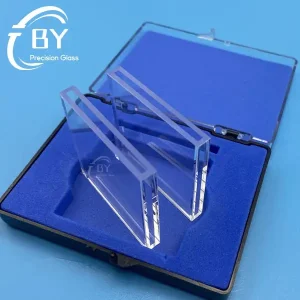
Wholesale Customize Quartz Cuvette for Spectrophotometer
View Product Specifications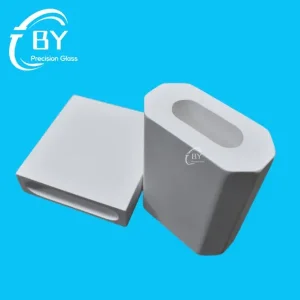
High-Quality Diffuse Reflectors Made of Spectralon‑Grade PTFE for Diode‑Pumping Chambers
View Product Specifications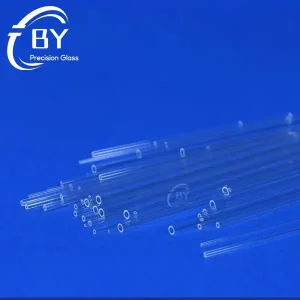
Wholesale Fluorine-Doped Fused Silica Capillary Tube Manufacturer
View Product Specifications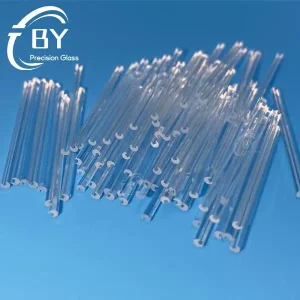
High-Quality Quartz Substrate Groove Use For Optical Fiber Coupler
View Product Specifications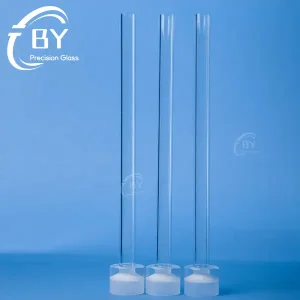
High-Quality Chemical Resistant Custom Quartz Glass Parts Fabrication
View Product Specifications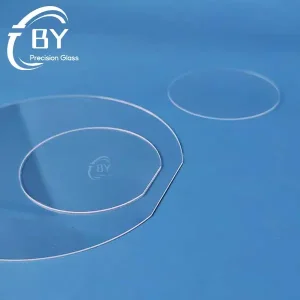
Custom Borofloat 33® Glass Wafers for Semiconductor Manufacturers
View Product Specifications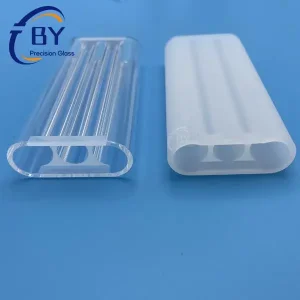
High-Quality Candela Laser Head Triple Bore Old & New Version
View Product Specifications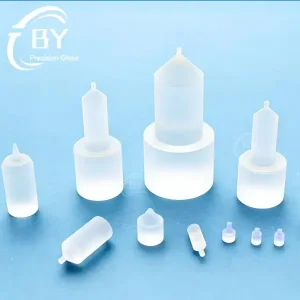
High-Quality Customized Quartz Fiber End Caps for QBH
View Product SpecificationsOptical Fiber V-Groove Substrates: Engineering Principles & Tolerance Thresholds
Optical Fiber V-Grooves (V-Groove Arrays) serve as the fundamental mechanical alignment foundation for multi-channel optoelectronic interconnects, arrayed waveguide gratings (AWG), and Co-Packaged Optics (CPO). Fabricated primarily from high-purity fused silica (JGS1), Borofloat 33®, and single-crystal silicon, these high-aspect microstructures must maintain sub-micron geometric tolerances across critical thermal gradients.
Sub-Micron Pitch Accuracy
Core-to-core pitch consistency (typically 127 µm or 250 µm) is maintained within ±0.3 µm cumulative error across up to 128 channels. This precision mitigates severe insertion losses during edge-coupling and vertical grating coupling in transceiver modules.
Geometric Angle Control
Anisotropic etching along single-crystal silicon planes (typically 54.74° for (100) silicon) or diamond micro-grinding on fused silica achieves an angular tolerance of ±0.1°. This ensures identical seated heights (eccentricity <0.5 µm) for bare fibers.
Thermal Coefficient Matching
By pairing high-purity synthetic fused quartz (CTE: 0.5×10⁻⁶/K) or Borofloat® with matched quartz cover lids, thermo-optic expansion mismatches are eliminated, preventing adhesive delamination and fiber pistoning during -40°C to +85°C Telcordia cycling.
| Metrological Metric | Standard Commercial Grade | Telecom Telecordia Standard | BY Photonics Ultra-Precision Grade | Testing & Verification Method |
|---|---|---|---|---|
| Channel Pitch Tolerance | ± 1.0 µm | ± 0.5 µm | ± 0.25 µm (Custom < 0.15 µm) | Non-contact Optical Vision Metrology |
| Fiber Core Seated Height | ± 1.2 µm | ± 0.6 µm | ± 0.35 µm | White Light Interferometry (WLI) |
| Channel Count Capacity | 1 to 16 Channels | 4, 8, 12, 24 Channels | Up to 128 Channels Continuous | Multi-Channel Coordinate Measuring |
| V-Groove Apex Roughness (Ra) | Ra < 0.2 µm | Ra < 0.08 µm | Ra < 0.02 µm (Optical Polished) | Atomic Force Microscopy (AFM) |
| End-Face Polish Angle | 0° Flat / 8° Standard | 8° ± 0.3° | 0° to 45° Custom ± 0.15° | Laser Goniometer Metrology |
Technology Roadmap: High-Density Optical Interconnects (2026–2030)
As global data architectures pivot toward 1.6T and 3.2T optical transceivers, standard optical alignment components must evolve beyond basic single-row topologies.
2D Matrix & Multi-Tier V-Grooves
Transitioning from planar 1D arrays to high-density 2D stacking configurations (e.g., 2×16, 4×32), allowing over 128 fibers per connector interface to facilitate dense co-packaged optics (CPO) architectures.
Integrated Micro-Lens Coupling
Direct integration of precision refractive microlens arrays (MLA) on the front-facet of the quartz V-groove lid. This enables collimated or focused beam mode-field matching directly into silicon PIC waveguides without active discrete alignment.
Sub-Kelvin Cryogenic Fiber Arrays
Novel metallurgical and glass-matrix engineering engineered for cryogenic quantum computing operating conditions (4 Kelvin to 10 mK), eliminating thermal expansion-induced fiber micro-bending and maintaining polarized state integrity.
Macro-Industry Solutions: Optical Interconnect Architectures
High-density fiber optic grooved blocks solve foundational optical routing challenges across mission-critical technological verticals.
Hyperscale AI Data Centers & CPO
Massive AI computing clusters demand optical transmission to overcome copper reach limits. Our custom 16-, 32-, and 64-channel V-groove arrays interface lasers directly with Silicon Photonics (SiPh) computing chips, maintaining signal fidelity at extreme throughputs.
Biomedical OCT & Endoscopy Imaging
Optical Coherence Tomography (OCT) requires compact, chemically unreactive fiber holder blocks. High-purity fused silica substrates with biocompatible properties allow sub-millimeter integration into clinical probes and scanning equipment.
Fiber Optic Gyroscopes (FOG) & Defense
In aerospace navigation, Fiber Optic Gyroscopes rely on precise polarization-maintaining (PM) fiber orientation. Our V-grooves allow Panda and Bow-Tie PM fibers to be aligned along stress axes with an angular alignment tolerance within ±0.5°.
China Factory 4.0: Supply Chain Resilience & Production Efficiency
Based in Tianjin, China since 2010, BY Photonics fuses multi-axis CNC micro-machining, automated dicing, and ultra-precision chemical etching under one roof to bypass third-party delays.
Single-Roof Manufacturing Chain
From synthetic quartz ingot slicing and chemical-mechanical polishing (CMP) to CNC profile grinding and cleanroom fiber assembly, complete internal control eliminates subcontracting cycle overhead and ensures lot-to-lot traceability.
DFM Engineering Turnaround
Our dedicated optical engineering desk conducts comprehensive Design for Manufacturability (DFM) reviews within < 24 hours, helping clients optimize channel pitch, chamfer bevels, and LID bonding margins prior to hard tooling.
Scalable Wholesale Capacity
Equipped with over 120 precision processing units and Class 1,000 cleanroom assembly lines, our facility outputs over 150,000 channels monthly, accommodating low-volume custom prototyping through high-volume telecommunication production.
Global Procurement Demands: Compliance & Reliability Assurance
Tier-1 optical transceiver manufacturers and research institutions demand rigorous international standard conformance. Our processing and quality assurance align with Telcordia and international industrial directives.
Telcordia GR-1221 & GR-1209
Our finished Fiber Array Units (FAU) and quartz substrate blocks undergo extensive thermal cycling (-40°C to +85°C), high-temperature storage (85°C for 2,000 hrs), and damp-heat aging without structural degradation or pitch shift.
RoHS & REACH International Conformance
Every synthetic fused silica substrate, borosilicate glass blank, and specialized epoxy resin is fully compliant with EU RoHS 2011/65/EU and REACH standards, complete with heavy-metal free testing certifications.
ESD Anti-Static Clean Packaging
Optical fiber grooved blocks and bare substrates are cleaned via multi-stage ultrasonic baths, packaged in vacuum-sealed conductive ESD-safe waffle trays, and crated for vibration-damped global air freight to North America, Europe, and Asia-Pacific.
Frequently Asked Questions: Custom Optical Fiber V-Grooves
Direct answers addressing material options, channel customization, adhesive integration, and ordering procedures.
What are the key material advantages of Fused Silica (Quartz) versus Silicon V-Grooves? +
Can BY Photonics fabricate non-standard pitches (e.g., 50 µm or 500 µm) and mixed channel counts? +
What end-face angles and optical coatings do you offer on finished arrays? +
What documentation and inspection data are supplied with optical fiber grooved components? +
What is the typical production lead time for prototype and volume wholesale batches? +
Specialized Optical Components & Waveguide Substrates (Series B)
Explore additional precision-ground flow components, ceramic laser chambers, and semiconductor glass platforms manufactured to print.
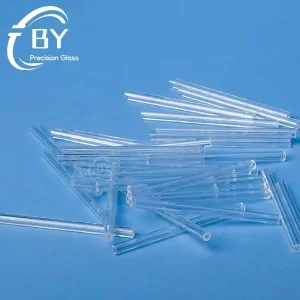
High-Quality Custom Precision Quartz Capillary Tubes
View Product Specifications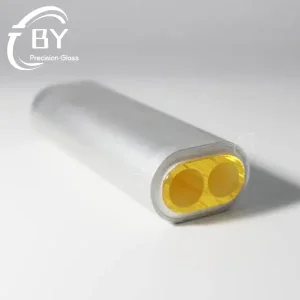
Custom Packed Laser Cavity Flowtubes for Laser Head
View Product Specifications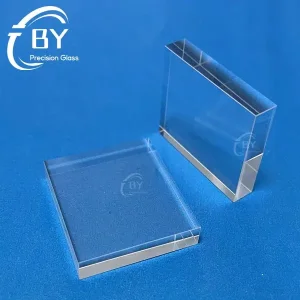
Custom Sapphire IPL Light Guide Block Used for Laser Hair Removal
View Product Specifications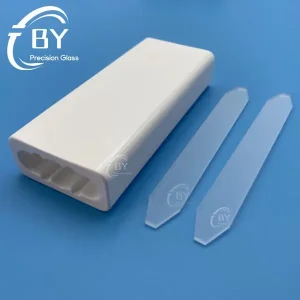
Wholesale Ceramic Cavity Reflector use for DEKA Laser
View Product Specifications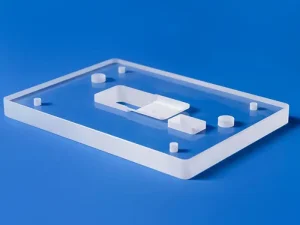
High-Quality Precision Quartz Glass Machining Plate
View Product Specifications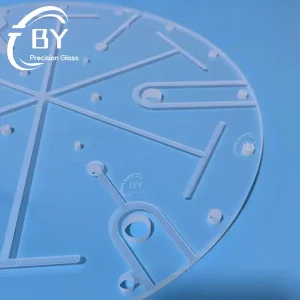
High-Quality Custom Precision Quartz Glass Fabrication
View Product Specifications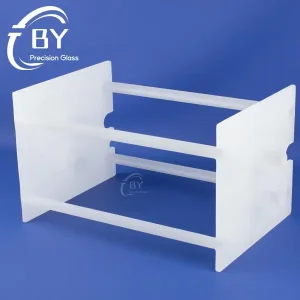
Wholesale Quartz Diffusion Boat for Semiconductor
View Product Specifications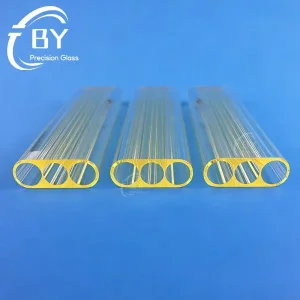
Custom Laser Cavity Flow Tubes & Filters Made from Samarium-doped Glass
View Product SpecificationsInitiate Your Sub-Micron Optical V-Groove Project
Upload your CAD specifications (.STEP, .IGES, .DWG, .DXF) or custom optical drawings. Our process engineering team provides comprehensive manufacturability reviews and firm wholesale quotations within 24 working hours.