
High-Performance Quartz & Optical Assemblies
Direct supply from factory lines: custom dimensional geometries, ultra-low bubble inclusions, and precision fire-polished or optical flat surface finishes.

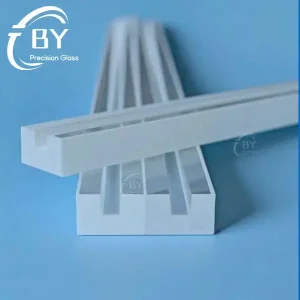
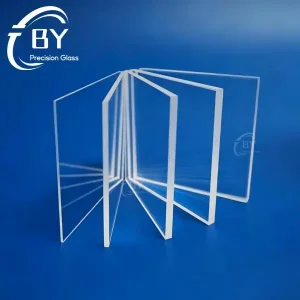
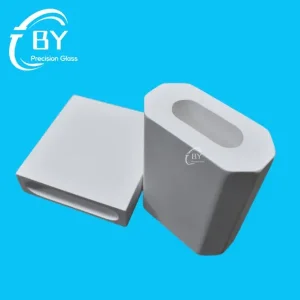
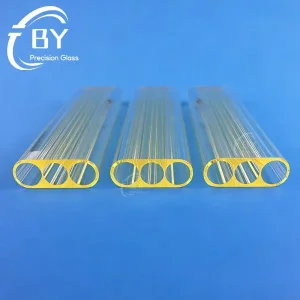
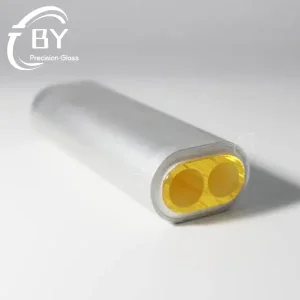
Precision Quartz Square Capillary Tubing: Physics, Optics & Thermal Dynamics
Why modern analytical sciences and optoelectronics require flat-walled square micro-bore structures over traditional cylindrical tubing.
Refractive Index Distortion Elimination
Cylindrical capillary channels act as cylindrical lenses, causing severe astigmatism, spherical aberration, and beam divergence. Square inner and outer geometries offer perpendicular, flat optical paths that virtually eliminate focal distortive lensing during in-capillary laser spectroscopic measurements and fluorescence detection.
Wavefront Error: < λ/4 @ 632.8 nmSynthetic Fused Silica Purity Grades
We redraw square capillary tubing utilizing select raw ingots: JGS1 for deep ultraviolet (DUV down to 185 nm with zero bubble clusters), JGS2 for broadband analytical instrumentation (220–2500 nm), and JGS3 for infrared instrumentation where hydroxyl (OH) absorption bands at 2730 nm must be suppressed below 5 ppm.
UV Transmission: > 90% @ 254 nmThermal Shock & Dielectric Resilience
Featuring a coefficient of thermal expansion (CTE) of only 5.5 × 10⁻⁷ /°C, our square capillaries withstand instantaneous thermal differentials exceeding 1000 °C. The ultra-high electrical breakdown voltage makes them the industry standard for High-Voltage Capillary Zone Electrophoresis (CZE) and microchip electrophoresis.
Continuous Temp: Up to 1100 °C| Performance Parameter | JGS1 Synthetic UV Fused Silica | JGS2 Standard Fused Quartz | Precision Borosilicate Glass |
|---|---|---|---|
| Optical Spectral Range | 185 nm – 2,500 nm (DUV to NIR) | 220 nm – 2,500 nm (Standard UV-Vis) | 350 nm – 2,500 nm (Vis-NIR only) |
| Hydroxyl (OH⁻) Content | Typically < 1,200 ppm (Grade dependent) | Typically < 30 ppm | N/A (Complex multicomponent) |
| Coefficient of Thermal Expansion | 5.5 × 10⁻⁷ / °C (Extreme Thermal Shock) | 5.5 × 10⁻⁷ / °C (Extreme Thermal Shock) | 32.5 × 10⁻⁷ / °C (Moderate shock resistance) |
| Inner Bore Geometry Tolerance | ±0.002 mm (Custom ultra-precision redrawing) | ±0.005 mm (Standard redrawing) | ±0.010 mm (Economic batching) |
| Autofluorescence Background | Ultra-Low / Zero Detectable Background | Slight Background in Deep UV Range | Moderate to High Native Background |
In-House Redrawing & Cold Working Precision Chains
Combining dynamic laser interferometric tower redrawing with multi-axis diamond micro-machining under one ISO 9001:2015 accredited roof in Tianjin.
Tower Capillary Redrawing
Utilizing vertical precision tension towers with micro-feed controls and non-contact dual-axis laser micrometer gauge feedback, ensuring strict outer width and inner bore concentricity across 1000-meter continuous draw runs.
Precision Draw ControlOxyhydrogen End Sealing & Fire Polishing
Specialized hot-working flames achieve zero-flaw cleavage, internal edge radiusing, or capillary cuvette welding without inducing vitrification or crystalline micro-nucleation that could shatter under pressure.
Hydro-Oxygen AnnealingOptical Cold Machining & Polishing
For extreme UV detection windows, square capillaries undergo precision external chemical-mechanical polishing (CMP), bringing surface roughness Ra below 0.5 nm to eliminate light scatter in ultra-sensitive single-molecule studies.
CMP Ultra-Smooth Ra < 0.5nmLocalized Scenarios: Where Quartz Square Capillaries Deliver Critical Value
Engineered for mission-critical roles in tier-1 diagnostic equipment, optoelectronics, quantum systems, and advanced process monitoring.
1. Flow Cytometry & Single-Cell Analysis
Square capillary tubes serve as the hydrodynamic focusing flow cell core. The flat exterior allows orthogonal excitation by 405 nm, 488 nm, and 633 nm lasers while collecting side-scatter (SSC) and forward-scatter (FSC) light with minimal baseline optical noise.
Flow Precision: Hydrodynamic Alignment2. Capillary Electrophoresis (CE & CE-MS)
For protein sequencing, oligonucleotide purification, and DNA fragment analysis. The square internal bore ensures uniform Joule heat dissipation across planar wall interfaces, preventing the thermal gradient band broadening common in round capillaries.
Uniform Thermal Gradient: < 0.1°C Var3. Optical Fiber Array & Photonic Packaging
Used as precision alignment ferrules and square sleeve interconnects for polarization-maintaining (PM) fibers and multi-core fiber arrays. The internal orthogonal flats lock fiber rotation angles, preserving polarization extinction ratios (PER).
Rotational Locking: < 0.5° Angular Drift4. Microfluidic Chemical Synthesis & NMR
High-pressure resistance (withstanding over 50 bar depending on wall thickness) combined with universal chemical resistance against concentrated acids, organic solvents, and halogenated compounds makes it ideal for continuous-flow microreactors.
Chemical Resistance: pH 0 – 11.5 Inert5. Semiconductor In-Line Gas Spectrometry
Employed in trace moisture and silane gas purity analyzers inside wafer fabs. Synthetic fused silica's near-zero outgassing under ultra-high vacuum (< 10⁻⁹ Torr) prevents wafer chamber contamination.
Vacuum Rating: Ultra-High UHV Compatible6. Future Horizon: Quantum & Bio-Photonics (2026–2030)
Development of anti-resonant hollow-core fiber (AR-HCF) preforms, trapped-ion micro-traps, and integrated organ-on-a-chip diagnostic cartridges with sub-micron square redrawn features.
Roadmap: Sub-Micron Precision DrawsChina Supply Chain Agility, Resilient Cost Architecture & Export Compliance
Combining the cost advantages of established domestic synthetic silica raw materials with strict international metrological validation.
Upstream Material Independence
Direct supply partnerships with domestic high-purity polysilicon tetrachloride raw-stock refiners ensure uninterrupted availability of JGS1, JGS2, and JGS3 ingots without vulnerabilities to transatlantic geopolitical supply pinches.
Full RoHS, REACH & Conflict Minerals Compliance
Every shipment comes backed by certified Material Test Reports (MTR), spectrophotometer transmission scans, dimensional CMM verification logs, and strict compliance with EU RoHS Directive 2011/65/EU and REACH (EC 1907/2006).
Global Specialized Logistics & Shock-Proof Packaging
Capillary walls down to 50 μm demand engineered transport. Our cleanroom-packaged vacuum antistatic casing and multi-layer shock mitigation ensure safe DDP/CIF/FOB dispatch via DHL, FedEx, and air-freight across Europe, the Americas, and APAC.
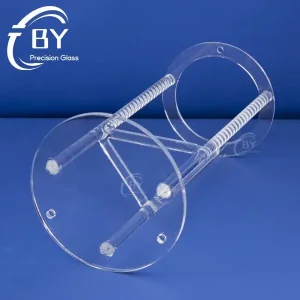
Advanced Optical, Laser & Wafer-Handling Assemblies
Explore specialized complementary components manufactured to strict customer engineering prints.


Frequently Asked Questions: Ordering Custom Quartz Square Capillaries
Direct technical answers from BY Photonics process engineers for optical designers and sourcing managers.