
Featured Medical Laser & Precision Quartz Cavity Components
Factory-direct engineered glass items tailored for aesthetic laser maintenance, replacement head assemblies, and industrial fluidic optomechanical tools.
Medical Cavity Fluid Dynamics & Samarium-Doped Optical Engineering
An in-depth metallurgical and photonic inspection into the tri-channel architecture powering dual-wavelength Alexandrite (755 nm) and Nd:YAG (1064 nm) aesthetic systems.
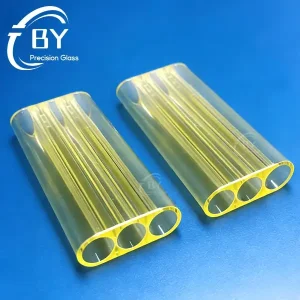
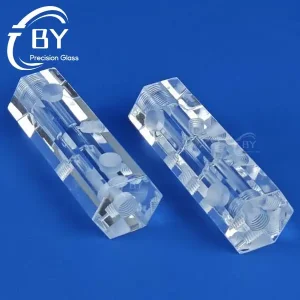
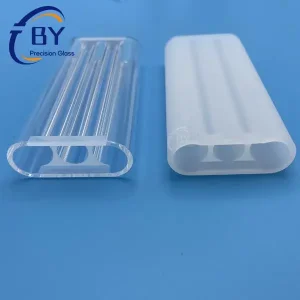
In high-power, flashlamp-pumped aesthetic and dermatological laser systems—most notably exemplified by the Candela® GentleLase®, GentleYAG®, and GentleMax Pro® platforms—the Candela Triple Bore flow tube functions as the thermo-optical core of the entire laser resonator. Rather than operating simply as a mechanical conduit for deionized (DI) cooling water, a custom triple bore must balance extreme hydrodynamic forces, mitigate non-linear solarization caused by intense UV flashlamp radiation, and execute sharp optical filtering to suppress parasitic laser oscillations.
The tri-channel design houses two parallel flashlamps flanking a single central Alexandrite or Nd:YAG crystal rod, or alternately a dual-lamp, single-rod pump cavity configuration optimized for uniform azimuthal pumping. During high-repetition pulse sequences (typically delivering pulse widths of 0.25 ms to 300 ms at energy fluences exceeding 100 J/cm²), the raw broadband emission from xenon flashlamps releases significant spectral energy below 400 nm. Unfiltered UV rays not only deteriorate the coolant and trigger photochemical degradation within the laser head potting compounds, but also provoke color-center formation (solarization) inside the laser rod, resulting in irreversible thermal lensing and output decay.
Achieving this level of selective spectral gating necessitates high-purity chemical vapor deposition (CVD) or vacuum electro-fusion silica manufacturing. Natural quartz tubes doped non-uniformly with transition metals fail rapidly under the harsh thermal gradient (ΔT > 80°C across a 1.5 mm wall boundary), leading to localized micro-fractures, coolant ingress into electrical terminals, and catastrophic cavity detonation.
Global Industry Trends: From OEM Monopolies to Qualified Open-Chain Sourcing
How third-party maintenance organizations (ISOs), laser hospital networks, and aesthetic clinic conglomerates manage supply security and total cost of ownership (TCO).
Rising Fluence & Pulse Duty Cycles
Modern clinical protocols demand aggressive treatment speeds with sub-millisecond multi-shot pulses. This elevated duty cycle places unprecedented thermal strain on laser cavity optics, making traditional quartz tubes vulnerable to accelerated erosion and surface pitting.
Supply Chain Diversification
Global MRO providers no longer rely on single-source, captive OEM distributor networks known for 4–6 month backorders and inflated markups. Engineering-driven procurement focuses on validated, direct-from-factory optical components adhering to ISO 13485 cleanroom protocols.
Depolarization & ASE Control
With dual-wavelength systems becoming standard across North America, Europe, and Asia-Pacific, maintaining perfect beam roundness and suppressing unwanted secondary emission rings at 1064 nm requires tighter optical tolerances than original 1990s legacy specifications.
China Industry 4.0: Supply Chain Resilience, Ultrasonic Machining & Flame Engineering
How our vertically integrated facility in Tianjin combines raw silica chemical doping, 5-axis ultrasonic CNC grinding, and oxyhydrogen annealing under one roof.
Producing a high-tolerance Candela triple bore is one of the most demanding challenges in optical quartz fabrication. The component consists of three micro-parallel longitudinal bores running through a monolithic or precision-fused quartz block with strict requirements for center-to-center distance (±0.03 mm), internal circularity (≤0.015 mm), and wall thickness uniformity across lengths exceeding 140 mm.
Under traditional manual glass-blowing or mechanical drilling, micro-fissures and subsurface mechanical damage inevitable arise, leading to stress concentrators that shatter under repeated 12-bar pulse water pressure. Our Tianjin Industry 4.0 production matrix operates through four integrated pillars:
1. Ultrasonic Diamond Core Drilling
Utilizing high-frequency piezo-driven acoustic vibration combined with hollow diamond trepanning tools, coolant lubricates cutting surfaces directly, virtually eliminating internal micro-cleaving and maintaining inner bore roughness Ra < 0.2 μm without subsurface strain.
2. Oxyhydrogen Fire Polishing
Automated, computer-controlled oxyhydrogen flame torches uniformly sweep inner bore channels, thermal-annealing the inner glass surface to absolute mirror transparency. This step eliminates turbulent fluid boundary resistance and minimizes dirt particulate adherence.
3. Sub-Zero Residual Stress Annealing
Every triple bore undergoes an intensive 72-hour computerized annealing schedule inside programmable electric muffle furnaces, raising the material to its transition temperature (1120°C) and stepping down at 1.5°C/min to eradicate birefringence and internal shear stress.
4. Full-Spectrum Spectral Verification
Every melt batch is measured using dual-beam UV-Vis-NIR spectrophotometers (PerkinElmer Lambda equivalent) from 200 nm to 1200 nm. Each batch is shipped with traceable transmittance curves confirming peak transmission at 755 nm and certified blocking at 1064 nm.
Technical Specification Matrix: Candela Triple Bore Generations
Direct physical, optical, and operational comparison across legacy models, new-version flange revisions, and customized high-duty MRO configurations.
| Critical Parameter | Legacy Candela (MGL / Old Version) | Contemporary GentleMax Pro® (New Version) | BY Photonics Custom High-Durability Grade |
|---|---|---|---|
| Base Glass Composition | Standard Sm-Doped Natural Fused Quartz | 10% Sm&sub2;O&sub3; Synthetic Quartz Composite | High-Purity CVD Synthetic Silica + 10% Sm Doping Zero Bubbles |
| Length & Profile Geometry | 142 mm, straight cut flat ends | 148 mm, flanged seating collar | Custom CAD-matched (140mm – 165mm, flat or flanged) |
| Internal Bore Diameters | Lamp: 10.0mm / Rod: 8.0mm | Lamp: 10.5mm / Rod: 8.5mm | Laser-Bored to ±0.015 mm tolerance |
| Bore Concentricity / TIR | ≤ 0.08 mm | ≤ 0.05 mm | ≤ 0.02 mm (Triple-Bore CMM Inspected) |
| UV Cutoff Bandwidth (T < 0.1%) | < 340 nm | < 370 nm | < 385 nm (Eliminates UV Rod Solarization) |
| 1064nm Parasitic Absorption | OD > 1.5 | OD > 2.2 | OD ≥ 3.0 (Absolute ASE Extinction) |
| 755nm Transmission Peak | > 86% | > 90% | ≥ 92.5% (Maximized Alexandrite Fluence) |
| Hydraulic Working Pressure | 3.5 – 5.0 Bar | 4.5 – 6.5 Bar | Tested to 12.0 Bar Static Burst Pressure |
| Service Life Cycle Expectancy | ~800,000 to 1,200,000 Pulses | ~1,500,000 Pulses | > 2,500,000 Pulses under ISO DI coolant regimen |
Localized Application Scenarios: Laser Head Refurbishment & Field MRO
Optimized installation practices for laser chambers in hospital aesthetic departments, franchised medspas, and independent third-party laser servicing labs.
GentleMax Pro® Dual-Wavelength Chambers
Where both 755 nm and 1064 nm rods operate inside adjacent cavity compartments or via rapid optic switching, the triple bore ensures uniform thermal dissipation. This eliminates beam pointing wander and prevents hot spots across the laser delivery fiber input face.
High-Throughput Medspa Depilation Clinics
In clinics firing 30,000+ pulses daily, substandard quartz quickly experiences devitrification and silica leaching, fouling DI water resistivity. Our samarium-doped tubes feature hydrophobic fire-polished bore walls that resist deionized water leaching up to 70°C continuous operating temperature.
Third-Party Chamber Refurbishment Labs
Certified laser service facilities rebuilding Candela laser heads require exact mechanical interchangeability. Our customized triple bores match original O-ring gland depths, flange steps, and center spacing down to ±0.02 mm, preventing elastomer extrusion and coolant leaks during pressure re-commissioning.
Frequently Asked Technical Questions: Candela Triple Bore Optics
Clear, authoritative technical answers addressing glass chemistry, dimensional fitment, failure analysis, and global supply logistics.
Why is Samarium doping (Sm&sub2;O&sub3;) mandatory in Candela triple bore tubes instead of standard clear quartz?
What is the structural difference between Old Version and New Version Candela Triple Bores?
What are the leading causes of triple bore fracture and catastrophic chamber failure?
Can BY Photonics fabricate triple bores from custom drawings or reverse-engineer discontinued laser models?
How does DI water purity impact the operating lifespan of the triple bore?
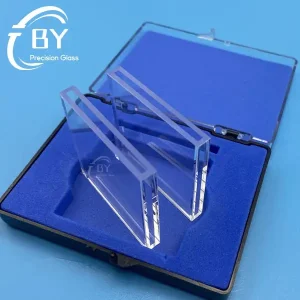
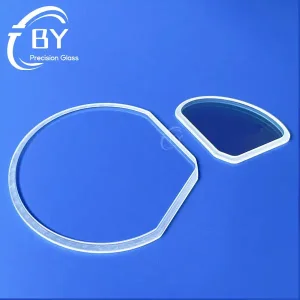
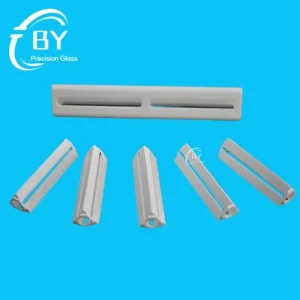
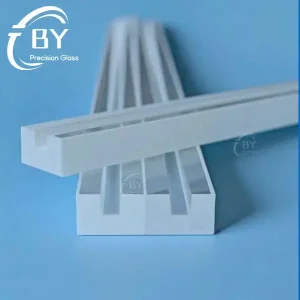
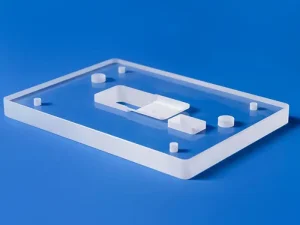
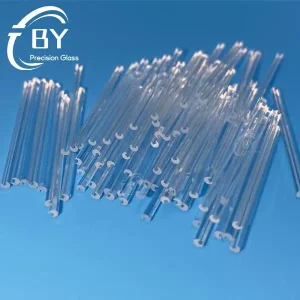
Complementary Optical Windows, Cuvettes & Machined Quartzware
Explore our full line of synthetic quartz substrates, laser pump reflectors, sapphire viewing windows, and specialized flow components manufactured to tight tolerances.
Need Custom Triple Bores or Specialized Laser Cavity Quartzware?
Our optical application engineering team provides immediate design for manufacturability (DFM) reviews, custom Sm-doping spectral tailoring, and rapid sample production. Connect with our technical desk in Tianjin today.