Precision Optical Substrates & Fabrications
Engineered quartz, doped silicas, laser components, and ceramics custom-fabricated under cleanroom-certified workflows for demanding photonic installations.
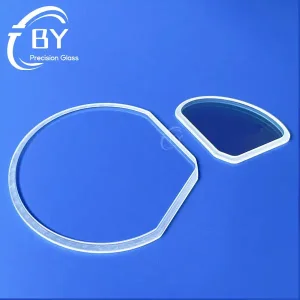

Global Industrial Status: Corning HPFS® 7980 in High-Yield Manufacturing
Analyzing structural supply dynamics, chemical vapor deposition standards, and high-frequency deployment across EUV/DUV semiconductor lithography and high-energy physics.
Supply Chain Bottlenecks & Pure Precursors
Corning HPFS® 7980 represents the benchmark for synthetic fused silica produced via flame hydrolysis of high-purity silicon tetrachloride (SiCl4) or direct-to-glass siloxane gas feeds. In the post-2024 industrial sphere, supply chains prioritize trace metallic purity (<10 ppb elemental impurities) to eliminate excimer absorption bands at 193 nm (ArF) and 248 nm (KrF). Machining factories must operate high-precision clean cold-processing setups to retain native chemical inertness during CNC milling and multi-surface lapping.
Tiered Homogeneity Classifications
Modern factories segment custom plates according to rigorous refractive index gradients. Corning 7980 offers defined optical grades: Grade 0A (homogeneity index variation Δn ≤ 1×10⁻⁶ across entire optical aperture) down to Grade F. Industrial precision shops tailor custom plates for spatial beam dividers, prism blanks, and high-numerical-aperture projection optics, counteracting wavefront distortions caused by non-uniform thermal stress profiles under multi-kilowatt pulsed loads.
Thermal Shock & Zero Solarization Resistance
With an ultra-low linear thermal expansion coefficient (CTE = 0.52 × 10⁻⁶/K across 5°C to 35°C), Corning 7980 plates outperform traditional borosilicates and standard quartz. In high-power industrial fiber laser cutting heads and wafer inspection tools, our manufacturing line mitigates localized phase transitions and optical absorption drifts, guaranteeing mechanical endurance across prolonged thermal cycles exceeding 1,000°C.
Comparative Material Specifications: Corning 7980 vs. Traditional Silicas
Exhaustive optical and thermomechanical engineering metrics demonstrating baseline superiority in precision fabrication environments.
| Performance Characteristic | Corning HPFS® 7980 (Synthetic) | JGS1 (Standard Synthetic) | JGS2 (Fused Quartz / Natural) | Optical Fused Quartz (Standard) |
|---|---|---|---|---|
| Precursor / Manufacturing Method | SiCl4 Flame Hydrolysis CVD | Synthetic SiCl4 Reaction | Natural Quartz Crystal Melting | Arc Fusion of Natural Quartz |
| UV Cut-off Wavelength (λ @ 50%) | ~160 nm | ~185 nm | ~220 nm | ~260 nm |
| Internal Transmittance (193nm, 10mm) | ≥ 99.2% (ArF Grade) | ≥ 90.0% | Non-transmitting / Degraded | Zero Transmission |
| Hydroxyl (OH) Content | 800 – 1000 ppm (Standard) | ~1200 ppm | < 30 ppm (Low OH) | 150 – 200 ppm |
| Abbe Number (vd) | 67.8 | 67.8 | 67.6 | 67.2 |
| Thermal Expansion (0°C to 200°C) | 0.57 × 10⁻⁶ / °C | 0.55 × 10⁻⁶ / °C | 0.54 × 10⁻⁶ / °C | 0.59 × 10⁻⁶ / °C |
| Laser Damage Threshold (1064nm, 10ns) | > 45 J/cm² | > 35 J/cm² | ~15 J/cm² | ~10 J/cm² |
| Residual Stress Birefringence | ≤ 2 nm/cm (Grade 0A) | ≤ 5 nm/cm | ≤ 10 nm/cm | ≤ 20 nm/cm |
Emerging Industry Trends & Sub-Surface Micro-Crack Mitigation
How specialized machining factories conquer brittle material anomalies through advanced ultrasonic milling, plasma-assisted chemical etching, and MRF polishing.
Ultrasonic-Assisted 5-Axis CNC Milling
Traditional diamond tooling induces sub-surface mechanical fractures (SSD) that act as crack initiators under thermal loading. Our production facility applies ultrasonic longitudinal vibration (20–40 kHz) to cutting tools, transforming brittle crack propagation into ductile shearing. This reduces tool edge wear by 65% and limits SSD depth to under 2.5 μm before rough polishing steps begin.
Magnetorheological Finishing (MRF)
Demands for extreme ultraviolet (EUV) photolithography substrates require surface error budgets under λ/20. We deploy deterministic MRF fluid ribbons containing sub-micron ceria and magnetic iron particles to polish custom Corning 7980 blanks. This non-contact shearing removes mid-spatial frequency ripples, eliminating high-order wavefront aberrations without edge roll-off.
Cleanroom Oxyhydrogen Micro-Welding
Joining complex 7980 quartz components without compromising internal stress profiles requires tight oxyhydrogen micro-torch control. Our master glassblowers execute automated thermal stitching in positive-pressure laminar flow hoods, followed by multi-stage thermal annealing cycles to eliminate internal lattice stress and guarantee strict optical transmission profiles across weld seams.
Industrial Solutions: Custom Corning 7980 Quartz Component Integration
Addressing structural requirements in high-power laser manufacturing, wafer fabrication, bio-analytical instruments, and deep-space observation.
Semiconductor Lithography Masks
Precision-lapped 7980 plates serve as primary photomask substrates for DUV immersion steppers. Zero bubble inclusions (Class 0 per DIN 58927) ensure defect-free circuit printing down to single-digit nanometer nodes.
High-Power Laser Debris Windows
In multi-kilowatt fiber and disk laser cutting, custom 7980 cover slides with dual-band anti-reflective coatings withstand intense back-reflections and metal spatter without thermal fracture or focal shift.
Bio-Photonic Flow Chambers
Optical interrogation windows for high-throughput DNA sequencers require zero native fluorescence. Custom 7980 plates provide exceptional signal-to-noise ratios under 365nm and 405nm laser excitation.
Avionics & Spacecraft Viewports
Corning 7980 mirrors and viewing windows survive rapid thermal excursions during atmospheric re-entry and spaceborne operations, resisting cosmic radiation-induced darkening over long duty cycles.
Corning 7980 Quartz Plates: Frequently Asked Questions
Technical guidance and commercial clarity for optical design teams and enterprise procurement specialists.
What distinguishes authentic Corning HPFS® 7980 from domestic JGS1 synthetic silica?
Which surface flatness and roughness specifications can your factory achieve on custom 7980 plates?
How does your engineering team inspect and verify inclusion quality and optical homogeneity?
What custom machining geometries, tolerances, and features can be produced?
What are typical turnaround times for prototypes versus volume manufacturing?
Custom Engineered Optical Assemblies & Specialized Quartz Components
Explore our specialized fabrication capabilities across high-power laser delivery systems, microfluidics, aesthetic optics, and advanced reflection cavities.