Precision Engineering Series
Featured Fiber Laser Cavity & Optical Glass Products
Direct OEM & ODM supply from Tianjin BY Photonics. Fully traceable fused silica, quartz, and active laser components tailored to exact engineering CAD profiles.
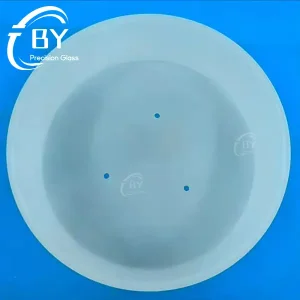
Custom Quartz Glass Components for Vacuum Coating
View Specifications
High-Quality Borosilicate Windows & Viewport Plates
View Specifications
Wholesale Customize Quartz Cuvette for Spectrophotometer
View Specifications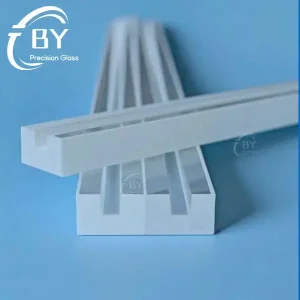
Square Groove Quartz Substrate for Fiber Couplers
View Specifications
UV Block Yellow Quartz Flow Tube for IPL Handle
View Specifications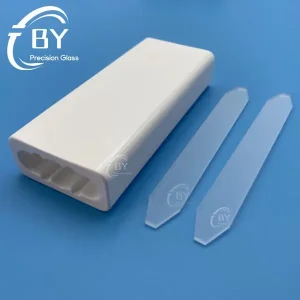
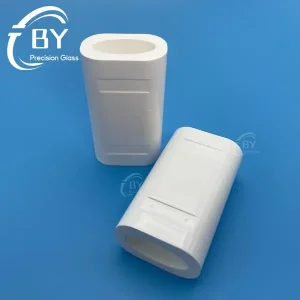
Ceramic Cavity Reflector for DEKA Medical Laser
View Specifications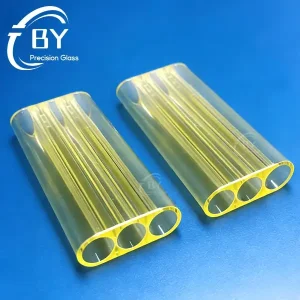
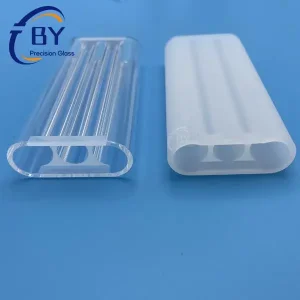
Samarium-Doped Quartz Triple Bore Tube Assembly
View Specifications
Industry Macro Intelligence
Technological Vectors & The Fiber Laser Paradigm Shift
Understanding high-brilliance kW-scale architectures, non-linear mitigation, and how custom photonic materials define next-generation laser beam reliability.
Ultra-High Power Scaling (30kW - 100kW+)
The transition from kilowatt to multi-tens-of-kilowatts power regimes demands severe optical damage resistance. Modern industrial fiber lasers utilize custom synthetic fused silica (JGS1) and samarium-doped absorbing glasses to suppress Transverse Mode Instability (TMI) and Stimulated Raman Scattering (SRS). Thermal distortion in output end-caps requires surface flatness up to λ/10 and bulk OH- radical content lower than 5 ppm.
Ultrafast Picosecond & Femtosecond Regimes
Micro-machining of semiconductor wafers and precision medical glass stent cutting rely heavily on ultrafast fiber lasers. Operating in sub-picosecond pulse regimes shifts laser-material interactions to athermal cold ablation. Optical engine components require zero subsurface damage, scratch-dig metrics down to 10-5, and stress birefringence below 2 nm/cm to maintain ultrashort pulse temporal fidelity.
Wavelength Diversification: Mid-IR & Deep-UV
Moving beyond standard 1064 nm and 1070 nm ytterbium lines, procurement demands are accelerating for thulium-doped (2 μm) and frequency-tripled UV (355 nm) systems. These extreme spectra challenge conventional borosilicate materials. Our specialized JGS3 anhydrous infrared quartz ensures zero OH absorption bands at 2.7 μm, while high-purity excimer-grade silica eliminates color-center formation under persistent UV radiation.
Supply Chain Strategy
Global Procurement Demands & China Industry 4.0 Resilience
How Tier-1 OEM photonic buyers mitigate geopolitical risk and escalating bill-of-materials (BOM) costs through direct Chinese manufacturing integration.
Consolidated Single-Roof Fabrication
Traditional western optical sourcing fragments across separate raw material suppliers, cold-machining shops, and cleanroom coaters—amplifying lead times and tolerance drift. At Tianjin BY Photonics, oxyhydrogen flame welding, 5-axis CNC diamond grinding, high-precision capillary redrawing, and Zygo laser interferometry reside within one 3,000+ m² facility, slashing end-to-end BOM delivery by 40%.
Agile DFM Engineering Reviews (<24h)
Global procurement cycles fail when engineering teams wait weeks for custom manufacturability assessments. Our technical department interfaces directly with STEP, DWG, and PDF blueprints. We evaluate thermal expansion coefficients, laser damage threshold (LIDT) limits, and inner-bore concentricity, providing verified engineering design-for-manufacturing feedback within 24 working hours.
Deterministic Quality Assurance
Deploying over 20 advanced metrology instruments—including spectrophotometers, 3D coordinate measurement machines (CMM), surface profilometers, and polarization stress analyzers. Every batch is certified with full dimensional inspection reports, material chemical composition certificates, and MIL-PRF-13830B surface cosmetic verification for zero defect escape.
15+
Years Operational Experience (Est. 2010)
110+
Specialized Optical Engineers & Technicians
120+
CNC, Grinding, Polishing & Flame Stations
<24h
Engineering Feasibility & DFM Feedback
Technical Specification Matrix
Optical Substrate & Laser Cavity Performance Benchmarks
Engineers must match transmission profiles, operational temperatures, and thermal shock resistance precisely to operational wavelengths.
| Substrate Material | Spectral Bandwidth | Refractive Index (nd) | Thermal Expansion (CTE) | Max Temp (°C) | Core Laser Application |
|---|---|---|---|---|---|
| JGS1 Synthetic Fused Silica | 185 nm – 2,500 nm | 1.4585 @ 589nm | 5.5 × 10⁻⁷ / °C | 1,100 °C | UV Excimer Windows, End-Caps, Spectroscopy Cuvettes |
| JGS2 Fused Optical Quartz | 220 nm – 2,500 nm | 1.4584 @ 589nm | 5.5 × 10⁻⁷ / °C | 1,100 °C | Laser Cavity Flow Tubes, Industrial Sight Glass, Tube Furnaces |
| JGS3 Anhydrous Quartz (Low OH) | 260 nm – 3,500 nm | 1.4580 @ 589nm | 5.4 × 10⁻⁷ / °C | 1,150 °C | Mid-IR Fiber Couplers, Thermal Imaging, Sensor Caps |
| Samarium-Doped Quartz (Sm3+) | Select Band Cut-off | 1.4620 | 5.8 × 10⁻⁷ / °C | 1,050 °C | Parasitic 1064nm Absorption in Nd:YAG Medical Pump Cavities |
| Optical Sapphire (Single Crystal Al₂O₃) | 170 nm – 5,500 nm | 1.7680 @ 589nm | 5.8 × 10⁻⁶ / °C | 1,800 °C | IPL Light Guides, Ultra-High Pressure/Abrasive Viewports |
| Sintered Ceramic Cavities (99.7% Al₂O₃) | Diffuse 97.8% R | N/A (Reflective) | 7.2 × 10⁻⁶ / °C | 1,450 °C | Diode-Pumped Solid State & Fiber Laser Resonator Blocks |
Application Engineering
Mission-Critical Field Deployments
From automotive battery welding cells to clinical dermatology arrays, our optical elements endure extreme continuous optical energy density.
Electric Vehicle & Battery Manufacturing
Continuous-wave (CW) fiber lasers at powers exceeding 12 kW are central to battery tab welding (copper and aluminum). Our high-reflectivity PTFE diffuse chambers, protective fused silica blast shields, and debris cover-slides survive high-velocity spatter and elevated temperatures, preventing downtime in high-throughput gigafactories.
Aerospace & Defense Laser Directed Energy
Defense countermeasures and additive manufacturing of titanium airframe structures demand supreme mechanical hardness and thermal survivability. We provide optical sapphire viewing ports, custom precision quartz capillary ferrule arrays, and extreme thermal-shock-resistant vacuum viewports tested up to 100 bar differential pressures.
Medical Aesthetic & Surgical Laser Heads
Dermatology and surgical ablation tools demand pristine beam delivery. Our replacement triple-bore flow chambers, Candela/DEKA compatible ceramic reflectors, and yellow UV-blocking flow tubes filter dangerous flashlamp UV bands, preventing water breakdown and protecting expensive Nd:YAG and Alexandrite rod crystalline lattices.
Procurement & Technical Clarifications
Frequently Asked Technical Questions
Direct answers addressing tolerances, fabrication thresholds, material certifications, and custom order logistics.
Which glass and crystal materials can BY Photonics machine?
We machine JGS1 UV fused silica, JGS2 and JGS3 fused quartz, borosilicate glass, optical glass, optical color filter glass, infrared glass, samarium- and cerium-doped glass, sapphire, PTFE-based diffuse reflector material and laser ceramics.
What is the practical difference between JGS1, JGS2, and JGS3 quartz glass?
JGS1 is synthetic UV-grade fused silica providing ultra-high optical transmission starting from ~185 nm, ideal for UV laser windows, end-caps, and cuvettes. JGS2 is high-purity fused quartz designed for standard visible and near-infrared applications (transmitting from ~220 nm to 2,500 nm). JGS3 is infrared-grade anhydrous fused quartz with exceptionally low OH- content (<5 ppm), offering bubble-free transmission reaching 3,500 nm without the broad OH water absorption dip around 2,700 nm.
Which drawing formats and engineering parameters should I submit for quotation?
We accept STEP, IGES, DWG, DXF, and fully dimensioned PDF files. For an optimal Design for Manufacturability (DFM) review, please include base material preference (e.g., JGS1 vs. Borofloat), dimensional tolerances, required scratch-dig surface cosmetics (MIL-PRF-13830B or ISO 10110), laser wavelength and power density, target operational temperatures, and estimated prototype vs. batch production volume.
How fast can our team receive formal engineering feedback and DFM reviews?
Our Senior Process Engineering Desk reviews all incoming drawings and returns a comprehensive process feasibility assessment, including manufacturing risk notes and optimization pathways, within 24 working hours.
Do you support rapid prototyping, NPI, and worldwide export shipping?
Yes. We routinely assist universities, research institutions, and OEM optical labs with prototype and small-batch orders (from 1–5 pieces) all the way up to annual contract supply runs in the hundreds of thousands. Parts are packaged in specialized class-10,000 cleanroom vacuum packaging with shock-proof crating for direct DHL, FedEx, or air freight dispatch worldwide.
Expanded Optical Portfolio
Specialized Precision Glass & Optical Ceramic Series
Browse our extended product lines for semiconductor wafer handling, solid-state pumping cavities, and sapphire viewing windows.

Custom Fabrication of Quartz Glass Precision Components
View Specifications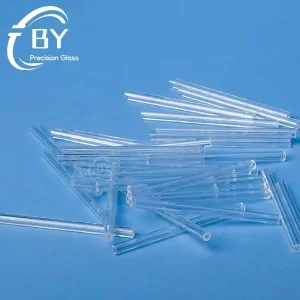
High-Quality Custom Precision Quartz Capillary Tubes
View Specifications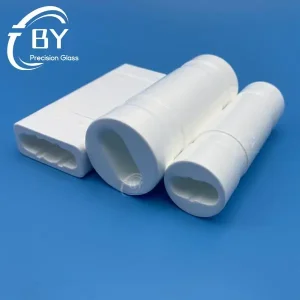
Wholesale Ceramics Reflector for Semiconductor Lasers
View Specifications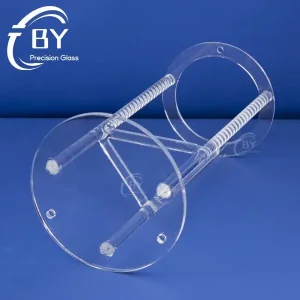
Wholesale Quartz Wafer Carriers for Semiconductor
View Specifications
Diode-Pumping Chamber Diffuse Reflectors (PTFE-Based)
View Specifications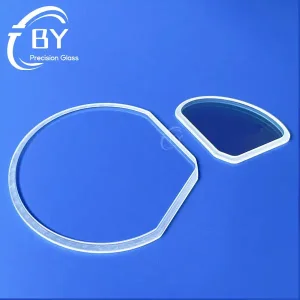
Sapphire Viewing Plates for Harsh Chemical Environments
View Specifications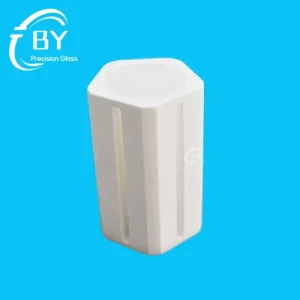
Diffuse High-Reflectivity PTFE Reflectors for Pump Cavities
View Specifications