
Primary Production Portfolio
Featured Precision Micro-Optics & Optical Substrates
Explore specialized borosilicate, synthetic fused silica, and engineered crystalline products fabricated directly from our state-of-the-art Tianjin machining and hot-working facilities.

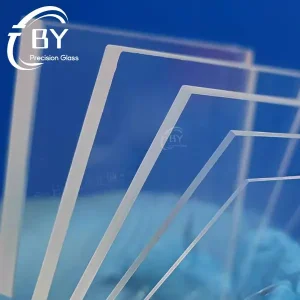
High-Quality Chemical Resistant Custom Quartz Glass Parts Fabrication Supplier, Factories
Request Spec & Quote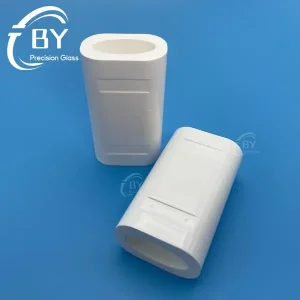
High-Quality Ceramic Cavities For Nd YAG Laser Supplier, Factories
Request Spec & Quote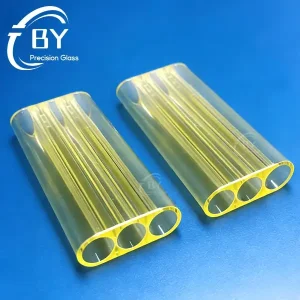
Wholesale Samarium-doped Quartz Triple Bore for Medical Laser Manufacturer, Supplier
Request Spec & Quote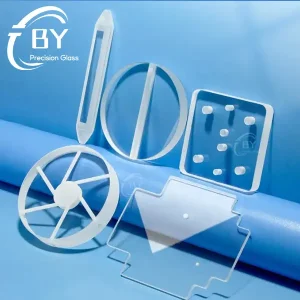
Wholesale High Temperature Custom Quartz Glass Fabrication Suppliers, Factories
Request Spec & Quote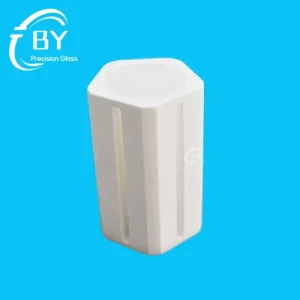
Wholesale Diffuse High‑Reflectivity PTFE Reflectors for Diode‑Pumping Chambers Suppliers, Factory
Request Spec & Quote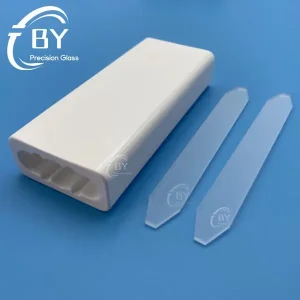
Wholesale Ceramic Cavity Reflector use for DEKA Laser Manufacturers, Supplier
Request Spec & Quote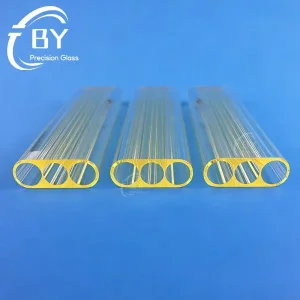
Custom Laser Cavity Flow Tubes & Filters Made from Samarium-doped Glass Supplier, Suppliers
Request Spec & QuoteExecutive Industrial Whitepaper
Engineering Authority: Why High-Purity Glass Ferrules Outperform Zirconia in Next-Gen Photonics
While traditional telecommunications networks have predominantly utilized polycrystalline zirconia ceramic ferrules for single-mode SC and LC patch cords, modern ultra-dense architectures, high-power fiber lasers, and photonic integrated circuits (PIC) increasingly mandate custom optical glass and fused quartz ferrules.
Near-Zero CTE Thermal Homogeneity
Standard fused silica ferrules exhibit an extremely low Coefficient of Thermal Expansion (CTE ~0.55 × 10⁻⁶/K), practically identical to silica fiber cores. This eliminates thermal stress gradients, modal displacement, and insertion loss fluctuations under military/aerospace cycles (-55°C to +150°C).
Deep-UV to SWIR Optical Transparency
Unlike opaque ceramic matrixes, borosilicate and synthetic fused silica (JGS1 grade) permit complete visual and machine-vision inspection through the ferrule barrel. This enables rapid 360-degree UV curing of epoxies, precise fiber tip location, and micro-bubble defect auditing.
Extreme Chemical & High-Voltage Inertness
Quartz glass ferrules withstand aggressively corrosive chemicals, high ionizing radiation fields, and plasma sterilization regimes. In medical laser probes and down-hole petroleum optical sensing, glass ferrules maintain micro-structural integrity without leaching or degradation.
Macro Industry Sourcing Framework
Custom Glass Ferrule Procurement Across High-Reliability Sectors
Strategic procurement executives and Tier-1 optical designers face critical supply constraints. Our factory addresses specific industry pain-points through tight tolerance redrawing and certified cold micro-machining.
Co-Packaged Optics & AI Data Centers
Supporting 800G and 1.6T transceiver assemblies with multichannel capillary arrays, pitch accuracy within ±0.5 μm, and customized polarization-maintaining (PM) fiber alignment grooves.
Medical Endoscopy & Surgical Delivery
Biocompatible, non-toxic borosilicate and doped quartz ferrules for laser ablation scalpel tips, OCT imaging catheters, and disposable spectroscopic diagnostic fibers.
Harsh-Environment Fiber Sensing
Fiber Bragg Grating (FBG) interrogation tubes deployed in electrical power grid transformers, aircraft structural health monitoring, and nuclear research installations.
Quantum Key Distribution (QKD)
Ultra-low back-reflection (UPC/APC angle polished) glass capillary ferrules designed for single-photon routing with insertion loss metrics controlled below 0.08 dB.
Factory Metrology Standards
Custom Glass Optical Ferrule Manufacturing Specifications
Every custom ferrule fabricated at BY Photonics undergoes rigorous multi-axis concentricity scanning, interferometric end-face topology analysis, and laser micrometer calibration.
| Dimensional Metric | Standard Commercial Grade | Precision Laser Grade | Ultra-Precision Lab Grade | Testing & Metrology Standard |
|---|---|---|---|---|
| Outer Diameter (OD) | 1.25 mm / 2.5 mm ± 0.005 mm | 1.25 mm / 2.5 mm ± 0.001 mm | Custom (0.5 to 8.0 mm) ± 0.0005 mm | Non-contact dual-axis Laser Gauge |
| Inner Bore (ID) | 126.0 μm +2.0/-0.0 μm | 125.5 μm +1.0/-0.0 μm | 125.2 μm +0.5/-0.0 μm (Custom up to 1000 μm) | Air-gauge pneumatic & Pin Gauge |
| Concentricity (Bore to OD) | < 3.0 μm | < 1.4 μm | < 0.5 μm PIC Grade | Video Micro-Coordinate Interferometer |
| Bore Taper & Chamfer | Standard funnel (R 0.2 mm) | Micro-funnel transition (smooth lead-in) | Custom conical taper (angle ± 0.5°) | High-Magnification Optical Profile |
| End-Face Geometry | Flat (PC) Polished | Angled (8° / 12° APC) | Custom spherical radiused / Dual-pitch | White-Light Phase Shift Interferometry |
| Substrate Material | Borosilicate Glass (Borofloat 33) | Fused Quartz (JGS2) | Synthetic Fused Silica (JGS1) / F-Doped | Spectral Spectrophotometry (VUV-NIR) |
Factory Scalability & Verification
Scale, Consistency, and Traceability Under One Roof
Combining cold precision CNC cutting, ultrasonic drilling, precision capillary drawing towers, and oxyhydrogen annealing directly in Tianjin, China since 2010.
110+
Dedicated Engineers & Technicians
3,000+m²
Modern Cleanroom & Machining Plant
<0.5μm
Concentricity Threshold Held in Batch
<24hr
DFM Drawing Review Turnaround Time
Capillary Redrawing Towers
Custom high-temperature draw towers control preform draw ratios down to micro-fractions, maintaining inner hole circularity above 99.2% and nominal wall thickness without ovality.
Chemical Lapping & CMP Polishing
End-face sub-surface damage (SSD) is completely removed through progressive diamond slurry lapping followed by colloidal silica chemical-mechanical polishing (CMP) yielding scratch-dig ratings down to 10-5.
Full Traceability & Stress Relief
Computer-controlled batch annealing relieves all internal stresses, validated via cross-polarizers. Each production batch is assigned lot tracking matching raw ingot spectrometer certificates.
Technology Roadmap 2026 - 2030
Future Directions in Glass Micro-Ferrule Fabrication
Anticipating the demands of silicon photonics integration, multicore fiber (MCF) transmission, and high-density space-division multiplexing (SDM).
Phase I: Sub-0.3μm Multibore
Multicore Fiber (MCF) Ferrules
Standardizing 4-core, 7-core, and 19-core high-precision capillary arrays with bore-to-bore rotational angle variance restricted below 0.25 degrees for petabit-scale long-haul links.
Phase II: Integrated Micro-Lens
Collimating Ferrule Hybrids
Direct CO₂ laser-polishing and micro-machining of spherical lenses on ferrule termination points, removing discrete gradient index (GRIN) lens interfaces in optical isolators.
Phase III: Low-Expansion Doping
Zero-Drift Titania-Silica Alloys
Formulating ultra-low thermal expansion (ULE) glass ferrules for deep space satellite laser cross-links and atomic clock fiber deliveries exhibiting near-zero expansion across -100°C to +200°C.
Phase IV: Photonic Packaging
V-Groove & Capillary Co-Integration
Monolithic integration of fused quartz capillary guide blocks with etched silicon sub-mounts for automated robotic pick-and-place PIC butt-coupling without active alignment.
Quality Assurance & Export Compliance
Global Standards, Localized Engineering Support
BY Photonics complies with stringent European and North American industrial directives, guaranteeing seamless customs clearance and frictionless OEM assembly line integration.
RoHS & REACH Compliance
All synthetic fused silica, borosilicate, and crystal precursors are 100% free of hazardous heavy metals, arsenic, or restricted plasticizers, accompanied by certified annual third-party SGS laboratory test audits.
Secure Cleanroom Export Packing
Ferrules are ultrasonically decontaminated, vacuum-sealed in anti-static gel-paks or wafer trays inside ISO Class 6 cleanrooms, and cushioned within heavy-duty export containers for zero-breakage global logistics.
Direct Bilingual DFM Review
Direct communication between your optical architects and our factory engineering bench in Tianjin. No intermediary sales friction—CAD models (STEP/DWG) reviewed within 24 hours with complete feasibility analysis.
Specialized Quartz & Capillary Range
Featured Micro-Tubing, Capillaries & Laser Glass
Browse our tailored capillary tubing, square-groove quartz couplers, semiconductor-grade Borofloat 33® wafers, and custom vacuum coating optics machined to tight print specifications.
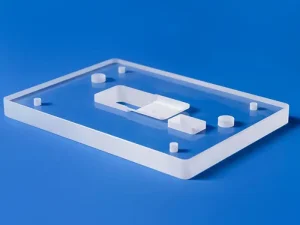
High-Quality Factory Supply Precision Quartz Glass Machining Plate Supplier, Suppliers
Request Spec & Quote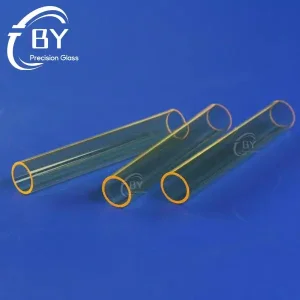
Custom UV Block Yellow Quartz Tube for IPL Lamp Flow Handle Manufacturer, Factories
Request Spec & Quote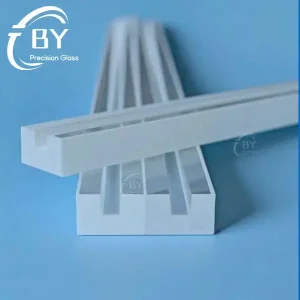
High-Quality Square Groove Quartz Substrate for Fiber Couplers Supplier, Factories
Request Spec & Quote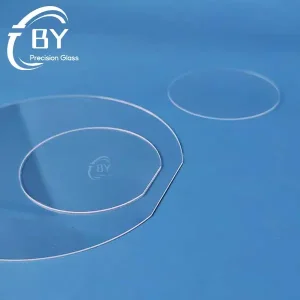
Custom Borofloat 33® Glass Wafers for Semiconductor Manufacturers, Factories
Request Spec & Quote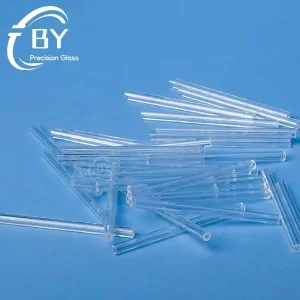
High-Quality Custom Precision Quartz Capillary Tubes Manufacturers, Suppliers
Request Spec & Quote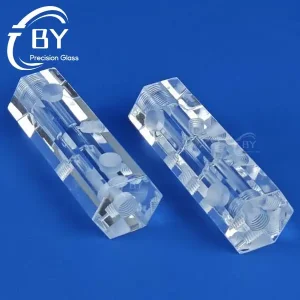
High-Quality Custom Fabrication of Quartz Glass Precision Components Supplier, Factory
Request Spec & Quote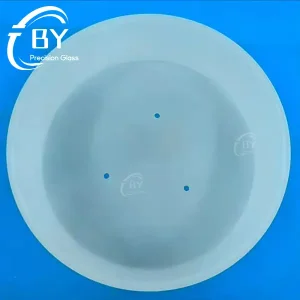
High-Quality Custom Quartz Glass Components for Vacuum Coating Supplier, Factories
Request Spec & Quote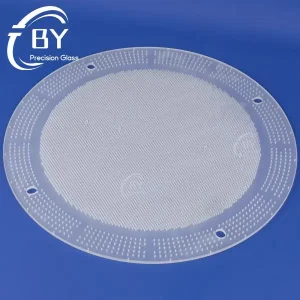
Custom Custom Optical Quartz Gas Distribution Plate Manufacturer, Suppliers
Request Spec & QuoteProcurement & Engineering Answers
Frequently Asked Technical Questions: Custom Glass Ferrules
Detailed explanations from our senior process engineers to assist in design-for-manufacturability (DFM) verification before placing production orders.
Why choose custom glass ferrules over standard ceramic (zirconia) ferrules?
Glass ferrules (fused silica and borosilicate) offer thermal expansion matching that of the glass fiber core, preventing thermal pistoning and micro-displacement over wide temperature fluctuations. Furthermore, glass is completely transparent, allowing 360° visual inspection and UV-light curing of adhesives during fiber potting, while also providing superior chemical inertness in harsh biomedical and sensing environments.
What is the minimum inner bore diameter and tolerance achievable?
Our precision capillary redrawing and micro-honing processes allow inner diameters (ID) as small as 80 μm up to 1000 μm. For standard telecommunication and single-mode fibers (125 μm clad), our typical production tolerance is +1.0/-0 μm, with ultra-precision lab-grade selections held to +0.5/-0 μm and concentricity error below 0.5 μm relative to the ferrule outer diameter.
What materials are available for custom ferrule fabrication?
We machine and redraw components using high-purity synthetic UV-grade fused silica (JGS1), optical visible-grade fused quartz (JGS2), low-OH infrared quartz (JGS3), borosilicate glass (SCHOTT Borofloat 33® equivalent), and custom fluorine-doped silica. For high-wear applications, single-crystal sapphire ferrules can also be CNC ultrasonic-machined to print.
Can you provide angled end-face polishing (APC) and custom funnel chamfers?
Yes. We produce custom lead-in funnel geometries (smooth conical chamfers) to ensure safe, snag-free fiber insertion on automated assembly lines. End-faces can be delivered flat (PC) with λ/10 optical flatness, or precision angle-polished at 8°, 12°, or customized angles with anti-reflective (AR) thin-film coatings applied down to 0.1% reflectance.
How does your factory handle quality control and batch inspection?
Our quality control lab utilizes automated dual-axis non-contact laser micrometers for outer diameter verification, air-gauges and certified pin gauges for inner bores, and white-light interferometers for end-face curvature and roughness. Full CMM inspection reports, optical transmittance curves, and material certificates of compliance accompany each shipment.
What is the typical lead time for custom prototype batches versus mass OEM volumes?
Custom tooling and prototype batches (10 to 500 pcs) typically complete in 2 to 3 weeks following drawing confirmation. Scaled OEM volume production (tens of thousands of units monthly) operates on rolling scheduled deliveries, with dedicated cleanroom packaging and standard courier or air-freight global transit taking 3 to 5 business days worldwide.