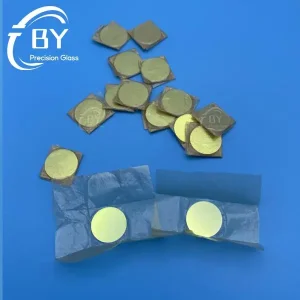
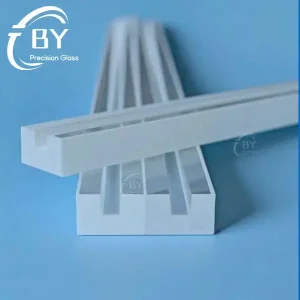
Engineered Substrates & Laser Cavity Optics
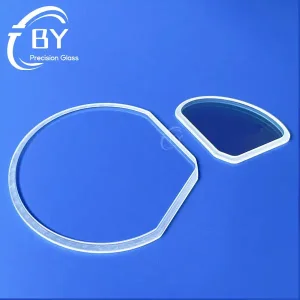
High-performance optical components manufactured by BY Photonics. Each precision part is crafted to tight geometrical tolerances and optimized for advanced thin-film coatings, ensuring minimal Fresnel reflection losses and thermal-mechanical resilience.

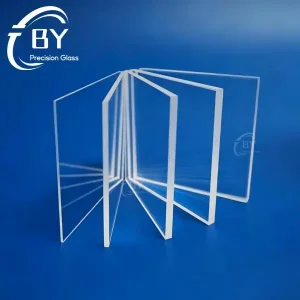
Engineering Foundations of Anti-Reflective (AR) Coatings
In optical systems, uncoated transmissive substrates (such as fused silica, sapphire, borosilicate, or optical flint glasses) lose significant light intensity due to Fresnel reflections at each air-glass boundary. Anti-Reflective (AR) coatings resolve this by utilizing destructive optical interference across single or multi-layer thin dielectric stacks.
Fresnel Reflection Mitigation
Uncoated normal-incidence reflectance follows $R = ((n_s - 1) / (n_s + 1))^2$. For standard optical glass ($n \approx 1.52$), surface loss is ~4.25% per face, cascading to over 30% system loss in multi-element assemblies. Custom AR coatings suppress surface reflectance down to $R < 0.1\%$, maximizing total throughput.
Destructive Wave Interference
By engineering thin-film dielectric layer stacks with an optical thickness matching a quarter-wave ($\lambda/4$) and refractive index matching $n_c = \sqrt{n_0 n_s}$, reflections from the outer boundary and the substrate interface become 180° out of phase, destructively canceling reflection and funneling power forward.
Laser-Grade LIDT Optimization
In high-power solid-state, fiber, and industrial laser applications, electric field peaks inside the coating stack determine failure thresholds. Through computer-optimized film layer synthesis, electric field peak intensity is shifted away from layer interfaces, delivering multi-gigawatt damage thresholds.
Global Enterprise Sourcing & Drawing Specification Framework
Procurement directors and optomechanical system architects require clear definitions to balance performance, yield, and unit costs. Sourcing high-precision custom AR-coated lenses demands explicit parameter control on CAD prints and RFQ datasheets.
1. Spectral & AOI Envelope
Define clear operational wavelengths: Single-wavelength (V-coat), Dual-Band (e.g., 532nm + 1064nm), or Broadband (BBAR, 400–700nm or 700–1100nm). Specify Angle of Incidence (AOI) ranges (e.g., 0°–45°), including polarization states ($R_s$, $R_p$, or $R_{avg}$).
2. Substrate Physics & Grade
Proper substrate matching is paramount. Fused silica (JGS1 synthetic UV grade, JGS2 visible, JGS3 low-OH IR grade), sapphire crystal ($Al_2O_3$, c-plane or a-plane), or borosilicate must have controlled bulk absorption and polished surface roughness ($Ra < 0.5nm$).
3. Surface Quality & Transmitted Wavefront
Specify scratch-dig standards per MIL-PRF-13830B (e.g., 20-10 or 10-5 for laser grade, 40-20 for commercial imaging) or ISO 10110-7. Require surface flatness up to $\lambda/10$ @ 632.8nm and parallel tolerances down to 5 arcseconds to avoid beam deviation.
4. Laser-Induced Damage (LIDT)
Specify pulsed or CW parameters: energy density ($J/cm^2$), repetition frequency, pulse length (fs, ps, ns), beam spot diameter ($1/e^2$), and testing protocol conforming strictly to ISO 21254 (1-on-1 or S-on-1 testing methods).
Deposition Methodologies & Thin-Film Physics Comparison
Choosing the correct physical vapor deposition (PVD) technique dictates packing density, structural stoichiometry, moisture shifting, and mechanical durability under aggressive thermal cycles.
| Deposition Process | Layer Packing Density | Refractive Index Stability | Residual Stress | LIDT Performance | Primary Industrial Use-Case |
|---|---|---|---|---|---|
| Ion Beam Sputtering (IBS) | 1.0 (Completely bulk-like, zero voids) | Extreme (Zero vacuum-to-air spectral shift) | High Compressive (Requires stress compensation) | High to Extreme (Ultra-low absorption < 1 ppm) | Laser gyro optics, ultra-low loss cavity mirrors, gravitational wave sensors |
| Ion-Assisted Deposition (IAD / E-Beam) | 0.95 – 0.98 (Dense columnar structure) | High (Negligible thermal-moisture drift) | Moderate (Controllable via chamber heating) | Superior (High threshold for ns and ps pulses) | High-power laser windows, medical beam delivery, industrial imaging optics |
| Thermal / E-Beam Evaporation | 0.75 – 0.85 (Porous columnar matrix) | Moderate (Subject to environmental humidity shifts) | Low Tensile | Moderate | Commercial lenses, consumer cameras, cost-sensitive volume sensors |
| Atomic Layer Deposition (ALD) | 1.0 (True conformal atomic monolayering) | Absolute Uniformity | Very Low | High (Emerging in high-power optics) | High-curvature aspheric optics, micro-lenses, deep steep-trench prisms |
Single-Layer Coatings ($MgF_2$)
Standard physical thickness matching $\lambda_0/4$. Typically applied on borosilicate or flint glass substrates to drop surface reflection from 4.2% to roughly 1.3%. Cost-effective for broad spectrum viewing, microscope cover slips, and industrial viewports.
Multi-Layer "V" Coatings (VAR)
Optimized for a discrete wavelength (e.g., 355nm, 532nm, 1064nm, or 2940nm). Narrow reflection curve dips below $R < 0.05\%$. Essential for laser resonators, harmonic generation crystals, and high-energy medical surgical heads.
Broadband AR (BBAR)
Multilayer designs spanning octaves (400–700nm, 650–1050nm, 1050–1600nm, or SWIR/LWIR). Provides average reflection $R_{avg} < 0.5\%$ over broad bandwidths. Ideal for multispectral cameras, FLIR pods, and spectroscopy equipment.
Macro-Industry Solutions & Application Scenarios
Precision anti-reflective coated optical components act as vital hardware across high-technology manufacturing verticals. Operating conditions vary from cryogenic vacuums to high-temperature laser cavities.
Semiconductor & Lithography
Deep-ultraviolet (DUV 193nm ArF excimer and 248nm KrF) stepper lenses require zero absorption and zero photo-darkening. BY Photonics supplies ultra-pure JGS1 synthetic fused silica substrates coated with fluoride-rich thin-film stacks capable of sub-nanometer wavefront retention.
Medical Aesthetics & Dermatology
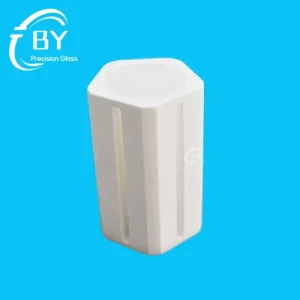
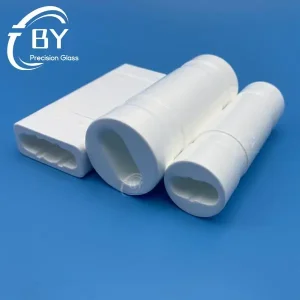
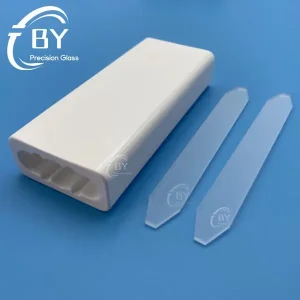
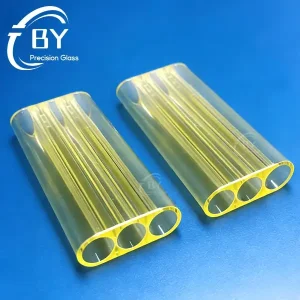
IPL hair removal and tattoo-removal lasers (e.g., Candela, DEKA, Cynosure) rely on sapphire light guides, samarium-doped flow tubes, and distance gauge slider windows. Customized coatings filter unwanted UV rays while sustaining extreme optical pulse powers at 755nm and 1064nm.
Industrial Kilowatt Laser Cutting
High-power continuous wave (CW) fiber lasers require protective windows and beam collimator lenses with absorption under 5 ppm. Uncontrolled thermal lensing distorts focus position; our low-absorption AR coatings guarantee focal stability across continuous production cycles.
Aerospace, Avionics & Defense
Sensor viewports on UAVs, targeting pods, and aerospace cockpits face sand abrasion, high altitude thermal cycling (-55°C to +85°C), and humidity. Hard carbon and dense sapphire AR coating stacks adhere strictly to severe abrasion and salt spray standards.
Industrial Sourcing Landscapes, Localization & Quality Compliance
Geographic diversification and single-source dependency have made supply chain transparency vital for western OEMs. Sourcing precision optical components requires reliable material traceability, ISO certification, and calibrated metrology.
Full Material Traceability
Every melt run of synthetic silica, fused quartz, sapphire boule, and technical ceramic is documented with chemical impurity records, bubble class certification, and refractive index homogeneity testing before entering production cutting.
Rigorous Environmental Testing
Coatings undergo environmental testing per ISO 9211 and MIL-C-675C standards: Tape adhesion testing (MIL-M-13508C), cheesecloth moderate/severe abrasion, 24-hour humidity chamber (50°C, 95% RH), and liquid nitrogen to hot water thermal shock cycles.
Calibrated Metrology Verification
Our quality control lab utilizes Zygo Verifire laser interferometers for transmitted and reflected wavefront assessment, PerkinElmer Lambda 1050+ UV/Vis/NIR spectrophotometers for absorption/reflectance traces, and non-contact profilometers for roughness validation.
Expert Procurement & Engineering Q&A
Authoritative engineering answers regarding anti-reflective thin-film chemistry, substrate behaviors, tolerances, and custom OEM manufacturing.
What is the primary difference between JGS1, JGS2, and JGS3 fused silica substrates for AR coating?
How does BY Photonics measure and certify Laser Induced Damage Threshold (LIDT)?
Can high-hardness materials like sapphire crystal ($Al_2O_3$) receive high-durability AR coatings?
What causes coating peeling or delamination under temperature fluctuations, and how is it prevented?
How do you maintain coating thickness uniformity on complex geometries and curved optics?
What CAD files and drawing tolerances should be supplied for custom quotation?
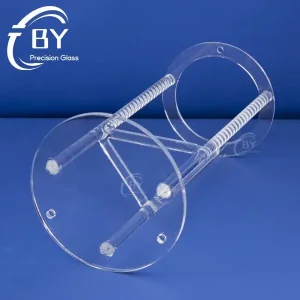
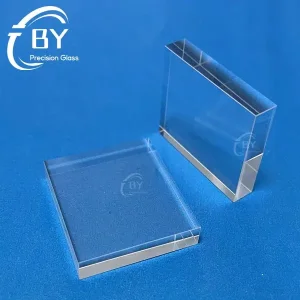
Specialized Optical Plates, Flow Cavities & Substrates
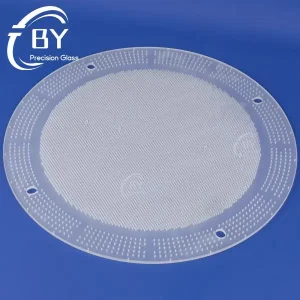
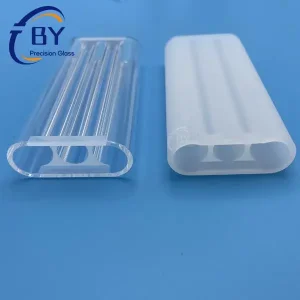
High-durability optical substrates, custom flow tubes, and laser cavity components manufactured by BY Photonics for medical, scientific, and aerospace applications worldwide.