
Engineered Optical Components & Precision Assemblies
Traceable fabrication across high-temperature synthetic silica, laser cavities, doped matrices, and multi-channel assemblies engineered to tight sub-micron tolerances.

Chemical Resistant Custom Quartz Glass Parts
View Specifications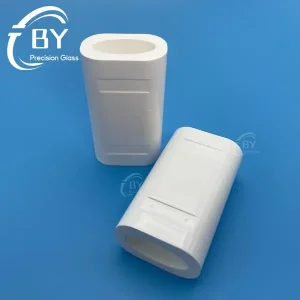
Ceramic Cavities For Nd YAG Laser
View Specifications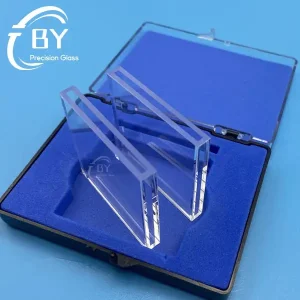
Custom Quartz Cuvette for Spectrophotometer
View Specifications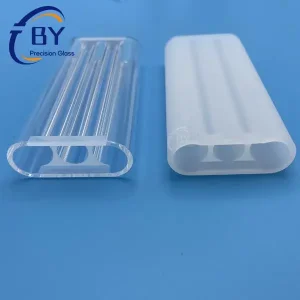
Candela Laser Head Triple Bore Tubes
View Specifications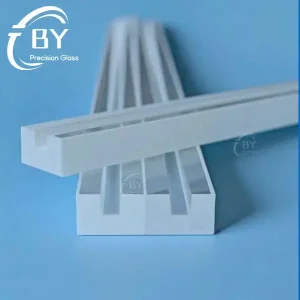
Square Groove Quartz Substrate for Couplers
View Specifications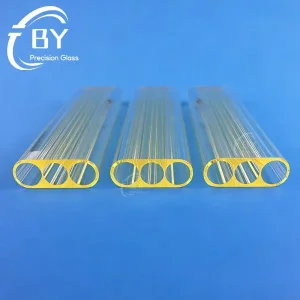
Samarium-Doped Laser Cavity Flow Tubes
View Specifications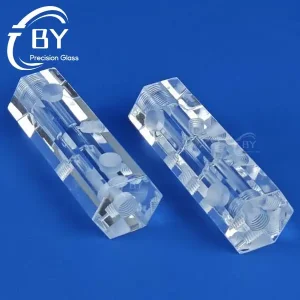
Custom Precision Quartz Components
View Specifications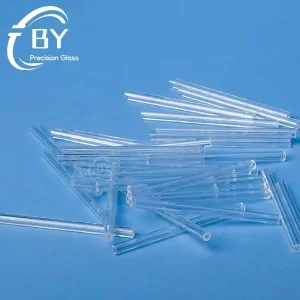
Custom Precision Quartz Capillary Tubes
View SpecificationsThe Engineering Physics of Custom Multibore Glass Tubing
How modern optofluidics, laser head architectures, and chemical instrumentation demand tighter channel dimensional stability, absolute parallelism, and defect-free internal lumen geometries.
In high-precision photonics, analytical spectroscopy, chromatography, and diode-pumped solid-state (DPSS) lasers, multibore glass tubing represents the vanguard of fluidic and optical integration. Unlike traditional single-bore capillary tubes or standard round glass piping, multibore glass tubing—often referred to as multi-lumen capillary tubing, multi-channel quartz sleeves, or multi-hole flow conductors—features two, three, four, or dozens of independent, micrometer-scale parallel channels running longitudinally along a single monolithic vitreous envelope.
The manufacturing physics behind custom multibore glass tubing requires overcoming extraordinary thermal-rheological challenges during the preform redrawing and precision hot-forming cycles. Because each channel must maintain identical hydraulic diameters, surface roughness (Ra < 0.5 nm on unpolished internal walls), and zero inter-bore cross-talk, material selection and draw-tower stabilization play decisive roles. From synthetic UV-grade fused silica (JGS1) capable of transmitting deep ultraviolet wavelengths down to 185 nm, to low-expansion borosilicate 3.3 for analytical microfluidic lab-on-a-chip setups, the synergy between material purity and geometric concentricity determines overall systemic performance.
Global OEM Procurement Demands & Sourcing Bottlenecks
Navigating the intricate balance between purity, chemical resistance, wall-thickness uniformity, and non-destructive optical testing across international production frameworks.
Ultra-Precision Bore Geometry
Global instrumentation brands require custom multi-bore configurations (dual-bore, triple-bore, cloverleaf, honeycomb) with hole pitches repeatable down to ±1.5 µm to facilitate automated robotic fiber pig-tailing and multi-wavelength laser alignment.
Traceable Optical Homogeneity
For samarium-doped, cerium-doped, and UV-absorbing yellow quartz flow tubes, multinational laser medical device OEMs require certified batch-to-batch absorption curves that isolate 1064 nm parasitic oscillations and cut off ultraviolet blistering.
Hermetic Hydrothermal Resistance
Analytical HPLC and capillary electrophoresis manufacturers demand zero OH leachability, acid corrosion resistance against aggressive mobile phases, and thermal shock survivability under rapid cyclic fluid pressurization above 400 bar.
| Material Class | Transmission Band | Thermal Expansion (α) | Softening Point | Primary Industrial Application |
|---|---|---|---|---|
| JGS1 Synthetic Silica | 185 nm – 2,500 nm | 5.5 × 10⁻⁷ / °C | 1,730 °C | UV Excimer Lasers, DUV Metrology, Flow Cytometry |
| JGS2 Fused Quartz | 220 nm – 2,500 nm | 5.5 × 10⁻⁷ / °C | 1,680 °C | Triple-Bore Candela Laser Heads, Sight Tubes |
| JGS3 Low-OH Quartz | 260 nm – 3,500 nm | 5.5 × 10⁻⁷ / °C | 1,680 °C | Infrared Spectrophotometers, Pyrometry Guides |
| Borosilicate 3.3 | 310 nm – 2,200 nm | 3.3 × 10⁻⁶ / °C | 820 °C | Electrochemical Capillaries, Microdialysis Kits |
| Samarium-Doped Silica | Selective Cutoff @ 1064 nm | 5.4 × 10⁻⁷ / °C | 1,670 °C | Nd:YAG Flashlamp Cavities, Parasitic Emission Quenching |
China Industry 4.0: Supply Chain Resilience & Redrawing Precision
How end-to-end integration of automated vertical draw towers, ultrasonic micro-hole machining, and AI-assisted laser gauge feedback establishes global cost and delivery benchmarks.
Historically, complex multibore glass components were burdened by exorbitant prototype fees, high scrap rates, and 16-to-24-week delivery cycles. At our advanced machining and redrawing facilities in Tianjin, China, the realization of Industry 4.0 smart manufacturing has fundamentally re-engineered the supply chain dynamics for high-purity silica products.
By leveraging closed-loop dual-axis laser scanning micrometers synchronized with real-time servomotor drawing winches, our vertical redraw towers dynamically compensate for furnace thermal drifts in fractions of a second. This ensures internal bore concentricity down to 0.5% of wall thickness along continuous 1,500 mm canes. Combined with multi-axis CNC ultrasonic diamond milling centers capable of grinding, drilling, and slotting hard, brittle vitreous materials without micro-chipping, OEMs worldwide capture unrivaled turnaround speeds from drawing conception to mass validation.
Vertical In-House Integration
From initial high-purity quartz ingot boule selection and ultrasonic core drilling to oxyhydrogen lathe fire-polishing and cleanroom laser packaging, all fabrication cycles remain under a single traceable quality roof.
AI In-Line Laser Inspection
Multi-angle telecentric vision systems detect micro-bubbles, crystalline inclusions, and internal bore ovality in real-time, executing non-destructive geometry checks before cutting and end-face fire polishing.
Rapid Scalability & DFM Review
Bilingual optical engineering desks deliver Design-for-Manufacturability (DFM) analyses within 24 hours, transitioning custom prototypes into thousands of precision units without re-tooling penalties.
Mission-Critical Applications of Custom Multibore Tubing
Empowering precision industries where liquid routing, thermal shielding, and multi-wavelength laser transmission converge inside a single glass element.
Dermatology & Aesthetic Medical Lasers
Triple-bore quartz flow tubes used within aesthetic laser systems (such as Candela Alexandrite and Nd:YAG flashlamp heads) simultaneously carry cooling deionized water, house the active laser crystal rod, and encase high-intensity flashlamps within an optimized, UV-filtering optical envelope.
Optofluidics & Droplet Microfluidics
Dual-bore and multi-channel fused silica capillaries act as shearing nozzles for precision oil-in-water nano-emulsions, single-cell genomic sequencing chips, and flow cytometers where parallel laminar flow streams must run adjacent without intermixing.
Multi-Core Fiber Array Alignment Ferrules
Square-profile and rectangular-exterior glass sleeves embedded with sub-millimeter multi-bores provide structural alignment for telecommunication ribbon fiber splicing, high-density optical transceivers, and silicon photonic chip coupling.
Frequently Asked Technical & Procurement Questions
Clear, authoritative guidance covering material properties, fabrication limitations, DFM tolerances, and custom ordering protocols.
What is the standard manufacturing tolerance achievable for multibore glass tubing internal diameters?
How do engineers choose between synthetic fused silica (JGS1) and natural fused quartz (JGS2/JGS3) for multibore tubes?
Can custom bore shapes (e.g., square, hexagonal, elliptical, or asymmetric holes) be redrawn into glass tubes?
What surface finishes and end-face treatments are available for multi-channel tubes?
What is the typical lead time for custom engineered prototypes versus high-volume repeat runs?
Semiconductor Quartzware, Flowtubes & Specialized Optics
Expand your system integration with vacuum furnace diffusion boats, PTFE laser reflectors, fluorine-doped capillary assemblies, and sub-micron lithography windows.
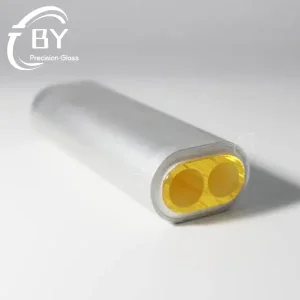
Custom Packed Laser Cavity Flowtubes
View Specifications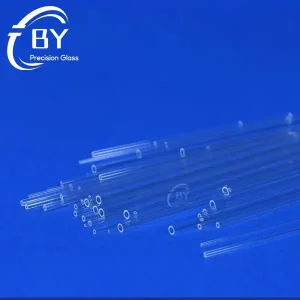
Fluorine-Doped Fused Silica Capillary Tube
View Specifications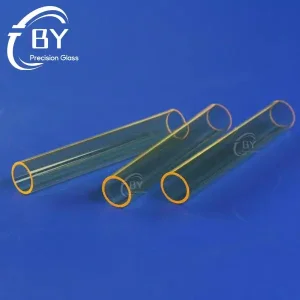
UV Block Yellow Quartz Tube for IPL
View Specifications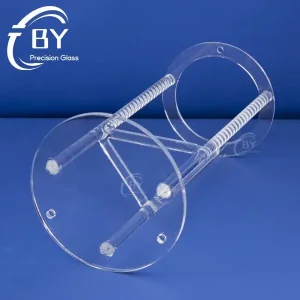
Quartz Wafer Carriers for Semiconductor
View Specifications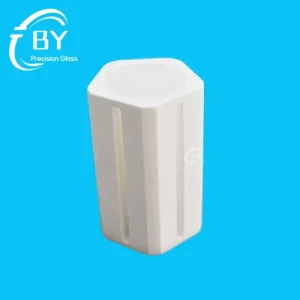
Diffuse High-Reflectivity PTFE Reflectors
View Specifications
Lithography Quartz Optical Windows
View Specifications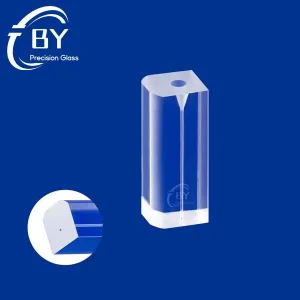
Custom Fiber Optic Glass Ferrules
View Specifications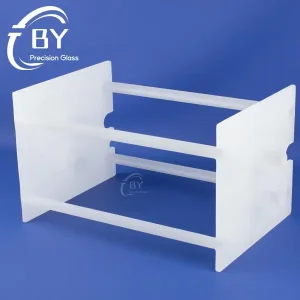
Quartz Diffusion Boat for Semiconductor
View SpecificationsAbsolute Defect Inspection & International Certification Protocols
Every custom multibore tube shipment is backed by interferometric surface verification, UV-Vis spectrophotometer curves, and mechanical stress birefringence testing.
Interferometric Flatness & Transmission
Utilizing Zygo laser interferometers and PerkinElmer Lambda 1050+ UV-Vis-NIR dual-beam spectrophotometers, we guarantee that transmitted wavefront distortion meets or exceeds λ/10 across all functional optical apertures.
Stress Birefringence & Polarimetry
Thermal hot-forming and redrawing inherently introduce hoop and longitudinal stresses. Our computer-controlled polarimeters verify that annealing processes eliminate residual thermal tension down to < 5 nm/cm path difference.
Cleanroom Ultrasonic Packaging
Prior to export logistics, multibore capillary channels undergo multi-stage deionized megasonic flushing, vacuum baking to remove volatile traces, and hermetic nitrogen-purged ESD antistatic double-pouch packing.