
Precision Laser Cavities & Micro-Machined Substrates
Engineered ceramic components, synthetic quartz elements, and optical wave delivery systems built to rigorous micron-level tolerances.

Engineering Physics: Diffuse Reflectivity in Solid-State Cavities
A technical analysis of why 99.7% porous alumina (Al₂O₃) outperforms specular gold and silver metallic coatings under high thermal flux and intense optical pumping.
Diffuse Lambertian Scattering
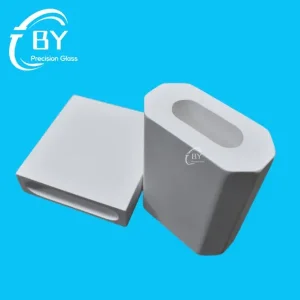
Unlike specular metal mirrors which cause localized hotspots and non-uniform thermal lensing in laser rods (Nd:YAG, Er:YAG), porous Al₂O₃ induces high-order Lambertian scattering. Light rays undergo multiple random internal refractions across bulk crystal boundaries, producing an exceptionally uniform pump energy field inside the active medium.
Solarization & Heat Resistance
Under continuous UV and high-energy xenon flashlamp exposure, thin-film electroplated coatings blister, peel, and oxidize. High-purity alumina ceramics withstand bulk temperatures exceeding 1,500°C without crystalline phase shifts, exhibiting zero optical darkening, solarization degradation, or reflectivity decay over decades of operational life.
Dielectric Glazed Protection
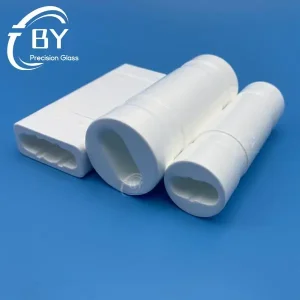
To eliminate cooling fluid contamination, our ceramic cavity reflectors can be integrated with customized lead-free high-temperature vitreous glazing. The glaze seals microscopic surface porosity, making the chamber impervious to deionized (DI) water erosion while maintaining optimal bulk diffuse reflectivity of ≥97% across 600–1000 nm.
| Material Property | High-Purity Laser Ceramic (Al₂O₃) | Electroplated Gold / Silver | Spectralon-Grade PTFE Reflector |
|---|---|---|---|
| Bulk Diffuse Reflectivity (500–1100 nm) | 97.5% – 98.2% (Lambertian) | 92% – 95% (Specular Only) | 99.0% – 99.4% (Diffuse) |
| Maximum Working Temperature | 1,600°C (Glazed: 1,200°C) | ~250°C (Risk of film delamination) | ~260°C (Polymer creep occurs) |
| Thermal Conductivity (W/m·K) | 28 – 35 W/m·K | 150 – 400 W/m·K (Substrate limited) | 0.25 W/m·K (Insulator / Hotspots) |
| Chemical & Coolant Durability | Impervious to DI water, Glycol & ozone | Oxidizes; sensitive to sulphur / moisture | Chemically inert; porous absorption risk |
| Mechanical Rigidity (Mohs / Hardness) | Mohs 9 (Vickers 15–18 GPa) | Mohs 2.5 – 3 (Prone to scratches) | Shore D 55–65 (Easily deformed) |
Industrial Production Capacity & Metrology Standards
Continuous investment in ultra-precision diamond grinding, optical profilometry, and controlled cleanroom batch sintering.
Calibrated via integrating sphere across 500–1200 nm pump bands.
Ultra-precise bores for rod diameters, flow tubes, and flashlamps.
Zero toxic binders; eliminated iron and heavy-metal absorption trace.
Rapid technical turnaround for STEP, IGES, and custom optical CAD files.
China Supply Chain Advantages: Scale, Precision & Resilience
Why leading multinational photonics OEMs integrate BY Photonics into their primary production workflows.
Vertically Integrated Raw-to-Finish Processing
By housing raw high-purity powder preparation, isostatic pressing, green-body high-speed machining, high-temperature sintering (1,700°C), and automated ultrasonic grinding under one facility in Tianjin, we eliminate subcontracting handoffs, reduce scrap margins, and yield a 30–45% procurement cost benefit without compromising optical quality.
Rapid Prototype to Full Batch Scaling
Western ceramic manufacturers frequently mandate 16 to 24-week delivery cycles for custom tooling. Our modular diamond tooling setup and state-of-the-art 5-axis ceramic CNC lathes allow sample iteration delivery within 10 to 14 working days, swiftly ramping to thousands of units monthly for commercial laser production schedules.
Comprehensive Optical & Geometry Metrology
Every ceramic reflector leaving our factory undergoes 100% QA dimensional inspection on calibrated coordinate measuring machines (CMM), surface roughness stylus profilometry (Ra ≤ 0.4 μm glazed), and spectrophotometric reflectance verification, backed by certified mill test reports and material traceability dossiers.
Global Enterprise Procurement & Regulatory Compliance
Ensuring frictionless international logistics, cleanroom packaging, and cross-border environmental compliance.
RoHS, REACH & Conflict Minerals Compliance
All alumina bodies, vitreous glaze materials, and chemical cleaning agents utilized at BY Photonics strictly conform to EU Directive 2011/65/EU (RoHS 2.0), REACH Regulation (EC No 1907/2006), and Dodd-Frank Act Conflict Minerals disclosure. Complete lab analysis documents (SGS/TÜV) are provided directly to enterprise compliance officers for smooth audit clearance.
Cleanroom Export Packaging & Incoterms Support
Ceramic laser reflectors are susceptible to surface grease and airborne particulate accumulation. All finished products undergo ultrasonic multi-stage DI-water washing, vacuum heat drying, and class 10,000 cleanroom nitrogen-purged double-bag sealing. We provide flexible DDP, CIF, and FOB terms with overnight door-to-door air freight via DHL, FedEx, and UPS.
Application Scenarios & Technological Frontiers
High-reliability applications transforming modern medicine, high-precision micro-machining, and defense optics.
Aesthetic & Medical Surgical Systems
Widely deployed in Alexandrite (755 nm), Nd:YAG (1064 nm), and Er:YAG (2940 nm) medical lasers for dermatology, hair removal, and ophthalmology. Glazed alumina cavities resist discoloration from intense pulse flashlamps while guaranteeing cleanroom hygienic standards in hospital environments.
Ultra-Fast & High-Power Industrial Welding
Industrial solid-state lasers operating at high kilowatt levels require extreme thermal dissipation. Our ceramic reflectors maintain geometric and optical integrity despite continuous duty cycles in automated aerospace sheet cutting, battery tab welding, and semiconductor wafer dicing.
Industry Trend: Diode-Pumped (DPSS) Cavity Refinement
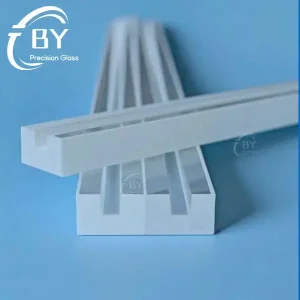
Modern photonics is migrating rapidly from flashlamp pumping to high-efficiency diode-side-pumped laser modules. We develop multi-faceted ceramic reflectors engineered with micro-grooves and side slit apertures specifically matching linear diode stacks, maximizing electrical-to-optical conversion ratios.
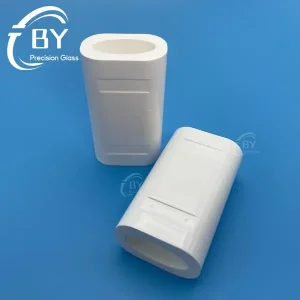
Advanced Ceramic Reflectors & Optical Substrates
Comprehensive standard inventory and custom fabrication for solid-state laser replacement and original equipment design.
Frequently Asked Questions: Technical & Sourcing Insights
Comprehensive engineering guidance to assist optical engineers and procurement specialists.