
High-Performance Laser Cavity & Substrate Solutions
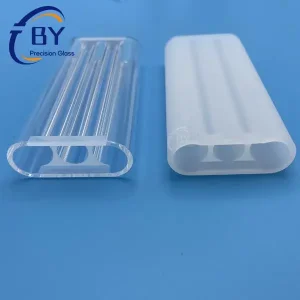
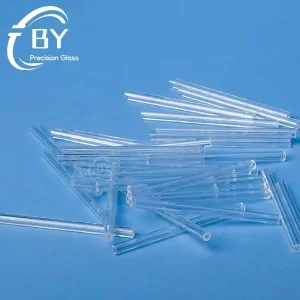
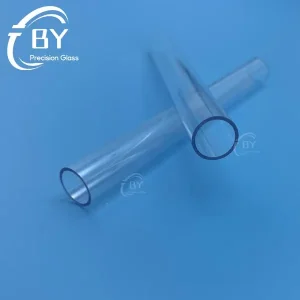
Direct OEM manufacturing under ISO 9001 quality controls. Browse featured dual/triple bore components, filter flow tubes, and semiconductor quartzware machined to drawing specifications.
Deep Dive: Double Bore Reflector Engineering & Optical Physics
Solid-state flashlamp-pumped and diode-pumped laser systems rely fundamentally on the optical transfer efficiency of their pump cavity. Double bore reflectors serve as the thermodynamic and optical heart of dual-channel laser architectures.
Porous High-Alumina Ceramic Matrix
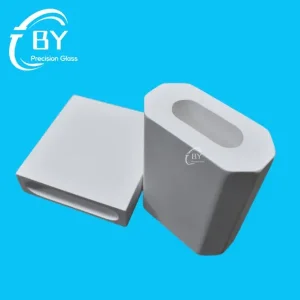
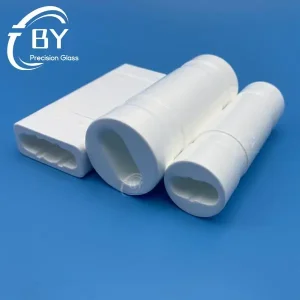
Our double bore ceramic reflectors utilize ultra-high purity porous sintered Al₂O₃ (porosity 20% to 25%, bulk density 3.1 g/cm³). The bulk diffuse scattering operates via volumetric Lambertian distribution, completely eliminating localized "hot spots" on Nd:YAG, Alexandrite, or Er:YAG crystals.
- Diffuse reflectance exceeding 97.5% across primary pump bands (600 nm – 1064 nm).
- Glazed internal bore finish prevents coolant permeation and chemical scale adherence.
- Zero thermal lensing distortion caused by asymmetric pump flux.
Samarium & Rare-Earth Doped Flowtubes
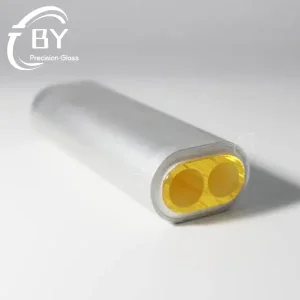
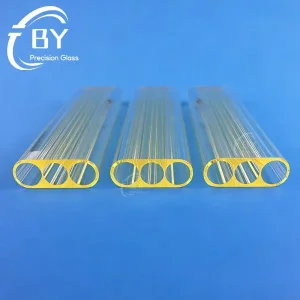
When engineering high-duty aesthetic or medical systems, parasitic 1064 nm amplified spontaneous emission (ASE) and unwanted ultraviolet radiation degrade efficiency. Our integrated dual-bore samarium-doped (Sm10% / Sm20%) cavities act as natural photonic filters.
- Strong absorption band at 1064 nm suppressing parasitic laser depopulation.
- UV solarization cutoff below 380 nm protecting Nd:YAG rods from color-center aging.
- Hydrodynamically balanced twin flow channels for symmetric thermal dissipation.
Sub-Micron CNC Ultrasonic Bore Grinding
Double bore reflectors require strict geometric tolerance between the optical excitation lamp channel and the laser gain medium channel. Any deviation in axial parallelism causes asymmetric pumping and wavefront phase aberration.
- Center-to-center bore pitch tolerance held to ±0.010 mm along total length.
- Bore concentricity < 0.008 mm verified by Zeiss 3D coordinate measuring machines (CMM).
- O-ring sealing gland surfaces ground to Ra < 0.4 µm to guarantee high-pressure seal.
Where BY Photonics Double Bore Reflectors Drive Innovation
From dermatological surgical systems to high-throughput wafer dicing, explore how our precision machined optical cavities satisfy demanding commercial operational cycles.
Aesthetic & Surgical Medical Lasers
Medical devices such as dual-wavelength Alexandrite (755 nm) and Nd:YAG (1064 nm) platforms (including Candela GentleLase/GentleMax architecture) run high pulse rep rates under heavy clinical loads. Our double bore reflectors ensure:
- Long-Term Colorfastness: Porous ceramic matrix will not scorch, craze, or peel under mega-watt peak pulse energies.
- Coolant Immersion Durability: Inert glaze withstands high-temperature deionized water flow without chemical leeching.
- Direct Drop-In Replacement: 100% mechanical compatibility with OEM laser heads, reducing hospital maintenance downtime.
Semiconductor Processing & Micro-Welding
High-reliability wafer annealing, PCB via micro-drilling, and battery tab welding demand zero pulse-to-pulse energy fluctuations. By integrating our double bore cavities into solid-state resonators, industrial laser integrators achieve:
- Beam Quality Factor (M²) Optimization: Homogeneous diffuse pump light creates radial symmetry across the gain medium.
- High Thermal Shock Resistance: Low coefficient of thermal expansion (< 7.5 × 10⁻⁶/K) prevents crack propagation during repetitive duty-cycles.
- Cleanroom Compliance: Parts ultrasonically cleaned and vacuum sealed to Class 1000 cleanroom standards for microelectronic machinery.
Engineering Evaluation: Ceramic vs. Quartz vs. PTFE Double Bore Cavities
Choosing the correct optical material prevents costly laser degradation. Compare core mechanical, thermodynamic, and reflectance characteristics evaluated by BY Photonics testing laboratories.
| Evaluation Parameter | Porous Ceramic Al₂O₃ Reflector | Gold-Coated Fused Silica / Quartz | Spectralon-Grade Sintered PTFE | Sm-Doped Dual Flowtube Assembly |
|---|---|---|---|---|
| Diffuse Reflectance (600–1064nm) | 97.5% – 98.2% | Specular > 98.0% (Gold) | 98.5% – 99.1% | Filters 1064nm / Transmits 500-800nm |
| Thermal Stability / Max Temp | 1,200 °C (Continuous) | 1,100 °C (Fused Quartz) | ~ 260 °C (Melting Threshold) | ~ 450 °C (Glass Annealing Limit) |
| Coolant Resistance (DI Water) | Excellent (Glazed Internal Bore) | Susceptible to Gold Film Flaking | Inert, Hydrophobic | Immune, Optical Polished Flow Path |
| Parasitic ASE Suppression | Moderate (Scatters Resonances) | None (Reflects all NIR) | Moderate | High (Sm³⁺ 1064nm Extinction) |
| Typical Geometry Application | Flashlamp Nd:YAG / Alexandrite | High Power CW Lamp Pumps | Diode-Pumped Laser Modules | Medical High-Energy Pulse Heads |
| Dimensional Tolerance | ±0.010 mm CNC Ground | ±0.020 mm Flame / Cold Work | ±0.030 mm Precision Machined | ±0.005 mm Redrawn & Polished |
End-to-End Vertical Manufacturing in Tianjin, China
Combining optical cold working, precision CNC grinding, oxyhydrogen hot flame fusing, and capillary drawing under a unified 3,000+ m² facility to eliminate supplier handoffs.
Integrated Tooling & Sintering
From dry-pressing high-purity raw powders to vacuum high-temperature sintering ovens running up to 1,750 °C, BY Photonics controls 100% of the ceramic formulation and grain boundary microstructure to guarantee zero bulk inclusions.
5-Axis CNC Ultrasonic Centers
Processing sintered ceramics and ultra-hard quartz requires non-impact cutting to prevent subsurface micro-fracturing. Our ultrasonic-assisted CNC machining preserves structural integrity across thin walls between the dual bores.
Zygo Metrology & QA Traceability
Every double bore reflector batch ships with full inspection records: Zygo laser interferometric flatness reports, spectrophotometer diffuse reflectance curves, and laser coordinate bore alignment maps.
Engineering DFM Checklist for Custom Double Bore Reflectors
Before submitting CAD drawings (STEP, DWG, DXF, or PDF), review this design checklist to minimize manufacturing lead times and optimize cost-to-performance ratio.
Critical Geometric Parameters to Specify
When drafting RFQs for dual-bore laser head components, ensure your mechanical prints define the following constraints clearly:
- Bore Pitch & Centerline Distance: Standard pitch ranges between 12.0 mm to 45.0 mm depending on lamp/rod OD.
- Internal Glaze Boundaries: Indicate whether ends require masking or full circumferential glaze for O-ring sealing lands.
- Chamfers & Lead-Ins: Specify 0.5 mm × 45° lead-in chamfers on bore entries to eliminate rod scratching during field insertion.
- Cooling Ports & Alignment Flats: Provide location tolerances for sensor ports and anti-rotation key slots.
International Compliance & Export Packaging
BY Photonics ships regularly to laser manufacturers and medical service networks throughout North America, Europe, Japan, and Southeast Asia:
- RoHS 3 & REACH Compliance: Certified chemical composition free of hazardous heavy metals and volatile binders.
- Custom Shock-Absorbing Packaging: High-density molded EPE foam compartments inside rigid moisture-barrier export cases.
- Prototype to Mass Production: Rapid prototyping in 7 to 10 days; mass production schedules scaling to 2,000+ units monthly.
- Direct Engineering Support: Dedicated bilingual photonics application engineers accessible via email, phone, and video conference.
Frequently Asked Questions on Double Bore Reflectors
In-depth technical answers addressing common thermal, optical, and mechanical queries from optical system architects and procurement heads.
Why is high-purity alumina ceramic preferred over gold-plated metal cavities in solid-state laser heads?
While specular gold plating offers high initial reflectivity, it deteriorates rapidly in high-duty flashlamp environments due to intense UV exposure, galvanic flaking, and abrasion from deionized cooling water. Furthermore, specular reflectors concentrate light into caustic focal lines, resulting in asymmetric rod heating and thermal lensing. Diffuse ceramic reflectors produce a 360-degree Lambertian scattering field that heats the laser rod uniformly and retains its optical reflectance over tens of thousands of operating hours without degradation.
What is the specific function of glazing the internal bores of ceramic laser reflectors?
Porous ceramic has an open micro-pore structure that offers volumetric diffuse reflection. However, direct contact with cooling water allows liquid absorption, mineral scale deposition, and algae growth inside the porous matrix. Glazing applies an amorphous fused glass layer (typically 20 to 50 µm thick) over the internal bores. This creates a glassy, chemically inert, non-wetting surface that eliminates hydraulic permeation, facilitates laminar fluid flow, and maintains high reflectivity throughout the cavity lifetime.
How does BY Photonics maintain bore parallelism and concentricity across long double bore bodies?
Holding axial parallelism across lengths up to 180 mm in hard sintered ceramics requires specialized diamond-tooled CNC grinding centers equipped with high-frequency ultrasonic spindles. We hone both bores simultaneously in a single fixture clamp, eliminating re-fixturing error. Real-time in-process air gauging monitors bore diameter, followed by 100% verification on automated Zeiss 3D coordinate measuring machines (CMM) to ensure axial parallelism remains within ±0.005 mm.
Can you provide custom double bore configurations for non-standard laser rod and lamp diameters?
Yes. Approximately 70% of our production consists of tailored OEM components. We produce asymmetric dual bores (e.g., 10 mm lamp bore paired with a 4 mm rod bore), triple bores (dual lamps pumping a single central rod), as well as complex integrated flow channels, external indexing keys, and custom O-ring grooves based on your STEP, DWG, or PDF specifications.
Precision Quartzware, Laser Ceramics & Flow Tubes
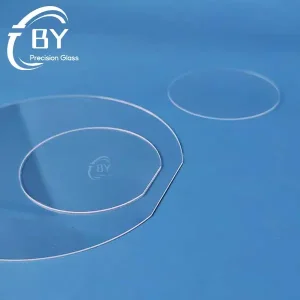
Explore the remainder of our engineered product range, featuring samarium filter tubes, semiconductor-grade quartz components, and custom spectrophotometer optics.



Next-Generation Double Bore Reflector Innovations
As solid-state laser systems transition toward higher rep-rates, picosecond pulses, and extreme environmental ruggedness, BY Photonics is actively developing advanced cavity architectures.
Micro-Channel Direct Liquid Cooling
Integrating 3D micro-cooling manifolds within the ceramic body itself to increase thermal heat dissipation by 45%, enabling multi-kilowatt average pump power without structural stress or coolant boiling.
Multi-Doped Rare-Earth Glazes
Pioneering multi-element glaze chemistry combining Neodymium, Cerium, and Samarium directly onto the bore walls, eliminating separate filter tubes and reducing total laser head part counts.
AI-Assisted Optical Ray-Tracing DFM
Deploying computational photon transport simulations to assist clients during early prototyping, predicting volumetric pump absorption efficiency and recommending optimized bore wall thicknesses before tooling begins.