
Precision Optical Cavity Components & Ceramic Reflectors
Engineered to exact OEM specifications for high-energy medical laser heads, aesthetic flow handles, and high-purity optical alignment cavities.
The Global Micro-Optic Interconnect & Ferrule Ecosystem
Analyzing physical limits, material transitions, and high-density packaging paradigms across hyperscale telecommunications, industrial laser power delivery, and optoelectronic packaging.
Sub-Micron Alignment Physics
As transmission data rates advance from 400G to 800G and 1.6T Co-Packaged Optics (CPO), spatial tolerances in fiber optic interconnect ferrules leave zero room for margin. A lateral core offset of merely 0.5 micrometers in single-mode fibers (SMF-28) generates severe insertion loss exceeding 0.35 dB.
Modern ferrules demand rigorous geometric stability: absolute cylindrical concentricity below 0.3 μm, ultra-smooth inner-bore roughness (Ra < 0.05 μm), and flawless perpendicularity to guarantee physical core contact under thermal cycling.
Material Evolution: Silica vs Zirconia
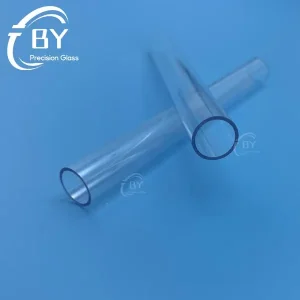
While standard telecom relies predominantly on yttria-stabilized tetragonal zirconia polycrystal (Y-TZP) ceramic ferrules, mission-critical photonic architectures are transitioning toward precision synthetic fused silica (JGS1) and samarium/fluorine-doped quartz capillary tubes.
Fused silica features a matching coefficient of thermal expansion (CTE = 0.55 × 10⁻⁶/K) to fiber glass cores, eliminating thermally induced stress cracking during intense continuous-wave (CW) or ultra-fast pulsed beam injection in medical and industrial laser systems.
High-Density Array Interconnects
Multi-bore capillary glass ferrules and multi-groove quartz substrates are rapidly supplanting discrete single-fiber connectors inside co-packaged optical transceivers and silicon photonics engine arrays. Tight multi-bore spacing demands precision wire EDM, CNC micro-ultrasonic drilling, and controlled thermal down-drawing.
Integrated assemblies maintain pitch accuracy across 8, 16, or 24 channels within ±0.5 μm, supporting high-speed optical cross-connects and high-capacity interconnect manifolds without polarization-mode dispersion.
Integrated Precision Glass Machining: The Chinese Factory Benchmark
Tianjin BY Photonics demonstrates how consolidating high-purity optical raw materials, precision CNC cold processing, oxyhydrogen flame hot forming, and capillary re-drawing provides unrivaled cost efficiency and speed.
Full In-House Processing Chain
Unlike regional workshops that outsource critical lapping or thermal flame polishing steps, our integrated facility manages the end-to-end processing pipeline under a unified ISO-monitored roof:
- Precision diamond grinding and double-sided polishing
- Multi-axis CNC ultrasonic micro-machining
- Oxyhydrogen flame hot working for seamless welding
- High-precision capillary thermal redrawing
Aggressive DFM & Engineering Speed
Global procurement teams struggle with prolonged vendor feedback loops. Our specialized engineering division performs comprehensive Design for Manufacturability (DFM) analyses within 24 hours of CAD receipt:
- Instant feedback on glass aspect ratios and wall thickness
- Optimization of corner stress fillets and taper transitions
- Custom tooling design without third-party delay
- Direct engineer-to-engineer technical consultation
Stringent Metrology & QA Rigor
Maintaining micro-scale repeatability over production runs exceeding tens of thousands of units is secured by our extensive optical metrology suite:
- Laser interferometry checking surface flatness to λ/10
- Non-contact video measuring microscopes (±0.5 μm)
- Spectrophotometric verification (185 nm – 3500 nm)
- Cleanroom vacuum degassing and sealed anti-static packing
Cost Rationalization & Scalability
Capitalizing on localized raw material supply networks across high-purity synthetic silica deposits and advanced sintered alumina ceramics delivers major advantages:
- 30% to 55% tooling cost reductions compared to Western shops
- Rapid transitions from 5-piece prototypes to 50k batch runs
- Buffer stock agreements for contracted international OEMs
- Traceable melt batch certificates and RoHs/REACH compliance
Mission-Critical Applications of Fiber Interconnect & Optical Glass
From high-energy dermatology operating rooms to cryogenic aerospace sensing and ultra-clean semiconductor lithography lines.
Medical & Aesthetic Lasers
Aesthetic dermatology devices like Candela VBeam, GentleLase, and DEKA pulsed dye systems generate intense flashlamp pump pulses. High-energy optical cavities demand durable laser pump chamber components:
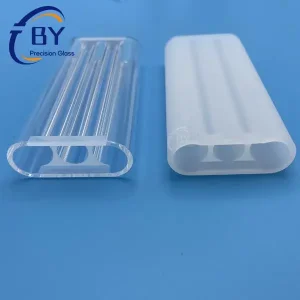
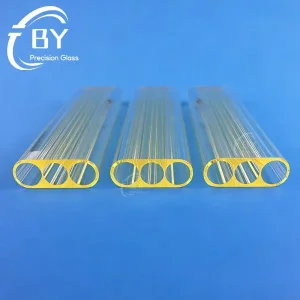
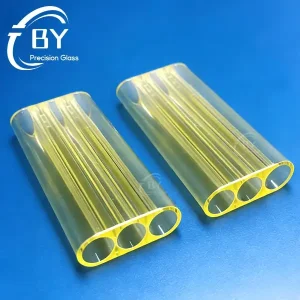
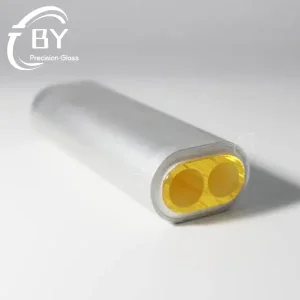
- Triple-Bore Flow Tubes: Houses the laser crystal rod and flashlamps while isolating high-velocity deionized cooling water.
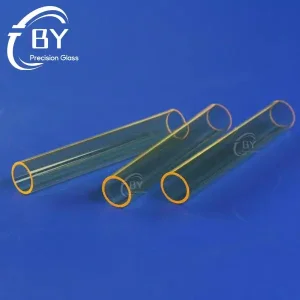
- Samarium-Doped Glass: Extinguishes 1064 nm parasitic lasing and completely filters hazardous 400 nm UV radiation to safeguard laser crystal longevity.
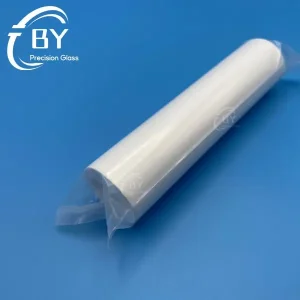
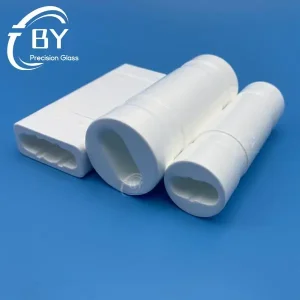
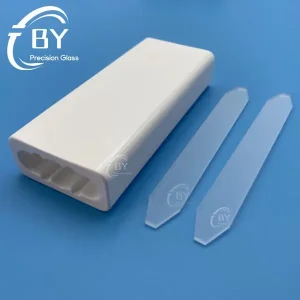
- Diffuse Ceramic Reflectors: Replaces short-lived gold plating with 99.2% diffuse reflectance for homogeneous rod excitation.
Semiconductor Lithography & Wet Processing
Wafer fabrication plants require inert, heat-resistant components that withstand aggressive chemical slurries and high thermal cycling:
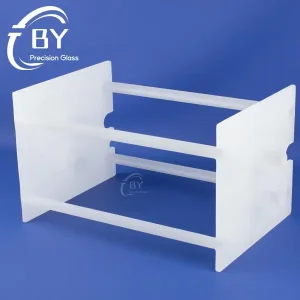
- Quartz Diffusion Boats & Carriers: Flame-welded from semiconductor-grade fused quartz for oxidation, diffusion, and LPCVD processes up to 1,150°C.
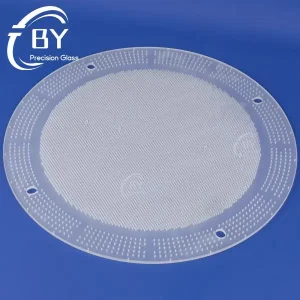
- Gas Distribution Plates: Micro-drilled showerhead glass plates distributing silane, nitrogen, and oxygen gases evenly across 200mm/300mm wafer stages.
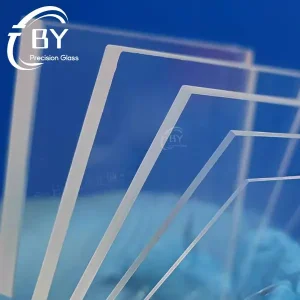
- Optical Viewports & Windows: Optically polished borosilicate and synthetic fused silica windows for real-time chamber plasma monitoring.
Fiber Optic Telecommunications & Sensors
High-reliability telecom infrastructures depend heavily on capillary glass components and precision fiber optic alignment accessories:
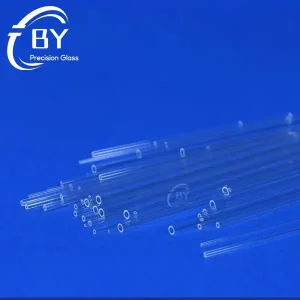
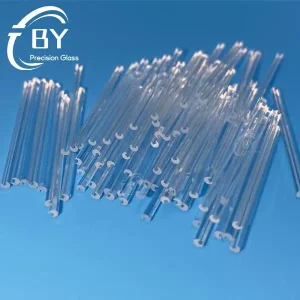
- Fluorine-Doped Silica Capillaries: Engineered with depressed cladding refractive indices for specialty fiber splicing and fiber laser pump couplers.
- V-Groove Quartz Substrates: Highly accurate pitch-controlled grooves ensuring micro-alignment between multi-core fibers and arrayed waveguide gratings (AWG).
- Down-Drawn Alignment Sleeves: Inner bore diameter controlled within ±0.25 μm for zero-friction single-mode and polarization-maintaining (PM) fiber mating.
Physical & Optical Properties of Core Optical Materials
Compare synthetic quartz, optical glass grades, doped flow tubes, and laser ceramics to balance transmission band, thermal shock index, and damage resistance.
| Material Classification | Transmission Band | CTE (10-6/K) | Max Temp (°C) | Laser Damage Threshold | Key Industrial Role |
|---|---|---|---|---|---|
| JGS1 Synthetic Fused Silica | 185 nm – 2,500 nm | 0.54 | 1,100 °C | > 20 J/cm2 (1064nm, 10ns) | UV Optics / Fiber Laser Interconnect |
| JGS2 Optical Fused Quartz | 220 nm – 2,500 nm | 0.55 | 1,050 °C | > 12 J/cm2 (1064nm, 10ns) | Sight Viewports & Flow Tubes |
| JGS3 Low-OH Infrared Quartz | 260 nm – 3,500 nm | 0.55 | 1,050 °C | > 15 J/cm2 (2100nm, 10ns) | Mid-IR Sensors & Holmium Laser Cavities |
| Samarium-Doped Fused Glass (Sm3+) | Filters 1064 nm / UV | 0.85 – 1.20 | ~ 650 °C | > 8 J/cm2 (Pulsed Flash) | Nd:YAG Flow Tubes / Candela Laser Heads |
| Sintered Porous Alumina Ceramic (99.7%) | Diffuse Reflectance (380–1200nm) | 7.20 | 1,500 °C | Reflectance > 99.2% | Laser Pump Chambers / DEKA Reflectors |
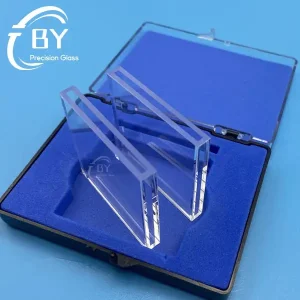
| Optical Borosilicate (Borofloat 33) | 320 nm – 2,200 nm | 3.25 | 450 °C | > 5 J/cm2 | Vacuum Viewports & Cuvette Windows |
Global Enterprise Sourcing & Quality Engineering (DFM)
Guidelines for optical system architects, procurement managers, and quality assurance specialists when ordering custom interconnect ferrules and glass parts.
1. Geometric Stack-up & Tolerancing
Over-specifying tolerances increases manufacturing costs exponentially, while under-specifying causes optical coupling failure:
- Inner Bore Clearance: Fiber insertion requires an optimal gap of 0.5 μm to 1.0 μm over standard fiber cladding (e.g., 125.5 μm ID for 125.0 μm fiber). Gaps over 2.0 μm generate catastrophic angular tilt.
- End-Face Chamfering: A 45-degree or conical entry funnel prevents fiber edge shearing and micro-fragmentation during assembly.
- Outer Diameter Concentricity: Keep OD-to-ID runout under 0.5 μm to allow precise rotation inside mating sleeve connectors.
2. Surface Integrity & Polish Quality
Micro-defects and micro-cracks inside glass capillaries or laser flow tubes act as seed points for high-energy thermal destruction:
- Scratch-Dig Standards: Specifying MIL-PRF-13830B 20-10 or 10-5 for laser transmission zones prevents absorption hotspots.
- Surface Lapping: Double-sided mechanical planetary polishing eliminates residual stress and surface waviness down to λ/10.
- Thermal Annealing: High-temperature oven soaking relieves micro-stress introduced during CNC ultrasonic grinding or flame glassblowing.
3. Supply Chain Traceability & Packaging
High-purity quartz and optical alignment components are susceptible to atmospheric hydrocarbon contamination and transit damage:
- Cleanroom Washing: Multi-frequency ultrasonic degreasing using deionized water (18.2 MΩ·cm) eliminates particulates down to class 100 cleanrooms.
- Vacuum Packaging: Anti-static moisture-barrier clean packs ensure moisture-free shelf life exceeding 24 months.
- Lot Traceability: Complete melt lot inspection data sheets and dimensional CMM inspection reports provided with every production batch.
Frequently Asked Technical & Sourcing Questions (FAQ)
In-depth answers to core engineering questions regarding optical interconnect ferrules, custom laser cavities, and quartzware manufacturing.
Why use fused silica ferrules instead of standard zirconia (ZrO2) ferrules?
Zirconia ferrules are ideal for standard telecom patch cords because of high fracture toughness. However, for high-power laser beam combining, high-temperature sensor monitoring, or silicon photonics, zirconia creates issues: it does not match the coefficient of thermal expansion of the glass fiber, and epoxy adhesives absorb stray light and burn. Fused silica ferrules provide identical thermal expansion, zero UV fluorescence, and allow CO2 laser fusing directly to fiber ends without adhesives.
What is the specific function of samarium-doped glass (Sm3+) in laser flow tubes?
Samarium-doped glass absorbs light at 1064 nm (the fundamental emission wavelength of Nd:YAG) while transmitting the pumping bands (between 730 nm and 800 nm). In high-gain laser cavities, Amplified Spontaneous Emission (ASE) and parasitic 1064 nm light oscillate across the pump chamber, causing significant efficiency drop and thermal buildup. Samarium flow tubes absorb this parasitic light and cut off wavelengths under 400 nm, protecting crystal rods from solarization.
How do you guarantee bore concentricity below 0.5 μm on micro-capillaries?
Sub-micron concentricity cannot be accomplished by traditional mechanical drilling. Tianjin BY Photonics uses ultra-stable vertical capillary down-drawing towers. An oversized fused silica preform is turned, ground, and bored with zero runout on precision CNC lathes. The preform is then drawn down in a multi-zone furnace controlled by laser micrometer feedback loops, preserving the ID/OD ratio and minimizing bore eccentricity across kilometer lengths.
What is the typical lead time for custom prototype glass components?
For custom components with customer-provided drawings (STEP, DWG, or PDF), our engineering review is completed within 24 hours. Prototypes requiring multi-axis CNC milling, custom grinding, and flame welding are shipped within 10 to 14 business days. Standard materials (JGS1/JGS2 plates, common capillary sizes, stock replacement Candela/DEKA cavity components) ship within 48 to 72 hours.
Why are diffuse ceramic reflectors preferred over gold-plated metal cavities?
Gold plating deteriorates rapidly when exposed to deionized cooling water, intense pulsed UV lamp radiation, and cavitation bubbles, flaking away and dropping reflectance below 85% within months. High-purity sintered alumina ceramics (Al2O3) are chemically inert and provide diffuse (Lambertian) reflectance above 99.2% across 600–1100 nm. Diffuse reflection distributes optical energy symmetrically through the laser rod, eliminating hot spots and thermal lensing.
How does fluorine-doped silica alter the performance of optical capillary tubes?
Fluorine functions as an index-lowering dopant in silica glass matrix. By lowering the refractive index below pure fused silica (e.g., NA > 0.22), fluorine-doped capillaries serve as optical claddings. When used to bundle or splice active fiber cores, the tube acts as an optical confinement boundary, guiding stray pump light and preventing cladding-mode leakage from overheating mechanical connectors.
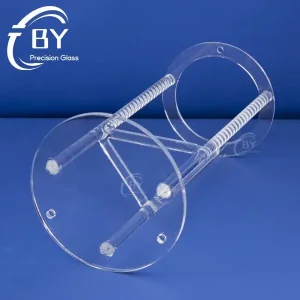
High-Purity Quartzware, Substrates & Precision Tubing
Engineered for corrosive semiconductor diffusion furnaces, optical fiber coupling assemblies, and extreme temperature viewports.
Request Engineering Consultation & Manufacturability Analysis
Upload your STEP, DWG, IGES, or dimensioned PDF drawings directly to our optical glass and ferrule engineering desk. Receive DFM feedback, tolerance optimization advice, and cost models within 24 working hours.