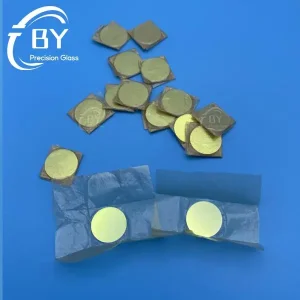
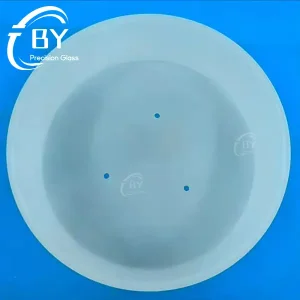
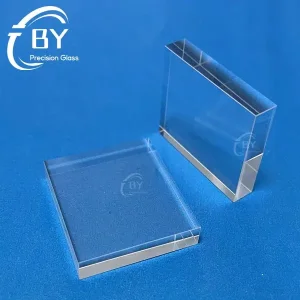
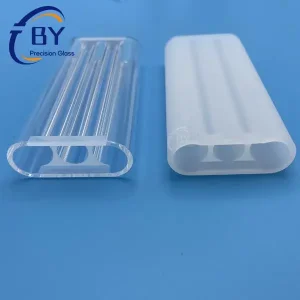
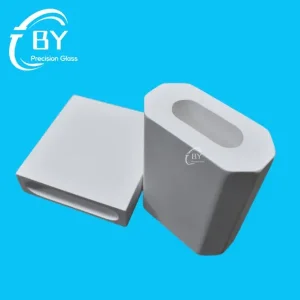
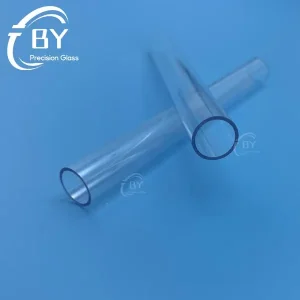
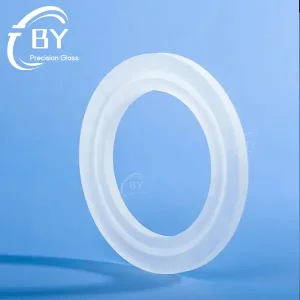
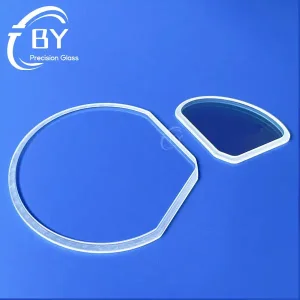
Primary Precision Quartz & Optical Sub-Assemblies
Explore high-performance optical glass components machined in-house for laser cavity assemblies, lithography wafer stages, and advanced analytical instrumentation.
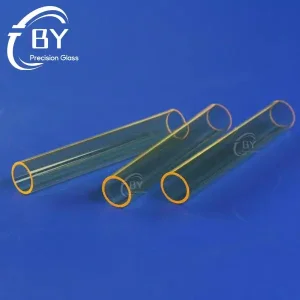
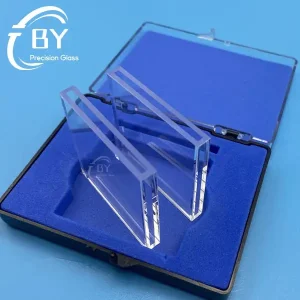
Engineering Architecture of Precision Glass Fiber Optic Ferrules
In high-speed optoelectronic interconnects and extreme-environment photonic links, the mechanical and material interface determines system-level performance. Glass ferrules deliver thermal expansion matching, micron-level concentricity, and optical UV-NIR transparency that conventional ceramic alternatives cannot achieve.
Thermal Expansion Match (CTE)
Traditional zirconia ferrules possess a Coefficient of Thermal Expansion (CTE) of approximately 10.5 × 10⁻⁶/K, whereas silica optical fibers sit at 0.55 × 10⁻⁶/K. When subjected to thermal cycling between -40°C and +85°C (Telcordia GR-326-CORE), differential expansion causes radial micro-displacement, leading to insertion loss drift. Synthetic fused silica and tailored borosilicate glass ferrules mirror the fiber's thermal profile, eliminating internal mechanical stress across extreme operational ranges.
Sub-Micron Bore Concentricity
Achieving low insertion loss (<0.1 dB) in single-mode fibers requires core alignment tolerances below 0.5 µm. BY Photonics employs continuous-draw precision redrawing combined with computerized non-contact laser interferometry. Our inner diameter (ID) tolerances are held strictly to +0.0005 mm / -0.0000 mm, with eccentricity between the capillary bore and outer diameter restricted within 0.001 mm (1.0 µm), preserving absolute geometric symmetry.
Direct Laser Cleaving & Polishing
Glass and silica ferrules share identical hardness indices (Mohs 6.5–7.0) with standard telecom fibers. During polishing processes, abrasive wear proceeds at a completely uniform removal rate. This avoids the problematic fiber protrusion or undercut common in ceramic ferrules, yielding flawless physical contact (UPC/APC) with Return Loss values consistently exceeding -65 dB.
Global Commercial & Industrial Landscape
The transition toward AI cluster architectures (800G, 1.6T, and 3.2T links) and Co-Packaged Optics (CPO) has accelerated demand for customized glass capillary arrays and high-precision fiber optic ferrules.
The Paradigm Shift from Zirconia Ceramic to Glass
For four decades, zirconia (ZrO₂) dominated standard patchcords. However, next-generation silicon photonics modules and Fiber Array Units (FAUs) face physical scaling bottlenecks. Ceramic ferrules are opaque to ultraviolet radiation, forcing module packagers to rely on heat-cured epoxies that require hours to set and generate thermal shrinkage stress.
Glass fiber optic ferrules and multi-bore capillary blocks permit rapid UV-curable adhesive curing in less than 15 seconds directly through the transparent sleeve body. Furthermore, the refractive index matching properties of optical borosilicate and fused silica enable integrated transmissive collimation and fusion splicing protocols that simplify automated robotic packaging lines across North America, Europe, and the Asia-Pacific region.
Surging Demand in Co-Packaged Optics & Hyperscale AI
With artificial intelligence computing clusters consuming hundreds of thousands of high-speed optical transceivers, thermal dissipation in dense optical engines has become critical. Glass capillary ferrules and multi-core pigtail arrays withstand sustained operational temperatures above 180°C in immersion-cooled and direct-to-chip liquid cooling setups without mechanical warping or polymer degradation.
Modern silicon photonic transceiver designers rely on custom multi-channel glass blocks featuring pitches precisely registered at 127 µm or 250 µm with sub-micron pitch accuracy (±0.3 µm across 16-channel arrays). Our manufacturing ecosystem bridges the gap between raw optical quartz melting and finished, micro-machined packaging sub-mounts.
| Property / Characteristic | Synthetic Fused Silica (JGS1) | Precision Borosilicate Glass | Standard Ceramic (Zirconia ZrO₂) |
|---|---|---|---|
| Coefficient of Thermal Expansion (CTE) | 0.54 × 10⁻⁶ / K Exact Match | 3.25 × 10⁻⁶ / K Low Shift | 10.5 × 10⁻⁶ / K Mismatch Warning |
| Optical Transmission Range | 185 nm – 2,500 nm (Deep UV to NIR) | 350 nm – 2,500 nm (Near UV to NIR) | Completely Opaque (Zero Transmission) |
| UV Epoxy Curing Compatibility | Instantaneous (< 10s direct penetration) | Instantaneous (< 15s direct penetration) | Impossible (Requires thermal bake) |
| Hardness (Mohs Scale) | 7.0 (Identical to Telecom Fiber) | 6.5 (Balanced Polishing) | 8.5 (Harder than Fiber; Risk of Undercut) |
| Chemical & Plasma Inertness | Extreme (Immune to HF-free acids/solvents) | High (Hydrolytic Class 1 resistance) | Moderate (Degrades in acidic atmospheres) |
| Maximum Working Temperature | ~1,100 °C Continuous | ~450 °C Continuous | ~400 °C (Limited by grain boundary phases) |
Chinese Factory Supply Chain Resilience & Efficiency
Combining high-purity ingot casting, redraw pulling towers, high-speed multi-axis CNC micro-machining, and oxyhydrogen flame welding under a single roof in Tianjin, China.
Vertical Raw Material Autonomy
We source certified JGS1, JGS2, and JGS3 raw quartz boules along with low-expansion borosilicate preforms directly from tightly integrated regional chemical vapor deposition (CVD) centers. This insulates our global partners from ingot shortages, providing absolute transparency and batch chemistry traceability from raw silicon tetrachloride (SiCl₄) to polished ferrule end-faces.
Dual Cold & Hot Processing
Unlike standard machining workshops that subcontract hot glass forming, our 3,000 m² Tianjin plant houses continuous capillary redraw towers alongside ultra-precision ultrasonic milling and centerless grinding units. This consolidation eradicates inter-supplier transit delays, reduces cumulative geometric error stack-ups, and allows 24-hour turnaround on initial DFM engineering reviews.
Rapid Scale & Buffer Inventory
Our facility operates 120+ processing machines including high-speed precision cutting saws, lapping disks, and multi-bore redraw furnaces. We support our Tier-1 customers with localized safety stock agreements and flexible batch scheduling, transitioning from prototype quantities (10–50 pieces) to volume production runs exceeding 500,000 units per month with consistent Cpk > 1.33.
End-to-End In-House Manufacturing Verification Pipeline
Preform Selection & Redraw
Synthetic fused silica cane drawing under cleanroom positive-pressure thermal towers.
Micro-Hole Honing & OD Sizing
Centerless grinding holds outside diameter (1.25mm / 2.5mm) within ±0.001 mm.
End-Face Lapping & Chamfer
Flat/angled polishing to 20-10 scratch-dig; lead-in funnel precision micro-chamfering.
Laser Metrology & Clean-Pack
100% video inspection, interferometric concentricity logging, and Class 1000 cleanroom packaging.
Localized Engineering Application Scenarios
From high-power surgical fiber laser handpieces to multi-channel optical sensing arrays in deep-well exploration, explore how our precision glass ferrules operate in mission-critical environments.
High-Power Industrial Fiber Lasers (QBH/QCS)
In high-power industrial fiber laser cutting heads (1 kW to 30 kW), back-reflected light frequently burns standard epoxy joints in metallic or ceramic ferrules. Using fused silica ferrules fused directly to large-core fiber end-caps (homogeneous glass-to-glass fusion) eliminates organic glues entirely. This produces beam delivery interfaces that survive continuous thermal loads up to 1,000°C without laser-induced optical damage (LIDT > 45 J/cm² @ 1064 nm, 10 ns).
Aerospace, Avionics & Downhole Sensing
Fiber Bragg Grating (FBG) interrogators installed in geothermal wells, nuclear reactors, and jet turbine health monitoring systems encounter pressures exceeding 2,000 psi and ambient temperatures over 300°C. Our heavy-wall borosilicate and synthetic quartz ferrules offer chemical inertness against hydrogen darkening, sour gas (H₂S), and saltwater corrosion, ensuring long-term signal fidelity across decades of continuous service.
Medical Diagnostics & Surgical Endoscopes
Medical Holmium:YAG (2.1 µm) and Thulium fiber lasers used in urology and minimally invasive surgeries require biocompatible optical interfaces. Fused silica ferrules provide non-toxic, USP Class VI compliant biocompatibility, non-magnetic resonance profile (ideal for intraoperative MRI-guided interventions), and flawless resistance to repetitive autoclave steam sterilization cycles without micro-fissuring.
Technology Roadmap & Future Outlook (2026–2030)
Anticipating next-generation optical engineering challenges, our research and engineering initiatives focus on overcoming spatial limits in sub-micron alignment and high-density multi-core photonic integration.
Monolithic Micro-Lens Array Integration
By integrating refractive micro-lenses directly onto the exit end-face of fused silica capillary ferrules via laser-assisted chemical etching, our 2026–2027 roadmap eliminates external ball lenses. This delivers expanded-beam collimated interfaces directly from the ferrule tip, dramatically relaxing dust and contaminant sensitivity in field-deployable connectors.
Ultra-Dense Multi-Bore Capillaries
To support multi-core fibers (MCF with 4, 7, or 19 cores) and Space-Division Multiplexing (SDM), BY Photonics is scaling proprietary precision redraw tooling capable of holding angular rotational tolerances of multi-bore capillary holes within ±0.2°. This supports pitch center accuracy across 32-channel fiber ribbons without pitch drift across high-temperature cycles.
Doped Glass Waveguide Capabilities
Leveraging our established background in Samarium-doped and Cerium-doped quartz drawing, our advanced research desk is prototyping active filtering capillary ferrules that absorb parasitic 1064 nm amplified spontaneous emission (ASE) within high-power fiber laser seed launch assemblies, preventing upstream diode bank destruction.
Global Compliance, Quality Assurance & Local Support
Every customized glass ferrule, capillary tubing length, and optical component ships with comprehensive inspection documentation that satisfies strict aerospace, telecommunication, and semiconductor requirements.
Full Regulatory & Environmental Certification
BY Photonics operates under certified ISO 9001:2015 quality management procedures. All finished glass products conform strictly to RoHS 3 (EU Directive 2015/863), REACH (EC 1907/2006), and Dodd-Frank conflict mineral reporting acts. Every delivery batch includes material purity certificates, refractive index reports, and transmission spectrometer curves confirming OH content specifications.
Our cleanroom packaging operations adhere to Fed Std 209E Class 1000 standards. Parts undergo multi-stage ultrasonic agitation cleaning in deionized water (18.2 MΩ·cm resistivity) followed by vacuum-sealed antistatic pouch packaging to eliminate microscopic particulate contamination prior to shipment.
Dedicated Engineering Desk & Rapid DFM Turnaround
Navigating tight geometric tolerances in brittle optical materials demands responsive technical dialogue. Our engineering team reviews native 3D and 2D CAD files (STEP, IGES, DWG, DXF, or dimensioned PDFs) within 24 working hours. We provide actionable Design-for-Manufacturability (DFM) suggestions concerning micro-chamfer angles, runout feasibility, wall thickness safety margins, and cost-effective surface finishes.
We maintain an open-account logistics workflow with leading global air express carriers (DHL, FedEx, UPS), ensuring quick prototype transit to tech hubs in the United States, Germany, Japan, South Korea, and Singapore within 3–5 working days of dispatch.
Accelerate Your Micro-Optic Prototype Validation
Whether you require standard 1.25mm / 2.5mm OD single-mode glass ferrules or bespoke multichannel capillary arrays with proprietary hole geometries, our optical engineers are ready to evaluate your print.
Frequently Asked Questions (FAQ)
Detailed technical responses addressing materials, tolerance limits, polishing mechanics, and commercial logistics for procurement managers and optical design engineers.
What are the key technical advantages of glass optical ferrules over zirconia ceramic ferrules?
What dimensional tolerances can BY Photonics maintain on capillary inner bore diameter and concentricity?
Which glass material is best suited for my application: JGS1, JGS2, JGS3, or Borosilicate?
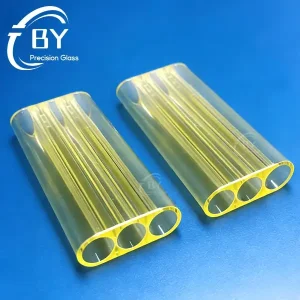
Can BY Photonics fabricate non-circular, rectangular, or multi-bore custom capillary ferrules?
How do you verify concentricity and geometric tolerances before dispatch?
What CAD formats do you accept for engineering feasibility reviews, and what is your turnaround?
Specialized Glass, Quartz & Sapphire Components
Complete your optical assembly requirements with our custom-fabricated sapphire viewing ports, Candela medical laser flow tubes, vacuum deposition accessories, and doped quartz tubes.