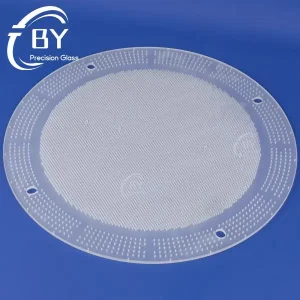
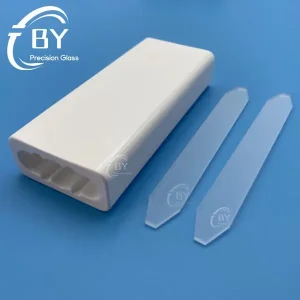
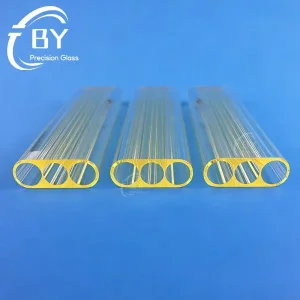
Precision Core Components for Laser Heads & Process Chambers
Engineered for extreme thermal shock resistance, zero hydroxyl absorption, and high laser damage threshold (LIDT) across ultraviolet, visible, and near-infrared spectrums.
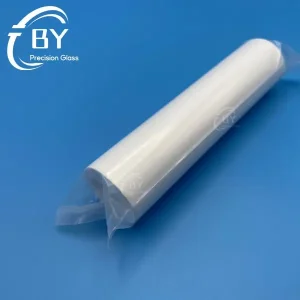



Evolution of High-Power Laser Processing: From Macro-Cutting to Sub-Micron Cold Ablation
Global industrial manufacturing is undergoing a profound structural transition. As fiber lasers push continuous-wave power levels beyond 30 kW and ultrafast picosecond/femtosecond lasers redefine micro-machining, the optical subsystem has become the paramount bottleneck governing thermal stability, beam propagation ratios ($M^2$), and total operational uptime.
Ultra-High Fluence & Thermal Lensing Mitigation
Multi-kilowatt fiber and disk laser operations suffer severe focal shift caused by minute bulk absorption ($\alpha < 3 \times 10^{-6}\text{ cm}^{-1}$ at 1064 nm). As laser processing equipment suppliers, our precision synthetic fused silica (JGS1) substrates are purified down to single-digit parts-per-billion metallic impurity levels, preventing wavefront distortion and preserving beam caustic integrity during continuous heavy-gauge sheet cutting and high-speed EV hairpin welding.
Ultrafast Micro-Machining & Cold Ablation
Femtosecond and picosecond processing allows athermal ablation of brittle semiconductor wafers, glass substrates, and medical stents without Heat-Affected Zones (HAZ). Supplying this sector requires optics with non-linear absorption mitigation, ultra-low group delay dispersion (GDD), and zero subsurface damage (SSD) achieved via deterministic magnetorheological finishing and plasma polishing.
Laser-Induced Damage Threshold (LIDT) Protocols
Laser processing components must withstand stringent peak fluence thresholds exceeding $20\text{ J/cm}^2$ @ 1064 nm, 10 ns, 20 Hz. Our proprietary ion-assisted deposition (IAD) and magnetron-sputtered dielectric coatings prevent defect-assisted nodular growth, pinhole flaking, and laser degradation in high-duty industrial cycles across harsh factory ambient environments.
Global Enterprise Procurement: Substrate Selection & Performance Vector
Comparing foundational photonic materials deployed across high-power laser heads, semiconductor wafer handling, and medical optical cavities.
| Material Category | Transmission Bandwidth | Thermal Expansion ($\alpha$) | OH⁻ Radical Content | Typical LIDT Threshold | Primary Industrial Applications |
|---|---|---|---|---|---|
| JGS1 Synthetic Fused Silica | 185 nm – 2,500 nm | $5.5 \times 10^{-7}\text{ /K}$ | $< 5\text{ ppm}$ to $> 1200\text{ ppm}$ | > 25 J/cm² @ 1064nm | QBH fiber end caps, DUV stepper windows, UV laser optics |
| JGS2 Optical Fused Quartz | 220 nm – 2,500 nm | $5.5 \times 10^{-7}\text{ /K}$ | $\approx 30\text{ ppm}$ | 12–18 J/cm² @ 1064nm | Laser cavity flow tubes, protective cover slides, viewport plates |
| JGS3 Infrared Grade Quartz | 260 nm – 3,500 nm | $5.5 \times 10^{-7}\text{ /K}$ | $< 5\text{ ppm}$ (Ultra-Dry) | 15–20 J/cm² @ 1064nm | CO₂/IR laser optics, gas analyzer cells, pyroelectric viewports |
| High-Purity Laser Ceramics | Diffuse Reflection (>99%) | $8.0 \times 10^{-6}\text{ /K}$ | N/A (Sintered Al₂O₃) | High Thermal Resistance | Pump cavities, Candela/DEKA reflector blocks, diffuse reflectors |
| Samarium-Doped Glass (Sm) | Selective 1064 nm cut-off | $7.2 \times 10^{-6}\text{ /K}$ | Trace Controlled | High Parasitic Resistance | Flashlamp-pumped Nd:YAG cavity flowtubes, ASE suppressors |
China Factory 4.0: Supply Chain Agility, Vertical Integration & Cost Superiority
Tianjin BY Photonics bridges the gap between deep optical material synthesis, multi-axis automated CNC micro-machining, and oxyhydrogen thermo-forming under a single unified quality control umbrella.
Total Material Traceability
From high-purity crystalline silicon tetrachloride synthesis to ingot growth, raw quartz annealing, and cold-stage cutting, every optical component links to an internal lot ledger, guaranteeing chemical homogeneity class 0 and zero micro-bubble inclusion.
Oxyhydrogen Hot Working
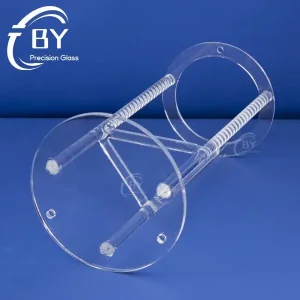
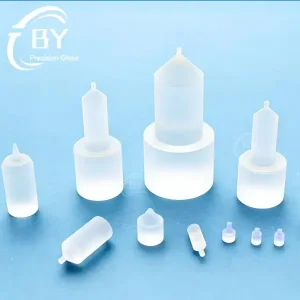
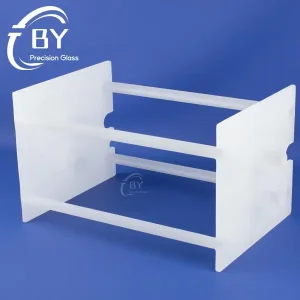
Manual and semi-automated oxyhydrogen flame welding stations enable seamless fabrication of quartz diffusion boats, high-temperature carriers, and sealed multi-bore flow channels without residual tensile stress or surface crystallization.
Multi-Axis Ultrasonic CNC
Hard, brittle glass substrates like fused silica, sapphire, and technical ceramics are carved using ultrasonic-assisted 5-axis diamond tooling. Micro-chipping along edges is kept strictly under $15\ \mu\text{m}$, safeguarding structural yield under thermal fatigue.
Cleanroom Metrology (ISO 6)
Precision testing arrays utilize Zygo phase-shifting laser interferometers, PerkinElmer Lambda 1050+ spectrophotometers, and 3D optical profilometers. Deliverables include surface roughness reports down to Angstrom scales and 100% dimensional CMM data.
Mission-Critical Deployment Scenarios Across Global Heavy Industries
Precision laser processing components must integrate seamlessly into diverse production lines with zero room for process drift.
Medical Aesthetic & Dermatological Lasers
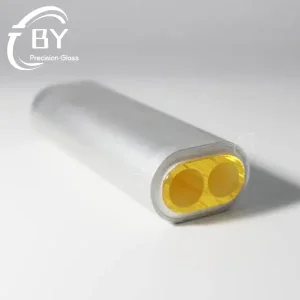
Pulsed dye lasers (595 nm), Alexandrite (755 nm), and Nd:YAG (1064 nm) systems demand durable pump chamber cavity reflectors. High-density glazed porous ceramic cavities ensure homogeneous light redistribution around flashlamps, maximizing fluorescence efficiency while Yellow Quartz and Samarium filter tubes filter harmful UV rays and parasitic oscillating modes that cause thermal fatigue in crystal rods.
E-Mobility & Battery Hairpin Welding
EV traction motor manufacturing demands spatter-free copper welding. Operating high-power wobbling laser heads with fiber lasers up to 12 kW requires QBH quartz fiber end caps and protective cover glasses capable of surviving sustained high thermal radiation, back-reflections, and microscopic particulate impact without optical coating breakdown.
Semiconductor Lithography & Wafer Handling
Advanced packaging, deep ultraviolet (DUV) lithography steppers, and thermal diffusion furnaces operate in extreme environments. Flame-polished quartz diffusion boats, gas showerheads, and vacuum wafer carriers provide sub-ppm chemical inertness, resisting corrosive etching gases (NF₃, CF₄) while maintaining zero structural distortion at 1,150°C.
Sub-Nanometer Optical Finishing & Compliance Standards
Precision photonics reliability is verified against internationally accredited ISO and MIL standards.
Scratch-Dig & Surface Quality
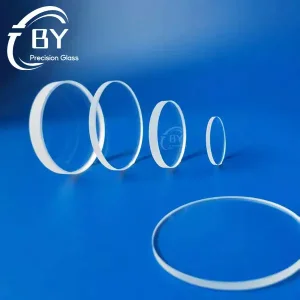
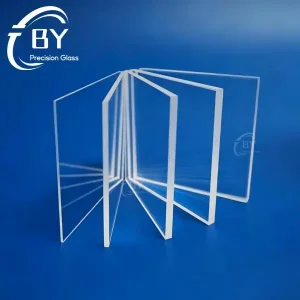
Adhering strictly to MIL-PRF-13830B and ISO 10110-7, our optical flats and laser windows are polished down to 10-5 or 20-10 scratch-dig levels. This prevents local electric field amplification under multi-megawatt pulsed laser beams, eliminating coating blowout incidents.
Wavefront Distortion & Flatness
Transmitted wavefront error is maintained up to $\lambda/10$ (Peak-to-Valley @ 632.8 nm) across 90% of the clear aperture. Parallelism and wedge angles are held within $< 5\text{ arcseconds}$, assuring pinpoint beam focal spot accuracy during deep laser trepanning and micromachining.
Thermal Stress & Birefringence
Fused silica and quartz blanks undergo computer-controlled annealing cycles exceeding 72 hours to eliminate internal strain birefringence ($\Delta n < 2 \times 10^{-6}$). This preserves polarization purity in fiber coupling heads and polarization-sensitive laser resonators.
Frequently Addressed Technical Questions from Laser System Integrators
Direct, fact-based answers on material selection, drawing specifications, and volume manufacturing parameters.
What criteria determine the choice between JGS1, JGS2, and JGS3 quartz?
The primary discriminator is operational wavelength and hydroxyl (OH⁻) content. JGS1 is synthetic fused silica with zero bubble inclusions and high deep-UV transmission down to 185 nm, making it essential for excimer lasers and high-fluence 1064 nm applications. JGS2 is fused quartz made from natural quartz crystal, optimized for 220 nm–2500 nm visible/NIR applications at a lower cost point. JGS3 is water-free quartz with ultra-low OH⁻ (<5 ppm), specifically designed to eliminate absorption bands at 1.4 µm, 2.2 µm, and 2.7 µm, making it ideal for infrared systems up to 3.5 µm.
How do Samarium-doped glass flowtubes suppress parasitic laser oscillations?
In flashlamp-pumped solid-state lasers (such as Nd:YAG or Nd:Glass), Amplified Spontaneous Emission (ASE) at 1064 nm can deplete the upper-state population inversion, severely reducing laser output efficiency. Samarium-doped glass exhibits strong, targeted optical absorption at 1064 nm while maintaining high transmission in the flashlamp's optical pumping bands (400–900 nm). Furthermore, it absorbs harmful ultraviolet radiation under 400 nm, protecting the laser rod from solarization.
What is the typical lead time for custom precision CNC quartz components?
For prototype development and first-article validation based on STEP, IGES, or DXF prints, our engineering evaluation is completed within 24 hours, and manufactured parts typically ship within 10 to 14 working days. High-volume recurring batch orders (e.g., thousands of protective windows or capillary tubes) benefit from dedicated production lines with lead times compressed to 3 to 4 weeks, backed by buffer stock holding agreements.
Why are ceramic reflectors preferred over gold/silver plating in laser cavities?
Metallic coatings (such as electroplated gold or silver) in liquid-cooled pump chambers frequently suffer from chemical oxidation, blistering, and electro-chemical erosion over extended service periods. Glazed porous ceramic reflectors offer diffuse reflectance exceeding 97–99% across the pump band, operate with absolute chemical inertness in DI water cooling circuits, and possess an indefinite operating lifespan without reflective degradation.
What engineering drawings and tolerance inputs are required for an RFQ?
We accept 3D CAD files (STEP, IGES) alongside fully dimensioned 2D PDF or DXF drawings. To provide an authoritative feasibility assessment and quotation, your drawing should state nominal dimensions with tolerances, clear aperture requirements, surface quality (scratch-dig), transmitted wavefront error, operating wavelength, coating specifications (AR/HR), and expected operational ambient temperatures.
How do you guarantee cleanroom packaging for contamination-sensitive optics?
All precision laser optics and semiconductor components undergo ultrasonic multi-stage immersion cleaning in automated deionized water cascades, followed by vacuum hot air drying. Parts are inspected under Class 100 (ISO 5) laminar flow clean hoods, vacuum-sealed in static-dissipative antistatic PET/AL bags, and housed within shock-absorbent nitrogen-purged blister packs to prevent transit scratching or particle deposition.
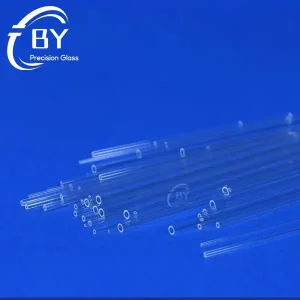
Advanced Photonic Subsystems, Capillaries & Custom Quartzware
Engineered to drawing for advanced research institutes, laser equipment manufacturers, and tier-1 semiconductor fabs worldwide.