
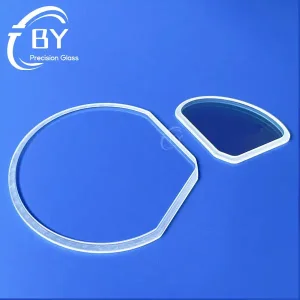
Sapphire Viewing Plates for Harsh Chemical Environments
Extreme Mohs 9 hardness and superior chemical resistance for process viewports.
Explore ProductFully integrated fabrication: oxyhydrogen flame polishing, CNC multi-axis milling, and high-purity redrawing under cleanroom management.
Extreme Mohs 9 hardness and superior chemical resistance for process viewports.
Explore Product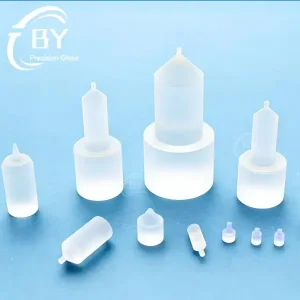
Low-OH fused quartz construction for kilowatt-level fiber laser termination safety.
Explore Product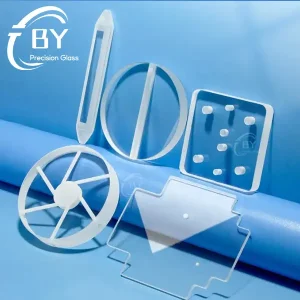
Thermal shock resistant components handling stable operation at up to 1,100 °C.
Explore Product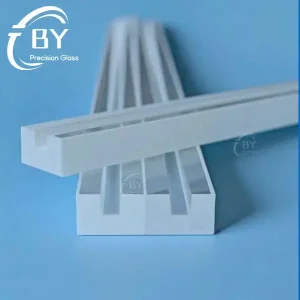
Sub-micron precision groove profile for optical telecom splitters and passive alignment.
Explore Product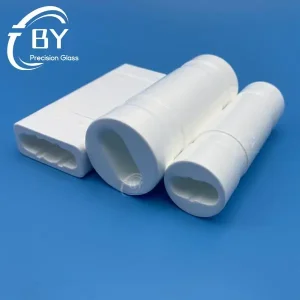
Porous diffuse alumina ceramic with extreme reflectance in diode pumping cavities.
Explore Product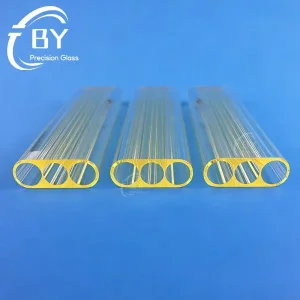
Selective cutoff absorbing 1064 nm parasitic emission while passing pump radiation.
Explore Product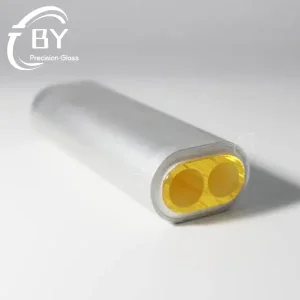
Ready-to-integrate high-yield cooling channels optimized for solid-state laser units.
Explore Product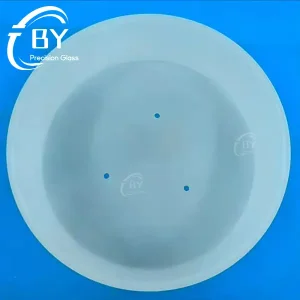
High chemical purity guaranteeing zero outgassing in high-vacuum deposition chambers.
Explore ProductQuartz glass windows—synthesized through vapor-phase axial oxidation or electric fusion of high-purity natural quartz crystals—represent a mission-critical pillar across modern optical manufacturing, semiconductor fabrication, and high-energy laser science.
Global demand continues to tilt sharply toward synthetic fused silica (JGS1) produced from silicon tetrachloride (SiCl4). The absence of metallic impurities limits UV solarization, permitting long-term duty under deep-UV excimer laser exposure (193 nm ArF and 248 nm KrF lithography) without catastrophic optical degradation.
With an extremely low coefficient of thermal expansion (CTE of ~5.5 × 10⁻⁷ /°C), optical fused quartz components withstand thermal gradients that instantly shatter standard borosilicate or soda-lime glass. This makes quartz the substrate of choice for sight viewports exposed to high-pressure vacuum thermal processing.
Traditional mechanical lapping creates micro-fissures (SSD) extending microns into the bulk matrix. Under extreme laser fluence, these cracks trigger localized thermal absorption, beam distortion, and laser-induced damage (LIDT). Our manufacturing relies on MRF (Magnetorheological Finishing) to virtually eliminate SSD.
Selecting the exact quartz grade is fundamental to balancing transmission bands, absorption lines, and cost efficiency. Review our factory baseline engineering matrix:
| Grade | Origin & Synthesis | Spectral Band | OH Content | Core Application |
|---|---|---|---|---|
| JGS1 (Synthetic Fused Silica) | Chemical vapor synthesis via SiCl4 | 185 nm – 2,500 nm | ~1,200 ppm (High OH) | Deep-UV laser viewports, analytical spectrophotometers, excimer optics |
| JGS2 (Fused Quartz) | Electric fusion of natural crystal rocks | 220 nm – 2,500 nm | < 30 ppm (Standard OH) | Sight glasses, furnace viewports, plasma processing chambers |
| JGS3 (Infrared Fused Quartz) | Vacuum electro-thermal molten fusion | 260 nm – 3,500 nm | < 5 ppm (Water-free) | Mid-wave IR imaging windows, pyrometry ports, military avionics |
| Corning 7980 / Suprasil Equivalent | High purity CVD flame hydrolysis | 190 nm – 2,100 nm | 800 – 1,000 ppm | Semiconductor steppers, EUV/DUV lithography mask blanks, aerospace windows |
Quartz windows serve as the physical barrier separating extreme operating environments from sensitive sensor suites and delicate electronics without distorting signal fidelity.
Used as protective viewports in Inductively Coupled Plasma (ICP) etch tools. High-purity quartz windows resist corrosive halogenated plasmas (CF4, Cl2) while permitting real-time optical emission spectroscopy (OES) monitoring for etch endpoint detection.
Installed as debris shields and output windows in multi-kilowatt fiber and disk cutting systems. Coated with ultra-low absorption antireflection (AR) thin films, these windows maintain a thermal lensing coefficient below 1 nm/kW.
Critical in analytical flow cells, absorption cuvettes, and optical sensors. The consistent internal transmittance (>90% from 200 nm to 2,000 nm) allows precise radiometric calculations in chromatography and water quality analyzers.
Engineered for supersonic flight pods, atmospheric sounding rockets, and satellite imaging pods. Quartz provides high structural stiffness-to-weight ratio, zero atmospheric degassing, and extreme thermal resilience during re-entry heating.
Emerging fabrication standards are reshaping how optical components interact with high-energy photons and extreme mechanical loads.
As node scaling contracts below 2 nm, optical elements demand ultra-low thermal expansion materials (ULE) and synthesized quartz glasses with trace inclusions below 10 nanometers. BY Photonics is active in precision polishing surfaces to Root Mean Square (RMS) roughness < 0.2 nm.
Standard electron-beam deposition creates columnar thin-film structures susceptible to atmospheric moisture shifting. Modern high-power quartz windows utilize dense, amorphous IBS coatings that deliver laser damage thresholds exceeding 40 J/cm² @ 1064 nm (10 ns pulse width).
Oxyhydrogen combustion produces zero carbon emissions, yielding purely water vapor during thermal working. Furthermore, the recovery and precision re-drawing of high-purity quartz tubing and scrap cullet supports circular sustainability initiatives across top-tier semiconductor fabs worldwide.
To keep pace with the accelerating demands of quantum optics, orbital satellite communications, and high-energy physics, our Tianjin facility has implemented a structured 5-year scaling matrix:
Rollout of robotic double-sided pitch polishers combined with in-situ Zygo Verifire interferometric feedback, achieving consistent λ/20 peak-to-valley across 300 mm clear apertures.
Proprietary wet chemical etching cocktails that strip mechanical micro-cracking layers, elevating Laser-Induced Damage Thresholds (LIDT) past the 50 J/cm² threshold for fusion research.
Expanding direct internal doping (Samarium, Cerium, Fluorine) within fused quartz lattices to produce integrated gradient-index (GRIN) window assemblies that correct optical aberrations internally.
Femtosecond cold laser processing for crack-free 3D channel excavation within solid quartz blocks for monolithic lab-on-a-chip bio-diagnostics and spaceborne quantum sensors.
Technical clarity directly from optical engineers to streamline your procurement cycle.
Explore complementary product lines engineered in our Tianjin facility to complete your optoelectronic system builds.
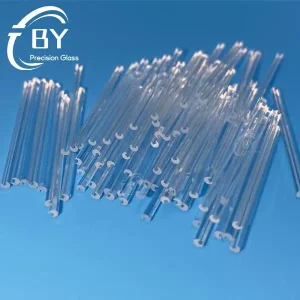
V-groove and U-groove precision machining for single-mode fiber alignment arrays.
Explore Product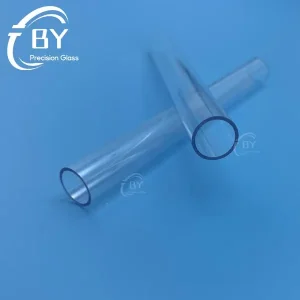
Blocks deep-UV radiation completely below 380 nm to protect pump cavities from degradation.
Explore Product
Specialized spectral filtering for intense pulsed light medical aesthetic devices.
Explore Product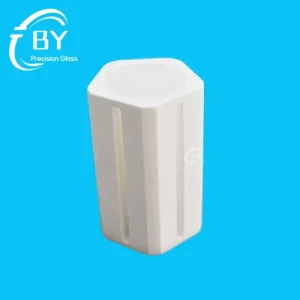
Hydrophobic, high Lambertian diffuse reflection performance for diode laser pump heads.
Explore Product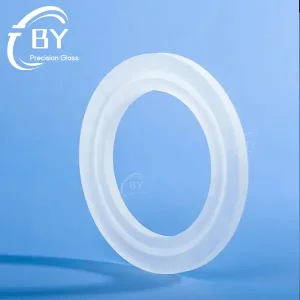
Cleanroom fabricated quartz rings, flanges, and plasma shielding components.
Explore Product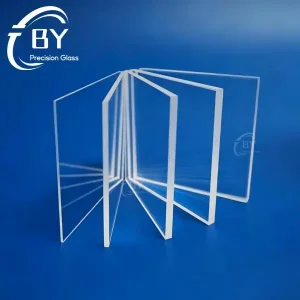
Pure synthetic silica plates yielding >90% transmission down to 185 nm UV waveband.
Explore Product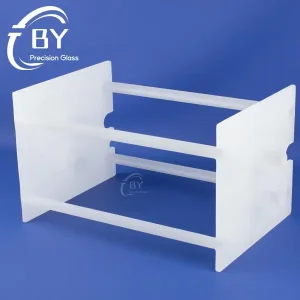
High-temperature resistance welded construction for oxidation and furnace processing.
Explore Product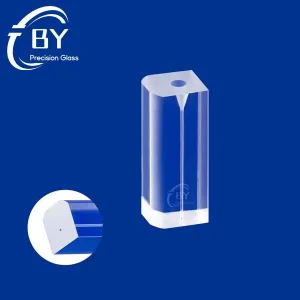
Sub-micron concentricity and smooth inner bore finishes for reliable fiber optic interlinks.
Explore ProductSend your STEP, DWG, or PDF specifications directly to our senior glass engineers in Tianjin. We review dimensional tolerances, material trade-offs, and clear aperture requirements without intermediary delays.