
Integrated High-Purity Quartz & Photonics Components
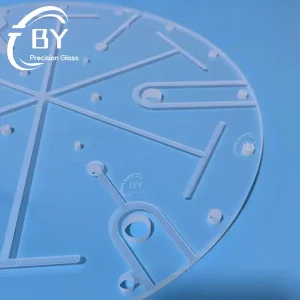
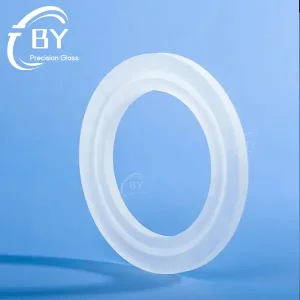
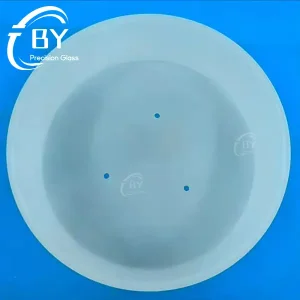
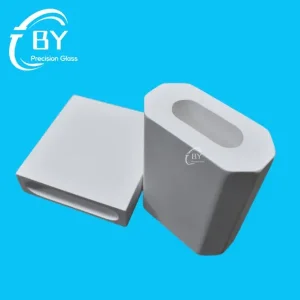
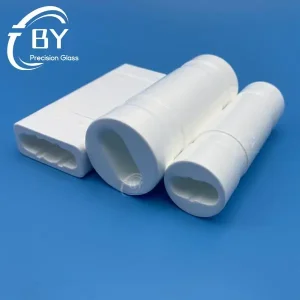
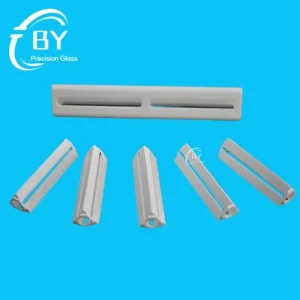
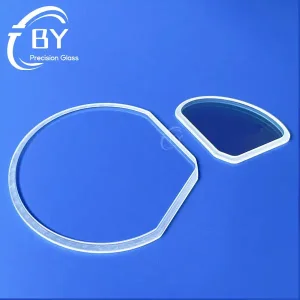
Explore our first tier of precision-machined fused silica, laser cavity components, and specialized wafer fixtures engineered to nanometer-grade surface finishes.

Global Status: Precision Quartz Slides & Micro-Coverslips
Strategic analysis of synthetic fused silica versus soda-lime/borosilicate substrates across next-generation biophotonics, semiconductor inspection, and DUV instrumentation.
Industrial Landscape & Supply Chain Geopolitics
The global commercial landscape for optical quartz microscope slides and ultra-thin quartz coverslips has transitioned from routine laboratory microscopy accessories to mission-critical photonics substrates. Valued at over USD 380 million globally and expanding at an aggressive CAGR of 8.2% through 2032, this demand is primarily driven by three convergent macro sectors: high-throughput spatial transcriptomics, extreme ultraviolet (EUV)/deep-ultraviolet (DUV) semiconductor lithography metrology, and high-power laser beam diagnostics.
Standard soda-lime and commercial borosilicate glasses suffer from severe optical quenching below 340 nm and possess intrinsic autofluorescence bands caused by transition metal oxide dopants (Fe, Ti, and B). In contrast, engineered synthetic fused silica (such as JGS1, Suprasil, and Corning 7980 grades) delivers unmatched chemical purity (>99.9999% SiO₂), nearly zero autofluorescence background across the 200–800 nm spectrum, and robust chemical resilience to pirahna etching, HF vapors, and plasma stripping. As cleanroom semiconductor fabs and clinical sequencing hubs standardize on sub-100-micron planar tolerances, procuring certified quartz slides directly from precision manufacturers with in-house chemo-mechanical planarization (CMP) has become an essential competitive differentiator.
The Technical Imperative: Why Soda-Lime Fails Advanced Applications
When operating in high-numerical-aperture (NA > 1.40) oil or water immersion total internal reflection fluorescence (TIRF) and single-molecule localization microscopy (STORM/PALM), the substrate interface dictates signal-to-noise ratio (SNR). Commercial glass cover glasses exhibit significant autofluorescence under common 405 nm, 488 nm, and 532 nm laser excitation, masking single-fluorophore photon bursts.
Furthermore, soda-lime slides release sodium, potassium, and calcium mobile ions into microfluidic channels over prolonged biological incubations, creating ionic drift, zeta potential fluctuations, and enzymatic destabilization. Quartz slides and coverslips provide an chemically inert, pristine SiO₂ lattice with negligible leaching, zero birefringence, and extreme thermal shock tolerance (ΔT > 1000°C). This allows researchers and industrial fabricators to perform direct high-temperature thermal bonding, silanization surface functionalization, and harsh acid cleanings without hazing, devitrification, or dimensional distortion.
Empirical Substrate Comparison: Quartz vs Borosilicate vs Soda-Lime
Comprehensive metallurgical and physical property breakdown verifying optical performance across research and cleanroom production lines.
| Property / Parameter | JGS1 Synthetic Fused Silica | JGS2 / Optical Fused Quartz | Precision Borosilicate (D263/BK7) | Standard Soda-Lime Glass |
|---|---|---|---|---|
| Usable Spectral Range | 185 nm – 2,500 nm (DUV-NIR) | 220 nm – 2,500 nm (UV-NIR) | 320 nm – 2,500 nm | 380 nm – 2,200 nm (Visible only) |
| Autofluorescence (405nm / 488nm) | Undetectable / Zero Base | Extremely Low (<2% baseline) | Moderate to High (Flavins/Borates) | Severe Background Interference |
| Refractive Index (nd @ 587.6 nm) | 1.4585 | 1.4585 | 1.5230 | 1.5180 |
| Abbe Number (vd) | 67.8 (Ultra-low chromatic dispersion) | 67.8 | 54.5 | 58.5 |
| Thermal Expansion (0–300°C) | 0.55 × 10⁻⁶ / °C | 0.54 × 10⁻⁶ / °C | 7.2 × 10⁻⁶ / °C | 9.0 × 10⁻⁶ / °C |
| Max Safe Service Temperature | 1,150 °C (Continuous) / 1,300 °C (Peak) | 1,100 °C (Continuous) | 450 °C | 120 °C – 150 °C |
| Chemical Purity (% SiO₂) | > 99.9999% (< 0.1 ppm Fe, Ti) | > 99.99% | ~ 80% SiO₂ (Contains B₂O₃, Na₂O) | ~ 72% SiO₂ (Contains CaO, Na₂O) |
| Achievable Surface Finish (Ra) | < 0.2 nm (CMP Polished) | < 0.5 nm (Super-polished) | < 0.8 nm (Fire-drawn) | > 1.5 nm (Commercial Float) |
Localized Application Scenarios & Sector Solutions
Where nanometer-flat quartz slides and thin coverslips fulfill irreplaceable engineering functions across world-class fabrication laboratories.
Single-Molecule TIRF & Super-Resolution
In total internal reflection fluorescence (TIRF), stochastic optical reconstruction microscopy (STORM), and STED super-resolution nanoscopy, optical signal acquisition is limited by photon budget. Standard glass slides generate significant fluorescent autofluorescence noise under intense 405 nm and 488 nm excitation. Our synthetic JGS1 quartz slides deliver zero background signal, allowing the precise localization of individual fluorophores down to 2-5 nanometer spatial resolutions.
Semiconductor Mask & Wafer Metrology
Lithography alignment targets, pellicle inspection monitors, and photomask test flats require extreme dimensional rigidity and zero thermal distortion under high-intensity 193 nm (ArF) and 248 nm (KrF) excimer illumination. Our double-sided CMP polished quartz slides (thickness tolerances to ±0.005 mm) function as benchmark calibration substrates that survive high-temperature baking and chemical etching without warping.
Next-Generation Sequencing (NGS) Flow Cells
High-throughput cyclic reversible terminator and sequencing-by-synthesis (SBS) platforms require optical window coverslips with extreme laser damage thresholds and total planar uniformity. Fused silica coverslips with custom laser-drilled fluidic ports (diameters < 0.3 mm) and nanostructured microchannels enable high-fidelity fluorescent image capture over thousands of scanning cycles without focal plane drift.
DUV & VUV Spectrophotometry Substrates
Analytical characterization of DNA, RNA, oligonucleotides, and conjugated proteins requires transmission windows down to 190 nm–220 nm. While traditional borosilicate ceases transmitting below 320 nm, JGS1 fused silica slides exhibit over 92% internal transmittance at 200 nm, enabling pristine spectrophotometric purity analysis and UV circular dichroism (CD) spectroscopy directly on the slide surface.
In-Situ High-Temperature Micro-Reactors
Material synthesis, catalytic observation, and geological micro-thermometry require optical containment capable of withstanding thermal gradients up to 1,100 °C. Standard glass melts or shatters above 500 °C. Our fused quartz slides feature a near-zero thermal expansion coefficient (0.55 × 10⁻⁶/K), permitting direct heating, laser-induced plasma breakdown, and rapid cryo-quenching without structural failure.
Abrasive & Corrosive Lab-on-a-Chip Assembly
Microfluidic architectures exposed to hydrofluoric-adjacent etching mixtures, concentrated sulfuric acid, supercritical CO₂, and aggressive organic solvents require chemical inertness that only vitreous silica provides. Our coverslips support direct anodic bonding, plasma-activated fusion bonding, and silane self-assembled monolayer (SAM) functionalization with extreme bond strength.
Technological Roadmap & Future Outlook (2025–2035)
Strategic developmental milestones directing precision glass fabrication, chemo-mechanical polishing, and micro-machining over the next decade.
Sub-50µm Ultra-Thinning
Industrializing chemical-mechanical planarization (CMP) capable of batch-fabricating No. 000 (30–50 µm) flexible quartz coverslips with Total Thickness Variation (TTV) under 0.8 µm for high-NA oil immersion lenses.
Direct Laser Micro-Structuring
Integration of picosecond and femtosecond IR/UV lasers for zero-taper via hole drilling (<50 µm diameter) and stress-free microfluidic channel engraving directly onto polished quartz slides without micro-cracking.
Integrated Functional Coatings
Deposition of low-stress ion beam sputtered (IBS) dielectric filters, dual-band anti-reflective coatings (193nm/405nm), and conductive ITO/graphene thin films maintaining optical transmission above 90%.
Quantum & Photonic Platforms
Ultra-pure synthetic fused silica doped with localized nitrogen-vacancy or color centers, establishing ultra-flat quantum sensor substrates and cryogenic optical waveguiding coverslips.
Enterprise Solutions: From Drawing to Cleanroom Delivery
End-to-end manufacturing workflows designed to de-risk high-volume optical substrate procurement for biomedical device and metrology equipment manufacturers.
Dimensional & Thickness Customization
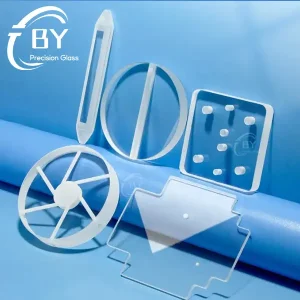
While standard 75 × 25 mm (3" × 1") and 1" × 1" formats are held in stock, our CNC high-speed diamond slicing line fabricates any custom geometry: 100 mm / 200 mm circular quartz discs, micro-wells, multi-slot slides, and stepped coverslips from 0.08 mm to 5.0 mm thickness with ±0.01 mm dimensional tolerances.
Advanced Edge Profile & Chamfering
Unfinished cut edges harbor micro-cracks that induce brittle fracture during automation handling or thermal processing. We implement ultrasonic contour grinding to provide 45° safety bevels, bullnose rounded edges, and optical ground pencil edges, reducing chipping and eliminating particulate generation in cleanrooms.
Class 100 Cleanroom Packaging Protocol
To prevent particle accumulation and organic surface contamination, all finished slides and coverslips undergo multi-stage megasonic SC-1/SC-2 wet chemical washing, ultrapure 18.2 MΩ·cm deionized water cascade rinsing, hot filtered nitrogen drying, and vacuum sealing in lint-free Class 100 cleanroom packaging.
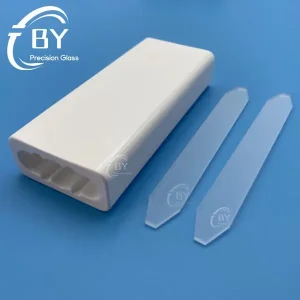
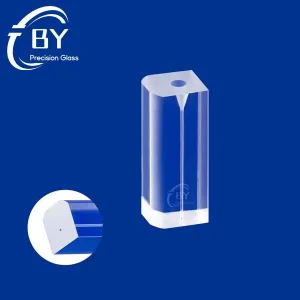
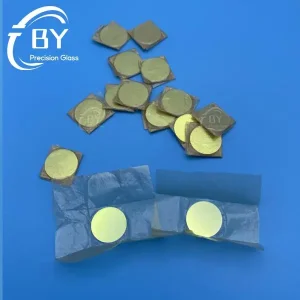
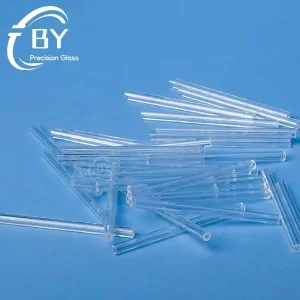
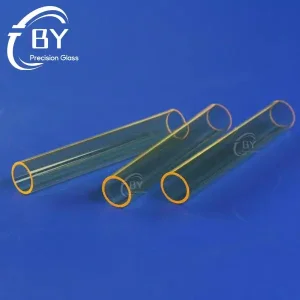
Specialized Laser Flow Components & Capillaries
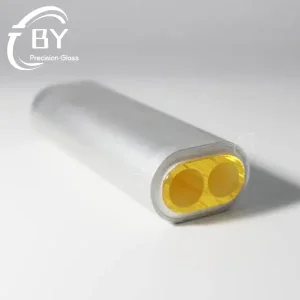
Explore our second tier of precision laser optics, samarium-doped filter tubes, ceramic assemblies, and redrawn capillary arrays manufactured for rigorous industrial use.

Technical & Procurement FAQ: Quartz Slides & Coverslips
Direct answers to the most stringent engineering, tolerance, cleaning, and material verification questions encountered in production.