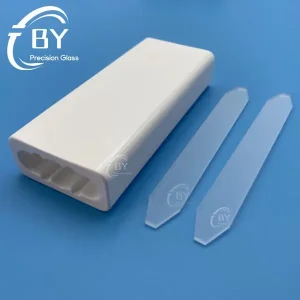
Precision Semiconductor & Optical Glass Assemblies
Explore our certified precision-machined quartzware, optical windows, and custom flow chambers engineered for zero-distortion optical systems and critical thermal applications.
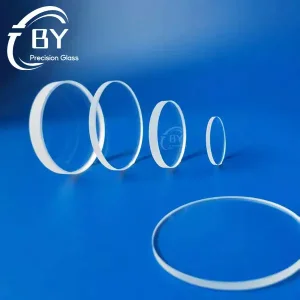
Wholesale Quartz Optical Windows for Semiconductor Lithography Equipment
View Specifications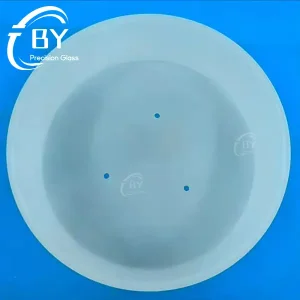
High-Quality Custom Quartz Glass Components for Vacuum Coating
View Specifications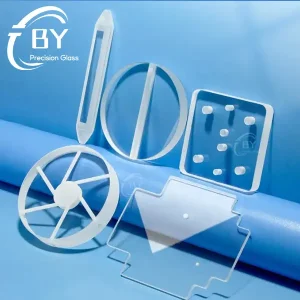
Wholesale High Temperature Custom Quartz Glass Fabrication
View Specifications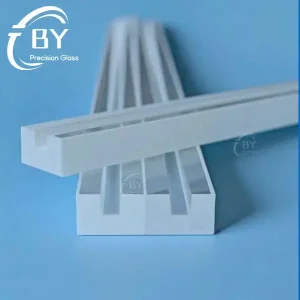
High-Quality Square Groove Quartz Substrate for Fiber Couplers
View Specifications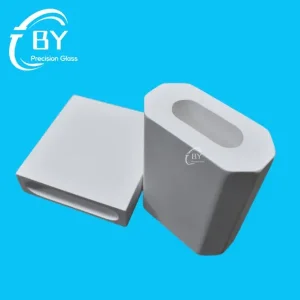
Diffuse Reflectors Made of Spectralon-Grade PTFE for Diode-Pumping Chambers
View Specifications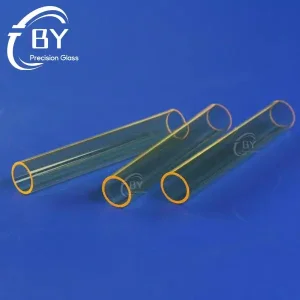
Custom UV Block Yellow Quartz Tube for IPL Lamp Flow Handle
View Specifications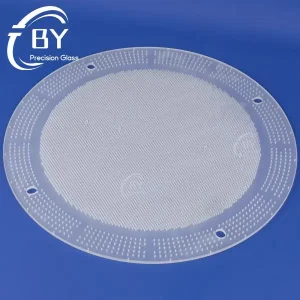
Custom Precision Optical Quartz Gas Distribution Plate
View Specifications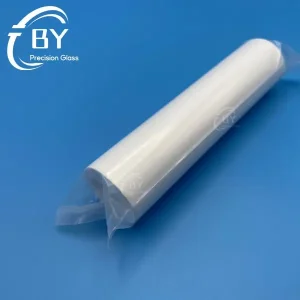
Wholesale Candela VBeam Laser 6" White Cavity Ceramic Reflector
View SpecificationsSquare Glass Tubes: The Structural Paradigm Shift in Precision Optics
Why modern analytical optics, cytometry channels, and micro-reaction systems are phasing out round tubular conduits in favor of geometrically flat planar square glass tubes.
1. The Physics of Non-Distortion: Overcoming Cylindrical Lens Effects
In high-throughput flow cytometry, single-molecule fluorescence detection, and high-energy laser excitation, traditional cylindrical (round) glass tubes impose an inherent optical deficiency: the radial curvature behaves as a positive cylindrical lens. This phenomenon introduces severe focal aberrations, non-uniform astigmatism, refractive beam warping, and unpredictable path-length variations. Light rays entering off-axis undergo refraction proportional to their radial distance, distorting excitation beams and scattering back-fluorescence into the optical detector plane.
Precision-manufactured square glass tubes and square quartz capillary channels resolve this fundamental physical limitation. By presenting four optically planar, parallel external surfaces and matching inner bores, square glass tubing eliminates ray divergence. Excitation laser lines traverse perpendicular to the planar boundary with zero beam curvature, maximizing depth-of-field integrity, simplifying numerical aperture calculations, and eliminating spatial blind spots within fluidic microchannels. As biophotonics advances into ultra-sensitive spatial transcriptomics and nano-particle tracking, square profile quartz and borosilicate tubes have transitioned from a specialized design preference into an irreplaceable industry mandate.
Microfluidic Capillary Integration
Next-generation lab-on-a-chip and organ-on-a-chip platforms increasingly require high-aspect-ratio square glass capillaries. Unlike polymer-based chips prone to autofluorescence and chemical leaching, square quartz tubes offer complete chemical inertness across pH 0 to 14, zero gas permeability, and flawless transparency under deep ultraviolet (DUV) interrogation.
- Square capillary cross-sections from 50μm × 50μm ID up to 50mm OD.
- Dual optical window alignment for dual-orthogonal multi-color fluorescence detection.
Semiconductor & Lithography Channels
Semiconductor gas sampling manifolds, high-purity chemical vapor distribution conduits, and wafer cleaning inspection cells necessitate ultra-clean square tubes capable of handling volatile halides and high thermal cycling without devitrification or microscopic ion leaching into sub-5nm fabrication lines.
- JGS1 synthetic fused silica with metallic impurities < 1.0 ppm total.
- Hydrofluoric acid (HF) etching tolerance and pristine oxyhydrogen fire-polished bore surfaces.
High-Power UV-C LED Encapsulation
As mercury vapor lamps are phased out worldwide under the Minamata Convention, industrial water and air purification reactors are adopting high-flux UV-C (265–280 nm) solid-state LEDs. Square fused quartz tubes allow surface-mount UV-C arrays to bond flush against the flat outer walls, preventing internal total reflection losses.
- 91%+ internal transmittivity across 260–280 nm germicidal peaks.
- Direct planar heat sink mounting eliminating optical coupling gel deterioration.
What Global OEM Buyers Demand in Square Glass Tubing
Sourcing precision glass requires rigorous metrological benchmarks. Below is the engineering framework utilized by tier-one global buyers when qualifying square glass tube suppliers.
Corner Radius (Internal & External R) Management
One of the most failure-prone parameters in square capillary tube manufacturing is uncontrolled corner rounding. In microfluidics, excessive internal radius generates stagnant boundary layer vortices; conversely, an overly sharp, unannealed corner concentrates mechanical stress, causing premature catastrophic cracking under hydraulic pressure pulses.
Our Tianjin redrawing facility implements real-time dynamic laser micrometer feedback during hot drawing, holding corner radii to tight engineering boundaries (e.g., R ≤ 0.15mm for microcapillaries, or specified custom radiused corners up to R = 2.0mm for high-pressure pneumatic vessels).
Wall Thickness Uniformity & Parallelism
A square glass tube with wedge angle errors between opposite faces produces optical beam deviations and focal drift in spectroscopy. Global instrumentation buyers require tight parallelism tolerance between opposing external and internal planes (≤ 10 arcseconds for laser cavity grade, ≤ 30 arcseconds for standard diagnostics).
BY Photonics employs four-sided synchronized diamond-lapping coupled with double-sided Zygo phase-shifting laser interferometers to verify that wall wedge distortion does not exceed ±0.01mm across entire 1000mm tube lengths.
| Material Category | Transmission Band | Thermal Expansion (×10⁻⁷/K) | Softening Point | Hydroxyl [OH⁻] Content | Primary Industrial Use-Case |
|---|---|---|---|---|---|
| JGS1 Synthetic Silica | 185 – 2,500 nm (UV-Visible) | 5.5 | 1730 °C | < 50 ppm | Semiconductor photolithography, flow cytometry cuvettes, UV-C laser flowtubes |
| JGS2 Fused Quartz | 220 – 2,500 nm (Standard Optical) | 5.4 | 1680 °C | 150 – 200 ppm | Furnace sight tubes, chemical observation cells, thermal sensor shielding |
| JGS3 Dehydroxylated Silica | 260 – 3,500 nm (Infrared Grade) | 5.5 | 1710 °C | < 5 ppm | FTIR spectroscopy gas cells, IR pyroelectric pyrometers, thermal imaging tubes |
| Borosilicate 3.3 Glass | 350 – 2,500 nm (Visible-NIR) | 33 | 820 °C | N/A (Standard) | Electrochemical flow cells, microfluidic lab chips, sight glass, bioreactors |
| Doped / Filter Quartz (Sm/Ce) | Select Cut-off (UV-blocking/1064nm absorb) | 5.5 | 1680 °C | < 100 ppm | Solid-state laser pump filter tubes, IPL handpiece cooling tubes |
Macro Industry Solutions: Engineering from Raw Silica to End Assemblies
How BY Photonics integrates specialized cold working, CNC ultrasonic grinding, oxyhydrogen micro-welding, and proprietary thermal redrawing to deliver turnkey components.
Biomedical Cytometry Flow Cells
Our square quartz capillary tubes form the optical heart of modern cell counters, DNA sequencers, and blood diagnostic analyzers. By applying mechanical flame polishing and precision chemical etching, we maintain flow channels with internal cross sections as low as 100μm × 100μm with mirror-smooth Ra < 0.8nm roughness, preventing sample clumping and laser scatter.
Semiconductor Wet-Bench Sensors
In high-purity etching baths (SC1, SC2, Piranha, and HF mixtures), standard plastics dissolve and sapphire is cost-prohibitive. We manufacture heavy-wall square fused quartz tubes functioning as liquid level monitors and optical refractive index sensors, surviving aggressive chemistry up to 180 °C without trace metal desorption.
Micro-Channel Reaction Engineering
For fine chemical synthesis, pharmaceutical flow synthesis, and continuous photocatalysis, square glass tubing provides maximized surface-to-volume ratios and uniform photon penetration compared to spherical flasks. Our modular square glass reactor channels withstand continuous operating pressures up to 30 bar when custom-cladded.
Aerospace & Laser Rangefinding Viewports
Square glass tubes are widely used in specialized telemetry, fiber collimation arrays, and multi-sensor payload covers. Their orthogonal exterior faces enable precise mechanical indexing into CNC-machined titanium housings without elastomeric seal twisting or localized hoop-stress concentrations.
Localized Engineering Collaboration & International Compliance
Mitigating supply-chain friction through full material traceability, dedicated DFM feedback within 24 hours, and cleanroom packaging compliant with North American and European standards.
Direct DFM Consultation < 24h
Every engineering drawing (STEP, IGES, DXF, or PDF) is assigned directly to a Senior Glass Processing Engineer in Tianjin. We perform predictive thermal-stress and mechanical-yield modeling, recommending optimal tolerances, chamfer styles, and flame-polishing profiles before initiating tooling, preventing costly iterative design errors.
RoHS, REACH & Conflict-Free Compliance
All quartz and borosilicate boules undergo certified Glow Discharge Mass Spectrometry (GDMS) testing. We certify full compliance with EU RoHS (Directive 2011/65/EU and amendments) and REACH regulations (EC 1907/2006). Certificates of Conformance (CoC) and spectral transmittance curves are furnished with every production lot.
Class 1000 Cleanroom Vacuum Packaging
Brittle square tubes, especially thin-walled capillaries, are susceptible to transit micro-chipping and ambient airborne moisture contamination. Parts undergo 5-stage ultrasonic deionized water cleaning, vacuum drying, and dual-layer antistatic nitrogen-flushed packaging in our ISO Class 6 cleanroom before export palletization.
Technology Roadmap: Advancing Square Glass Tube Fabrication
How our ongoing capital investments in ultra-short pulse laser machining, multi-lumen capillary drawing, and synthetic glass synthesis redefine the boundaries of precision manufacturing.
Femtosecond Laser Micro-Dicing
Replacing traditional diamond wheel saw dicing with non-thermal femtosecond pulse laser cutting. Eliminates subsurface micro-cracks along tube rims, elevating edge fracture resistance by 300% without flame annealing.
Multi-Lumen Square Capillaries
Developing multi-bore matrix square capillaries (e.g., 2×2, 3×3, and dual-coaxial square flow channels) for concurrent multi-analyte biosensing, laminar sheath fluid containment, and integrated sensor wiring.
Integrated Optical Thin-Film Coatings
Internal wall atomic layer deposition (ALD) of hydrophobic fluoropolymers, dielectric anti-reflective (AR) multilayer coatings, and metallic reflectance films directly inside narrow-aperture square capillaries.
Direct Glass-to-Silicon Anodic Bonding
Pre-conditioning square quartz tube mating flanges with planar sub-nanometer roughness for direct low-temperature anodic fusion to silicon chips, establishing monolithic optofluidic semiconductor packages.
Frequently Asked Questions on Square Glass Tube Sourcing
In-depth answers addressing thermal stability, corner geometries, cut-end finishes, and customized dimensions for OEM procurement teams.
What are the key differences between square quartz tubes and square borosilicate glass tubes?
Square borosilicate 3.3 glass tubes contain roughly 81% SiO2, 13% B2O3, and 4% Na2O/Al2O3. They have a higher thermal expansion coefficient (33 × 10-7/K), a maximum continuous service temperature of 450 °C, and absorb UV radiation below 310 nm. However, borosilicate is significantly more economical for visible-spectrum microfluidics, electrochemical flow cells, and standard lab-scale applications where high UV transmission and extreme thermal resistance are not required.
How do you handle end-finishing on square glass tubes? Can ends be optically polished or fire-polished?
- Precision Precision Saw Cut with Chamfer: Cleanly diced via high-speed diamond saws with beveling (chamfering 0.1mm to 0.5mm at 45°) to eliminate micro-burrs and prevent chipping during installation into compression O-ring fittings.
- Oxyhydrogen Fire-Polished Ends: Ends are momentarily subjected to an ultra-clean oxyhydrogen flame to melt and round sharp edges, sealing microscopic fracture origins and enhancing mechanical shock resistance, ideal for burner heads, sight glasses, and fluid manifolds.
- Optical Face Polishing (Lapping & Polishing): The square tube end-faces are lapped on polyurethane pads with cerium oxide to an optical surface quality (typically 40/20 or 20/10 scratch-dig, with flatness to λ/4), permitting perpendicular optical transmission, direct butt-coupling to optical fibers, or adhesive-free optical contacting.
What are the achievable minimum and maximum dimensional tolerances for custom square glass tubes?
- Micro-Capillary Channels: Inner Dimensions (ID) from 0.05 mm × 0.05 mm up to 3.0 mm × 3.0 mm, with wall thicknesses down to 0.08 mm. Tolerance on ID/OD: ±0.005 mm (±5 μm).
- Standard Structural & Optical Tubes: Outer Dimensions (OD) from 3.0 mm × 3.0 mm up to 50.0 mm × 50.0 mm, with wall thicknesses between 0.5 mm and 8.0 mm. Tolerance on OD: ±0.02 mm to ±0.10 mm.
- Heavy Industrial Square Tubes: Dimensions up to 200 mm × 200 mm, lengths up to 2,000 mm with custom milled edge steps, flange welding, or perforated gas ports.
Can BY Photonics fabricate rectangular or multi-bore cross-section tubing in addition to square tubes?
What quality documentation and metrology verification accompany custom production batches?
- Dimensional Metrology Inspection Sheet: Complete dimensional record (ID, OD, wall thickness, corner radius, parallelism, squareness) inspected via Mitutoyo non-contact CNC optical measurement projectors.
- Surface Roughness & Interferometer Analysis: Zygo laser interferometry reports for optical-grade polished faces and stylus profilometer Ra measurements.
- Material Purity & Transmission Curves: Spectrophotometer transmission charts (190 nm – 3200 nm) confirming UV-grade or IR-grade absorption compliance, along with raw boule melt lot traceability.
Precision Fabrication: Cuvettes, Laser Head Tubes & Substrates
Engineered for high-power laser chambers, analytical spectrophotometry, and semiconductor diffusion furnaces. Manufactured to tight mechanical tolerances in Tianjin, China.
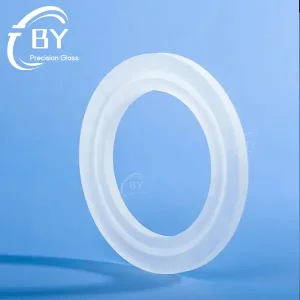
Precision Custom Quartz Glass Components for Semiconductor Manufacturers
View Specifications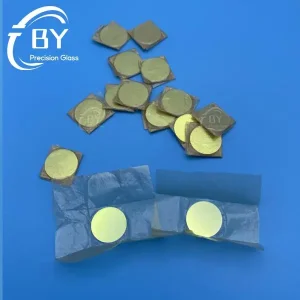
Candela Laser Distance Gauge Slider Windows (755nm & 1064nm Dual AR)
View Specifications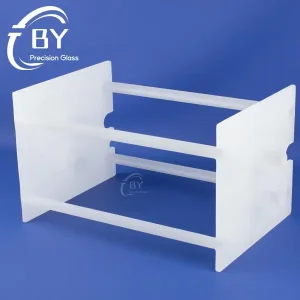
Wholesale High-Purity Quartz Diffusion Boat for Semiconductor Fabs
View Specifications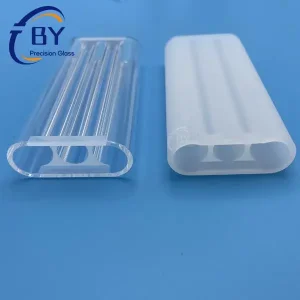
High-Quality Candela Laser Head Triple Bore Flow Tube Cavity
View Specifications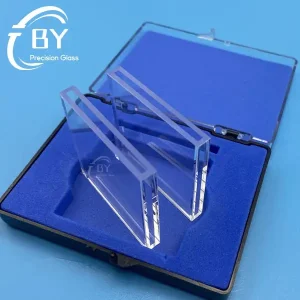
Customized Fused Quartz Cuvettes for UV-Vis Spectrophotometers
View Specifications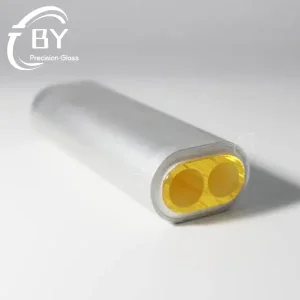
Custom Packed Laser Cavity Flowtubes for Solid-State Laser Heads
View Specifications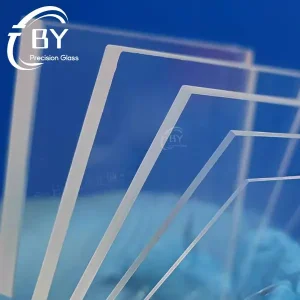
High-Quality Borosilicate Windows and Plates for Vacuum Viewports
View Specifications