Featured Industrial Quartz & Laser Optics Portfolio
Authorized Momentive Quartz Distribution: Trends Reshaping High-Purity Silicon Dioxide Markets
As wafer fabrication shrinks below 3nm nodes and ultra-high-power solid-state lasers breach the 60kW mark, sourcing certified Momentive (formerly GE Quartz) base materials is no longer merely an option—it is a baseline reliability mandate.
Semiconductor Purity Demands
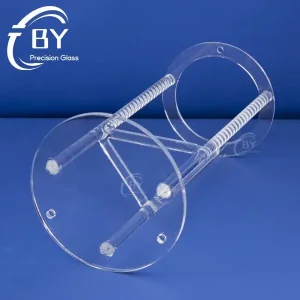
Advanced front-end fab environments (ALD, CVD, Epitaxy) demand heavy-metal contamination profiles lower than 1 ppb. Authorized distributors guarantee access to pure natural fused quartz grades (such as Momentive GE 214) and synthetic silicas resistant to devitrification at continuous 1200°C thermal cycles.
Sub-Wavelength Laser Optics
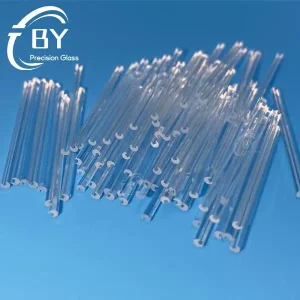
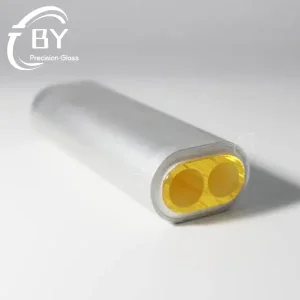
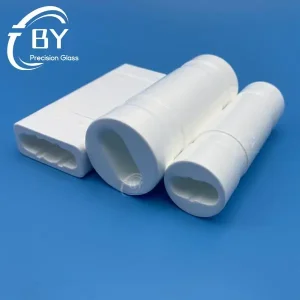
Modern fiber lasers and QBH delivery heads produce peak thermal-lensing conditions. By deploying precision-drawn Momentive capillary canes and doped triple bores, OEMs mitigate phase distortion and eliminate optical surface micro-explosions caused by internal micro-bubble entrapment.
Authorized Raw Material Traceability
Counterfeit or substandard quartz glass poses catastrophic risks of furnace tube collapse and particulate contamination. Authorized distribution guarantees full lot-to-lot spectroscopic tracking, ensuring absolute stability in hydroxyl (OH) concentration and thermal expansion coefficients.
Global Procurement Technical Specification & Material Index
Compare core thermodynamic and optical parameters between authentic industrial Momentive grades and standardized optical silicon dioxide substrates processed within our factories.
| Material Classification | Transmission Band (nm) | OH Content (ppm) | Softening Point (°C) | Purity Profile (Trace Impurity) | Primary Industrial Use Cases |
|---|---|---|---|---|---|
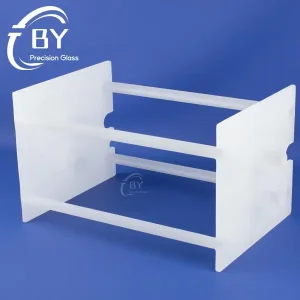
| Momentive GE 214 Equivalent | 260 – 2,500 | < 5 ppm | 1683 °C | < 15 ppm total metals | Semiconductor diffusion tubes, wafer carriers, furnace boats |
| JGS1 Synthetic Silica | 185 – 2,500 | > 1,000 ppm | 1580 °C | < 1 ppm (UV laser grade) | QBH laser end caps, high-power beam splitters, UV viewports |
| JGS2 Electrically Fused | 220 – 2,500 | < 30 ppm | 1610 °C | < 20 ppm total metals | Vacuum coating sight glass, gas distribution plates, flow tubes |
| JGS3 Infrared Silica | 260 – 3,500 | < 8 ppm | 1600 °C | < 10 ppm total metals | Mid-IR spectroscopy, infrared windows, pyrometry sensors |
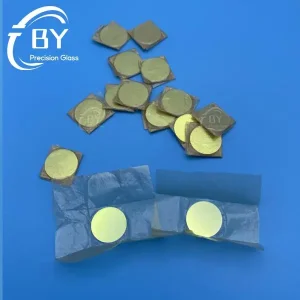
| Samarium-Doped Quartz | Selective cut-off | N/A | ~1550 °C | Controlled Sm₂O₃ Doping | Medical laser pump filters, Nd:YAG 1064nm parasitic suppression |
China Industry 4.0: Fabricating Resilience, Scale, and Nanometer Precision
Integrating raw material master distribution with fully automated cold- and hot-processing lines under one roof in Tianjin. We eliminate middle-tier distributor markups while securing high batch repeatability.
Sub-Micron CNC
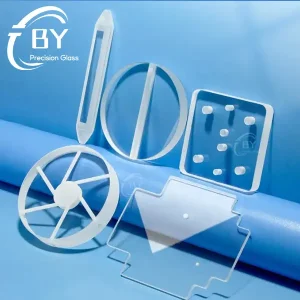
5-axis multi-head ultrasonic CNC grinding workstations carve micro-grooves, gas-distribution matrices, and deep-hole flow paths into quartz without producing subsurface micro-cracks.
Flame Glassblowing
Automated oxyhydrogen welding machines bond wafer diffusion boats and complex multi-bore flow cells with bubble-free joints, backed by dynamic laser interferometry checks.
Continuous Drawing
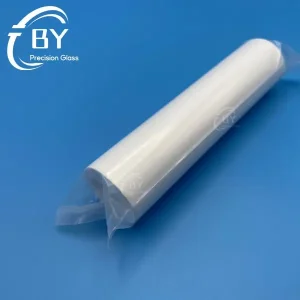
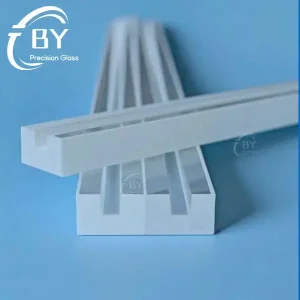
Vertical tower redraw equipment maintains concentricity errors within ±0.005mm on custom capillaries and square groove substrates, critical for fiber-optic pigtails.
Class 1000 Cleanroom
Semiconductor-grade acid bath etching, ultrapure deionized water cascade ultrasonic cleaning, and hermetic vacuum packaging preserve pristine surface chemistry prior to shipment.
Engineering Impact: Where Our Authorized Fabricated Parts Perform
From Tier-1 European medical equipment brands to high-throughput Asian semiconductor wafer lines, custom quartz configurations resolve fundamental thermal, chemical, and optical constraints.
Medical & Aesthetic Laser Heads
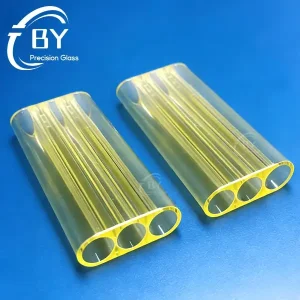
Candela-compatible diffuse ceramic reflectors and samarium-doped triple-bore quartz tubes operate inside high-repetition pulsed-dye lasers. The doped material acts as a high-pass optical filter, suppressing 1064nm parasitic oscillation while protecting lamp cavities from solarization.
Front-End Semiconductor Etch
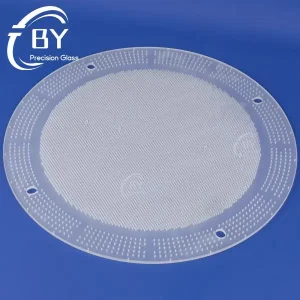
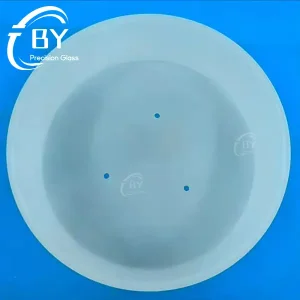
Optical quartz showerheads and gas distribution plates withstand harsh chlorine and fluorine plasma discharges. Uniformly machined micro-orifices ensure homogeneous laminar gas flow across 200mm and 300mm wafer stages during thin-film deposition routines.
High-Power Industrial Fiber Splicing
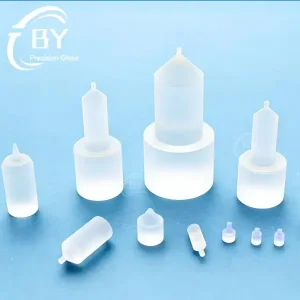
QBH quartz fiber end caps and V-groove array substrates align multi-kilowatt fiber laser outputs. The zero-defect bulk purity of synthetic fused silica blocks self-focusing damage and withstands high laser-induced damage thresholds (LIDT > 40 J/cm² @ 1064nm, 10ns).
Authorized Distribution & Custom Quartz Manufacturing FAQ
How does purchasing from an Authorized Momentive Quartz distributor-aligned factory safeguard our production line?
Can you machine complex quartz shapes based directly on custom 3D CAD files?
What is the standard turnaround time for wholesale and prototyping batches?
What inspection certifications accompany every batch of machined quartzware?
Engineered Quartzware, Substrates & Laser Components